Category: Uncategorized

  • Analysis suggests that solar thermal can provide baseline power

    Analysis suggests that solar thermal can provide baseline power

    But it requires careful coordination across multiple plants.

    by – June 25 2014, 4:28am AUSEST

    With the cost of photovoltaic devices and wind power dropping dramatically, the economics of some forms of renewable power are becoming increasingly compelling. But these sources of power come with a significant limitation: intermittency. Solar can’t generate power around the clock (and output drops during cloudy days), while wind power can suffer from low output that can last days. There are various ways to work around some lack of production—grid-scale storage and careful matching of supply and demand—but some degree of what’s termed “baseline power” is needed to ensure the stability of the grid.

    There are ways to provide this baseline power that don’t involve significant carbon emissions, like nuclear and hydro power. But those come with their own set of issues. So a group of European researchers decided to look into a form of renewable power that hasn’t attracted as much attention: concentrating solar power (CSP), sometimes termed solar thermal power.

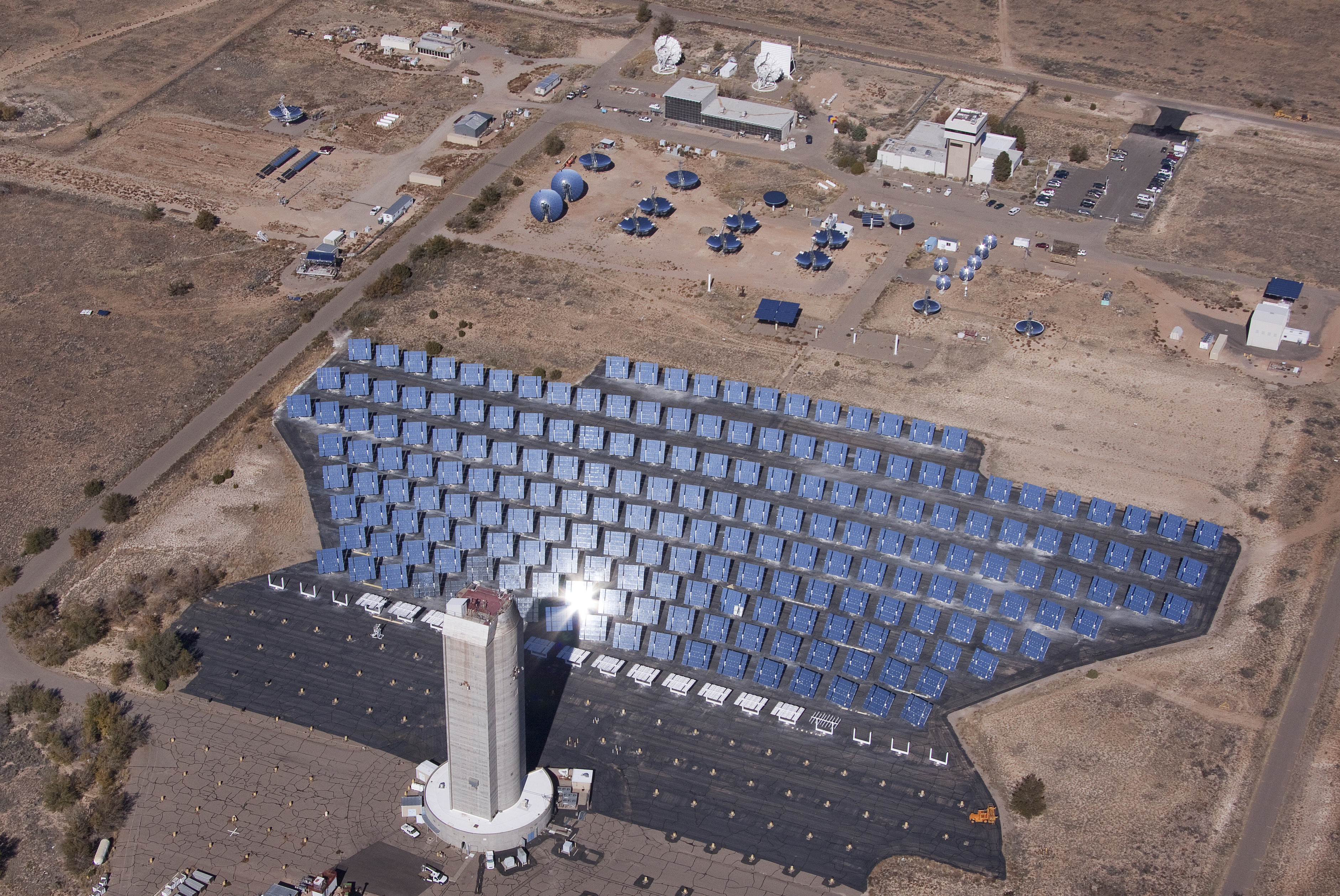
    CSP involves the use of mirrors to focus sunlight onto a liquid, rapidly bringing it up to extremely high temperatures. The resulting heat can be used immediately to generate electricity, or some fraction of it can be stored and used to drive generators later. Depending on the details of the storage, CSP can typically generate electricity for at least eight hours after the Sun sets, and some plants have managed to produce power around the clock during the summer.

    Typically, a CSP plant is optimized for a mixture of generation and storage. But the authors of the new paper note that it’s possible to expand the area where the mirrors are located (called the “solar field”) relative to its power block. This may be less efficient economically, but it allows the plant to start generating more power rapidly at the start of the day and continue to store heat at the same time as generating power.

    To determine whether this sort of approach could allow CSP to provide better baseline power, the authors looked at three scenarios: a flat power demand, one based on the European Union (where demand peaks in winter evenings), and one based on California, where demand peaks during summer afternoons. They also looked at three different levels of plant optimization: none at all, optimization of layout and equipment based on economic considerations, and a regional optimization. In this last case, the layout of multiple sites are coordinated in order to provide the best baseline power output.

    If this sort of regional coordination can be achieved—and the authors don’t offer any suggestions as to how it could—then as few as 10 sites in southern Europe would be sufficient to provide 70 to 80 percent reliable baseline power at very little added cost. And that, the authors point out, is similar to the reliability of a typical nuclear plant. Looking at other regions of the globe, CSP would also provide similar performance in South Africa, but wouldn’t be as effective in the US and India. The problem in these locations isn’t the lack of good sites, it’s that the weather at the best sites tends to be similar (ie, a cloudy day at one site will often be cloudy at the rest).

    The more we’re willing to spend on the CSP plants, the better optimized they can be, and the more reliable the power would be. But this gets into the biggest problem with CSP: it’s expensive. While it was competitive with photovoltaic power a few years ago, the price of PV has plunged, while CSP’s costs have only dropped slowly. We can expect continued declines in price, but it’s likely to remain one of the pricier options.

    That situation should sound familiar, because it’s the same problem faced by offshore wind. Although the wind is much more reliable in offshore locations—and thus the power produced there is closer to a baseline quality—the cost of installing wind turbines in the ocean is significantly more expensive. The challenge here is that, once on the grid, the value of power generated by any source is treated equally, with no bonuses attached to the source being renewable or baseline.

  • Solar Parabolic trough

    Parabolic trough

    From Wikipedia, the free encyclopedia
    This article’s lead section may not adequately summarize key points of its contents. Please consider expanding the lead to provide an accessible overview of all important aspects of the article. (November 2012)

    Array of parabolic troughs.

    A parabolic trough is shaped as a parabola in the x-y plane, but is linear in the z direction

    A diagram of a parabolic trough solar farm (top), and an end view of how a parabolic collector focuses sunlight onto its focal point.

    A parabolic trough is a type of solar thermal collector that is straight in one dimension and curved as a parabola in the other two, lined with a polished metal mirror. The energy of sunlight which enters the mirror parallel to its plane of symmetry is focused along the focal line, where objects are positioned that are intended to be heated. For example, food may be placed at the focal line of a trough, which causes the food to be cooked when the trough is aimed so the Sun is in its plane of symmetry. Further information on the use of parabolic troughs for cooking can be found in the article about solar cookers.

    For other purposes, there is often a tube, frequently a Dewar tube, which runs the length of the trough at its focal line. The mirror is oriented so that sunlight which it reflects is concentrated on the tube, which contains a fluid which is heated to a high temperature by the energy of the sunlight. The hot fluid can be used for many purposes. Often, it is piped to a heat engine, which uses the heat energy to drive machinery or to generate electricity. This solar energy collector is the most common and best known type of parabolic trough. The paragraphs below therefore concentrate on this type.

    Efficiency

    The trough is usually aligned on a north-south axis, and rotated to track the sun as it moves across the sky each day. Alternatively, the trough can be aligned on an east-west axis; this reduces the overall efficiency of the collector due to cosine loss but only requires the trough to be aligned with the change in seasons, avoiding the need for tracking motors. This tracking method approaches theoretical efficiencies at the spring and fall equinoxes with less accurate focusing of the light at other times during the year. The daily motion of the sun across the sky also introduces errors, greatest at the sunrise and sunset and smallest at solar noon. Due to these sources of error, seasonally adjusted parabolic troughs are generally designed with a lower concentration acceptance product.

    Parabolic trough concentrators have a simple geometry, but their concentration is about 1/3 of the theoretical maximum for the same acceptance angle, that is, for the same overall tolerances of the system to all kinds of errors, including those referenced above. The theoretical maximum is better achieved with more elaborate concentrators based on primary-secondary designs using nonimaging optics[1][2] which may nearly double the concentration of conventional parabolic troughs[3] and are used to improve practical designs such as those with fixed receivers.[4]

    Design

    Heat transfer fluid (usually thermal oil) runs through the tube to absorb the concentrated sunlight. This increases the temperature of the fluid to some 400 °C.[5] The heat transfer fluid is then used to heat steam in a standard turbine generator. The process is economical and, for heating the pipe, thermal efficiency ranges from 60-80%. The overall efficiency from collector to grid, i.e. (Electrical Output Power)/(Total Impinging Solar Power) is about 15%, similar to PV (Photovoltaic Cells) but less than Stirling dish concentrators.[6]

    Most mirrors used are parabolic and single-piece. In addition, V-type parabolic troughs exist which are made from 2 mirrors and placed at an angle towards each other.[7]

    In 2009, scientists at the National Renewable Energy Laboratory (NREL) and SkyFuel teamed to develop large curved sheets of metal that have the potential to be 30% less expensive than today’s best collectors of concentrated solar power by replacing glass-based models with a silver polymer sheet that has the same performance as the heavy glass mirrors, but at a much lower cost and much lower weight. It also is much easier to deploy and install. The glossy film uses several layers of polymers, with an inner layer of pure silver.[8]

    As this renewable source of energy is inconsistent by nature, methods for energy storage have been studied, for instance the single-tank (thermocline) storage technology for large-scale solar thermal power plants. The thermocline tank approach uses a mixture of silica sand and quartzite rock to displace a significant portion of the volume in the tank. Then it is filled with the heat transfer fluid, typically a molten nitrate salt.

    Variations

    Enclosed trough

    Enclosed trough systems are used to produce process heat. The design encapsulates the solar thermal system within a greenhouse-like glasshouse. The glasshouse creates a protected environment to withstand the elements that can negatively impact reliability and efficiency of the solar thermal system.[9] Lightweight curved solar-reflecting mirrors are suspended from the ceiling of the glasshouse by wires. A single-axis tracking system positions the mirrors to retrieve the optimal amount of sunlight. The mirrors concentrate the sunlight and focus it on a network of stationary steel pipes, also suspended from the glasshouse structure.[10] Water is carried throughout the length of the pipe, which is boiled to generate steam when intense sun radiation is applied. Sheltering the mirrors from the wind allows them to achieve higher temperature rates and prevents dust from building up on the mirrors.[9]

    Early commercial adaption

    A 1917 patent drawing for Shuman’s parabolic trough solar energy system

    In 1897, Frank Shuman, a U.S. inventor, engineer and solar energy pioneer built a small demonstration solar engine that worked by reflecting solar energy onto square boxes filled with ether, which has a lower boiling point than water, and were fitted internally with black pipes which in turn powered a steam engine. In 1908 Shuman formed the Sun Power Company with the intent of building larger solar power plants. He, along with his technical advisor A.S.E. Ackermann and British physicist Sir Charles Vernon Boys,[11] developed an improved system using mirrors to reflect solar energy upon collector boxes, increasing heating capacity to the extent that water could now be used instead of ether. Shuman then constructed a full-scale steam engine powered by low-pressure water, enabling him to patent the entire solar engine system by 1912.

    Shuman built the world’s first solar thermal power station in Maadi, Egypt between 1912 and 1913. Shuman’s plant used parabolic troughs to power a 45-52 kilowatt (60-70 H.P.) engine that pumped more than 22,000 litres of water per minute from the Nile River to adjacent cotton fields. Although the outbreak of World War I and the discovery of cheap oil in the 1930s discouraged the advancement of solar energy, Shuman’s vision and basic design were resurrected in the 1970s with a new wave of interest in solar thermal energy.[12] In 1916 Shuman was quoted in the media advocating solar energy’s utilization, saying:

    We have proved the commercial profit of sun power in the tropics and have more particularly proved that after our stores of oil and coal are exhausted the human race can receive unlimited power from the rays of the sun.

    —Frank Shuman, New York Times, July 2, 1916[13]

    Parabolic trough at a plant near Harper Lake, California

    Usage by commercial plants

    Most commercial plants utilizing parabolic troughs are hybrids; fossil fuels are used during night hours, but the amount of fossil fuel used is limited to a maximum 27% of electricity production, allowing the plant to qualify in the US as a renewable energy source.[citation needed] Because they are hybrids and include cooling stations, condensers, accumulators and other things besides the actual solar collectors, the power generated per square meter of area varies enormously.[citation needed]

    The largest operational solar power system at present is the 280 MW Solana Generating Station in Arizona. It has 6 hours worth of molten salt heat storage. The 250MW Genesis Solar Energy Project in California came online in 2014.

    Two of the SEGS plants, located at Harper Lake in California, USA, use trough technology, at 80 MW generation capacity each.[14] At 354 MW, SEGS is the largest solar power plant in the world.[15]

    The 64 MW Nevada Solar One also uses this technology. In the new Spanish plant, Andasol 1 solar power station, the ‘Eurotrough’-collector is used. This plant went online in November 2008[16] and has a nominal output of 49.9 MW.

    The 5 MW Archimede solar power plant, which opened in 2010, in Sicily was the first to use molten salt for energy storage.[citation needed]

    See also

    References

    1. Julio Chaves, Introduction to Nonimaging Optics, CRC Press, 2008 ISBN 978-1-4200-5429-3
    2. Roland Winston et al.,, Nonimaging Optics, Academic Press, 2004 ISBN 978-0-12-759751-5
    3. Diogo Canavarro et al., New second-stage concentrators (XX SMS) for parabolic primaries; Comparison with conventional parabolic trough concentrators, Solar Energy 92 (2013) 98–105
    4. Diogo Canavarro et al., Infinitesimal etendue and Simultaneous Multiple Surface (SMS) concentrators for fixed receiver troughs, Solar Energy 97 (2013) 493–504
    5. Absorber tube temperature
    6. Patel99 Ch.9
    7. V-type parabolic troughs
    8. Harry Tournemille. “Award-Winning Solar Reflectors Will Cut Production Costs”. www.energyboom.com. Retrieved 2009-11-25.
    9. Deloitte Touche Tohmatsu Ltd, “Energy & Resources Predictions 2012”, 2 November 2011
    10. Helman, Christopher, “Oil from the sun”, “Forbes”, April 25, 2011
    11. C.V. Boys, scientist, Yatedo.com website.
    12. Smith, Zachary Alden; Taylor, Katrina D. (2008). Renewable And Alternative Energy Resources: A Reference Handbook. ABC-CLIO. p. 174. ISBN 978-1-59884-089-6.
    13. American Inventor Uses Egypt’s Sun for Power; Appliance Concentrates the Heat Rays and Produces Steam, Which Can Be Used to Drive Irrigation Pumps in Hot Climates, The New York Times, July 2, 1916.
    14. “Solar energy generating system (SEGS)”.
    15. Concentrating Solar Power Case Studies
    16. “The Construction of the Andasol Power Plants”. Solar Millennium AG.

    Bibliography

    External links

  • Towering Imbroglio MONBIOT

    1 of 2
    Why this ad?
    Best Solar Power Dealssolarquotes.com.au/+Solar+Power – Australia’s NO:1 in Solar Quotes™ Best Installers » Find Top 3 Free!

    Monbiot.com

    Inbox
    x

    George Monbiot news@monbiot.com via google.com

    5:04 PM (13 minutes ago)

    to me

    Monbiot.com


    Towering Imbroglio

    Posted: 23 Jun 2014 11:49 AM PDT

    Is the government preparing to dispose of our forests and other public land?


    By George Monbiot, published in the Guardian 24th June 2014

    Planning laws inhibit prosperity. That’s what we’re told by almost everyone. Those long and tortuous negotiations over what should be built where are a brake on progress. All the major parties and most of the media believe that we would be better off with less regulation, less discussion and more speed. Try telling that to the people of Spain and Ireland.

    Town planning in those countries amounts to shaking a giant dustbin over the land. Houses are littered randomly across landscapes of tremendous beauty, so disaggregated that they’re almost impossible to provide with public services. The result, of course, is a great advance in human welfare. Oh, wait a moment. No, it’s economic collapse followed by mass unemployment. Spain and Ireland removed the brakes on progress and the car rolled over a precipice. Their scarcely-regulated planning systems permitted the creation of property bubbles that trashed the economy along with the land.

    Needless to say, we have learnt nothing from this. Our lords and masters still whip the buttocks of the Gaderene swine. When the Infrastructure Bill was discussed in the House of Lords last week, our unelected legislators rained curses upon peace and quiet, beauty and stillness(1).

    Lord Adonis, a Labour peer, complained that “for the first time in 350 years, Britain will no longer have the world’s largest port or airport. That accolade will pass, symbolically, to Dubai.” The shame of it – to have some upstart petro-city making more noise and pollution than we do! For the government, Baroness Kramer boasted that “we are making the biggest investment in roads since the 1970s”. The Conservative peer Lord Jenkin, in discussing the new freedoms for frackers the government proposes, celebrated what he called a “drill, baby, drill Bill”. All this, we are assured, will enhance the life of the nation.

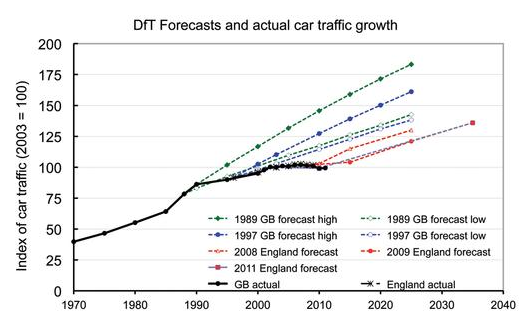
    Since the 1980s, the Department for Transport has consistently forecast traffic growth along a steep trajectory(2). But the distance covered by car drivers in England is now 7% lower than it was in 1997(3). The total volume of traffic has flatlined since 2002, nixing every prediction the department has made(4). Last year, 32 transport professors wrote to the secretary of state pointing out that, in the absence of traffic growth, “the basis for major infrastructure spending decisions appears to be changing”(5). The only thing likely to induce more traffic growth, they argued, is building more trunk roads, and that would put intolerable pressure on the city streets into which they feed. The facts might have changed, but the policy remains the same. The department continues to make the same failed forecasts, using the same failed model. The desire to build – and to appease the construction industry and motoring lobby – comes first, and the forecasts are made to fit.

    Dept for Transport forecasts versus real trend. By Phil Goodwin: http://www.bettertransport.org.uk/campaigns/roads-to-nowhere/ltt-130412Dept for Transport forecasts versus real trend. By Phil Goodwin: http://www.bettertransport.org.uk/campaigns/roads-to-nowhere/ltt-130412

    So is the planning system. The government’s draft national policy statement for major roads weakens the protection of wildlife, ancient woodlands and treasured landscapes(6). It forbids any consideration of climate change during planning inquiries: motorways will officially produce no more carbon dioxide than cycle paths.

    Not a word of this was heard in the chamber last Wednesday. No one questioned the need for the road building programme of which the government boasted. The peers, an unlikely club of boy racers, stood only to demand that we should go further and faster, on a journey without purpose or destination.

    If they have their way, we will become the proud recipients of a new network of roads to nowhere. Like Benidorm’s Intempo towers, the tallest residential buildings in Europe, they will be commissioned in a convulsion of optimism and greed, before becoming monuments to bad debt and human folly(7). “Round the decay of that colossal wreck, boundless and bare …”.

    But this is by no means the worst of it. Buried in a schedule at the bottom of this bill is the kind of clause that was once inserted to relieve tribal leaders of their lands for a rifle and a bolt of cloth. The kind of obscure, innocuous wording from which, in those days, the entire grandiloquent flummery of the proceeding pages was designed to distract. In schedule 3 there are a couple of lines, noticed by some campaigners but not by the press(8,9,10), which could, if they have been interpreted correctly, licence the government to sell off any public land it chooses, while cancelling, without process or debate, public access and use.

    This is what it says. “The property, rights and liabilities that may be transferred by a scheme include: property, rights and liabilities that would not otherwise be capable of being transferred or assigned.”(11) This refers to the transfer of public land to the government’s Homes and Communities Agency. The HCA can then sell this land to private developers. In transferring it, the government will have new powers to extinguish easements (rights of use), public rights of way, and the protections afforded to consecrated ground. These transfers “are to take effect irrespective of any requirement to obtain a person’s consent or concurrence, any liability in respect of a contravention of another requirement, or any interference with an interest or right, which would otherwise apply.”(12)

    The news site Schnews reveals that during the great battle over the Coalition’s attempt to sell off the public forest estate, which resulted in the government’s first major U-turn(13), one of the campaigners received an anonymous call from a civil servant(14). “The forests are just the start,” he warned. “They are absolutely determined to sell every scrap of public land – beaches, parks, the lot.”

    Is that what this is? I don’t know. During the Lords debate, Baroness Kramer insisted that this measure applies only to “surplus land” and “applies only to private rights and not to those that are public”(15). Just one problem: there are no such safeguards in the bill. The word “surplus” does not occur anywhere, and the bill creates specific powers “to extinguish public rights of way”(16). Yes, public – not private. Had Kramer read the bill she moved? Or was she making it up as she went along? In either case, until this is either clarified or struck out, the forests for which we fought so hard and, perhaps, all other state-owned land, could be at risk.

    But who needs all that, when you have the world’s biggest airport to boast of, and the biggest investment in pointless roads since the 1970s and a “drill, baby, drill Bill”? What else would anyone who loved this country wish for?

    www.monbiot.com

    References:

    1. http://www.publications.parliament.uk/pa/ld201415/ldhansrd/text/140618-0001.htm#14061871000194

    2. http://www.bettertransport.org.uk/blogs/roads/170412-phil-goodwin-ltt

    3. http://www.bettertransport.org.uk/media/30-07-2013-nts-2012

    4. http://www.bettertransport.org.uk/blogs/roads/170412-phil-goodwin-ltt

    5. http://www.tps.org.uk/files/Main/news/pr/Open%20letter%20to%20SoS.pdf

    6. https://www.gov.uk/government/uploads/system/uploads/attachment_data/file/263720/consultation-document-draft-national-policy-statement.pdf

    7. http://www.theguardian.com/world/2013/jul/17/in-tempo-apartment-building-spain

    8. https://you.38degrees.org.uk/petitions/infrastructure-bill-allows-ministers-to-sell-off-public-land

    9. Open Spaces Society, 2014. Infrastructure Bill, second reading on Wednesday 18 June 2014. Briefing from the Open Spaces Society.

    10. http://www.schnews.org.uk/stories/SEEING-INFRA-RED/

    11. http://www.publications.parliament.uk/pa/bills/lbill/2014-2015/0002/15002.pdf

    12. http://www.publications.parliament.uk/pa/bills/lbill/2014-2015/0002/15002.pdf

    13. http://www.theguardian.com/environment/england-forest-sell-off

    14. http://www.schnews.org.uk/stories/SEEING-INFRA-RED/

    15. http://www.publications.parliament.uk/pa/ld201415/ldhansrd/text/140618-0001.htm#14061871000194

    16. http://www.publications.parliament.uk/pa/bills/lbill/2014-2015/0002/15002.pdf

  • Daily update: Abbott may close renewables scheme in January

    2 of 2
    Why this ad?
    Your Local Solar Experts.www.saegroup.com – Get Your Quality Solar System Now Experienced Installers & Best Price

    Daily update: Abbott may close renewables scheme in January

    Inbox
    x

    Renew Economy editor@reneweconomy.com.au via mail200.atl81.rsgsv.net

    1:53 PM (1 hour ago)

    to me
    Abbott may close renewables scheme in January, Is NSW serious about its support for renewables, Frugal households subsidise rich and profligate energy users, Graph of the Day, Age of entitlement has not ended for fossil fuels, Solar at grid parity in Utah, Solar can provide grid reliability, 100% renewables will be achieved in German state soon, US media giant offers to pay employees to try solar, TrustPower buys NSW wind and hydro assets, and Australia has led way in slashing solar costs.
    Is this email not displaying correctly?
    View it in your browser.
    RenewEconomy Daily News
    The Parkinson Report
    Modelling by Tony Abbott’s hand-picked firm has destroyed the two major arguments the Abbott government had against the renewable energy target. But it seems the target is destined to be slashed anyway, and support for solar ended.
    NSW says it supports renewables target, but modelling for market commission suggests no renewables will be built in NSW if its policy position is adopted.
    Households are being forced by incumbent energy monopolies to pay electricity supply charges for grid capacity that they don’t actually need.
    Clean energy contributed nearly 15 per cent of Australian’s electricity in 2013, with a big boost in hydro.
    State governments are providing billions of dollars in subsidies to fossil fuel industries.
    New RMI/GTRI analysis shows how to reduce U.S. solar PV costs through installation labor efficiency.
    Energy consumers in Utah could soon be paying less for solar than for coal.
    New study says network of utility scale concentrating solar power plants could provide same grid reliability as conventional power plants, at less cost.
    TrustPower wins tender for purchase of NSW government wind and hydro assets.
    Germany’s windiest area, Schleswig-Holstein, will probably achieve “100% renewable electricity” sometime this year.
    Eligible employees of Cox Enterprises who want
  • Former Pro-GMO Scientist Speaks Out On The Real Dangers of Genetically Engineered Food

    Jun
    22

    Former Pro-GMO Scientist Speaks Out On The Real Dangers of Genetically Engineered Food


    By Thierry Vrain

    I retired 10 years ago after a long career as a research scientist for Agriculture Canada. When I was on the payroll, I was the designated scientist of my institute to address public groups and reassure them that genetically engineered crops and foods were safe. There is, however, a growing body of scientific research – done mostly in Europe, Russia, and other countries – showing that diets containing engineered corn or soya cause serious health problems in laboratory mice and rats. I don’t know if I was passionate about it but I was knowledgeable. I defended the side of technological advance, of science and progress.

    In the last 10 years I have changed my position. I started paying attention to the flow of published studies coming from Europe, some from prestigious labs and published in prestigious scientific journals, that questioned the impact and safety of engineered food. I refute the claims of the biotechnology companies that their engineered crops yield more, that they require less pesticide applications, that they have no impact on the environment and of course that they are safe to eat. There are a number of scientific studies that have been done for Monsanto by universities in the U.S., Canada, and abroad. Most of these studies are concerned with the field performance of the engineered crops, and of course they find GMOs safe for the environment and therefore safe to eat.

    Individuals should be encouraged to make their decisions on food safety based on scientific evidence and personal choice, not on emotion or the personal opinions of others. We should all take these studies seriously and demand that government agencies replicate them rather than rely on studies paid for by the biotech companies. The Bt corn and soya plants that are now everywhere in our environment are registered as insecticides. But are these insecticidal plants regulated and have their proteins been tested for safety? Not by the federal departments in charge of food safety, not in Canada and not in the U.S. There are no long-term feeding studies performed in these countries to demonstrate the claims that engineered corn and soya are safe. All we have are scientific studies out of Europe and Russia, showing that rats fed engineered food die prematurely.

    These studies show that proteins produced by engineered plants are different than what they should be. Inserting a gene in a genome using this technology can and does result in damaged proteins. The scientific literature is full of studies showing that engineered corn and soya contain toxic or allergenic proteins. Genetic engineering is 40 years old. It is based on the naive understanding of the genome based on the One Gene – one protein hypothesis of 70 years ago, that each gene codes for a single protein. The Human Genome project completed in 2002 showed that this hypothesis is wrong. The whole paradigm of the genetic engineering technology is based on a misunderstanding. Every scientist now learns that any gene can give more than one protein and that inserting a gene anywhere in a plant eventually creates rogue proteins. Some of these proteins are obviously allergenic or toxic.

    I have drafted a reply to Paul Horgen’s letter to the Comox Valley Environmental Council. It is my wish that it goes viral as to educate as many people as possible rapidly. Any and all social media is fine by me. This can also be used as a briefing note for the councilors of AVICC or anywhere else. Thank you for your help.

    — Thierry Vrain, Innisfree Farm

    I am turning you towards a recent compilation (June 2012) of over 500 government reports and scientific articles published in peer reviewed Journals, some of them with the highest recognition in the world. Like The Lancet in the medical field, or Advances in Food and Nutrition Research, or Biotechnology, or Scandinavian Journal of Immunology, European Journal of Histochemistry, Journal of Proteome Research, etc … This compilation was made by a genetic engineer in London, and an investigative journalist who summarized the gist of the publications for the lay public.

    GMO Myths and Truths – an evidence based examination of the claims made for the safety and efficacy of genetically modified crops. A report of 120 pages, it can be downloaded for free from Earth Open Source. “GMO Myths and Truths” disputes the claims of the Biotech industry that GM crops yield better and more nutritious food, that they save on the use of pesticides, have no environmental impact whatsoever and are perfectly safe to eat. Genetic pollution is so prevalent in North and South America where GM crops are grown that the fields of conventional and organic grower are regularly contaminated with engineered pollen and losing certification. The canola and flax export market from Canada to Europe (a few hundreds of millions of dollars) were recently lost because of genetic pollution. Did I mention superweeds, when RoundUp crops pass their genes on to RoundUp Resistant weeds. Apparently over 50% of fields in the USA are now infested and the growers have to go back to use other toxic herbicides such as 2-4 D. Many areas of Ontario and Alberta are also infested. The transgenes are also transferred to soil bacteria. A chinese study published last year shows that an ampicillin resistance transgene was transferred from local engineered crops to soil bacteria, that eventually found their way into the rivers. The transgenes are also transferred to humans. Volunteers who ate engineered soybeans had undigested DNA in their intestine and their bacterial flora was expressing the soybean transgenes in the form of antibiotic resistance. This is genetic pollution to the extreme, particularly when antibiotic resistance is fast becoming a serious global health risk. I can only assume the American Medical Association will soon recognize its poorly informed judgement.

    In 2009 the American Academy of Environmental Medicine called for a moratorium of GM foods, safety testing and labeling. Their review of the available literature at the time noted that animals show serious health risks associated with GM food consumption including infertility, immune dysregulation, accelerated aging, dysregulation of genes associated with cholesterol synthesis, insulin regulation, cell signaling, and protein formation, and changes in the liver, kidney, spleen and gastrointestinal system. Monsanto writes “There is no need to test the safety of GM foods”. So long as the engineered protein is safe, foods from GM crops are substantially equivalent and they cannot pose any health risks.” The US Food and Drug Administration waived all levels of safety testing in 1996 before approving the commercialization of these crops. Nothing more than voluntary research is necessary, and the FDA does not even want to see the results. And there is certainly no need to publish any of it. If you remember 1996, the year that the first crops were commercialized, the research scientists of the US FDA all predicted that transgenic crops would have unpredictable hard to detect side effects, allergens, toxins, nutritional effects, new diseases. That was published in 2004 in Biotechnology if you recall seeing it.

    I know well that Canada does not perform long term feeding studies as they do in Europe. The only study I am aware of from Canada is from the Sherbrooke Hospital in 2011, when doctors found that 93% of pregnant women and 82% of the fetuses tested had the protein pesticide in their blood. This is a protein recognized in its many forms as mildly to severely allergenic. There is no information on the role played by rogue proteins created by the process of inserting transgenes in the middle of a genome. But there is a lot of long term feeding studies reporting serious health problems in mice and rats. The results of the first long term feeding studies of lab rats reported last year in Food and Chemical Toxicology show that they developed breast cancer in mid life and showed kidney and liver damage. The current statistic I read is that North Americans are eating 193 lbs of GMO food on average annually. That includes the children I assume, not that I would use that as a scare tactic. But obviously I wrote at length because I think there is cause for alarm and it is my duty to educate the public.

    One argument I hear repeatedly is that nobody has been sick or died after a meal (or a trillion meals since 1996) of GM food. Nobody gets ill from smoking a pack of cigarette either. But it sure adds up, and we did not know that in the 1950s before we started our wave of epidemics of cancer. Except this time it is not about a bit of smoke, it’s the whole food system that is of concern. The corporate interest must be subordinated to the public interest, and the policy of substantial equivalence must be scrapped as it is clearly untrue.

    Originally published in: Prevent Disease.

  • Daily update: Utilities wake up to threat of mass grid defection

    ere to enable desktop notifications for Gmail.   Learn more  Hide

    1 of 3
    Why this ad?
    Small loads our specialtywww.sydney-rubbishremovals.com.au – Rubbish recycling, collection and more – save time and money

    Daily update: Utilities wake up to threat of mass grid defection

    Inbox
    x

    Renew Economy editor@reneweconomy.com.au via mail200.atl81.rsgsv.net

    3:09 PM (9 minutes ago)

    to me
    Utilities wake up to threat of mass grid defection, CCA warns on action as Abbott’s advisor rejects science, Clean energy manufacturers warn of doom if RET slashed, Yingli, NGOs launch campaign as polling backs renewables, Slash Australians’ power bills by beheading a duck at night, The death of another beautiful game? Women smart than men on climate and clean energy, Massive Oz coal project dumped in face of China energy revolution.
    Is this email not displaying correctly?
    View it in your browser.
    RenewEconomy Daily News
    The Parkinson Report
    At least one of Australia’s big retailers has woken up to the threat of mass grid defection, as solar and storage make competitors of their consumers.
    Australia’s independent climate policy advisor calls for stronger climate policies, while Abbott’s business advisor says climate science a con.
    Australia’s few clean energy manufacturers – including one transitioning from car industry – have warned of job losses and closures if RET is changed.
    World’s 2nd biggest turbine maker warns China companies took Abbott at his word, while world’s biggest solar manufacturer says Australia could be International laggard.
    NGO’s launch “Stop the Dinosaur” campaign to protect renewables target, as new polling shows overwhelming support for green energy.
    Solar has slashed demand for electricity during the day, but left evening peak power demand largely unchanged. That’s why we now need to behead a duck.
    The EU’s ‘bought’ proposal to kill off renewable energy makes FIFA’s decision to hold the 2022 World Cup in Qatar look scrupulously honest.
    More women accept the science of climate change, and the benefits of renewable energy, than men.
    Another major Australian coal infrastructure project – a proposed 180m tonne coal port – has been dumped as coal markets turn and China