Category: Uncategorized

  • Newman well and truly stuffs the joint

    Queensland loses jobs faster than rest of nation

    By Tony Moore in the Brisbane Times

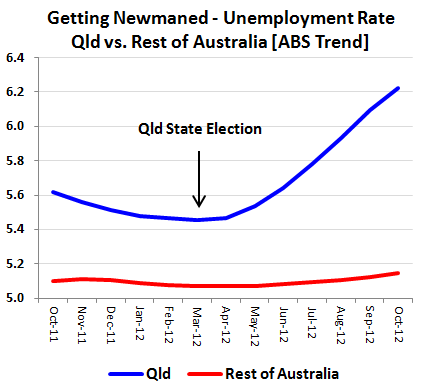
    Queensland has recorded the worst unemployment figure in three years, with a seasonally adjusted unemployment rate of 6.3 per cent in September 2012.

    The figures issued today by the Australian Bureau of Statistics show Queensland’s unemployment rate increasing progressively since April, when unemployment was 5.2 per cent.

    Queensland’s unemployment rose to 5.8 per cent in May and to 6.0 per cent in August before jumping to 6.3 per cent in September.

    It is the state’s worst unemployment outcome since September 2009 and harks back to 2003, when the Queensland economy was shaking off double-digit unemployment figures. It is also the second highest rate in the country behind Tasmania on 7.3 per cent.

    Read the original: http://www.brisbanetimes.com.au/queensland/queenslands-worst-unemployment-rate-for-three-years-20121011-27exm.html#ixzz2EUgNhl7q

    Queensland unemployment is higher than the national figures, which show Australia’s overall unemployment has increased to 5.4 per cent.

    There have been increases in both Queensland men and women registered as unemployed, with men showing a bigger increase – from 5.9 per cent to 6.3 per cent – than women – up from 6.1 per cent to 6.3 per cent.

    It appears Queensland has been hardest hit of the mining states, with Western Australia’s unemployment rate remaining steady at a national low of 4 per cent for the second month running.

    In New South Wales, it rose to 5.2 per cent from 4.9 per cent in the same period. In Victoria, the jobless rate was steady at 5.6 per cent.

    The unemployment results for individual cities and towns in August 2012, show unemployment worsening in Brisbane’s outer suburbs, on the Gold Coast, in Ipswich and north Queensland.

    In Brisbane’s outer suburbs, there were 19,200 registered as unemployed in August (up from 17,400); in Ipswich 7650 people registered as unemployed (up from 5500), while the Gold Coast has seen a big increase to 18,000 unemployed (up from 12,500).

    In Brisbane’s inner-ring of suburbs, there has been a slight improvement, with the number of people registering as unemployed dropping from 15,700 to 12,700.

    Far North Queensland is at its worst position since May 2011, with 16,000 people registered as unemployed, up from 12,500 in July.

    Unemployment in Mackay and the central Queensland coast has stabilised with 7500 people registered as unemployed, down from 8000 in July.

    Labor’s shadow treasurer Curtis Pitt said the LNP government was directly responsible for the recent increase in unemployment in Queensland.

    “We have been saying for months that the Newman government’s slash-and-burn budget strategy would result in an increase in unemployment and now it has been confirmed by labour force figures and their own bureaucrats,” he said in a statement.

    “The premier and treasurer must now explain how they propose to meet their key election commitment of keeping unemployment at 4 per cent.”

    However Queensland’s Attorney-General Jarrod Bleijie said the government had already made announcements that would generate jobs in the private sector in the longer -term.

    Treasurer Tim Nicholls and Queensland Treasury has predicted unemployment would average at 6 per cent during 2012-13, in its 2012-13 Budget.

    In a statement this afternoon, Mr Nicholls said today’s result was “disappointing” but it was still “well below Queensland’s long run average unemployment rate”.

    “The fluctuating nature of unemployment data in recent times is indicative of the areas of growth within the Queensland economy,” he said.

    “The high Australian dollar and global economic uncertainty are continuing to weigh on business sentiment and consumer confidence, and so any improvement in employment growth in Queensland will likely be modest over the near–term.”

    Mr Nicholls said the government remained committed to reducing unemployment to four per cent in six years.

    Queensland Council of Unions president John Battams said it was clear the state government was contributing to the increasing unemployment problem.

    “The LNP is only part way through the 14,000 jobs it wants to cut from the Queensland

    public sector,” Mr Battams said.

    “Figures this week showed that 3400 public sector workers had lost their jobs – there are thousands more to go across the state.”

  • The Unsung World MONBIOT

    The Unsung World

    Posted: 08 Dec 2012 11:06 AM PST

    Biodiversity offsets threaten both the survival and the meaning of nature.

    By George Monbiot, published on the Guardian’s website, 7th December 2012

    Propose a get-out clause and – however many warnings and caveats you wrap round it – before long it will be used. This post is about the dangerous new concept the government has seeded in the minds of developers and planners.

    The idea is called biodiversity offsetting. It involves trading places: allowing people to destroy wildlife and habitats if, in return, they pay someone to create new habitats elsewhere. In April the UK government launched six pilot projects to test the idea, which would run for two years.

    Four months ago, I wrote this:

    “The government warns that these offsets should be used only to compensate for ‘genuinely unavoidable damage’ and ‘must not become a licence to destroy’; but once the principle is established and the market is functioning, for how long do you reckon that line will hold?”

    The answer, it seems, is “not very long”. A year and a half before the pilot projects have been completed, the new spirit of destruction is roaming the land. A place of outstanding wildlife value is now being considered for demolition, and biodiversity offsetting is being mooted as the means by which it can be justified. It’s hard to believe that this scheme would still be receiving serious consideration if the mother of all excuses had not been proposed by the government.

    Lodge Hill, close to Gillingham in north Kent, contains what could be the UK’s highest concentration of nightingales. The species has suffered an astonishing decline in this country – over 90% in just 40 years – partly as a result of the destruction of its habitat. This site – of just 325 hectares – contains roughly 1% of the remaining population. It is one of the very few places where, on a summer’s night, you can still hear the full nightingale orchestra, a sound that would once have been familiar to people across much of the country.

    Medway Council has proposed that the land at Lodge Hill be turned into a development of 5,000 houses. This, according to a report by the British Trust for Ornithology, could destroy the area’s entire population of nightingales. Even if some birds continue to use the adjoining woods, they are extremely vulnerable to cats, as they nest close to the ground. The pets arriving with the new homes are likely to snuff out what John Clare called “the old woodland’s legacy of song.”

    So how do you justify the unjustifiable? You commission a consultancy (the Environment Bank) to investigate the potential for offsetting: in effect moving the habitat and its nightingales somewhere else. It reported that:

    “offsetting could work in principle for nightingales in Kent – it is technically
    feasible but it is neither straightforward nor guaranteed”

    If a site of around 500 hectares were found and stocked with suitable habitat, a similar number of nightingales might establish itself there. But no one can be sure it will work. If it doesn’t, by the time we find out it will be too late: the new habitat will take at least a decade to establish, while the existing habitat will be destroyed and the houses built in just two or three years. If the experiment fails it cannot be reversed.

    The report suggests two principal means by which new nightingale habitat could be created in Kent. One is to coppice existing woodland: cutting the trees at ground level so that they resprout to create the shrubby growth that nightingales use. The other is to take an area of agricultural land and either plant it with scrub or allow scrub to regenerate naturally.

    This invites two obvious responses. If woods are chosen, the offsetting process would not be creating wildlife habitat, but merely changing an existing habitat into something different. Coppicing favours some species at the expense of others, particularly those which require large trees, dead wood and an undisturbed understorey. What’s good for nightingales may be bad for woodpeckers.

    If 500 hectares of fields – a bigger site than Lodge Hill – can be taken out of agricultural use to compensate for the destruction of the nightingales’ homes, why not spare Lodge Hill and build the houses in the fields?

    The prospect of offsetting in this case looks to me like the “licence to destroy” that the government warned against. Rather than compensating for “genuinely unavoidable damage” it looks as if it could be used to justify avoidable destruction: trashing a remarkable place for an unremarkable project which could be built elsewhere.

    This case illustrates the danger inherent in the principle of offsetting. It makes nature as fungible as everything else. No place is valued as a place: it is broken down into a list of habitats and animals and plants, which could, in theory, be shifted somewhere else. It subjects our landscape and wildlife to the same process of commodification that has blighted everything else the corporate economy touches.

    The notion of a “like for like” replacement is bogus. No two places are the same. No place that has been planned and measured and designed and planted as a wildlife habitat is the same as one that has arisen spontaneously, or that has always been there. Much of the delight of nature is that it is unscripted, spontaneous, unofficial, that it owes little or nothing to human design.

    Accept the principle of biodiversity offsetting and you accept the idea that place means nothing. That nowhere is to be valued in its own right any more, that everything is exchangeable for everything else, and nothing can be allowed to stand in the way of the graders and degraders. That is not an idea I find easy to swallow.

    www.monbiot.com

  • Millions wasted in dump bungles

    Millions wasted in dump bungles

    EXCLUSIVE by LINDA SILMALIS
    The Sunday Telegraph
    December 09, 201212:00AM

    Increase Text Size
    Decrease Text Size
    Print
    Email
    Share

    0

    It has become far cheaper to dump rubbish over the border, even with extra fuel and transportation costs. Picture: David Earley Source: The Sunday Telegraph

    MILLIONS of dollars set aside to improve the state’s infrastructure are being lost as waste operators dodge a $95 levy by dumping Sydney’s rubbish in Queensland.

    Every day scores of B-double trucks loaded with soil contaminated with asbestos, heavy metals and household rubbish are being unloaded at Queensland waste stations.

    The practice began on July 1 after the NSW government increased the rubbish dumping levy in the state by $10 to $95.25 at the same time as the Queensland government scrapped its waste taxes altogether.

    Waste operators have told The Sunday Telegraph that it had become far cheaper to head north on the Pacific Highway, even with extra fuel and transportation costs.

    The Sunday Telegraph has also been told of instances where landfill operators have dug up old rubbish and loaded it on to trucks to send it across the border.

    Under State laws, the levy is returned per tonne for rubbish taken from a landfill site – a regulation designed to encourage recycling.

    Dial A Dump Industries operator Ian Malouf – whose $300 million landfill site in western Sydney was opened with great fanfare by the NSW government late last year and formally began receiving waste last month – said the volume of rubbish was well down on expectations prior the levy hike. “It is madness. The guys have told me that it is too expensive to tip their rubbish here and I understand that, but it is a completely mad situation,” he said.

    “The amount of revenue that should be going to NSW for roads and infrastructure and other things is basically being lost because Queensland has removed its levy.

    “Also, it’s such a carbon contradiction because half the rubbish being trucked over to Queensland is the by-product of recycled products. So here people are recycling rubbish, then burning up fuel to truck it to Queensland.”

    Mr Malouf, whose rubbish dump is regarded as the biggest in the southern hemisphere, said each Queensland-bound B-double truck represented just under $4000 worth of lost revenue to NSW in waste levies.

    NSW Waste Contractors & Recyclers Association executive director Tony Khoury, who has written to NSW Premier Barry O’Farrell about the situation, said around 2000 trucks per month were heading to Queensland.

    “I know of one case where around 10 trucks a day are being ordered to collect waste to take to Queensland,” Mr Khoury said.

    “If every truck is around $3800 per load, that’s millions of dollars in lost revenue to the state government each month.”

  • Magnificent seven’s money-making machine

    Magnificent seven’s money-making machine

    Date December 8, 2012 15 reading now
    Read later

    Kate McClymont

    Senior Reporter

    View more articles from Kate McClymont

    Follow Kate on TwitterEmail Kate

    A ‘sure thing’ turned sour and took big names with it, writes Kate McClymont.

    inShare.
    Pin It
    Email article
    Print
    Reprints & permissions

    .

    Wealth estimated at $665 million … Travers Duncan. Photo: Michele Mossop

    It must have seemed like an eternity for Travers Duncan as the 80-year-old sat in the witness box at the state’s most sensational corruption inquiry waiting for an intercepted telephone call to be played.

    Duncan, one of the nation’s wealthiest men, was estimated by BRW’s Rich List to be worth a mere $665 million. But here he was being grilled remorselessly over his involvement in Cascade Coal, which won a mining exploration licence which has engulfed the Labor party and has now spilled over into the very richest of our nouveau riche.

    The tall, forceful Duncan hasn’t had so much bad press since the Australian Federal Police and the Corporate Affairs Commission raided the offices of his company White Constructions in 1988. Duncan and several other White directors faced the possibility of five years jail when they were charged under the Companies Act with making untrue statements and non-disclosures in a prospectus.

    Made $500 million … Brian Flannery. Photo: Glenn Hunt

    The matter was ultimately dismissed in 1994 by Federal Court Justice Alan Neaves, who said the evidence was ”not capable of satisfying a jury beyond reasonable doubt”.

    Advertisement

    This time, it is another of Duncan’s ”White” companies – White Energy – that has landed him before a major corruption inquiry.

    When counsel assisting the Independent Commission Against Corruption Geoffrey Watson, SC, claimed in his opening address last month that the allegedly corrupt granting of coal exploration licences by then minister Ian Macdonald back in 2009 had the potential to make ”rich men even richer” he was not exaggerating.

    Investor … John McGuigan. Photo: Paul Miller

    Take those magnificent seven who invested in a private miner Cascade Coal. In August 2008, just as the family and associates of the controversial Labor MP Eddie Obeid were snapping up properties around the Bylong area, near Mudgee, an events company reinvented itself as a coal miner to be called Cascade Coal.

    Cascade’s investors included Duncan and his partner Brian Flannery who made $500 million each when they flicked their coalminer Felix Resources to China’s Yanzhou Coal for $3.54 billion in 2009.

    Then there was John Kinghorn, whose reputation took a hit after he floated RAMS Home Loans only days before the global financial crisis hit. He pocketed more than $650 million but investors were wiped out.

    Good timing … John Kinghorn. Photo: Louie Douvis

    Also investing in Cascade were former Baker & McKenzie law partners John McGuigan and John Atkinson, who have also made their fortunes in the resources industry.

    Richard ”Digger” Poole, who arrived from Perth several years ago to hang out his shingle as a boutique investment bank, Arthur Phillip, was also an investor. He and his former flight attendant wife, Amanda, had all the trappings of the newly wealthy – flashy cars, designer rags and the mandatory overseas holidays. Cascade’s office was at Arthur Phillip.

    In 2010, White Energy offered to pay $500 million for the small private company Cascade Coal, which had picked up the Mount Penny exploration from the NSW government for $1 million.

    Resources wealth … John Atkinson. Photo: Jim Rice

    Cascade’s successful bid for the exploration licence at Mount Penny may have gone unnoticed but for two things.

    The first was the extraordinary coincidence that Eddie Obeid’s family and friends had all secured key properties in the same area proposed for an open-cut mine.

    The other crucial development was the November 2010 announcement to the stock exchange that White Energy was offering an astonishing $500 million for Cascade, whose only asset was the Mount Penny licence.

    Close to Macdonald … Greg Jones.

    The problem was, several of the White Energy directors – including Duncan, Kinghorn, Flannery, Atkinson and McGuigan – just happened to own Cascade and stood to make a handsome $50 million each if White’s shareholders approved the deal.

    But throwing a spanner in the works was the pesky press, who began asking about the proposed sale and raising nasty questions as to whether the Obeid family was in on the Cascade deal.

    Also raising eyebrows was the fact some of the owners of Cascade had hidden their identity by owning Cascade shares through the intriguingly named Lost Ark Nominees. Even more interesting was the timing of Lost Ark’s bullish $28 million investment in Cascade – the day before White’s announcement to the stock exchange that it was planning to buy the company for $500 million.

    Boutique bank … Richard Poole. Photo: Michel O’Sullivan

    Kinghorn, of RAMS Home Loans, Allco and Krispy Kreme fame, held about 14 per cent of Cascade through a private company but he also held another 12.5 per cent on behalf of someone else.

    That someone else turned out to be Greg Jones, one of the closest friends of the man in charge of the coal tender – Macdonald. Jones had known ”Macca” since the early 1980s, when the pair were caught rorting expenses while employed in the office of then Labor minister Frank Walker.

    Jones, who was also a long-time business associate of Kinghorn and McGuigan, had been telling his eastern suburbs mates, including property developer Denis O’Neil and luxury car dealer Neville ”Croaky” Crichton, that he was on to a ”sure thing” in the way of a coal deal. ”It was going to be a ‘multi-bagger’,” he told friends.

    In investment circles, ”multi-bagger” is used to describe an investment that is expected to return at least several times a much as the original investment.

    This week, the identities behind the Lost Ark investors were revealed. Among the cast of veritable movers and shakers in the business community were Jones’s drinking buddies Crichton and O’Neil.

    The Lost Ark syndicate was brought together by Peter Gray and Brent Potts, the former stockbroking partner of the late disgraced Rene Rivkin.

    It included Potts’s great mate from Monaco, Bobby ”Bothways” Pittorino, along with Peter ”Talky” Newton, well-known corporate raider Sir Ron Brierley, Travers Duncan’s children Andromeda and Campbell, stockbrokers Richard Granger and Rex Adams, who now work alongside Potts and Gray at Blue Ocean Equities.

    Other investors were Wayne Seabrook and Simon Keyser from boutique stockbroking firm Ironstone Capital, and Anthony Levi who works with Poole at Arthur Phillip.

    At the same time they were investing, analysts from Potts’s stockbroking firm Southern Equities were spruiking the merits of the White Energy and Cascade purchase.

    It now transpires that the $28 million the Lost Ark syndicate invested in Cascade, was channelled by Cascade director Poole – via a solicitor’s trust fund – into the family coffers of the Obeids.

    There is no evidence any of the Lost Ark people were aware their money was going to the Obeid family.

    The Cascade investment has turned out to be a dud for everyone except ”the boys”. This was the nickname for Labor powerbroker Eddie Obeid’s five sons – Damien, Paul, Gerard, Moses and Eddie jnr.

    The inquiry has heard that ”the boys” orchestrated a 25 per cent stake in Cascade Coal in return for agreeing to let Cascade deal with their ”farm” consortium.

    Having the land owners on board is an attractive proposition to mining companies in that their access to the land is not being blocked by unhappy farmers.

    But by late 2010, the Obeid name had become synonymous with controversy, the commission has heard, and therefore, the good people at Cascade had to go to great pains to hide the Obeids’ payout.

    ”Jimmy, what are you thinking, you can’t say this,” Poole said in an email to his underling James McGuigan in August 2009.

    James McGuigan is the son of John McGuigan. Since July 2012, James McGuigan has been Cascade Coal’s sole employee but in 2008, he was working on the Cascade deal at Poole’s firm Arthur Phillip.

    ”Jimmy” had raised the ire of his boss by drafting an agreement between Cascade Coal and Buffalo Resources, which was a company associated with the Obeids.

    In his evidence this week, McGuigan conceded that ”By that point in time [August 2009] I understood they [the Obeids] were very controversial people, yes.”

    ”So it would be damaging to put them in?” he was asked by Watson. ”Ah, yes,” McGuigan replied hesitatingly.

    ”Jimmy, this needs more work. Remember, this document could easily end up in court one day so it needs to be accurate,” Mr Poole continued in his email.

    ”Quite prescient of Mr Poole?” Mr Watson said sardonically. ”You could say that,” McGuigan replied.

    McGuigan had a torrid time in the witness box. It transpired he had told a private ICAC hearing in July he knew the Obeids were involved with Cascade. But in his evidence this week, McGuigan said he was flustered during the hearing and had made a mistake.

    ”I suggest to you that an inference could be drawn that you’ve changed your evidence because suddenly you realise it was prejudicial to you?” Commissioner David Ipp suggested.

    Following James McGuigan into the box was his dad’s business partner Duncan.

    Duncan, who is chairman of White Energy, and one of the investors in Cascade, was in an ebullient mood when he settled into the witness box just before 3pm on Thursday.

    Within an hour, his life had been turned upside down.

    Read more: http://www.smh.com.au/nsw/magnificent-sevens-moneymaking-machine-20121207-2b11c.html#ixzz2ESrBACT1
  • Troubled UN climate talks spill over

    Troubled UN climate talks spill over

    by Sara Phillips for ABC Environment, ABCUpdated December 8, 2012, 5:30 pm

    tweet3

    Email
    Print

    International talks aiming to address global climate change have been extended amid fears they may collapse altogether.

    Talks at the United Nations Climate Change Conference in Doha, Qatar, aimed to finalise an agreement on cutting greenhouse gas emissions to replace the Kyoto Protocol.

    The key issues under consideration were the extension of the Kyoto Protocol, which expires at the end of December, and aid for developing nations who will be most affected by the changing climate.

    The conference was due to wrap up late last night (local time), but will now resume after talks stalled in the dying hours.

    Dr Chuks Okereke, from the School of Human and Environmental Sciences at the University of Reading, says tension between developing and developed countries has delayed negotiations.

    “The biggest stumbling block at the UN climate negotiations is the tension between developing and developed countries,” he said.

    “From the developing world perspective, the developed countries have failed in their commitments on three counts: domestic emission reductions; technology transfer; and, most crucially, finance.Â

    “Climate change is ultimately a question of justice and those who have contributed the most should assume responsibility in solving the problem.”

    The Kyoto Protocol, drafted in 1997, aimed to reduce the world’s greenhouse gas emissions by around five per cent from 1990 levels by the end of 2012.

    Instead, global greenhouse gases have risen around 58 per cent in that time.

    Green groups and scientists say while a global treaty to address emissions by 2015 has been agreed upon, it does not go far enough.

    Lidy Nacpil of Jubilee South Asia Pacific, an alliance of environmental and social justice organisations, says the wording is vague and ineffective.

    “[It’s] a million miles from where we need to be to even have a small chance of preventing runaway climate change,” she said. Â

    Ms Nacpil is based in the Philippines which is currently experiencing devastation as a result of Typhoon Bopha.Â

    “As civil society movements, we are saying that this is not acceptable,” she said.

    “We cannot go back to our countries and tell them that we allowed this to happen, that we condemned our own future.Â

    We cannot go back to the Philippines, to our dead, to our homeless, to our outrage, and tell them that we accepted this.”

    While expectations were low for the Doha meeting, the failure of the talks to drive the formation of a treaty has raised doubts about the future of the United Nations climate negotiations.
    Asad Rehman, spokesperson for Friends of the Earth International, described the meeting as “an empty shell, an insult to our futures”.

    tweet3

  • Gas hydrates in Arctic are shallowest yet found

    Gas hydrates in Arctic are shallowest yet found

    Undersea methane hydrate deposit could serve as climate-change canary.
    Zoë Corbyn

    07 December 2012

    The Beaufort Sea’s shallow methane-hydrate deposits are particularly vulnerable to rising sea temperatures.

    R. Gehman/Corbis

    Article tools
    Print
    •Email
    •Rights & Permissions

    •Share/bookmark

    A ‘test case’ for how undersea deposits of methane — a greenhouse gas locked in sediments — might respond to climate change has been uncovered in the Arctic Circle.

    The shallowest known deposit of methane hydrate — a crystalline solid comprising methane molecules trapped in an ice-lattice structure — has been discovered on the continental slope off Canada in the Beaufort Sea.

    The trapped gas deposit is located in an area of small conical hills on the ocean floor just 290 metres below sea level. Before the discovery, the shallowest known marine gas-hydrate deposits were found in the Gulf of Mexico and in the vicinity of the Svalbard Islands at depths of around 400 m, says Charles Paull, a senior scientist at the Monterey Bay Aquarium Research Institute in Moss Landing, California, who presented the work on Thursday at the annual meeting of the American Geophysical Union in San Francisco, California1.

    Related stories
    •Seismic signs of escaping methane under the sea
    •Charles Paul, MBARI

    This particular deposit is only modest in size, but the methane trapped in such deposits represents an immense global carbon reservoir. Some experts fear that destabilization of such gas-hydrate deposits around the world — caused by changes in sea temperature or drilling, for example — could cause a release of methane into the environment and accelerate global warming.

    At such a shallow depth, the newly discovered deposit is vulnerable to decomposition if there is even subtle warming of the overlaying water, says Paull.

    The Arctic is thought to be undergoing some of the most dramatic effects of climate change anywhere in the world. And this particular deposit is just within what scientists call the ‘methane hydrate stability zone’, the range of pressure and temperature at which gas hydrates are stable. In this region, the stability zone begins at a depth of about 270 m, above which sea temperatures are too warm to ensure the methane remains locked in its water-molecule cage.

    Landslides and tsunamis

    Because this deposit is small, the methane released by its decomposition would not substantially affect the Earth’s climate, says Paull. However, the discovery could give some hints about, for example, how much methane could be released when a deposit begins to decompose as the sea warms.

    “This is a great place to study what happens,” under such conditions Paull says.

    Some climate scientists fear that gas-hydrate decomposition could also create geohazards — for example, by destabilizing the sea floor and causing landslides and accompanying tsunamis.

    Timothy Collett, a research geologist at the United States Geological Survey in Denver, Colorado, says that the shallowness of the deposit means it could help researchers identify signs of future events. But he urged caution in speculating about potential geohazards that might result from decomposition of methane hydrate deposits. “We don’t have proof in the geological record that any of that has ever happened before,” he says.

    Paull is now planning a more detailed survey of the structure, along with another two identified in the same area but at deeper depths to better track any changes related to global warming.
    Naturedoi:10.1038/nature.2012.11988

    References

    1.
    Paull, C. K. et al. Active seafloor gas vents on the Shelf and upper Slope in Canadian Beaufort Sea. Abstract presented at the Fall Meeting of the American Geophysical Union, 3–7 December, San Francisco, California (2012).
    Show context

    Related stories and links

    From nature.com

    Seismic signs of escaping methane under the sea

    25 October 2012


    Charles Paul, MBARI

    Author information

    :

    Comments

    There are currently no comments.

    You need to be registered with Nature and agree to our Community Guidelines to leave a comment. Please log in or register as a new user. You will be re-directed back to this page.