TIPPING POINTS NEAR
Inbox
x
Andrew Glikson
12:21 PM (21 minutes ago)
to JOHN, me
TIPPING POINTS NEAR
Tipping Points Near.pdf Tipping Points Near.pdf
559K View Download
TIPPING POINTS NEAR
Inbox
x
Andrew Glikson
12:21 PM (21 minutes ago)
to JOHN, me
TIPPING POINTS NEAR
Tipping Points Near.pdf Tipping Points Near.pdf
559K View Download
Carbon credits row could derail UN climate talks, says Brazil
Head of Brazilian delegation says countries should not be allowed to carry over credits into second round of Kyoto protocol
Share5
inShare.0
Email
Fiona Harvey, environment correspondent
guardian.co.uk, Sunday 2 December 2012 18.23 GMT
The climate change talks are taking place in Doha, Qatar. Photograph: Osama Faisal/AP
Brazil has said a row over carbon credits could derail the United Nations climate change negotiations taking place in Qatar this week.
The row concerns whether countries entering the second round of the Kyoto protocol should be allowed to carry over emissions credits from the first phase. Some countries, including Poland, Ukraine and Russia, have large surpluses of credits, generated because their carbon output collapsed alongside their industrial base after the fall of communism.
These credits are derided as “hot air” by critics because they represent greenhouse gases already reduced many years ago, rather than new efforts. André Corrêa do Lago, head of the Brazilian delegation, told the Guardian: “The second phase has to have environmental integrity, and you will not have that if countries are allowed to carry over [the credits]. The second period will be completely compromised. This is not a way to have effective reductions.”
Brazil occupies an important position at the talks: it is one of the rapidly developing Basic countries (Brazil, South Africa, India and China), but has acted as a moderating force between this group and the developed nations, which often have major differences.
Russia and the Ukraine are thought to have billions of emissions credits unsold, but the focus has been on Poland because as a member of the EU it has committed to the second phase of Kyoto. Its refusal to give up its credits has riven a deep split in the EU, which likes to be seen as one of the engines of progress in the talks.
“They are debating this inside the European bloc and we really hope that they will solve it in a way that gives environmental integrity. This is a loophole that means they won’t reduce emissions [as much as promised], so it’s a very strange logic,” said Corrêa do Lago.
Russia has refused to join the second commitment period, likely to run from 2012 to 2020, and Ukraine’s position is unclear.
Developing countries are already unhappy that so few rich nations have agreed to join a second phase of Kyoto. The non-joiners have argued that the focus should shift from the 1997 Kyoto protocol to forging a new global agreement covering developed and developing countries, that would be drafted by 2015 and come into force in 2020. New Zealand’s climate minister, Tim Groser, told the Associated Press in Doha: “This excessive focus on Kyoto, Kyoto, Kyoto, Kyoto, was fine in the 1990s. But given that it covers only 15% of emissions, I’m sorry, this is not the main game.”
Corrêa do Lago said the second phase was needed to give all sides the confidence to proceed: “It is clear from the number of ship-jumpers that if we do not have a Kyoto protocol, things will go rapidly downhill.” He said the number of countries taking on pledges under the continued protocol meant it would not be enough to cut emissions in line with scientific advice, but said it might be “enough politically” to bring developing and developed countries together in a new global agreement to succeed the protocol after 2020.
The row in Doha came as a paper in the journal Nature Climate Change suggested emissions rose again this year, by about 2.6%, to a record high of 35.6bn tonnes. This means global emissions from burning fossil fuels are now 58% above 1990 levels, which was used as the base year for calculating emissions cuts under the Kyoto protocol, according to the Tyndall Centre for Climate Change Research at the University of East Anglia.
The research follows stark warnings from other authorities in recent weeks, including the World Bank and International Energy Agency, that the world is headed for catastrophic levels of warming, of as much as 4-6C. Scientists say emissions must peak by 2020 to have a chance of holding warming to no more than 2C.
“The prospect of catastrophic climate change needs to change the mindsets of political leaders,” said Martin Kaiser, climate campaigner at Greenpeace. “Coal-rich Poland is so far dictating the European Union position on hot air. Ministers coming to Doha must make a choice now about whether they have the courage to defend people from the impacts of climate change, or whether they will pander to Brussels politics. If Europe makes the wrong call here, it will lose the trust of the rest of the world.”
Under the Kyoto protocol, Poland was obliged to cut its emissions by 6% by 2012 compared with 1988 levels. Poland’s emissions are currently about 30% below the baseline, but the country is a big producer and consumer of coal for power generation, and the country has frequently tried to block EU moves to strengthen environmental regulation.
Poland had an estimated 500m tonnes of carbon credits, known as assigned amount units, or AAUs, but has sold an unknown number to Spain, Japan and Ireland, to help those countries meet their emissions targets, for an estimated €190m so far. The credits are not worth much at present – similar credits can be picked up for as little as €1 – but Poland argues they are a “national right”.
In a move that some applauded as a diplomatic coup and others called a joke, the UN has agreed that next year’s climate talks will take place in Warsaw. Following on from this year’s choice of Qatar, which has the world’s highest per-capita emissions and derives most of its wealth from oil and gas, the choice may prove to be either inspired or disastrous.
Head of Brazilian delegation says countries should not be allowed to carry over credits into second round of Kyoto protocol
Share5
inShare.0
Email
Fiona Harvey, environment correspondent
guardian.co.uk, Sunday 2 December 2012 18.23 GMT
The climate change talks are taking place in Doha, Qatar. Photograph: Osama Faisal/AP
Brazil has said a row over carbon credits could derail the United Nations climate change negotiations taking place in Qatar this week.
The row concerns whether countries entering the second round of the Kyoto protocol should be allowed to carry over emissions credits from the first phase. Some countries, including Poland, Ukraine and Russia, have large surpluses of credits, generated because their carbon output collapsed alongside their industrial base after the fall of communism.
These credits are derided as “hot air” by critics because they represent greenhouse gases already reduced many years ago, rather than new efforts. André Corrêa do Lago, head of the Brazilian delegation, told the Guardian: “The second phase has to have environmental integrity, and you will not have that if countries are allowed to carry over [the credits]. The second period will be completely compromised. This is not a way to have effective reductions.”
Brazil occupies an important position at the talks: it is one of the rapidly developing Basic countries (Brazil, South Africa, India and China), but has acted as a moderating force between this group and the developed nations, which often have major differences.
Russia and the Ukraine are thought to have billions of emissions credits unsold, but the focus has been on Poland because as a member of the EU it has committed to the second phase of Kyoto. Its refusal to give up its credits has riven a deep split in the EU, which likes to be seen as one of the engines of progress in the talks.
“They are debating this inside the European bloc and we really hope that they will solve it in a way that gives environmental integrity. This is a loophole that means they won’t reduce emissions [as much as promised], so it’s a very strange logic,” said Corrêa do Lago.
Russia has refused to join the second commitment period, likely to run from 2012 to 2020, and Ukraine’s position is unclear.
Developing countries are already unhappy that so few rich nations have agreed to join a second phase of Kyoto. The non-joiners have argued that the focus should shift from the 1997 Kyoto protocol to forging a new global agreement covering developed and developing countries, that would be drafted by 2015 and come into force in 2020. New Zealand’s climate minister, Tim Groser, told the Associated Press in Doha: “This excessive focus on Kyoto, Kyoto, Kyoto, Kyoto, was fine in the 1990s. But given that it covers only 15% of emissions, I’m sorry, this is not the main game.”
Corrêa do Lago said the second phase was needed to give all sides the confidence to proceed: “It is clear from the number of ship-jumpers that if we do not have a Kyoto protocol, things will go rapidly downhill.” He said the number of countries taking on pledges under the continued protocol meant it would not be enough to cut emissions in line with scientific advice, but said it might be “enough politically” to bring developing and developed countries together in a new global agreement to succeed the protocol after 2020.
The row in Doha came as a paper in the journal Nature Climate Change suggested emissions rose again this year, by about 2.6%, to a record high of 35.6bn tonnes. This means global emissions from burning fossil fuels are now 58% above 1990 levels, which was used as the base year for calculating emissions cuts under the Kyoto protocol, according to the Tyndall Centre for Climate Change Research at the University of East Anglia.
The research follows stark warnings from other authorities in recent weeks, including the World Bank and International Energy Agency, that the world is headed for catastrophic levels of warming, of as much as 4-6C. Scientists say emissions must peak by 2020 to have a chance of holding warming to no more than 2C.
“The prospect of catastrophic climate change needs to change the mindsets of political leaders,” said Martin Kaiser, climate campaigner at Greenpeace. “Coal-rich Poland is so far dictating the European Union position on hot air. Ministers coming to Doha must make a choice now about whether they have the courage to defend people from the impacts of climate change, or whether they will pander to Brussels politics. If Europe makes the wrong call here, it will lose the trust of the rest of the world.”
Under the Kyoto protocol, Poland was obliged to cut its emissions by 6% by 2012 compared with 1988 levels. Poland’s emissions are currently about 30% below the baseline, but the country is a big producer and consumer of coal for power generation, and the country has frequently tried to block EU moves to strengthen environmental regulation.
Poland had an estimated 500m tonnes of carbon credits, known as assigned amount units, or AAUs, but has sold an unknown number to Spain, Japan and Ireland, to help those countries meet their emissions targets, for an estimated €190m so far. The credits are not worth much at present – similar credits can be picked up for as little as €1 – but Poland argues they are a “national right”.
In a move that some applauded as a diplomatic coup and others called a joke, the UN has agreed that next year’s climate talks will take place in Warsaw. Following on from this year’s choice of Qatar, which has the world’s highest per-capita emissions and derives most of its wealth from oil and gas, the choice may prove to be either inspired or disastrous.
Doha conference is warned that climate models do not yet take account of methane in thawing permafrost
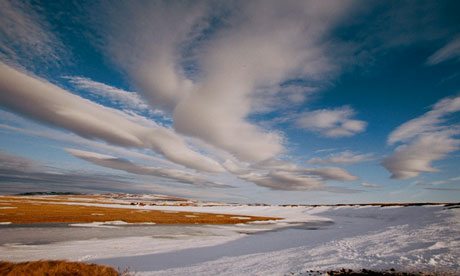
The United Nations sounded a stark warning on the threat to the climate from methane in the thawing permafrost as governments met for the second day of climate change negotiations in Doha, Qatar.
Thawing permafrost releases methane, a powerful greenhouse gas, but this has not yet been included in models of the future climate. Permafrost covers nearly a quarter of the northern hemisphere at present and is estimated to contain 1,700 gigatonnes of carbon – twice the amount currently in the atmosphere. As it thaws, it could push global warming past one of the key “tipping points” that scientists believe could lead to runaway climate change.
The UN Environment Programme (UNEP) called for the effect to be studied in detail by the Intergovernmental Panel on Climate Change (IPCC), the body of top climate scientists convened by the UN to provide governments with the most up-to-date and comprehensive knowledge on climate change. The next IPCC report will be published in several parts from next year.
Achim Steiner, executive director of UNEP, said: “Permafrost is one of the keys to the planet’s future because it contains large stores of frozen organic matter that, if thawed and released into the atmosphere, would amplify current global warming and propel us to a warmer world. Its potential impact on the climate, ecosystems and infrastructure has been neglected for too long.”
UNEP said warming permafrost could also “radically alter ecosystems and cause costly infrastructural damage due to increasingly unstable ground” and called for national monitoring systems to be put in place by countries with permafrost, including Russia, Canada, China and the US.
Most of the current permafrost formed during or since the last ice age and extends to depths of more than 700 metres in parts of northern Siberia and Canada. Permafrost consists of an active layer of up to two metres in thickness, which thaws each summer and refreezes each winter, and the permanently frozen soil beneath. As temperatures in the Arctic are rising faster than elsewhere, this could increase the danger of permafrost melting. Warming permafrost could emit 43 to 135 gigatonnes of carbon dioxide equivalent by 2100 and 246 to 415 gigatonnes by 2200, according to the report, and emissions could start within the next few decades. Permafrost emissions could ultimately account for up to 39% of total emissions, according to the report.
UNEP’s report came as governments argued over the future of the Kyoto protocol at the Doha climate talks. One of the main aims of the talks is an agreement to continue the protocol beyond the end of this year, when its current provisions and targets expire. But only the EU and a handful of other relatively small emitters, including Australia, Norway and Switzerland, have agreed.
Japan was once a strong defender of the protocol, taking pride in the fact that it was negotiated there. But the country has now abandoned it, in part because of fears that its neighbour, China, has taken a competitive advantage because it is not obliged to reduce its emissions.
Masahiko Horie, of the Japanese negotiating team, said: “Only developed countries are legally bound by the Kyoto protocol and their emissions are only 26% [of global emissions]. If we continue the same, only one quarter of the world is legally bound and three quarters of countries are not bound at all.”
He said it was more important to Japan to formulate a new framework that would require action on emissions from developing as well as developed countries. At the talks, governments are expected to draw up a work plan that would set out how they will draw up such a new global agreement by 2015, coming into force in 2020.
But many developing countries want developed countries to continue with Kyoto beyond 2012 as part of any deal. Andre Correa do Lago, head of the Brazilian delegation, said: “If rich countries which have the financial means, have technology, have a stable population, already have a large middle class, think they cannot reduce [emissions] and work to fight climate change, how can they ever think that developing countries can do it? That is why the Kyoto protocol has to be kept alive. If we take it out, we have what people call the Wild West. You are not going get the [emissions] reductions necessary.”
The talks will continue until the end of next week.
The story that won’t go away will dog the PM for the four remaining parliamentary sitting days of 2012 – and beyond.
The Prime Minister denies any past connection with an AWU slush fund, as disgraced former union boss Ralph Blewitt makes a sworn statement to Victoria Police fraud squad.
Video will begin in 1 seconds.
The Gillard government might have been rounding out a year of achievement with the Abbott opposition in retreat, but instead goes into the last week of Parliament facing its greatest crisis.
Its asylum seeker policy is in disarray, but that is not an existential threat to the government. The grave and immediate danger to Labor’s hold on power is the fast-building crisis over the Prime Minister’s connections to a major union fraud case from 1991 to 1995.
The government’s success this week in winning support for a plan to save the Murray-Darling river system is a signal moment for Australia, but it was given scant chance to celebrate.
 http://www.smh.com.au/opinion/politics/knives-are-out-for-gillard-20121123-29ytv.html#ixzz2D5atf2G4

Detective Inspector Peter Fox at home late last month. Photo: Peter Stoop
A senior detective who blew the whistle on an alleged police cover-up of sex abuse in the Catholic Church said he had received threatening messages on police letterhead since speaking out on an issue that he acknowledged would end his career in the force.
But after Prime Minister Julia Gillard announced a sweeping royal commission into child sex abuse on Monday, Detective Inspector Peter Fox said he felt vindicated and satisfied that the thousands of voices of abuse victims would finally be heard.
The senior investigator’s explosive allegations on Lateline last week – that the Catholic Church had covered up crimes of paedophile priests and silenced police investigations in the Newcastle-Hunter area of New South Wales – helped to trigger the royal commission, which will probe organisations ranging from church and state authorities to the Boy Scouts and sports groups.
Detective Inspector Fox said the royal commission was a “wonderful result”. He said the push for the inquiry had affected him and his family, including his wife, who suffered a nervous break-down after receiving threatening letters.
He had also received an anonymous threatening letter with police letterhead from a “disgruntled officer” after speaking out about the church and another controversial issue in the past year.
A smear campaign had also been launched against him, with rumours circulating in the police force that he was mentally unstable, Detective Inspector Fox said.
“I don’t want to go into it too deeply, but this is the end of my policing career,” Detective Inspector Fox told Lateline on Monday night.
“I realised that from the moment that I decided to speak out last week. As much as it’s denied, the culture within the police force would never allow someone like me to move back into it.
“I think the Wood Royal Commission [into police corruption in NSW] uncovered it years ago and I’m sorry to say that very little has changed. You know, ostracisation and things of that nature continue to go on within the police force.
“Don’t get me wrong, I’m not bitter with the police force. They’re a minority, those individuals, but they exist everywhere, whether it’s the police force or wherever else in society they may be. We will probably unfortunately never change that.”
Detective Inspector Fox said the royal commission should examine aspects of the Catholic Church such as confession, in which priests had been known to confess to other priests their abuse of children.
“We need to get laws to stop that happening and to compel those priests that are hearing those confessions to say, ‘Listen; God doesn’t want this man to commit more crimes. He wants me to come and tell the police to stop him’,” Detective Inspector Fox said.
He also hit out at Sydney Archbishop Cardinal George Pell’s claims that the royal commission was brought about by ongoing and at times one-sided media coverage.
“It certainly has been one-sided, because it seems to be the Church that has been continually screaming out the message that ‘We don’t need a royal commission, there’s nothing going on here, move along’,” Detective Inspector Fox said.
“We’ve had enough from that one side, Mr Pell. Now we’re going to start listening to the victims and start listening to their families and we’re going to start doing something about the problem.”
Detective Inspector Fox joined Twitter last week in his campaign for a royal commission.
On Monday night he tweeted: “I will sleep with a smile.”
Will Rising Seas Swamp Sydney, Australia by Century’s End?
CO2 Science Magazine
He reports, for example, that “low-lying coastal areas, where the majority of Australians are concentrated, have been declared at risk of sea level inundations,” and that “maps with 0.5, 0.8 and 1.1 meter sea level rise have been proposed for Sydney …
See all stories on this topic »
 Email
Email


