Category: Uncategorized

  • America’s miasma of misinformation on climate change

    America’s miasma of misinformation on climate change

    With serious reporting of global warming by US media virtually nonexistent, it’s no wonder Americans are paralysed in denial

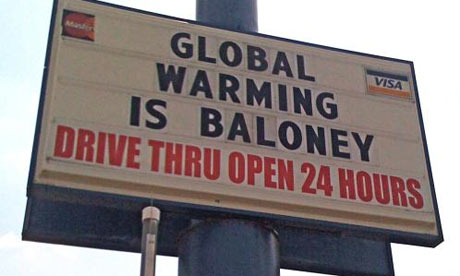
    Burger King Calls Global Warming 'Baloney' reports by the Memphis Flyer

    Sixty-one per cent of Americans consider themselves ‘cautious’, ‘disengaged’, ‘doubtful’ and ‘dismissive’ on climate change. Photograph: www.memphisflyer.com

    Since 1950, humans have manufactured more goods than have ever existed in history. Our consumption of those goods – a highly inefficient use of our natural capital – has wrought a long list of environmental consequences. Staggering deforestation, check. Increasing greenhouse gas emissions, check. Rising heat, sea level, and incidence of extreme weather events – check, check and check.

    To environmental experts, such evidence is the proverbial writing on the wall: we must transition to a low-carbon economy, stat, in order to avoid irrevocable damage. As President Obama affirmed, upon accepting his party’s nomination for president, no less:

    Climate change is not a hoax. More droughts and floods and wildfires are not a joke. They’re a threat to our children’s future.”

    The president’s choice of words seemed a pointed response to Republican Senator James Inhofe, author of The Greatest Hoax and, it’s worth noting, recipient of $1.3m in campaign contributions from the oil and gas lobby.

    Political maneuvering aside, why are Americans so disengaged from climate change – arguably, one of the most critical problems of our time?

    Denial ain’t just a river in Egypt; it’s also in places like North Carolina and perhaps even embedded into America’s cultural DNA. According to the latest study from the Yale Project on Climate Change Communication, the American public’s concern about global warming can be sorted into six categories, ranging from alarmed (13%) and concerned (26%), to cautious, disengaged, doubtful and dismissive (that’s the other 61% of us). Among the many explanations offered for the knowledge gap are clashing worldviews, varying education levels, demographics, and the media’s handling of the issue.

    Even as evidence for climate change mounts and the consequences of the phenomenon become more severe, the amount of climate coverage on broadcast networks has plummeted. According to a stunning analysis by Media Matters, the Sunday morning current affairs shows averaged about one hour each on climate change in 2009, compared to averaging 21 minutes apiece in 2010 and only 9 minutes per program in 2011. In 2011, Fox News Sunday covered climate change the most (just under an hour), “but much of the coverage promoted the ‘Climategate’ controversy and downplayed the threat of climate change,” reports Media Matters.

    At the other end of the spectrum, CBS had the least climate change coverage, devoting four minutes to the topic in three years. Altogether, in 2011, ABC, CBS, NBC and Fox spent twice as much time discussing Donald Trump’s “will he, won’t he” run for president rather than climate change. In fact, NBC’s Meet the Press devoted 23 minutes to Trump that year – but not a single minute to climate change.

    While there is virtually no mention of climate change in the local news, reporters have turned the weather into a national pastime. Perhaps this is because storms, hurricanes and tornadoes ignite a primal reaction, whereas climate change requires an intellectual one. There is also a perception of trust that grows from constant visibility on television – although we poke fun at the weatherman, we still hide in our closets during tornado warnings. On the other hand, we regard PhD-level climate scientists with suspicion, even though their work must hold up to rigorous peer review. The weather versus climate conflict illustrates what behavioral economists have said for years:

    “We base our decisions on emotion far more than reason.”

    Flawed climate risk perception may also explain why meteorologists have an advantage over climate scientists in making immediate weather more urgent than climate change. Although hard data do influence thinking, the psychology of risk perception is complicated. Often, our fears defy reason and statistics. For instance, blood-curdling events like shark attacks and plane crashes scare the living daylights out of us, when we have more reason to be afraid of climbing into our cars each morning: sharks claim about 12 lives per year, while car crash fatalities average around 93 per day. In the case of climate change, fear over problems that will affect us 50 years from now cannot compare with fear of challenges we face today. What people don’t understand is that climate change is, in fact, already affecting our economy.

    It’s understandable that our perception of risk may lead us to focus on surviving an immediate disaster more than preventing a future one. But it defies logic that so many would fall prey to “infotainers” such as Glenn Beck, who uses sustainable development as fodder for jokes. From McKinney, Texas to Trenton, New Jersey, sustainable development projects are being held up due to aggressive pushback and fear-mongering over Agenda 21, a voluntary initiative that some suspect to be diabolical attempt on the part of the UN to force a one-world government.

    Fortunately, most folks are not held back by reactionary ideology so much as basic lack of exposure to the problem. More than 1 billion people live in low-lying coastal areas, and most live in poverty. Already, at least 25 million climate refugees and counting are facing the consequences. For them, climate change is no longer an abstract concept to get their minds around; they are literally wading through it.

    Seeing is believing. If weak perception of risk is our blind spot, we needn’t let the media keep us in the dark. Instead, we can use media – pictures, videos and websites such as National Geographic – to confront the challenges, and so mobilize citizens and students toward solutions. Weather may fade, but pictures of post-drought west Texas, hurricane-ravaged New Orleans and submerging countries such as Tuvalu are a stark reminder that climate change carries not only an economic or environmental toll, but also a human one.

    Sure, we can always evacuate, but we cannot get around paying a price for avoiding climate change. And the price – like the sea level – keeps rising.

  • Welcome to the Sydney Coastal Councils Group Website

    Member Councils and their AreasThe Sydney Coastal Councils Group Inc. (SCCG) was established in 1989 to promote co-ordination between Member Councils on environmental issues relating to the sustainable management of the urban coastal environment. The Group consists of 15 Councils adjacent to Sydney marine and estuarine environments and associated waterways, and represents over 1.4 million Sydneysiders.

    Sydney Swell Conditions
    Sydney Weather

    Making Waves September

    The SCCG Monthly Update

    Key Activities

    Local Government Elections

    Congratulations to the new Councillors selected from the Local Government elections held 8 September. We are looking forward to meeting with our new delegates for the next term at our December Full Group meeting.

    Mapping and Responding to Coastal Inundation: Project Launch

    Inundation Launch FlyerThe CSIRO Responding to Coastal Inundation Launch is being held 4 October 2012 at Town Hall House. Whilst limited to Member Councils, key deliverables will be available on the project page. Click here for the Project Page.

    Coastal Management Forum

    Boundaries and Barriers Forum CoverThe Boundaries and Barriers: Managing the Intertidal Zone forum held on the 14 August at Customs House was a successful and informative event. Click here for presenter details and a copy of their PowerPoint presentation from the day.

    Climate Change Adaptation

    The Forum for the finalisation of the Prioritising Coastal Adaptation Development Options for Local Government project was held 6 September 2012. This project utilises multi-criteria analysis to provide a more holistic approach to decision-making by incorporating community values into the assessment of options. Final outputs, including assessment tools, will be available soon. Click here for the project page.

    Landslide Risk Management

    The SCCG partnership with Geomechanics Society Australia has produced the Landslide Risk Management Website. Please visit the website and take the test here.

    Landslide Risk Management Website

    COVERMAR Coastal Vulnerability to Multiple Inundation Sources Project

    COVERMAR Literature ReviewDr. Filippo Dall’Osso has completed an extremely comprehensive Literature Review underpinning the Coastal Vulnerability to Multiple Inundation Sources Project. It is available on the Project Page or by clicking on the image above.

    UPCOMING AWARDS AND FUNDING

    Annual NSW Coastal Management Awards

    The Local Government Award is awarded to a coastal local council which has demonstrated excellence in the implementation of ESD in the coastal zone. Click here to find out how to nominate.

    Closing date: 12 October 2012

    • The Metropolitan Greenspace Program

    The Metropolitan Greenspace Program assists local councils in the Sydney metropolitan region to improve regionally significant public open space, including regional recreational tracks and trails.

    Application forms and details are available here.


    Closing date: 5 October 2012

    Fish Habitat Action Grants

    Grants of up to $40,000 as part of the NSW Government’s Habitat Action Grant program for projects to improve fish habitat in your area. Click here for more details.

    Closing date: 28 September 2012

    Keep Australia Beautiful NSW Clean Beaches, Connecting Our Coasts; Presented by Sydney Water

    Proudly sponsored by Sydney Water, the Keep Australia Beautiful NSW Clean Beaches – Connecting our Coast Awards encourage and recognise coastal communities, local councils, volunteers and surf lifesaving clubs who protect this State’s beautiful coastline.

    Entries are open – for more information click here.

    Closing date: Unannounced.

    Web
    S M T W T F S
    Add to calendar

    View Sydney Coastal Councils Group ProjectsView Sydney Coastal Councils Group ProjectsSearch Sydney Coastal Councils Group Online Resource LibrarySydney Coastal Councils Group StrategySydney Coastal Councils Group EventsNRM Funding Guide

  • Sea surface temperatures reach record highs on Northeast continental shelf Posted: 18 Sep 2012 09:15 AM PDT During the first six months of 2012, sea surface temperatures in the Northeast Shelf Large Marine Ecosystem were the highest ever recorded. The a


    Sea surface temperatures reach record highs on Northeast continental shelf

    Posted: 18 Sep 2012 09:15 AM PDT

    During the first six months of 2012, sea surface temperatures in the Northeast Shelf Large Marine Ecosystem were the highest ever recorded. The annual 2012 spring plankton bloom was intense, started earlier and lasted longer than average. This has implications for marine life from the smallest creatures to the largest marine mammals like whales. Atlantic cod continued to shift northeastward from its historic distribution center.


    Posted: 18 Sep 2012 09:15 AM PDT

    During the first six months of 2012, sea surface temperatures in the Northeast Shelf Large Marine Ecosystem were the highest ever recorded. The annual 2012 spring plankton bloom was intense, started earlier and lasted longer than average. This has implications for marine life from the smallest creatures to the largest marine mammals like whales. Atlantic cod continued to shift northeastward from its historic distribution center.

  • FOCUS ON…. ARCTIC BIG MELT

    FOCUS ON…. ARCTIC BIG MELT

    Arctic warning: As the system changes, we must adjust our science
    http://www.climatecodered.org/2012/09/as-arctic-system-changes-we-must-adjust.html
    David Spratt, ReNewEconomy, 12 September 2012
    The Arctic sea-ice big melt of 2012 “has taken us by surprise and we must adjust our understanding of the system and we must adjust our science and we must adjust our feelings for the nature around us”, according to Kim Holmen, Norwegian Polar Institute (NPI) international director.

    Ice loss shifts Arctic cycles
    http://www.nature.com/news/ice-loss-shifts-arctic-cycles-1.11387
    Quirin Schiermeier, Nature News, 12 September 2012
    Record shrinkage confounds models and portends atmospheric and ecological change.

    ‘Astonishing’ Ice Melt May Lead to More Extreme Winters
    http://www.climatecentral.org/news/astonishing-arctic-sea-ice-melt-may-lead-to-extreme-winter-weather-14989
    Climate Central, September 12, 2012
    The record loss of Arctic sea ice this summer will echo throughout the weather patterns affecting the U.S. and Europe this winter, climate scientists said on Wednesday, since added heat in the Arctic influences the jet stream and may make extreme weather and climate events more likely.
    AND
    Arctic sea ice melt ‘may bring harsh winter to Europe’
    http://www.guardian.co.uk/environment/2012/sep/14/arctic-sea-ice-harsh-winter-europe

    Arctic melt down: Scientists Speak Out (audio)
    http://www.ecoshock.info/2012/09/arctic-melt-down-scientists-speak-out.html

    EcoShock, 10 September 2012
    In 2012, the Arctic Sea Ice hit a stunning new record low. Rutgers scientist Jennifer Francis explains how this changes weather for billions of people in the Northern Hemisphere. Plus the Director of the Snow and Ice Data Center, Mark Serreze on record and what it means, and analysis from polar scientist Jennifer Bitz, U of Washington. In depth, direct from top scientists. Radio Ecoshock 120912 1 hour.

    The staggering decline of sea ice at the frontline of climate change
    http://www.guardian.co.uk/environment/2012/sep/14/decline-sea-ice-arctic
    John Vidal, Guardian, 14 September 2012
    Scientists on board Greenpeace’s vessel exploring the minimum extent of the ice cap are shocked at the speed of the melt.

    How Fast Can Ice Sheets Respond to Climate Change?
    http://www.sciencedaily.com/releases/2012/09/120913141136.htm
    Science Daily, Sept 13, 2012
    A new Arctic study in the journal Science is helping to unravel an important mystery surrounding climate change: How quickly glaciers can melt and grow in response to shifts in temperature.
    AND
    New Study Shows How Fast Ice Sheets Can Change
    http://www.climatecentral.org/news/new-study-shows-how-fast-ice-sheets-can-change-14996

    History of sea ice in the Arctic (pdf)
    http://bprc.osu.edu/geo/publications/polyak_etal_seaice_QSR_10.pdf
    Polyak, Alley et al, QSR29: 1757-1778 (2010)
    Although existing records are far from complete, they indicate that sea ice… consistently covered at least part of the Arctic Ocean for no less than the last 13–14 million years. Ice was apparently most wide-spread during the last 2–3 million years, in accordance with Earth’s overall cooler climate.

    Significant contribution to climate warming from the permafrost carbon feedback
    http://www.nature.com/ngeo/journal/vaop/ncurrent/full/ngeo1573.html
    Andrew H. MacDougall, Christopher A. Avis & Andrew J. WeaverNature Geoscience, 9 September 2012
    Permafrost soils contain an estimated 1,700 Pg of carbon, almost twice the present atmospheric carbon pool1. As permafrost soils thaw owing to climate warming, respiration of organic matter within these soils will transfer carbon to the atmosphere, potentially leading to a positive feedback.

    Limitations of a coupled regional climate model in the reproduction of the observed Arctic sea-ice retreat
    http://www.the-cryosphere.net/6/985/2012/tc-6-985-2012.html

  • USTRALIAN COASTLINE SEA LEVEL RISE MAPS

    See these maps. Scientific reports re accelerated Greenland Ice Meltings indicate that Sea Level may be considerably higher than indicated in these maps. There is much confusion between Govt’s, Councils and residents about when or how high the sea-level rises will be.

    Sea level rise maps

    With around 85% of Australia’s population living in the coastal zone, rising sea levels and storm surges will have significant impacts on many of our coastal towns and cities.

    Understanding the risks to infrastructure and private property is particularly important for highly populated urban areas.

    The Australian Government has developed a series of initial sea level rise maps to illustrate the potential impacts of climate change for key urban areas. You can access the maps by selecting a region in the box on the right, or by clicking on the map below.

    The maps have been prepared by combining a sea level rise value with a high tide value. They illustrate an event that could be expected to occur at least once a year, but possibly more frequently, around the year 2100.

    Maps are available to show three sea level rise scenarios: low sea level rise (0.5m), medium sea level rise (0.8m) and high sea level rise (1.1m). These sea level rise scenarios are for a 2100 period, relative to 1990. The sea level rise values are based on IPCC projections (B1 and A1FI scenarios) and more recent science (see information on the right).

    The low scenario represents sea level rise that is likely to be unavoidable. The medium scenario is in line with recent global emissions and observations of sea level rise. The high end scenario considers the possible high-end risk identified in 4th Assessment Report (AR4) and includes new evidence on icesheet dynamics published since 2006 and after AR4. The sea level rise values were based on Intergovernmental Panel on Climate Change (IPCC) projections and more recent science and observations.

    The maps are based on a simple modelling approach and should be considered as approximate only. The actual impacts may vary as this model does not take account of existing sea walls, storm surge, erosion or other local factors, and it does not include consideration of any future protective action that may be taken.

    Click on a region to access inundation images

    Figure 1. Urban areas where sea level rise maps are available

    Go to frequently asked questions

    If you have questions about coastal climate change please contact:

    Department of Climate Change and Energy Efficiency
    General enquiries

    Phone: 1800 057 590 within Australia
    Email: enquiries@climatechange.gov.au
    Monday to Friday 9:00 am – 6:00 pm AEDST
    Media enquiries
    media@climatechange.gov.au

    The three scenarios developed by CSIRO for sea level rise between 2030-2100 (relative to 1990) are presented below.

    The low scenario (B1): considers sea-level rise in the context of a global agreement which brings about dramatic reductions in global emissions and represents the upper end of the range for sea-level rise by 2100 which is likely to be unavoidable.

    The medium scenario (A1FI): Represents the upper end of IPCC’s 4th Assessment Report (AR4) A1FI projections and is in line with recent global emissions and observations of sea-level rise.

    The high-end scenario: considers the possible high end risk identified in the AR4 and more specifically in post IPCC AR4 research. This scenario factors in recent publications that explore the impacts of recent warming trends on ice sheet dynamics beyond those already included in the IPCC projections.

    Table: Three global sea-level rise scenarios, 2030-2100 (metres)

    Year Scenario 1 (B1) Scenario 2 (A1FI) Scenario 3 (High end)
    2030 0.13 0.15 0.2
    2070 0.3 0.5 0.7
    2100 0.5 0.8 1.1

    Back to top of page


    • Link to the Geoscience Australia website  (new window)
  • Scientific reports re the previous item

    E: ATTACHMENT‏

    To see messages related to this one, group messages by conversation.
    Photos | 8:39 PM
    Attachment
    To ‘David Spratt’, ‘NEVILLE GILLMORE’
    Hotmail Active View
    2 attachments (total 472.1 KB)
    Download THE SHIFT IN STATE OF THE ATMOSPHERE AND EXTREME WEATHER EVENTS.pdf (387.3 KB)

    THE SHIFT…pdf
    Download(387.3 KB)
    Download MCH CONFERENCE THE FUTURE OF HOMO SAPIENS.pdf (55.9 KB)

    MCH CONFE…pdf
    Download(55.9 KB)

    Hi David