Category: Uncategorized

  • Geology.com News – 12 Topics

    Why this ad?
    Consolidate Loandebtrelief.com.au – Eliminate your debt, repair credit Fill in our free debt analysis form

    Geology.com News – 12 Topics

    Inbox
    x

    Geology News fb@geology.com via google.com

    7:05 PM (8 minutes ago)

    to me

    Geology.com News – 12 Topics

    Link to Geology News

    Tanzanite

    Posted: 16 May 2014 05:05 AM PDT

    Tanzanite is a gemstone first brought to the commercial market in the 1960s. It rapidly climbed to top popularity. It is a variety of zoisite that is only mined in a small area of northern Tanzania.

    Global Sea Level Rise Map

    Posted: 16 May 2014 04:53 AM PDT

    A Google map that shows where flooding will occur as sea level rises. You can change the amount of sea level rise using the dropdown in the upper left corner of the map.

    Attracting Foreign Investors to Mexican Oil and Gas

    Posted: 16 May 2014 04:51 AM PDT

    Now, for the first time in 76 years, Mexican oil and gas fields are open to foreign and private investment. A Bloomberg article explains some of the details.

    First LNG Shipment from Papua New Guinea

    Posted: 16 May 2014 04:46 AM PDT

    The first LNG shipment from Exxon’s new export facility in Papua New Guinea is on its way to Tokyo Electric Power.

    Related: What is LNG?

    Removing the Gas from Bakken Crude

    Posted: 16 May 2014 04:42 AM PDT

    Crude oil from the Bakken Formation has been involved in some explosive train derailments. The high gas content of the crude is thought to be part of the problem.

    Pipeline Will Carry Oil Sands Crude to the Atlantic Coast

    Posted: 16 May 2014 04:36 AM PDT

    Although the Keystone XL pipeline in the United States has been delayed for years, a pipeline that will transport oil sands crude across Canada to the Atlantic coast is gaining momentum.

    Related: What are oil sands?

    Severance Tax in Ohio ?

    Posted: 16 May 2014 04:36 AM PDT

    The Ohio House of Representatives approved a severance tax of 2.5% on horizontal wells. Now it goes to the Senate.

    Strong Texas Oil Production

    Posted: 16 May 2014 04:28 AM PDT

    “Texas produced more oil in 2013 than it had in decades and could be poised to surpass those totals again in 2014.” Quoted from the BizJournal article.

    One Million Barrels of Bakken and Three Forks Crude

    Posted: 16 May 2014 04:21 AM PDT

    When the final numbers for North Dakota’s shale oil production for the month of April are in, the total is expected to exceed one million barrels.

    Platinum-Group Resource Assessment

    Posted: 16 May 2014 04:14 AM PDT

    “The first-ever inventory and geological assessment of known and undiscovered platinum-group element resources estimates that more than 150,000 metric tons of PGEs may exist in the two southern African countries that produce most of the global supply of these critical elements.

    The potential global PGE supply is nearly double what we understood from previous studies, but the geographic concentration of the world’s resources in a few locations leaves the supply of this critical resource open to short-term disruptions.” Quoted from the USGS press release.

    Wildfires in California

    Posted: 16 May 2014 04:12 AM PDT

    Earth Observatory has a satellite image of Southern California that shows multiple wildfires that are visible from space.

    Geological Fieldbooks

    Posted: 16 May 2014 04:00 AM PDT

    Rite in the Rain bound books are manufactured with true outdoor-durable components. This bound book with factory-numbered pages and project identification form (project/client location, date) on every page is suitable for taking important notes that might be required for regulatory review or legal testimony. Included are 20 reference pages and removable photographic scale. Book has 63 leaves (136 pages) and measures 7 1/2″ x 4 3/4″.

  • Why this ad?
    Top 3 Uranium Stocksoutsiderclub.com/Uranium – Learn About The Coming Uranium Rush And How To Invest… Right Here

    Monbiot.com

    Inbox
    x

    George Monbiot news@monbiot.com via google.com

    5:12 PM (15 minutes ago)

    to me

    Monbiot.com


    Are We Bothered?

    Posted: 16 May 2014 01:07 PM PDT

    The more we consume, the less we care about the living planet.


    By George Monbiot, published on the Guardian’s website, 9th May 2014

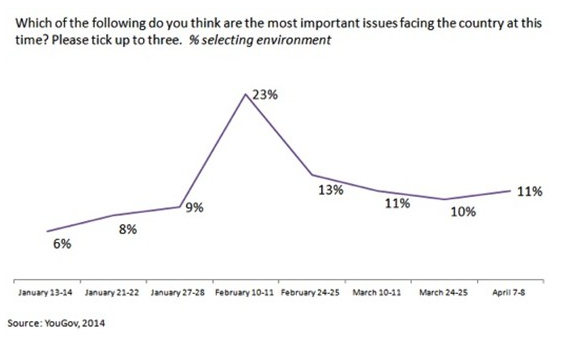
    That didn’t take long. The public interest in the state of the natural world stimulated by the winter floods receded almost as quickly as the waters did. A YouGov poll showed that the number of respondents placing the environment among their top three issues of concern rose from 6% in mid-January to 23% in mid-February. By early April – though the Intergovernmental Panel on Climate Change had just published two massive and horrifying reports – the proportion had fallen back to 11%.

    CarbonBrief has plotted the results on this graph:

    public response to floods

    Sustaining interest in this great but slow-burning crisis is a challenge no one seems to have mastered. Only when the crisis causes or exacerbates an acute disaster – such as the floods – is there a flicker of anxiety, but that quickly dies away.

    Why is it so difficult to persuade people to care about our wonderful planet, the world that gave rise to us and upon which we wholly depend? And why do you encounter a barrage of hostility and denial whenever you attempt it (and not only from the professional liars who are paid by coal and oil and timber companies to sow confusion and channel hatred)?

    The first thing to note, in trying to answer this question, is that the rich anglophone countries are anomalous. In this bar chart (copied from the website of the New York Times) you can see how atypical the attitudes of people in the US and the UK are. Because almost everything we read in this country is published in rich, English-speaking nations, we might get the false impression that the world doesn’t care very much.

    bar chart from New York Times

    This belief is likely to be reinforced by the cherished notion that we lead the world in knowledge, sophistication and compassion. The bar chart puts me in mind of the famous quote perhaps mistakenly attributed to Gandhi. When asked by a journalist during a visit to Britain, “What do you think of Western civilization?”, he’s reputed to have replied, “I think it would be a good idea.”

    Our erroneous belief that we are more concerned about manmade climate change than the people of other nations informs the sentiment, often voiced by the press and politicians, that there’s no point in acting if the rest of the world won’t play its part. For example, last year the Chancellor, George Osborne, remarked:

    “I don’t want us to be the only people out there in front of the rest of the world. I certainly think we shouldn’t be further ahead of our partners in Europe.”

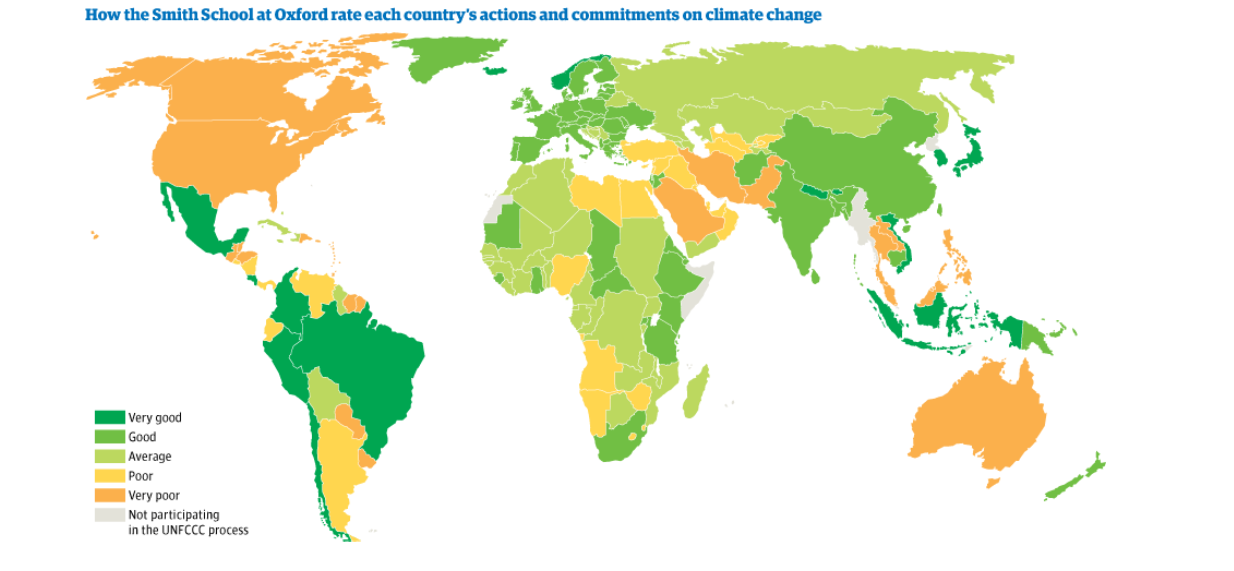
    But we’re not “the only people out there in front of the rest of the world.” In fact we’re not in front at all. As this map produced by Oxford University’s Smith School suggests, we are some way behind not only some other rich nations but also a number of countries much poorer than ours.

    mapping climate change commitments

    As for the US, Australia and Canada, they are ranked among the worst of all: comprehensively failing to limit their massive contribution to a global problem. We justify our foot-dragging with a mistaken premise. Our refusal to stop pumping so much carbon dioxide into the atmosphere is pure selfishness.

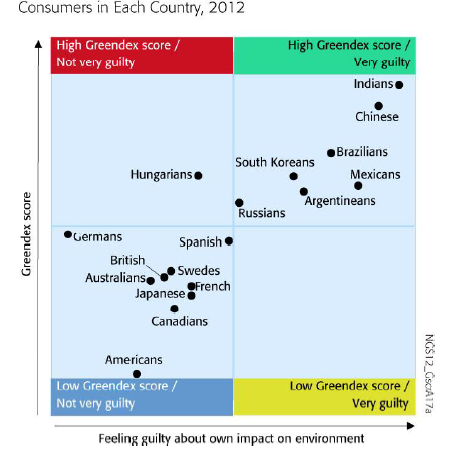
    Both the map and the bar chart overlap to some degree with the fascinating results of the Greendex survey of consumer attitudes.

    For years we’ve been told that people cannot afford to care about the natural world until they become rich; that only economic growth can save the biosphere, that civilisation marches towards enlightenment about our impacts on the living planet. The results suggest the opposite.

    As you can see from the following graph, the people consulted in poorer countries feel, on average, much guiltier about their impacts on the natural world than people in rich countries, even though those impacts tend to be smaller. Of the nations surveyed, the people of Germany, the US, Australia and Britain feel the least consumer guilt; the people of India, China, Mexico and Brazil the most.

    Greendex graph

    The more we consume, the less we feel. And maybe that doesn’t just apply to guilt.

    Perhaps that’s the point of our otherwise-pointless hyperconsumption: it smothers feeling. It might also be the effect of the constant bombardment of advertising and marketing. They seek to replace our attachments to people and place with attachments to objects: attachments which the next round of advertising then breaks in the hope of attaching us to a different set of objects.

    The richer we are and the more we consume, the more self-centred and careless of the lives of others we appear to become. Even if you somehow put aside the direct, physical impacts of rising consumption, it’s hard to understand how anyone could imagine that economic growth is a formula for protecting the planet.

    So what we seem to see here is the turning of a vicious circle. The more harm we do, the less concerned about it we become. And the more hyperconsumerism destroys relationships, communities and the physical fabric of the Earth, the more we try to fill the void in our lives by buying more stuff.

    All this is accompanied in the rich anglophone nations with the extreme neoliberalism promoted by both press and politicians, and a great concentration of power in the hands of the financial and fossil fuel sectors, which lobby hard, in the public sphere and in private, to prevent change.

    So the perennially low level of concern, which flickers upwards momentarily when disaster strikes, then slumps back into the customary stupor, is an almost inevitable result of a society that has become restructured around shopping, fashion, celebrity and an obsession with money. How we break the circle and wake people out of this dreamworld is the question that all those who love the living planet should address. There will be no easy answers.

    www.monbiot.com

  • Govt slams shut door shut on solar farm subsidies and the rest of the week’s news

    Why this ad?
    EnergyAustraliaenergyaustralia.com.au/quote – Great Energy Deals Online. Switch Online. Get a Quote in 30sec

    Govt slams shut door shut on solar farm subsidies and the rest of the week’s news

    Inbox
    x

    Nextgen sq@clickgreen.org.uk via nw005.com

    9:44 PM (17 minutes ago)

    to me
    Web Version | Update your profile | Unsubscribe
    Please add sq@clickgreen.org.uk to your address book to ensure that our emails reach your inbox.
    Govt slams shut door shut on solar farm subsidies and the rest of the week’s news | Update your profile 16 May 2014

    Tell a friend        Subscribe         Contact Us        Print all        Newsletter archive    Nextgen    RSS

    solar-panel-small
    Government slams the door shut on subsidies for solar farms

    Energy Ministers have unveiled yet more changes to the subsidy support it provides to the UK renewable energy industry.

    Read More

    LikeLike | Facebook Twitter LinkedIn Del.icio.us Digg Yammer
    In this issue
    Government slams the door shut on subsidies for solar farms
    Public participation is now critical for renewable energy
    REA Awards 2014
    UK team creates new renewable energy system using industrial gases

    Community green energy schemes blocked by gaps in Govt support

    Renewable energy industry now supports 6.5 million jobs worldwide

    Pioneering energy-generating sail is a step closer to reality

    £15m Anaerobic Digestion plant to help power London on food waste

    “A kick in the teeth”: All the reaction to UK’s solar subsidy cuts

    Warning over solar subsidy cuts – South West could be hardest hit

    DECC defers plans to switch Green Deal costs on to industry

    Shadow Energy Secretary calls for greater focus on green gas

    Ecotricity saves UK small wind firm Evance from closure

    FLI Energy breaks ground on Fraddon biogas project

    British engineering team wins prestigious IEA Heat Pump Award

    Making business more competitive through better energy management

    Fossil fuel-free investment sector grew 50% in the US last year

    Swedish solar energy expert Midsummer reaches new efficiency record for CIGS solar cells

    Mark Group and 4Eco announce partnership deal

    New guide to be released to help wind farms protect bird life

    Trina Solar and vogt solar provide 11.7MW solar energy for Knowlton Court

    Northern Ireland’s Simple Power completes two new wind turbine projects

    E
  • That Amazing ‘Solar Roadways’ Project Has a Working Prototype

    That Amazing ‘Solar Roadways’ Project Has a Working Prototype

    The inventors are looking for $1 million to keep testing technology they claim could power the United States three times

    Image
    Solar Roadways/Indiegogo

    Four years ago, Scott and Julie Brusaw announced their provocative concept of “Solar Roadways,” a system of modular solar panels that could be paved directly onto roads, parking lots, driveways, bike paths, “literally any surface under the sun.” Since then, the Brusaws have received two rounds of funding from the Federal Highway Administration as well as a private grant to develop their project.

    They now have a working prototype featuring hexagonal panels that cover a 12-by-36-foot parking lot. In addition to the potential to power nearby homes, businesses, and electric vehicles, the panels also have heating elements for convenient snow and ice removal, as well as LEDs that can make road signage. According to the Brusaws’ calculations, Solar Roadways, if installed nationwide, could generate over three times the electricity currently used in the United States.

    Concept rendering by Sam Cornett
    Concept rendering by Sam Cornett and Craig Fine 

    Before you ask—the panels have indeed been tested for traction, load testing, and impact resistance. It’s supposed to withstand a 250,000-pound load, typical of the heaviest trucks. For starters, here’s footage of a tractor driving over the prototype.


    In their current Indiegogo campaign, the Brusaws are trying to raise $1 million to help move Solar Roadways into production and start installing additional projects. With the campaign only 8 percent funded so far, their plan faces a long road ahead.

    Here’s the full demo.


  • Global networks and global change-induced tipping points

    cean acidification

    A news stream provided by the Ocean Acidification International Coordination Centre (OA-ICC)

    Global networks and global change-induced tipping points

    Published 15 May 2014 Science Leave a Comment
    Tags: ,

    The existence of “tipping points” in human–environmental systems at multiple scales—such as abrupt negative changes in coral reef ecosystems, “runaway” climate change, and interacting nonlinear “planetary boundaries”—is often viewed as a substantial challenge for governance due to their inherent uncertainty, potential for rapid and large system change, and possible cascading effects on human well-being. Despite an increased scholarly and policy interest in the dynamics of these perceived “tipping points,” institutional and governance scholars have yet to make progress on how to analyze in which ways state and non-state actors attempt to anticipate, respond, and prevent the transgression of “tipping points” at large scales. In this article, we use three cases of global network responses to what we denote as global change-induced “tipping points”—ocean acidification, fisheries collapse, and infectious disease outbreaks. Based on the commonalities in several research streams, we develop four working propositions: information processing and early warning, multilevel and multinetwork responses, diversity in response capacity, and the balance between efficiency and legitimacy. We conclude by proposing a simple framework for the analysis of the interplay between perceived global change-induced “tipping points,” global networks, and international institutions.


    Galaz V., Österblom H., Bodin O. & Crona B., 2014. Global networks and global change-induced tipping points. International Environmental Agreements: Politics, Law and Economics. Article (subscription required).

    Rate this:

    Rate This

    Share this post!

    0 Responses to “Global networks and global change-induced tipping points”

    1. Leave a Comment

    Leave a Reply

    Subscribe to the RSS feed

    Powered by FeedBurner

    Follow AnneMarin on Twitter

    Blog Stats

    • 731,586 hits

    Ocean acidification in the IPCC AR5 WG II

    OUP book

  • Towerless Buoyant Air Turbine May Expand Wind Energy’s Reach


    Towerless Buoyant Air Turbine May Expand Wind Energy’s Reach

    We cover wind turbine news here on a regular basis, but now this excellent renewable technology, currently second only to solar, may be capable of going towerless. Altaeros Energies has developed a promising buoyant air turbine to harness high-altitude winds and deploy low-cost power from them. A group from the Massachusetts Institute of Technology (MIT) formed Altaeros four years ago. The company views its invention as “the next generation of wind power.”

    "The BAT" (Altaeros)Altaeros calls its buoyant air turbine product “The BAT.” The moored silver aircraft is a pilotless cylindrical helium-filled blimp 35 feet in diameter that encases a three-bladed turbine. Like a 20th-century military reconnaissance balloon, the BAT hovers in consistent winds 1,000-2,000 feet aboveground. Its strong tethers transmit wind energy from the turbine to a portable ground station that can be linked to a power grid, local microgrid, or owner equipment. Safety lights and locator beacons serve to warn passing aircraft, although the BAT flies below most federal flight patterns.

    The BAT leverages proven aerospace technology to lift and sustain a wind turbine high aboveground, well beyond the reach of even the most advanced windmill towers. By harnessing five times stronger winds and eliminating the complex logistics of importing traditional renewables to remote areas, the Altaeros BAT drastically reduces the cost of energy generation.


    The buoyant aerial turbine packs into two small shipping containers. It requires no heavy machinery to set up and can be operable in about a day. Setup, remote monitoring, and periodic on-site inspections are the BAT’s only human inputs required. A computer-controlled automated system on the ground can optimize the BAT’s height to accommodate changing winds. Also, the BAT can reel itself down to the ground in severe weather. The Altaeros invention has a better environmental profile than traditional ground turbines because winged creatures don’t usually fly as high as the aeroturbines, although some critics have expressed concerns about the airborne device’s’s rapidly whipping, nearly invisible tethers.

    The buoyant air turbine’s generator can power up to 18 homes. It can enable isolated communities to have electric light and heat at dramatically lower cost than a standard generator used with fossil fuels. Altaeros will partner with the Golden Valley Electric Association in landlocked Fairbanks, Alaska, next year on an 18-month test run.

    “In Alaska, we have a very small electrical grid,” Golden Valley systems manager Paul Morgan told Thom Patterson of CNN. “When people live away from that, they generate their own power in all these villages, and that’s pretty expensive.” Electric power in The Last Frontier can cost ten times the U.S. average, according to The New York Times).

    On the whole, an estimated 1 billion people worldwide–well over 10% of the global population–live in rural areas where electric power is not available. An international economic commission last December pointed out the implications of being powerless:

    “There is a strong nexus between energy and other important development factors such as education, health, gender, environment, economic growth, food security, and water. Sustainable access to modern energy services is a critical input and catalyst for improving the productive capacities and welfare of rural isolated communities, leading to poverty eradication and sustainable development.”

    The UN Secretary-General has made universal access to modern energy services, or “Sustainable Energy for All,” one of the organization’s three main objectives for 2030.

    "The BAT" in a remote location (Altaeros)Importantly, the BAT will also prove useful to industry, government, and institutional groups conducting research and operations in areas out of reach of existing grids; and it may have some applications for telecommunications.

    Other consortia working on designs for aerial wind power generators include Google-owned Makani Power in California, whose lightweight carbon fiber invention looks like a solar airplane, Canadian LTA Windpower, whose PowerShip is a blimp-with-wings construction that runs on hydrogen, and Berlin-based EnerKite, which has designed a huge wind-capturing mono-wing and expects to start sales in 2016.

    Mike Barnard, Wind Senior Fellow at the Energy and Policy Institute, provided an excellent in-depth review for CleanTechnica in March of airborne wind energy devices. His technically astute article finds the Altaeros candidate tied for second place in terms of overall viability. However, Barnard questions the viability of airborne wind generation systems in general as opposed to ground-based solutions (using the metaphor of the platypus versus the cheetah) and cites the lack of working projects. Altaeros may provide the first of these. Barnard does not address the economics of the alternatives, the viability of this technology in isolated or brownfield situations, or its undeniable attractiveness in remote and poverty-stricken areas unserved by the grid.

    Google+