Category: Uncategorized

  • The ‘Unstable’ West Antarctic Ice Sheet: A Primer

    News and Features

    Share this page: Print this page Email this page Post this page to your Facebook wall Tweet this page

    The ‘Unstable’ West Antarctic Ice Sheet: A Primer

    Although the Amundsen Bay region is only a fraction of the whole West Antarctic Ice Sheet Although the Amundsen Sea region is only a fraction of the whole West Antarctic Ice Sheet, the region contains enough ice to raise global sea levels by 4 feet (1.2 meters). Image credit: NASA/GSFC/SVS
    › Larger image

    • submit to reddit
    • 4
    •  1933

    May 12, 2014

    The new finding that the eventual loss of a major section of West Antarctica’s ice sheet “appears unstoppable” was not completely unexpected by scientists who study this area. The study, led by glaciologist Eric Rignot at NASA’s Jet Propulsion Laboratory, Pasadena, California, and the University of California, Irvine, follows decades of research and theory suggesting the West Antarctic Ice Sheet is inherently vulnerable to change.

    Antarctica is so harsh and remote that scientists only began true investigation of its ice sheet in the 1950s. It didn’t take long for the verdict on the West Antarctic Ice Sheet to come in. “Unstable,” wrote Ohio State University glaciologist John Mercer in 1968. It was identified then and remains today the single largest threat of rapid sea level rise.

    Why is West Antarctica’s ice sheet considered “unstable”?

    The defining characteristic of West Antarctica is that the majority of the ice sheet is “grounded” on a bed that lies below sea level.

    In his 1968 paper, Mercer called the West Antarctic Ice Sheet a “uniquely vulnerable and unstable body of ice.” Mercer based his statement on geologic evidence that West Antarctica’s ice had changed considerably many, many millennia ago at times when the ice sheets of East Antarctica and Greenland had not.

    In 1973, University of Maine researcher Terry Hughes asked the question that scientists continue to investigate today. The title of his paper: “Is The West Antarctic Ice Sheet Disintegrating?” In 1981, Hughes published a closer look at the Amundsen Sea region specifically. He called it “the weak underbelly of the West Antarctic ice sheet.”

    Here’s the cause for concern: When the ice sheet is attached to a bed below sea level, ocean currents can deliver warm water to glacier grounding lines, the location where the ice attaches to the bed.

    Scientists recognized that this is the first step in a potential chain reaction. Ocean heat eats away at the ice, the grounding line retreats inland and ice shelves lose mass. When ice shelves lose mass, they lose the ability to hold back inland glaciers from their march to the sea, meaning those glaciers can accelerate and thin as a result of the acceleration. This thinning is only conducive to more grounding line retreat, more acceleration and more thinning. In this equation, more ice flows to sea every year and sea level rises.

    But that’s not all.

    Beginning with research flights in the 1960s that made radar measurements over West Antarctica, scientists began to understand that, inland of the ice sheet’s edge, the bed slopes downward, precipitously, in some cases.

    This downward, inland slope was theorized decades ago, but has been confirmed and mapped in detail in recent years by airborne campaigns such as NASA’s Operation IceBridge. In some spots the bed lies more than a mile and a half below sea level. The shape of this slope means that when grounding lines start to retreat, ocean water can infiltrate between the ice and the bed and cause the ice sheet to float off its grounding line.

    Why is the Amundsen Sea region more at risk than other parts of West Antarctica?

    In addition to the ice sheet being grounded below sea level, there are three main reasons. First, the glaciers here lack very large ice shelves to stem ice flow. Second, they aren’t “pinned” by obstructions in their beds except in a few small places, unlike the Ronne and Ross shelves which are pinned down by large islands. Third, as first observed in the 1990s, the area is vulnerable to a regional ocean current, ushered in by the shape of the sea floor and the proximity of the circumpolar deep current. This current delivers warm water to grounding lines and the undersides of ice shelves in the region.

    The pace and magnitude of the changes observed in this region match the expectation that Amundsen Sea embayment glaciers should be less stable than others. In some cases, the changes have outstripped expectations.

    Pine Island and Thwaites glaciers have experienced significant flow acceleration since the 1970s. Both saw the center of their grounding lines retreat dramatically. From 1992 to 2011, Pine Island’s grounding line retreated by 19 miles (31 kilometers) while the center of the Thwaites grounding line retreated by nearly 9 miles (14 kilometers). Annual ice discharge from this region as a whole has increased 77 percent since 1973.

    What would a loss of the Amundsen Sea region mean for sea level rise?

    Even as Rignot and colleagues suggest that loss of the Amundsen Sea embayment glaciers appears inevitable, it remains extremely difficult to predict exactly how this ice loss will unfold and how long it will take. A conservative estimate is that it could take several centuries.

    The region contains enough ice to raise global sea levels by 4 feet (1.2 meters). The most recent U.N. Intergovernmental Panel on Climate Change (IPCC) report estimates that by 2100, sea level will rise somewhere from just less than 1 foot to about 3 feet (26 to 98 centimeters). But the vast majority of these projections do not take into account the possibility of major ice loss in Antarctica. Rignot said this new study suggests sea level rise projections for this century should lean toward the high-end of the IPCC range.

    The Amundsen Sea region is only a fraction of the whole West Antarctic Ice Sheet, which if melted completely would raise global sea level by about 16 feet (5 meters).

    What are NASA and other science agencies doing to better understand this vulnerable region and its potential impact on global sea level?

    To better understand how this section of the ice sheet has changed in recent decades, scientists from NASA and research institutions around the world have made field campaigns to the region and used every airborne and spaceborne tool at their disposal, including NASA satellites and those launched by space agencies in Europe, Japan and Canada.

    The National Science Foundation has funded major field campaigns to West Antarctica, including POLENET, which place Global Positioning System (GPS) stations in the area to measure geological changes. A campaign to the Pine Island Glacier ice shelf led by NASA glaciologist Bob Bindschadler measured variables such as water temperature and melting rate at the underside of the ice shelf.

    NASA’s Operation IceBridge, which began in 2009, continues to fly one extended research campaign over Antarctica each year. IceBridge flights put multiple scientific instruments over key regions of the ice sheet to measure glacier thinning, the shape of the bed and other factors.

    In 2017, NASA will launch ICESat-2, the follow-up mission to ICESat, which operated from 2003 to 2009. ICESat-2 will use laser altimetry to make precise measurements of glacier heights. Combined with the ICESat and IceBridge data records, the ICESat-2 measurements will allow for a continuous record of year-over-year change in some of the most remote regions of the world.

  • California mountains rise as groundwater depleted in state’s Central Valley: May trigger small earthquakes

    Featured Research

    from universities, journals, and other organizations

    California mountains rise as groundwater depleted in state’s Central Valley: May trigger small earthquakes

    Date:
    May 14, 2014
    Source:
    University of California – Berkeley
    Summary:
    The weight of water pumped from California’s agricultural heartland, the Central Valley, over the past 150 years is enough to allow Earth’s crust to rebound upward, raising surrounding mountain ranges, the Sierra Nevada and Coast Ranges, some six inches. Winter rains and summer pumping cause annual up and down movements that could affect earthquakes on the San Andreas Fault, which parallels the ranges.

    GPS measurements show that the Sierra Nevada and Coast Ranges rise several millimeters per year (red dots) as a result of groundwater pumping in the Central Valley (brown). Blue dots are sites where the ground has subsided.
    Credit: Image courtesy of UC Berkeley

    Winter rains and summer groundwater pumping in California’s Central Valley make the Sierra Nevada and Coast Ranges sink and rise by a few millimeters each year, creating stress on the state’s earthquake faults that could increase the risk of a quake.

    Gradual depletion of the Central Valley aquifer because of groundwater pumping also raises these mountain ranges by a similar amount each year — about the thickness of a dime — with a cumulative rise over the past 150 years of up to 15 centimeters (6 inches), according to calculations by a team of geophysicists.

    While the seasonal changes in the Central Valley aquifer have not yet been firmly associated with any earthquakes, studies have shown that similar levels of periodic stress, such as that caused by the motions of the moon and sun, increase the number of microquakes on the San Andreas Fault, which runs parallel to the mountain ranges. If these subtle seasonal load changes are capable of influencing the occurrence of microquakes, it is possible that they can sometimes also trigger a larger event, said Roland Bürgmann, UC Berkeley professor of earth and planetary science at UC Berkeley.

    “The stress is very small, much less than you need to build up stress on a fault toward an earthquake, but in some circumstances such small stress changes can be the straw that broke the camel’s back; it could just give that extra push to get a fault to fail,” Bürgmann said.

    Bürgmann is a coauthor of a report published online this week by the journal Nature. The study, based on detailed global positioning satellite (GPS) measurements from California and Nevada between 2007 and 2010, was led by former UC Berkeley postdoctoral fellows Colin Amos, now at Western Washington University, and Pascal Audet, now of the University of Ottawa. The detailed GPS analysis was performed by William C. Hammond and Geoffrey Blewitt of the University of Nevada, Reno.

    Draining of Central Valley

    Water has been pumped from California’s Central Valley for more than 150 years, reducing what used to be a marsh and extensive lake, Tulare Lake, into fertile agricultural fields that feed the world. In that time, approximately 160 cubic kilometers (40 cubic miles) of water was removed — the capacity of Lake Tahoe — dropping the water table in some areas more than 120 meters (400 feet) and the ground surface 5 meters (16 feet) or more.

    The weight of water removed allowed the underlying crust or lithosphere to rise by so-called isostatic rebound, which has raised the Sierra probably as much as half a foot since about 1860, Bürgmann said.

    The same rebound happens as a result of the state’s seasonal rains. Torrential winter storms drop water and snow across the state, which eventually flow into Central Valley streams, reservoirs and underground aquifer, pushing down the crust and lowering the Sierra 1-3 millimeters. In the summer, water flow through the delta into the Pacific Ocean, evaporation and ground water pumping for irrigation, which has accelerated in the past few years because of a drought, allows the crust and surrounding mountains to rise again.

    Bürgmann said that the flexing of Earth’s crust downward in winter would clamp the San Andreas Fault tighter, lowering the risk of quakes, while in summer the upward flexure would relieve this clamping and perhaps increase the risk.

    “The hazard is ever so slightly higher in the summer than in the wintertime,” he said. “This suggests that climate and tectonics interact; that water changes ultimately affect the deeper Earth too.”

    High-resolution mapping with continuous GPS

    Millimeter-precision measurements of elevation have been possible only in the last few years, with improved continuous GPS networks — part of the National Science Foundation-funded Plate Boundary Observatory, which operates 1,100 stations around the western U.S. — and satellite-based interferometric synthetic aperture radar (InSAR). Synthetic aperture radar is a form of radar in which phase information is used to map elevation.

    These measurements revealed a steady yearly rise of the Sierra of 1-2 millimeters per year, which was initially ascribed to tectonic activity deep underground, even though the rate was unusually high, Bürgmann said. The new study provides an alternative and more reasonable explanation for the rise of the Sierra in historic times.

    “The Coast Range is doing the same thing as the Sierra Nevada, which is part of the evidence that this can’t be explained by tectonics,” he said. “Both ranges have uplifted over the last few years and they both exhibit the same seasonal up and down movement in phase. This tells us that something has to be driving the system at a seasonal and long-term sense, and that has to be groundwater recharging and depletion.”

    In response to the current drought, about 30 cubic kilometers (7.5 cubic miles) of water were removed from Central Valley aquifers between 2003 and 2010, causing a rise of about 10 millimeters (2/5 inch) in the Sierra over that time.

    After the new results were shared with colleagues, Bürgmann said, some geologists suggested that the state could get a better or at least comparable inventory of available water each year by using GPS to measure ground deformation instead of measuring snowpack and reservoir levels.

    Other coauthors are Colin B. Amos of Western Washington University in Bellingham, Ingrid A. Johanson of UC Berkeley. Funding for the research came from NSF EarthScope and UC Berkeley’s Miller Institute.


    Story Source:

    The above story is based on materials provided by University of California – Berkeley. The original article was written by Robert Sanders. Note: Materials may be edited for content and length.


    Journal Reference:

    1. Colin B. Amos, Pascal Audet, William C. Hammond, Roland Bürgmann, Ingrid A. Johanson, Geoffrey Blewitt. Uplift and seismicity driven by groundwater depletion in central California. Nature, 2014; DOI: 10.1038/nature13275

    Cite This Page:

    University of California – Berkeley. “California mountains rise as groundwater depleted in state’s Central Valley: May trigger small earthquakes.” ScienceDaily. ScienceDaily, 14 May 2014. <www.sciencedaily.com/releases/2014/05/140514133440.htm>.

  • IPCC reports ‘diluted’ under ‘political pressure’ to protect fossil fuel interests

    IPCC reports ‘diluted’ under ‘political pressure’ to protect fossil fuel interests

    Saudi-led coalition sought to make policy summaries as vague as possible to minimise climate action
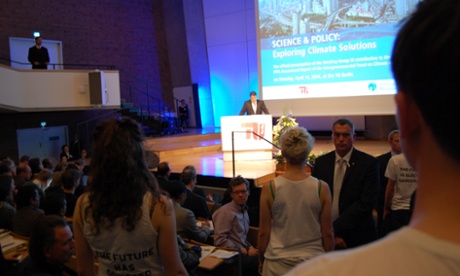
    Berlin: April 14th 2014. Sigmar Gabriel speaking at the IPCC WG3 briefing. Future protestors watch him in silence.

    Berlin: April 14th 2014. Sigmar Gabriel speaking at the IPCC WG3 briefing. ‘TheFuture.net’ protestors watch him in silence.

    Increasing evidence is emerging that the policy summaries on climate impacts and mitigation by the UN Intergovernment Panel on Climate Change (IPCC) were significantly ‘diluted’ under political pressure from some of the world’s biggest greenhouse gas emitters, including Saudi Arabia, China, Brazil and the United States.

    Several experts familiar with the IPCC government approval process for the ‘Summary for Policymakers’ (SPM) reports – documents summarising the thousands of pages of technical and scientific reports for government officials – have spoken out about their distortion due to political interests.

    According to David Wasdell, who leads on feedback dynamics in coupled complex global systems for the European Commission’s Global System Dynamics and Policy (GSDP) network, “Every word and line of the text previously submitted by the scientific community was examined and amended until it could be endorsed unanimously by the political representatives.”

    In a detailed paper critiquing the WG1 Summary for Policymakers, Wasdell revealed that:

    “Greatest pressure to establish grounds for the highest possible budget came from those countries whose national economy, political power and social stability depend on sustaining the asset value and production revenue derived from exploitation of their resources of fossil energy. Additional pressure was applied to the political agents by those vested interests whose sustained profitability was based on the extraction, refining, marketing and use of fossil energy as the ground of the global economy.”

    As an accredited reviewer for the IPCC’s 2007 Fourth Assessment Report, Wasdell had previously criticised the political approval process for playing down amplifying feedbacks which could accelerate climate change. That charge was strongly denied by the IPCC’s lead authors at the time, although political interference amounting to “scientific vandalism” was alleged by other sources.

    Wasdell told me that scientists familiar with the political approval process in Stockholm for the new WG1 Summary for Policymakers – including WG1 co-chair Prof Thomas Stocker who had signed the 2007 rejoinder to Wasdell – had confirmed that governments fought to amend text that would damage their perceived interests. His paper says:

    “… the objections were led by Saudi Arabia, strongly supported by China, and associated with an emerging group of ‘like-minded nations.’ The impasse was broken following suggested modifications of both text and diagram provided by the representatives of the USA. The resulting compromise safeguards the vested interests of global dependency on fossil sources of energy, while constraining the capacity of the international community to take any effective action to deal with the threat of dangerous climate change.”

    WG1 co-chair Prof Thomas Stocker, however, denied any knowledge of such political pressure, describing these allegations as “not correct for WG1.” He conceded that “the situation is different” for WG2 and WG3.

    Wasdell said that the draft submitted by scientists contained a metric projecting cumulative total anthropogenic carbon dioxide emissions, on the basis of which a ‘carbon budget’ was estimated – the quantity of carbon that could be safely emitted without breaching the 2 degrees Celsius limit to avoid dangerous global warming. He said that the final version approved by governments significantly amended the original metric to increase the amount of carbon that could still be emitted.

    The total carbon budget according to this estimate is about 1,000 gigatonnes of carbon (GtC) – although over 531 GtC was emitted already by 2011, leaving 469 GtC left. Applying the “corrected non-linear function” reduces this available budget to just “280 GtC” – this figure does not account for the role of greenhouse gases other than CO2, including the potential impact of thawing permafrost or methane hydrates.

    If included, they would reduce the budget even further. Current emissions reduction pledges, therefore, still guarantee disaster. His paper reads:

    “… present levels of international contribution towards the reduction of emissions still led to a cumulative total of 2000 GtC by the year 2100. That left an emissions reduction gap of some 1097 GtC between promised reductions and the 903 GtC required to prevent temperature increase exceeding the policy goal of 2°C.”

    Wasdell thus told me:

    “The summary for policymakers is a document of appeasement, not fit for purpose. In reality, if my calculations are correct, we not only don’t have much of a carbon budget left, we have already overshot that budget – we’re in overdraft.”

    Wasdell’s claims about the politicisation of the IPCC’s summary reports for policymakers are corroborated by other scientists.

    In a letter addressed to senior IPCC chairs dated 17th April, Prof Robert Stavins – a lead author for the IPCC’s Working Group 3 focusing on climate mitigation – complained of his “frustration” that the government approval process “built political credibility by sacrificing scientific integrity.” His critique was, however, widely misrepresented by climate deniers as proving that the IPCC’s scientific verdict about the dangers of global warming are too alarmist.

    Leading the pack, Daily Mail reporter David Rose attempted to equate Stavins’ concerns with those of economist Richard Tol, who withdrew “from the summary of an earlier volume of the full IPCC report, on the grounds it had been ‘sexed up’ by the same government officials and had become overly ‘alarmist.’”

    Yet as noted by Dimitri Zenghelis, principal research fellow at the London School of Economics Grantham Research Institute on Climate Change and the Environment, Tol’s claims about IPCC alarmism are riddled with “significant errors and misrepresentations,” “selective” and “misleading” quoting, and based on his own paper containing “a number of mistakes”, as well as a “fundamentally flawed” understanding of “the risks of climate change.”

    The IPCC’s assessments of the potential costs of climate change “is probably an underestimate,” argued Zenghelis, “because it omits consideration of many of the impacts of climate change, including potentially catastrophic risks.”

    Prof Stavins himself dismissed the denialist “fringe elements of the press and blogosphere” which “capitalised on the situation by distorting the message of my original post to meet their own objectives.”

    “My expressed concerns,” Stavins told me, “were about the government approval process of one section on international cooperation of the Working Group 3 Summary for Policymakers.” He emphasised: “My remarks did not include any comments on and have no implications regarding the integrity of climate science.” Rather, government representatives in Berlin sought to “protect their respective countries’ interests by minimising text that could be perceived to be inconsistent with their negotiating positions.”

    Stavins’ remarks were also backed up by Oxford University’s Prof John Broome, a IPCC WG3 lead author:

    “At our IPCC meeting, they treated the SPM as though it were a legal document rather than a scientific report. To achieve consensus, the text of the SPM was made vaguer in many places, and its content diluted to the extent that in some places not much substance remained.”

    Far from being too alarmist, these criticisms suggest that the IPCC’s summary reports are too conservative. Like Wasdell, Broome describes how “a coalition of countries led by Saudi Arabia” at the April approval session in Berlin “insisted” that all “figures” depicting increases of greenhouse gas emissions in countries classified by ‘income group’ “should be deleted.”

    Saudi Arabia, he said, also “wanted to delete all references to any part of the main report that mentioned income groups… in the end Saudi Arabia got its way

    close

    May 2014 Previous
    M T W T F S S
    28 29 30 1 2 3 4
    5 6 7 8 9 10 11
    12 13 14 15 16 17 18
    19 20 21 22 23 24 25
    26 27 28 29 30 31
  • Research Suggests Climate Change Affecting Seasons

    Site » News stories

    News

    Research Suggests Climate Change Affecting Seasons

    01.04.2014

    01.04.2014 17:54 Age: 43 days

    Autumn is ending later and Spring is starting earlier in the northern hemisphere, according to new research.


    A study by the University of Southampton suggests that on average the end of Autumn is taking place later in the year and Spring is starting slightly earlier.

    A team of researchers examined satellite imagery covering the northern hemisphere over a 25 year period (1982 – 2006), and looked for any seasonal changes in vegetation by making a measure of its ‘greenness’. They examined in detail, at daily intervals, the growth cycle of the vegetation – identifying physical changes such as leaf cover, colour and growth.

    The project was led by University of Southampton Professor of Geography Peter Atkinson, who worked with his colleague Dr Jadunandan Dash and in collaboration with Professor Jeganathan Chockalingam from the Department of Remote Sensing at the Birla Institute of Technology in India.

    Professor Atkinson says: “There is much speculation about whether our seasons are changing and if so, whether this is linked to climate change. Our study is another significant piece in the puzzle, which may ultimately answer this question.”

    The team was able to examine the data for specific vegetation types: ‘mosaic’ vegetation (grassland, shrubland, forest and cropland); broad-leaved deciduous forest; needle-leaved evergreen forest; needle-leaved deciduous and evergreen forest; mixed broad-leaved and needle-leaved forest; and mixed-forest, shrubland and grassland. They analysed data across all the groups, recognising that forests which have not changed size due to human intervention, for example through forestry or farming, provide the most reliable information on vegetation response to changes in our climate.

    The most pronounced change found by the researchers was in the broad-leaved deciduous and needleleaved deciduous forest groups, showing that Autumn is becoming significantly later. This delay in the signs of Autumn was generally more pronounced than any evidence for an earlier onset of Spring, although there is evidence across the groups that Spring is arriving slightly earlier.

    Professor Peter Atkinson comments: “Previous studies have reported trends in the start of Spring and end of Autumn, but we have studied a longer time period and controlled for forest loss and vegetation type, making our study more rigorous and with a greater degree of accuracy.

    “Our research shows that even when we control for land cover changes across the globe a changing climate is significantly altering the vegetation growth cycles for certain types of vegetation. Such changes may have consequences for the sustainability of the plants themselves, as well as species which depend on them, and ultimately the climate through changes to the carbon cycle.”

    The study used the Global Inventory Modelling and Mapping Studies (GIMMS) dataset and combined satellite imagery with an innovative data processing method to study vegetation cycles.

    Highlights

    Remote Sensing Of The Environment lists the highlights of this research as follows:

    Terrestrial vegetation phenology above 45°N was analysed using remote sensing data.

    Trends in vegetation phenology were analysed, controlling for land cover changes.

    Latitudes 55°N to 65°N experienced the greatest changes in vegetation phenology.

    Needle leaf deciduous vegetation had the maximum decrease in SOS (− 1.07 days yr− 1).

    Broad leaf deciduous vegetation had the maximum delay in EOS (+ 1.06 days yr− 1).

    Abstract

    Trends in the start or end of growing season (SOS, EOS) of terrestrial vegetation reported previously as latitudinal averages limit the ability to investigate the effects of land cover change and species-wise conditioning on the presented vegetation phenology information. The current research provided more reliable estimates of the trends in the annual growth pattern of terrestrial vegetation occurring at latitudes greater than 45°N. 25 years of satellite-derived Normalised Difference Vegetation Index (GIMMS NDVI) was used and reliable vegetated pixels were analysed to derive the SOS and EOS. The rate of change in SOS and EOS over 25 years was estimated, aggregated and scrutinised at different measurement levels: a) vegetation type, b) percentage vegetative cover, c) core area, d) percentage forest cover loss, and e) latitude zones. The research presents renewed and detailed estimates of the trends in these phenology parameters in these strata. In the > 45°N zone, when only reliable pixels were considered, there was an advancement of − 0.58 days yr− 1 in SOS and a delay of + 0.64 days yr− 1 in EOS. For homogeneous vegetated areas (91–100% cover at 8 km spatial resolution) the 55–65°N zone showed the maximum change with − 1.07 days yr− 1 advancement in SOS for needle leaved deciduous vegetation, and − 1.06 days yr− 1 delay in EOS for broad leaved deciduous vegetation. Overall, the increasing trend in EOS during senescence (September to November) was greater in magnitude than the decreasing trend in SOS during spring (March to May) and the change in EOS was more consistent and greater than that in SOS.

    Citation

    Remotely sensed trends in the phenology of northern high latitude terrestrial vegetation, controlling for land cover change and vegetation type by C. Jeganathan, J. Dash, P.M. Atkinson published in Remote Sensing of Environment Volume 143, 5 March 2014, Pages 154–170. DOI: 10.1016/j.rse.2013.11.020

    Read the abstract and get the paper here.

    Source

    University of Southampton news release here.


  • Scientists Fear Massive Sea Level Rise from “Unstoppable” Melt of West Antarctica Ice Sheet

    Tue, 2014-05-13 11:14Chris Rose

    Chris Rose's picture

    Scientists Fear Massive Sea Level Rise from “Unstoppable” Melt of West Antarctica Ice Sheet

    Comment on this StoryEmail this story
    thwaites glacier, west antarctic ice melt, nasa, climate change

    Two new academic studies released Monday reveal that the crucial West Antarctic ice sheet is now melting, a seemingly unstoppable disaster that could eventually trigger sea levels to rise by more than 14 feet (4.3 metres).

    The studies could finally make politicians rethink how climate change is affecting humankind and how society is going to deal with the increasingly expensive cost of mitigating climate change caused by burning fossil fuels overheating our atmosphere.

    One of the studies indicates the glaciers in the Amundsen Sea sector of West Antarctica “have passed the point of no return,” according to glaciologist and lead author Eric Rignot, of UC Irvine and NASA’s Jet Propulsion Laboratory in California. The new study has been accepted for publication in the journal Geophysical Research Letters.

    NASA says the glaciers already contribute significantly to sea level rise, releasing almost as much ice into the ocean annually as the entire Greenland ice sheet. “They contain enough ice to raise global sea level by four feet (1.2 metres) and are melting faster than most scientists had expected,” according to a press release.

    Greenland and Antarctic ice sheets. Image Credit: NASA

    “The collapse of this sector of West Antarctica appears to be unstoppable,” Rignot was quoted as saying. “The fact that the retreat is happening simultaneously over a large sector suggests it was triggered by a common cause, such as an increase in the amount of ocean heat beneath the floating sections of the glaciers. At this point, the end of this sector appears to be inevitable.”

    Image from NASA’s “The Unstable West Antarctic Ice Sheet: A Primer.”

    The other study, conducted by University of Washington researchers, also shows the collapse of the West Antarctic ice sheet appears to have already begun. “The fast-moving Thwaites Glacier will likely disappear in a matter of centuries, researchers say, raising sea level by nearly two feet,” according to a media release.

    “That glacier also acts as a linchpin on the rest of the ice sheet, which contains enough ice to cause another 10 to 13 feet (three to four metres) of global sea level rise. The study is to be published in Science.”

    Lead author Ian Joughin, a glaciologist at the UW’s Applied Physics Laboratory, said scientists looking at ice thinning previously didn’t know how fast the glacier would melt. “In our model simulations it looks like all the feedbacks tend to point toward it actually accelerating over time; there’s no real stabilizing mechanism we can see,” Joughin said.

    “All of our simulations show it will retreat at less than a millimeter of sea level rise per year for a couple of hundred years, and then, boom, it just starts to really go,” Joughin said.

    The studies suggest the ice sheet won’t totally melt for between 200 and 1,000 years, as they aren’t currently sure of the pace of melting, but they say the accompanying sea level rise is inevitable.

    West Antarctica bed topography. Areas colored brown are below sea level. Sea level itself is colored yellow, and green areas are above sea level. Image credit: NASA/GSFC/SVS

    And while scientists have been warning about the possibility of the West Antarctic ice sheet melting for years, the studies released Monday suggest that human-induced climate change is indeed redefining our world.

    The two studies come just a week after an alarming U.S. National Climate Assessment report noted climate change is already occurring in every region of America and a month after the Intergovernmental Panel on Climate Change said global emissions of greenhouse gases have risen to unprecedented levels.

    Together the recent reports could force politicians, engineers, money markets, health planners, military leaders and insurance companies to more aggressively embrace climate change as humankind’s most pressing issue.

    Ironically, as sea levels rise, offshore oil exploration platforms and drilling rigs — one of the most high-profile symbols of society’s addiction to fossil fuels — will also have to deal with problems associated with higher seas. But almost certainly the most negatively affected will be the more than a billion people estimated to live along low-lying coastlines, some of which will most likely be abandoned over time.

    Image Credit: Thwaites Glacier, NASA

  • A note on ‘Collapse’

    A note on ‘Collapse’

    There is a lot in the media at the moment about the ‘collapse’ of the West Antarctic Ice Sheet. See my previous blog post for more information. But when we talk about ‘ice sheet collapse’, what do we actually mean? When we talk of people ‘collapsing’, they fall down right in front of us in the street. Buildings collapse. Bridges collapse. It’s a very bad thing. Right?

    Collapse: rapid, irreversible recession

    When scientists talk about the ‘collapse’ of an ice sheet, they mean irreversible, rapidly increased rates of recession. The rates at which the grounding lines of the ice streams recede will increase. It’s a positive feedback cycle, a viscious loop that means that future recession of the ice stream is inevitable (see Marine Ice Sheet Instability and previous post). Given that Pine Island Glacier has a sea-level equivalent of 1.5 m and the West Antarctic Ice Sheet a sea level equivalent of 3.3 m1, this is something to be concerned about. The entire recession of the ice stream will still take centuries, but this is very difficult to model and there are huge uncertainty ranges with many unknown parameters.

    Floating ice shelves have also been discussed using terms like ‘collapse’. Here, the ice shelves are thinned for decades from warm water from below, leaving them vulnerable during warm summers when melt water ponds on their surface. This can lead to rapid iceberg production and fragmentation and distintegration of the floating ice shelf over the course of weeks. This can have long-term consequences, as the tributary glaciers accelerate, thin and recede in response to their changed boundary conditions. Ice shelves ‘hold back’ or buttress these tributary glaciers, and once they’re gone, the glacier is destabilised and must find a new equilibrium. This adjustment can take decades, as we’ve observed on the Antarctic Peninsula.

    Ice-stream collapse in West Antarctica

    Mouginot and colleagues found that ice streams in West Antarctica are accelerating, with a sustained increase in ice discharge2. Ian Joughin and colleagues also suggested that Thwaites Glacier may be in the early stages of irreversible recession, but we are still some way from passing a threshold that resulted in dramatically higher rates of recession. They suggested that we are heading inexorably towards this threshold, which could be passed anytime in the next 250-900 years3 (we’re heading towards 250 years at the moment). Future modelling efforts will reduce the timescale range, and the rates of ice-sheet recession that will occur once this threshold has been passed. This work is not unprecedented, and follows decades of work and several recent papers discussing marine ice sheet instability in West Antarctica (e.g., references 4, 5, 6).

    Ice streams of Antarctica with Pine Island Glacier and Thwaites glacier highlighted.

    Ice streams of Antarctica with Pine Island Glacier and Thwaites glacier highlighted.

    ‘Collapse’ is slow

    But the West Antarctic Ice Sheet will be with us for some time yet. The West Antarctic Ice Sheet is not going to melt away tonight, this decade, this century or even next century. But this work is certainly alarming; the IPCC did not include ice dynamical changes such as these in their future sea level predictions. This research indicates that rates of sea level rise over the next few centuries could be very rapid. London is unlikely to flood anytime soon, but small changes in sea level exacerbate storm surges, increase coastal erosion, and flood low-lying areas in places without barrages like London. Future generations will face significant challenges associated with sea level rise. We should be concerned about this, and we should try and consider ways in which we can reduce the melting of these ice streams. That means combating climate change.

    A better word for collapse?

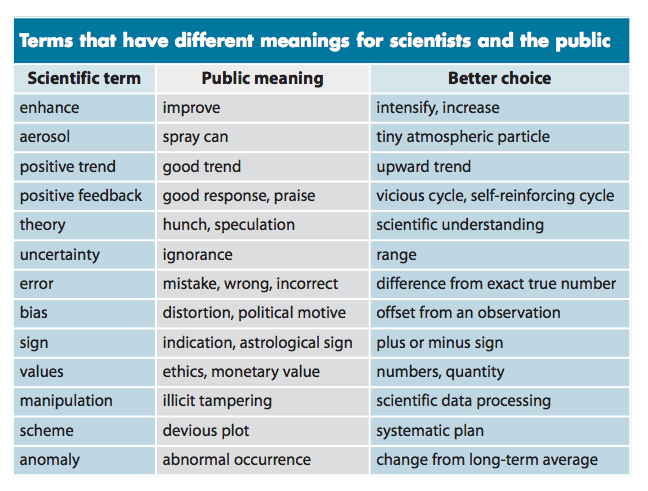
    This post brings to mind the work of Somerville and Hassol7, who suggested a series of words that could be better used for science communication. I include their table below. Perhaps we should find a better word for ‘collapse’. ‘Irreversible melt’? ‘Irreversible decline’? ‘Rapid, irreversible recession’? It just doesn’t have the same ring. Any other suggestions? Answers in the comments.

    Table from Somerville and Hassol, 2011. What scientists say, and what they mean.