Category: Uncategorized

  • Warm Winds Gather to Invade the Arctic: Summer Sea Ice Melt and The Storms of 2014

    robertscribbler

    Scribbling for economic, social and environmental justice

    Warm Winds Gather to Invade the Arctic: Summer Sea Ice Melt and The Storms of 2014

    If there’s an aspect of global warming science that remains unsettled, it’s the general state of prediction and analysis over the fate of Northern Hemisphere sea ice. As is well known by now, model predictions greatly underestimated the pace of sea ice loss as a response to human-caused warming. Big melt years like 2007 and 2012 brought sea ice extent and area, by end 2012, to less than 50% of 1979 values. Sea ice volume for the same period was nearly 80% lower than 1979 measures. Such lows were generally not predicted to appear until the 2060s at the earliest.

    Ice response to rapid human warming and polar amplification, in these cases, was, for lack of a better description, outrageously stunning. And the weather impacts of such amazing losses were increasingly dangerous and far-reaching. Climate systems inertia, in the case of sea ice, seemed to be no match at all for the strong and likely unprecedented warming forces we’d already unleashed.

    Sifting through the sea ice tea leaves

    Though much of what happened was and continues to be unexpected, a few overall patterns emerge in the data. Dynamic melt trends for area and extent were composed of massive melt years (2007 and 2012) followed by pseudo recovery years (2008, 2013) where the ice seemed to bounce back a little before inching again toward previous record lows (2009, 2010) or setting minor new melt records (2011 area) before the next big hit.

    Sea ice volume measures were somewhat less messy with massive melt years (2007, 2010), more minor melt years (2011, 2012), one minor pseudo-recovery year (2008) and one major pseudo-recovery year (2013). In this set, one year (2009) stands out as neither showing a new record low volume nor showing pseudo-recovery as end season volume fell off slightly from the previous year. The fact that 2009 followed a pseudo-recovery year (2008) may or may not be instructive for the current melt season.

    It is worth noting that in the volume progression, four out of seven years during the 2007 to 2013 period all showed new record lows.
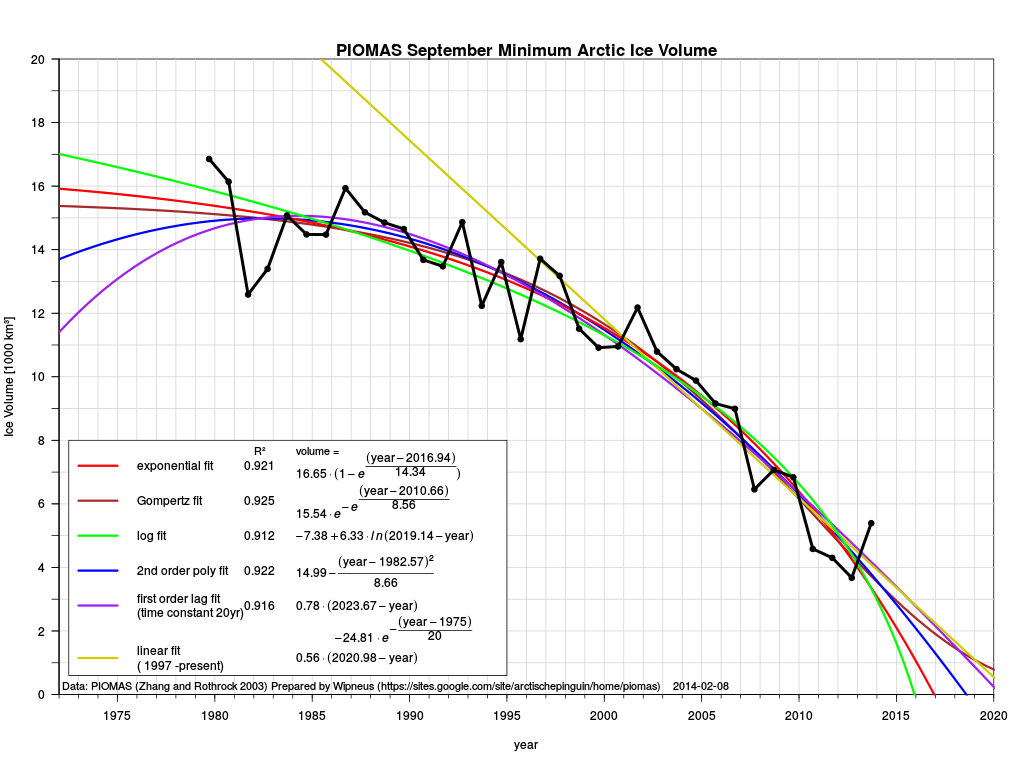
    Piomas Minimum Arctic Ice Volume

    (Graph of minimum Arctic sea ice volume as measured by PIOMAS since 1979 with various trend line projections. Data source: PIOMAS Image source: Wipneus.)

    What one can read from these data points is that strong pseudo-recovery years (like 2013 and 2008) have typically been followed in recent years by a return to the decline trend but not to new record lows. So, statistically, this is what we would expect for 2014.

    That said, keep in mind that though it remains extraordinarily difficult to predict end sea ice states for any single year, the overall trend of major and unprecedented melt is most likely to continue and the window for a total sea ice loss by end season before 2020 remains wide open. Further, statistical analysis will, in every case, bow to emerging conditions on and beneath the ice.

    Evolution of the early 2014 melt season

    For the 2014 melt season, the fickle Arctic does not at all disappoint. By late April and early May of 2014, an extraordinarily warm winter period had wiped out most of the 2013 recovery in sea ice volume measures. By mid April, PIOMAS was showing volume in the range of second or third lowest year on record for the date.

    By today, May 12, sea ice area and extent measures were in the range of 4th to 5th lowest on record with both measures approximately mirroring 2007 values for the date.

    Given the potential for very rapid melt during June and July, as displayed in recent melt years, these values are within striking distance of new record lows should the weather conditions for rapid melt emerge.

    Observed conditions for early to mid May 2014

    It is worth noting that May does not generally tend to be a predictive month for sea ice loss. In most cases, it is more a bottleneck period where values tend to crunch together as the sea ice softens up but generally shows few breaks toward the more rapid melt trends typically seen in June or toward a slower melt due to weather that is less favorable for ice degradation.

    That said, a few currently ongoing conditions may provide some strong indicators for how the 2014 melt season could progress.

    High amplitude Jet Stream waves through Eastern Siberia, the Bering Sea and Alaska. A doggedly persistent weakness in the polar Jet Stream along an arc from East Siberia to Western Canada has resulted in much warmer than usual conditions for the Bering Sea, the Chukchi Sea and regions of the Beaufort adjacent to the Alaskan and Canadian coasts. Warm air originating over a pool of much hotter than normal water in the Northern Pacific just south of Alaska has continued to flow up through the Bering Sea, into the Chukchi, and over Alaska and Western Canada and on into the Beaufort.

    Tracking this warm air flow resulted in a bit of incredulity as day after day observation showed the air continuing on through the Beaufort, past the North Pole zone, down over Svalbard and the Fram Strait, into the North Atlantic and finally being swept east in the strong cross-ocean wind pattern toward England and Ireland. In this way, air from 40 North Latitude in the Pacific jumped the pole to end up in the Atlantic near England.

    A persistence of this weather pattern would have numerous and potential critical impacts for the Arctic during the summer of 2014. First, it would result in a constant pressure of warmer than usual conditions for sea ice along an arc from the Mackenzie Delta and Adjacent Canadian Arctic Archipelago to the East Siberian Sea. Warm winds would assault the ice from launching pads over warmer land masses in this zone, resulting in increased and early ice erosions.

    Already, we can see such conditions emerging in the following MODIS satellite shots provided by NASA:

    Mackenzie Delta May 11, 2014

    (The Mackenzie Delta [upper left] and adjacent Canadian Archipelago waters. Image source: LANCE-MODIS.)

    The above image shows the Mackenzie Delta and the Canadian Arctic Archipelago on May 11 of 2014. In these images, we can seen the result of continued warm winds from the south and near-or-above freezing temperatures. For the Mackenzie Delta, temperatures since early May have ranged between 23 and 42 F, or between 5 and 25 F above average for this time of year. The high temperatures have brought the snow melt line all the way to the coast very early and have resulted in both ice melt and retarded refreeze in the broken ice and large polynyas offshore in the nearby Beaufort. Note that an additional heat influx to these coastal waters will occur once the shallow Mackenzie River fully melts, likely resulting in the early break-up of land-fast ice near the delta.

    Chukchi Beaufort Melt May 11, 2014

    (The Chukchi and Beaufort Seas on May 11, 2014 from the Bering Strait [upper left] to past Barrow, Alaska [lower center]. Image source: LANCE-MODIS.)

    Further along the Canadian and Alaskan coasts, we find a continuation of sea ice weakness and break up in the off-shore regions north of Barrow Alaska and on into the Chukchi Sea. Large polynyas remain open throughout the region and exhibit no refreeze in the open water sections. Past the Bering Strait zone, Chukchi melt is very well advanced for early-to-mid May due to a combination of near constant warm southerly wind influx and an advancing warm water wedge through the Bering Strait.

    This warm wind pattern through Eastern Siberia, Alaska and Canada and into the Arctic Ocean is reinforced by a combination of ongoing factors including a weakened polar Jet Stream which has tended to generate high amplitude ridges in this zone, a very warm pool of water in the Northern Pacific south of Alaska, and an emerging El Nino which historically has tended to push a high amplitude split in the Jet Stream up toward Alaska. These self-reinforcing factors make it likely that the overall pattern of warm southerly winds over the region will continue to persist and have an impact well into summer.

    Finally, it is worth noting that the current and ongoing warm air influx through this region provides a constant source of energy for Arctic storm genesis, a factor that may well become more significant as melt season progresses. Forecasts for the next 24 hours show a storm pulling warm, above-freezing temperatures deep into the Beaufort as it begins a transition toward the northern polar zone. It is the second system to exhibit such anomalous warm air inflow and progression into the Central Arctic during the month of May.

    GFS Warm Storm

    (GFS model summary showing warm storm with associated above-freezing temperatures invading deep into the Beaufort Sea during late Monday and early Tuesday of this week. Image source: University of Maine.)

    A third warm air invasion, this time from Eastern Siberia, and potential related storm development is also projected for late this week or early next week.

    The Arctic dipole: storms over the Arctic Basin, high pressure over Greenland. Today, we track three Arctic low pressure systems — one emerging from the warm air influx over the Beaufort, one over the Laptev and one north and east of Svalbard. Greenland, meanwhile, shows a high pressure system centered almost directly over its large ice sheet. The net effect of these lows and highs is to funnel the warm wind streaming up from the Beaufort over the Northern polar zone near the Canadian Arctic Archipelago and out over the Fram Strait and Svalbard.

    It is a dipole of high pressure over Greenland and low pressure over the Arctic Basin on the Central and Eastern Siberian side that has lasted for about two months through Northern Hemisphere Spring. This set-up creates a strong and consistent wind pressure providing transport of sea ice out of the Fram Strait. It is worth noting that Fram Strait export was one of the primary factors involved in the record low sea ice total seen during 2007, so a consistent dipole pattern of storms over the Arctic basin and highs over Greenland promoting ice export could well weigh heavily as melt season progresses.

    Warming over Western Russia and Eastern Europe. A second zone showing consistent ridge development, polar Jet Stream weakness and coincident anomalous warming has emerged over western Russia and Eastern Europe. Such warming was seen during the weak El Nino of 2010 and resulted in severe heatwaves and wildfires for the region. A similar pattern has emerged in tandem with the rising and potentially far stronger 2014-2015 El Nino currently developing in the Eastern Pacific. Though it is too early to tell if this emerging hot zone will reach the extremes seen in 2010, this heat pool is likely to contribute warmth to sea ice zones in the Kara and Laptev Sea as the summer melt season progresses.

    So far, Kara sea ice retreat has remained within usual boundaries for recent years. However, it is worth considering the potential strength of this developing warm air pool and how it may impact adjacent Arctic zones as May progresses into June. This week’s forecast now shows above-freezing temperatures predicted to progress into the Kara and 50 degree F readings predicted to push into estuaries bordering the Kara over the next few days.

    Warm water upwelling, north wind flush, storm suction for Baffin Bay. Finally we come to Baffin Bay, a place many may well consider the Arctic Ocean’s red-headed stepchild. Over recent years, warm water up-welling, possibly driven in part by sea-bed methane release, in Northern Baffin Bay has resulted in an almost constant weakness and erosion of sea ice. This condition creates a bizarre circumstance in which Baffin is often surrounded by warmer waters north and south by late spring. This year is no exception. In addition, a north wind now appears to be flushing Baffin Bay sea ice toward the North Atlantic. The result is an expanding zone of ice-free water along the West Coast of Greenland pushing toward a widening gap in the north of Baffin Bay near the Nares Strait.

    To the south, a persistent storm has developed near an anomalous cool zone in the North Atlantic waters off of Newfoundland. This cold pool is likely a residual of the continued dipole, hot-west, cold-east temperature anomaly over North America which has increasingly been squashed toward Newfoundland with the emergence of summer. The cold North Atlantic pool is also likely fed by a rising outflow of fresh, cold water from Greenland glaciers as well as the Baffin Bay ice export already described. A growing Gulf Stream weakening is also well established for the region.

    The persistent storm is fed by high temperature differentials in the dipole zone. It is one of the remnant storm systems of this winter’s epic assault on the coasts of Great Britain — a possible precursor to even more vicious storms this coming winter.

    But, today, the storm is simply providing added suction to drain ice out of Baffin Bay.

    Storm off Greenland and Newfoundland

    (Like a drain in a massive bathtub: storm off Greenland and Newfoundland on May 12 reinforces northerly wind flow pulling sea ice out of Baffin Bay. Image source: LANCE-MODIS.)

    A final word on Storms and Warm Winds

    During late April, we talked a bit about the impact of early season melt ponds on end-season sea ice levels. For recent scientific studies have found that early season melt pond formation has a high correlation with new record lows in sea ice area and extent.

    But given the current very thin and broken state of sea ice, it’s worth considering whether the rules for sea ice loss aren’t in the process of changing.

    Ever since the 2012 melt season’s close, the Arctic Ocean has exhibited a very battered sea ice state. One featuring widely disassociated packs of broken and brittle ice riddled with a long and pervasive spidering of leeds. For large melt pond systems to develop, the ice pack needs to be relatively contiguous. But the recent ice pack shows very little continuity and could, instead, be said to basically lack integrity. Such a state may well prevent a degree of melt pond formation in areas in which the ice is more and more highly disassociated into floes. And it is this disassociated ice state that may be the current and future norm as sea ice continues to thin and weaken.

    In addition, rising temperatures in and around the Arctic have resulted in increased atmospheric water vapor content, increased cloud formation, and increased storm presence during summer periods. This progression toward storminess is consistent with paleoclimate studies showing that ice-free or near-ice-free Arctic states were much stormier than the current one. In the event of an expected stormier Arctic, melt pond formation may well result less from direct solar insolation through clear Arctic skies and more from an increasing number of rainfall and warm fog events over sea ice.

    Cyclonic pumping of warmer waters from below the ice pack into surface water zones and the mixing of waters by waves generated by storm winds is also likely to have a far greater impact on sea ice melt than seen in recent years. It is likely we saw a prelude to just such an event during the great, late-season Arctic Cyclone of 2012 which sent waves the size of houses roaring across the Beaufort Sea to batter and disassemble the already weakened sea ice.

    In this dynamic and changing system, warm winds are also likely to play a much greater role. Jet Stream erosion, in such a case, unleashes warm southerly winds on the sea ice. The winds, being warmer, hold a higher water vapor content than was typical for the Arctic prior to the human warming insult. Encountering ice and cold water, the water vapor in the winds condenses to form fog. The latent heat in the water vapor is thus released to do work melting the sea ice and warming the sea surface. In such cases, a kind of snow and ice eating mist develops from the warm wind — a blow torch for the sea ice.

    Links:

  • Daily update: Abbott dumps clean energy for asphalt economy

    p notifications for Gmail.   Learn more  Hide

    1 of 1
    Why this ad?
    Solar – Sales & Serviceswww.rmsservice.com.au – Solar Systems for Home and Business Solar Hot Water & Electricity

    Daily update: Abbott dumps clean energy for asphalt economy

    Inbox
    x

    RenewEconomy editor@reneweconomy.com.au via mail15.atl111.rsgsv.net

    1:20 PM (1 hour ago)

    to me
    Budget helps complete Abbott’s clean sweep of renewable energy initiatives and climate research. Plus: ARENA vows to continue operations – as long as Senate lets it; is this a Budget, or a settling of old scores?; Tindo’s China solar dumping claim to be investigated; Snowtown 2 wind farm set to finish ahead of schedule; Australia’s CCS dreams up in smoke; why this Budget is a bad sign for ERF; AGL chief Michael Fraser announces retirement; leading Australian banker’s green bonds call; world’s first island to be powered 100% by wind and water; and Graph of the Day – green jobs boom.
    Is this email not displaying correctly?
    View it in your browser.
    RenewEconomy Daily News
    The Parkinson Report
    ARENA, which funds Australia’s world leading solar R&D projects, to be scrapped as Abbott completes clean sweep of clean energy initiatives, environmental and climate research. CSIRO and Bureau of Meteorology funds cut.
    Defiant and disappointed ARENA board says agency will continue to assess 190+ clean energy proposals worth $7.7bn plus as long as it has Senate support.
    The budget’s destruction of ARENA – and other components of Clean Energy Future package – are spiteful acts of revenge from right wing denied power in 2010.
    Australian solar industry welcomes investigation into cheap Chinese solar PV imports and their effect on the local market.
    TrustPower says 270MW Snowtown wind farm to open ahead of schedule, but 2,500MW of wind projects will depend on RET review.
    The coal industry’s dream of open-ended taxpayer funding of an expensive techno-fix for emissions from burning coal is over.
    The Coalition’s unfolding fiscal drama highlights risk of putting Australia’s emissions reductions at the whim of the annual budget arm-wrestle.
    AGL’s Michael Fraser – CEO of the only major utility chief to actively support renewable energy in Australia – says time is right to step down.
    Leading Australian banker Mark Burrows argue for green bonds to be deployed to help protect the environment.
    El Hierro (one of Spain’s Canary Islands off the coast of Africa) will become the first in the world to be fully powered by wind and water.
    IRENA data shows 800,000 new green jobs created in 2013, boosting overall number
  • Fight The Budget GET_UP

    6 of 54
    Why this ad?
    CEC Callaghan Electricalwww.cecontractors.com.au – Our Focus is Safety & Excellence Domestic, Comercial & Industrial

    Fight

    Inbox
    x

    Sam – GetUp!

    11:43 PM (9 hours ago)

    to me
    Hi NEVILLE,Remember this? “Governments should not and must not say one thing before an election and do the opposite afterwards” – Tony Abbott, August 2011.

    Only, that’s exactly what they just did. From “no cuts to the ABC or SBS”, to “we will make sure no school will be worse off”, to “no change to pensions” and “no cuts to health” — the 2014 budget is chock full of broken promises.

    Click here to read more & share this image far and wide.

    http://www.getup.org.au/broken-promises

    Tonight’s budget attacked the values many of us hold dear. Australia’s poorest will pay – as well as pensioners, the unemployed, and the disabled. Students will pay more for education. They cut aid to the world’s poorest. The sick will pay more for healthcare. Media, science, education, and the environment all suffer. To add insult to injury, much of the Government’s “savings” go to a huge fund to incentivise State and Territory Governments selling off more public assets.

    But we don’t just have to watch on in frustration. Instead, we can work together to hold this Government accountable, and stand up for the generous and fair Australia we still believe in. That’s what GetUp was built for, and we have plenty to do – now more than ever.

    You might find tonight’s budget depressing, but you wouldn’t feel that way if you saw what I saw today. GetUp members were incredible – on the lawns of Parliament House, they displayed thousands of messages in support of our favourite broadcaster, delivered a petition signed by a quarter of a million Australians and held a cracking media event that attracted every TV camera in town. Here’s how it looked from above:

    Over 30 MPs and Senators walked down from Parliament to stand with us as we unveiled our huge mobile billboard calling Tony Abbott out on his broken promises. One GetUp member, Kath, told me she drove 90 minutes from her farm to stand up for the ABC, because it’s the only media she gets in the bush.

    Right across the country, members have swung into action, organising community demonstrations in 61 electorates across the country, ensuring every MP in the country heard the message loud and clear that Australians won’t stand for cuts to our ABC. More than 11,000 members chipped in to fund a hard-hitting “broken promises” ad that’s on air as we speak. And that’s just the ABC campaign – GetUp members are fighting for so much more. And they’re not even close to giving up.

    Whenever you add your voice, attend an event, or hassle local politicians; whenever you volunteer on polling booths, persuade friends and family on social media, or chip in to run huge advertising campaigns; whenever you GetUp, you’re part of a huge movement of Australians who are going to fight back against this budget. Let’s keep at it – we have our work cut out for us.

    In the meantime, check out more detail from the budget here: http://www.getup.org.au/broken-promises

    We’ll be back in touch with plenty more opportunities to take action soon.

    Sam, for the GetUp Team.

    PS – There were some big winners in tonight’s budget. Big businesses got huge tax breaks. The mining industry will continue to receive huge subsidies. Right-wing thinktanks like the IPA, funded by Rupert Murdoch and Gina Rinehart, are rapidly crossing items off the “wish list” they gave this government.

    Despite assurances that we’re all “sharing the burden”, it’s clear the real burden falls on our struggling families, the sick, students and society’s most vulnerable. But unlike this government, the GetUp movement will not turn its back on those who need us most. We’re going to fight for them. Click here for more budget details: http://www.getup.org.au/budget


  • Melting of Antarctic ice sheet and 3 meters sea level rise inevitable – study

    Melting of Antarctic ice sheet and 3 meters sea level rise inevitable – study

    Published time: May 12, 2014 23:11
    Edited time: May 13, 2014 01:58

    Reuters / Balazs Koranyi Reuters / Balazs Koranyi

    Massive regions of the ice sheet that makes up West Antarctica have begun collapsing in a process that scientists have worried about for decades and fear is likely unstoppable.

    Researchers warned that the accelerated pace of disintegration is expected to remain relatively slow over the next 100 years, although after that point it will speed up so fast that it could become a major issue for seaside cities. Ocean levels could rise by at least three meters, according to two papers scheduled for publication this week in the Science and Geophysical Research Letters.

    This is really happening,” Thomas P. Wagner, chief of the NASA program on polar ice, told the New York Times Monday. “There’s nothing to stop it now. But you are still limited by the physics of how fast the ice can flow.”

    The authors of both papers conclude that the cause of the melting is warm water swelling up from the depths of the ocean and warming the ice sheet from below. The disintegration is not being caused by slowly-warming air temperatures, although intensifying winds are contributing to the problems by pushing the warm water through West Antarctica.

    Scientists believe the winds have been made stronger, and thus more damaging, by global warming. The problem is worsened by West Antarctica’s location, as the ice sheet sits level in a bowl-shaped depression in the earth.

    The dire forecast confirmed Monday was first predicted by Ohio State University glaciologist John H. Mercer in 1978. Mercer, according to the Times’ Justin Gillis and Kenneth Chang, warned that the ice located at the edge of the bowl will melt then move into deeper water, creating more instability.

    Even if the melting were to suddenly stop and revert to earlier levels, Ian Joughlin, University of Washington glaciologist and lead author of a paper in Science, said it would still be “too little, too late to stabilize the ice sheet…There’s no stabilization mechanism.”

    Climate change is one topic the normally contentious scientific community agrees upon almost universally. Dating back to Mercer’s initial prediction in 1978, studies have consistently indicated that human influence on the Antarctic ice is imminent.

    The scarcity of the observations in the Antarctic makes it harder to identify and attribute temperature trends, but it does not make it impossible,” climatologist Nathan Gillett of Environment Canada told the science journal Nature in 2008. “Warming in both polar regions has many potential impacts – for example on ice-sheet melting, sea level and on polar ecosystems.”

    The abstract of a study published in Nature Geoscience four years later, in December 2012, was less circumspect.

    There is clear evidence that the West Antarctic ice sheet is contributing to sea-level rise,” the authors wrote. “We confirm previous reports of West Antarctic warming, in annual average and in austral spring and winter, but find substantially larger temperature increases.

    In contrast to previous studies, we report statistically significant warming during austral summer, particularly in December-January, the peak of the melting season. A continued rise in summer temperatures could lead to more frequent and extensive periods of surface melting of the West Antarctic ice sheet.”

    While the studies slated for publication this week estimated that the problem won’t become more severe for another 100 years, previous scientists have been less generous. A 2013 study published in the Proceedings of the National Academy of Sciences warned that without a drastic curb in greenhouse gas emissions at least 80 US cities and towns could be at least partly underwater by 2100.

    Comments (10)

  • Europe’s Growing Immigration Challenge

    Global immigration Crisis

    By Brian McGavin, April 2014

    Immigration policy in Britain continues to reveal depths of incompetence, as Europe

    is under increasing pressure from illegal immigration. Government claims that they

    are tackling the issues will do little to reassure a worried public.

    Migration has enriched many societies, but immigration and the growing cost to

    communities of accommodating large-scale inflows of people, in a now crowded

    world, raises many challenging questions. This is not a left or right issue or racist. It is

    about social and environmental sustainability.

    Over 22,000 illegal immigrants have arrived in southern Italy alone in the first three

    months of 2014. Many more have entered Greece and Spain. Well over 100,000

    African immigrants landed in the Spanish Canary Islands trying to gain access to

    the EU in the last few years. The EU and the media attempt to cloud the picture

    by calling them ‘irregular’ migrants and ‘undocumented workers’, but the growing

    consequences of these pressures will have profound impacts.

    In 2010 the European Union’s population topped half a billion. Of the 1.4 million

    growth from the previous year, 900,000 resulted from legal immigration alone into the

    EU. according to Eurostat in July 2010.

    The number of foreign nationals given UK passports has soared. By 2050 the

    Government Actuary’s Department estimates the UK’s population could rise to 90

    million, 70 per cent of this due to inward migration – enough to fill a major conurbation

    the size of Birmingham every five years in what is already the most densely

    populated country in Europe. Add to this, illegal immigration.

    We now face a massive increase in population as our economy is struggling. Is this

    a sustainable policy supported by the environmental lobby? Is this a future we would

    vote for? We need to know but are still not being asked.

    Displaying a mixture of complacency and incompetence the UK Government first

    lost control of the immigration and asylum system and then tried to spin the idea that

    large-scale immigration was vital to our economic interests. Growing evidence has

    shown this to be profoundly misleading.

    What matters, not least to those in already vulnerable communities, is how

    immigration increases the number of people who are entitled to claim on the

    economy and the huge impact on infrastructure, schools, health, housing and the

    environment. The fact that the extra population cancels out any real benefit to

    the resident population was repeatedly denied until exposed by an investigation

    published in April 2008 by the Economic Affairs Committee of the House of Lords.

    In the last five years, with high unemployment in some member countries, net

    migration from the whole of the EU rose to about 36 per cent of total net migration

    into the UK, says MigrationWatch, so nearly two-thirds is still from outside the EU.

    The eurosceptic press ignores this. But there is much Europe could do.

    Illegal immigration pressure builds in Europe

    Instability in North African countries has seen a big jump in illegals trying to get into

    Europe. National authorities in the EU apprehend more than 500,000 illegal migrants

    annually. In addition, there were 335,895 asylum claims in 2012, according to the EU

    Home Affairs Directorate.

  • Update about ‘Jillian Skinner: Decriminalise the use of medicinal cannabis for people with terminal cancer like my son.’ on Change.org

    2 of 48
    Why this ad?
    Vet Nursing Coursesopencolleges.edu.au/Certificate-IV – TAFE Accredited. Online study. Download a free course guide today.

    Update about ‘Jillian Skinner: Decriminalise the use of medicinal cannabis for people with terminal cancer like my son.’ on Change.org

    Inbox
    x

    Lucy Haslam <mail@change.org>

    11:34 AM (7 minutes ago)

    to me

    Thankyou everyone for continuing to circulate this petition. Special thanks to the members of the NSW Police Force. It is wonderful to see that those at the forefront of the law can make this important distinction between recreational drug use and use for medicinal purposes which is a very valid reason to make subtle changes to NSW law. We are not asking for much.
    Also to all the nurses out there, please consider lobbying the NSW Nurses Association to support this. I am a retired nurse and former member. I have asked them to consider it. Thanks again. Lucy Haslam
    lucy@theoldbelltower.net.au if you need to contact me.