Category: Uncategorized

  • April Will Be First Month With CO2 Levels Above 400 PPM

    April Will Be First Month With CO2 Levels Above 400 PPM

    • Published: April 21st, 2014

    Repost This

    April will be the first time in human history where levels of atmospheric carbon dioxide were higher than 400 parts per million for an entire month, one scientist who monitors the levels said. And they could stay above that mark into July.

    Hourly, daily and monthly averages of carbon dioxide concentrations at Mauna Loa, Hawaii.
    Credit: Scripps Institution of Oceanography

    Carbon dioxide concentrations, as measured at a site atop Hawaii’s Mauna Loa volcano since 1958, surpassed the 400 ppm mark for the first time in recorded history on May 9, 2013. While the particular mark is symbolic, it serves to show how far concentrations have risen from their pre-industrial levels of 280 ppm as fossil fuels such as coal and oil have continued to be burned.

    “On some level, watching these milestones be passed is a lot like watching paint dry,” Jason Smerdon, a climate researcher at Columbia University’s Lamont-Doherty Earth Observatory, told Climate Central in an email. “The upward march is neither surprising nor unexpected as a direct consequence of human activities; it is only alarming in the sense that it keeps happening unabated.”

    Scientists expected the 400 ppm mark to be surpassed at an earlier date this year — and, indeed, that point came a full two months earlier than last year — and for this year to see the first monthly carbon dioxide average above 400 ppm.

    RELATED Carbon Dioxide Passes 400 PPM Milestone, NOAA Finds
    The Last Time CO2 Was This High, Humans Didn’t Exist
    Graphic: The Keeling Curve 

    So far, April has already seen daily and weekly average carbon dioxide levels above 400 ppm, the Mauna Loa data show, and that will assuredly continue for the rest of the month, Tans told Climate Central. Levels will continue to rise in May, the typical peak of carbon dioxide levels in the Northern Hemisphere.

    “The expectation is pretty firm that May will be higher than April,” said Pieter Tans, a climate scientist with the National Oceanic and Atmospheric Administration.

    The Keeling Curve, showing CO2 concentrations increasing to near 400 ppm in 2013.
    Credit: NOAA

    May is the peak of the yearly CO2 cycle because it is the point at which plants across the hemisphere have woken up from their winter slumber and begin to suck up the carbon dioxide in the atmosphere. The ups and downs of the cycle are seen as smaller wiggles in the overall rise of carbon dioxide over the past half-century as measured at Mauna Loa — the iconic Keeling Curve.

    While other greenhouse gases are more potent warmers on a molecule-by-molecule basis, carbon dioxide is considered the most important such gas because it is much more prevalent in the atmosphere and more long-lived than many other chemicals.

    How long CO2 levels stay above 400 ppm this year, before a hemisphere’s worth of photosynthesis begins to draw them down, depends on how high they get in May. Tans expects them to peak somewhere between 402 and 403 ppm. If they do reach 403 ppm, levels could stay above 400 ppm into July, he said. (Carbon dioxide levels are even higher in the Arctic, Tans said, running close to 405 ppm right now, as the carbon cycle there has a higher amplitude.)

    CO2 levels are far higher now than they have been for anytime during the past 800,000 years.
    Click image to enlarge. Credit: Scripps Institution of Oceanography.

    That higher peak this year means that the 400 ppm level will be passed even sooner next year, Tans said, possibly as early as February. The earlier benchmark happens because the biosphere draws down only a certain amount of carbon dioxide each growing season, leaving behind excess CO2 that hangs around into next year.

    In another year or so, CO2 levels could still be at 400 ppm come fall, then eventually will stay above that level for the entire year, “and it will never go below 400 again,” Tans said. Or at least it won’t for many centuries, as the long-lived nature of carbon dioxide in the atmosphere means that its effects will be felt for many human generations, absent efforts to curb emissions or use carbon capture technologies to pull CO2 out of the atmosphere, a controversial prospect.

    “This is a very long-term commitment,” Tans said.

    The last time atmospheric carbon dioxide levels were this high consistently was anywhere from 800,000 to 15 million years ago, various studies have estimated. And at that time, global temperatures were much warmer and sea levels were up to 100 feet higher.

    “Personally, I am alarmed,” Tans said.

    You May Also Like
    Hot West, Cold East May be the Norm as World Warms
    U.S. GHG Emissions at Lowest Level in 20 Years
    Huge Methane Leaks Add Doubt on Gas as ‘Bridge’ Fuel
    Move Over Kimye, El Niño Bound 2 Take Over Headlines

    Follow the author on Twitter @AndreaTWeather or @ClimateCentral. We’re also on Facebook & other social networks.

    Comments

    Name (required):
    Email (required):
    City/State/Zip:
    Enter the word “climate” in the box below:

    [+] View our comment guidelines.

    Please note: Comment moderation is enabled. Your comment will not appear until reviewed by Climate Central staff. Thank you for your patience.

  • Entire marine food chain at risk from rising CO2 levels in water

    Entire marine food chain at risk from rising CO2 levels in water

    Published 22 April 2014 Media coverage Leave a Comment

    Fish will make themselves vulnerable by being attracted to predator odour and exhibiting bolder behaviour.

    Escalating carbon dioxide emissions will cause fish to lose their fear of predators, potentially damaging the entire marine food chain, joint Australian and US research has found.

    A study by the Australian Institute of Marine Science, James Cook University and the Georgia Institute of Technology found the behavior of fish would be “seriously affected” by greater exposure to CO2.

    Researchers studied the behavior of coral reef fish at naturally occurring CO2 vents in Milne Bay, in eastern Papua New Guinea.


    They found that fish living near the vents, where bubbles of CO2 seeped into the water, “were attracted to predator odour, did not distinguish between odours of different habitats, and exhibited bolder behaviour than fish from control reefs”.

    The gung-ho nature of CO2-affected fish means that more of them are picked off by predators than is normally the case, raising potentially worrying possibilities in a scenario of rising carbon emissions.

    More than 90% of the excess CO2 in the atmosphere is soaked up by the oceans. When CO2 is dissolved in water, it causes ocean acidification, which slightly lowers the pH of the water and changes its chemistry. Crustaceans can find it hard to form shells in highly acidic water, while corals risk episodes of bleaching.

    The AIMS study found the diversity of fish at the CO2 vents was not influenced by the extra carbon, but that fish’s nerve stimulation mechanisms were altered, meaning the smell of predators became alluring.

    “What we have now also found in our study of fish behaviour in this environment is that the fish become bolder and they venture further away from safe shelter, making them more vulnerable to predators,” said Alistair Cheal, co-author of the research.

    While fish at the vents faced fewer predators than usual, the consequences for fish in the wider ocean could be significant as more CO2 was dissolved in the water.

    “Continuous exposure does not reduce the effect of high CO2 on behaviour in natural reef habitat, and this could be a serious problem for fish communities in the future when ocean acidification becomes widespread as a result of continued uptake of anthropogenic CO2 emissions,” the study said.

    A report released last year, which had input from the University of Western Australia’s Oceans Institute, found global warming could cause oceans to become 170% more acidic by the end of the century, the fastest rate of acidification in the past 300 million years.

    Hugh Sweatman, research scientist at AIMS, said: “The acidification of the ocean is much discussed because it’s potentially a gigantic thing. It’s the difference between normal water and soda water, if you like.

    “Ocean acidification seems to reverse sensations in fish so that things that smell repulsive become attractive. The small change in pH has a big impact on the fish.

    “Little fish are generally very nervous and stay close to shelter. This reverses this, meaning they are more vulnerable and become eaten more quickly.”

    Oliver Milman, The Guardian, 13 April 2014. Article.

    Rate this:

    Rate This

    Share this post!

    0 Responses to “Entire marine food chain at risk from rising CO2 levels in water”

    1. Leave a Comment

    Leave a Reply

    Subscribe to the RSS feed

    Powered by FeedBurner

    Follow AnneMarin on Twitter

    Blog Stats

    • 725,081 hits

    Ocean acidification in the IPCC AR5 WG II

    OUP book

    Tags

    abundance adaptation algae annelids Antarctic Arctic Arctic Ocean bacteria Baltic Baltic Sea biodiversity biogeochemistry biological response BRcommunity bryozoa calcification chemistry Cnidaria community community composition corals crustaceans dissolution diversity echinoderms education field fish fisheries global growth Indian ocean laboratory light Mediterranean

  • “Climate change war” is not a metaphor

    21 Apr 2014 2:55 PM

    “Climate change war” is not a metaphor

    By

    Cross-posted from Slate

    Enduring Freedom
    Staff Sgt. Jonathan Lovelady / U.S. Air Force

    The U.N. Intergovernmental Panel on Climate Change has just completed a series of landmark reports that chronicle an update to the current state of consensus science on climate change. In a sentence, here’s what they found: On our current path, climate change could pose an irreversible, existential risk to civilization as we know it – but we can still fix it if we decide to work together.

    But in addition to the call for cooperation, the reports also shared an alarming new trend: Climate change is already destabilizing nations and leading to wars.

    That finding was highlighted in this week’s premiere of Showtime’s new star-studded climate change docu-drama Years of Living Dangerously. In the series’ first episode, New York Times columnist Thomas Friedman traveled to Syria to investigate how a long-running drought has contributed to that conflict. Climate change has also been discussed as a “threat multiplier” for recent conflicts in Darfur, Tunisia, Egypt, and future conflicts, too.

    Climate change worsens the divide between haves and have-nots, hitting the poor the hardest. It can also drive up food prices and spawn megadisasters, creating refugees and taxing the resiliency of governments.

    When a threat like that comes along, it’s impossible to ignore. Especially if your job is national security.

    In a recent interview with the blog Responding to Climate Changeretired Army Brig. Gen. Chris King laid out the military’s thinking on climate change:

    “This is like getting embroiled in a war that lasts 100 years. That’s the scariest thing for us,” he told RTCC. “There is no exit strategy that is available for many of the problems. You can see in military history, when they don’t have fixed durations, that’s when you’re most likely to not win.”

    In a similar vein, last month, retired Navy Rear Adm. David Titley co-wrote an op-ed for Fox News:

    The parallels between the political decisions regarding climate change we have made and the decisions that led Europe to World War One are striking – and sobering. The decisions made in 1914 reflected political policies pursued for short-term gains and benefits, coupled with institutional hubris, and a failure to imagine and understand the risks or to learn from recent history.

    In short, climate change could be the Archduke Franz Ferdinand of the 21st century.

    Earlier this year, while at the American Meteorological Society annual meeting in Atlanta, I had a chance to sit down with Titley, who is also a meteorologist and now serves on the faculty at Penn State University. He’s also probably one of the most fascinating people I’ve ever spoken with. Check out his TEDxPentagon talk, in which he discusses how he went from “a pretty hard-core skeptic about climate change” to labeling it “one of the pre-eminent challenges of our century.” (This interview has been lightly edited and condensed.)

    Q. You’ve been a leader when it comes to talking about climate change as a national security issue. What’s your take on the connection between war and climate?

    David Titley.
    U.S. Navy
    David Titley.

    A. Climate change did not cause the Arab Spring, but could it have been a contributing factor? I think that seems pretty reasonable. This was a food-importing region, with poor governance. And then the chain of events conspires to have really a bad outcome. You get a spike in food prices, and all of a sudden, nobody’s in control of events.

    I see climate change as one of the driving forces in the 21st century. With modern technology and globalization, we are much more connected than ever before. The world’s warehouses are now container ships. Remember the Icelandic volcano with the unpronounceable name? Now, that’s not a climate change issue, but some of the people hit worst were flower growers in Kenya. In 24 hours, their entire business model disappeared. You can’t eat flowers.

    Q. What’s the worst-case scenario, in your view?

    A. There will be a discrete event or series of events that will change the calculus. I don’t know who, I don’t know how violent. To quote Niels Bohr: Predictions are tough, especially about the future. When it comes, that will be a black swan. The question is then, do we change?

    Let me give you a few examples of how that might play out. You could imagine a scenario in which both Russia and China have prolonged droughts. China decides to exert rights on foreign contracts and gets assertive in Africa. If you start getting instability in large powers with nuclear weapons, that’s not a good day.

    Here’s another one: We basically do nothing on emissions. Sea level keeps rising, three to six feet by the end of the century. Then, you get a series of super-typhoons into Shanghai and millions of people die. Does the population there lose faith in Chinese government? Does China start to fissure? I’d prefer to deal with a rising, dominant China any day.

    Q. That sounds incredibly daunting. How could we head off a threat like that?

    A. I like to think of climate action as a three-legged stool. There’s business saying, “This is a risk factor.” Coca-Cola needs to preserve its water rights, Boeing has their supply change management, Exxon has all but priced carbon in. They have influence in the Republican Party. There’s a growing divestment movement. The big question is, does it get into the California retirement fund, the New York retirement fund, those $100 billion funds that will move markets? Politicians also have responsibility to act if the public opinion changes. Flooding, storms, droughts are all getting people talking about climate change. I wonder if someday Atlanta will run out of water?

    Think back to the Apollo program. President Kennedy motivated us to land a man on the moon. How that will play out exactly this time around, I don’t know. When we talk about climate, we need to do everything we can to set the stage before the actors come on. And they may only have one chance at success. We should keep thinking: How do we maximize that chance of success?

    Climate change isn’t just an environmental issue; it’s a technology, water, food, energy, population issue. None of this happens in a vacuum.

    Q. Despite all the data and debates, the public still isn’t taking that great of an interest in climate change. According to Gallup, the fraction of Americans worrying about climate “a great deal” is still roughly one-third, about the same level as in 1989. Do you think that could ever change?

    A. A lot of people who doubt climate change got co-opted by a libertarian agenda that tried to convince the public the science was uncertain – you know, the Merchants of Doubt. Unfortunately, there’s a lot of people in high places who understand the science but don’t like where the policy leads them: too much government control.

    Where are the free-market, conservative ideas? The science is settled. Instead, we should have a legitimate policy debate between the center-right and the center-left on what to do about climate change. If you’re a conservative – half of America – why would you take yourself out of the debate? C’mon, don’t be stupid. Conservative people want to conserve things. Preserving the climate should be high on that list.

    Q. What could really change in the debate on climate?

    A. We need to start prioritizing people, not polar bears. We’re probably less adaptable than them, anyway. The farther you are from the Beltway, the more you can have a conversation about climate no matter how people vote. I never try to politicize the issue.

    Most people out there are just trying to keep their job and provide for their family. If climate change is now a once-in-a-mortgage problem, and if food prices start to spike, people will pay attention. Factoring in sea-level rise, storms like Hurricane Katrina and Sandy could become not once-in-100-year events, but once-in-a-mortgage events. I lost my house in Waveland, Miss., during Katrina. I’ve experienced what that’s like.

    Q. How quickly could the debate shift? How can we get past the stalemate on climate change and start focusing on what to do about it?

    A. People working on climate change should prepare for catastrophic success. I mean, look at how quickly the gay rights conversation changed in this country. Ten years ago, it was at best a fringe thing. Nowadays, it’s much, much more accepted. Is that possible with climate change? I don’t know, but 10 years ago, if you brought up the possibility we’d have gay marriages in dozens of states in 2014, a friend might have said “Are you on drugs?” When we get focused, we can do amazing things. Unfortunately, it’s usually at the last minute, usually under duress.

    This article is part of Future Tense, a collaboration among Arizona State University, the New America Foundation, and Slate.

    This story was produced by Slate as part of the Climate Desk collaboration.

    Eric Ho

  • Corn waste-based ethanol could be worse for the climate than gasoline By John Upton

    22 Apr 2014 12:20 PM

    Corn waste-based ethanol could be worse for the climate than gasoline

    By

    corn growing in stover
    Ron Nichols, USDA
    Young corn growing in the residue of the previous crop.

    A lot of carbon-rich waste is left behind after a cornfield is stripped of its juicy ears. It used to be that the stalks, leaves, and detrital cobs would be left on fields to prevent soil erosion and to allow the next crop to feast on the organic goodness of its late brethren. Increasingly, though, these leftovers are being sent to cellulosic ethanol biorefineries. Millions of gallons of biofuels are expected to be produced from such waste this year — a figure could rise to more than 10 billion gallons in 2022 to satisfy federal requirements.

    But a new study suggests this approach may be worse for the climate, at least in the short term, than drilling for oil and burning the refined gasoline. The benefits of cellulosic biofuel made from corn waste improve over the longer term, but the study, published online Sunday in Nature Climate Change, suggests that the fuel could never hit the benchmark set in the 2007 U.S. Energy Independence and Security Act, which requires that cellulosic ethanol be 60 percent better for the climate than traditional gasoline.

    The problem is that after corn residue is torn out and hauled away from a farm field, more carbon is lost from the soil. This problem is pervasive throughout the cornbelt, but it’s the most pronounced in Minnesota, Iowa, and Wisconsin, owing in part to the high carbon contents of soils there.


    Researchers used a supercomputer to run models to estimate the effect of removing corn residue from 128 million acres of farmland in 12 corn-farming states. Removing the residue was found to release 50 to 80 grams of carbon dioxide from the exposed soil for every megajoule of biofuel produced. Add to that figure the biofuel’s tailpipe CO2 emissions and, voila, you get an average of 100 grams of CO2 released for every megajoule of power produced — which is 7 percent worse than emissions from regular old gasoline.

    The key findings are shown in the following graph from the paper. The top line shows that soil organic carbon (SOC) is gradually lost over nine years when corn residue is left in place. But when the residue is hauled off to be turned into biofuel, as shown in the dashed lower line, the loss of soil carbon is more rapid. The loss of such soil carbon is a blow for the farm — crops need that material to grow. But it’s also a blow for the climate, because the carbon ends up in the atmosphere as a greenhouse gas.

    Click to embiggen.
    Nature Climate Change
    Click to embiggen.

    The researchers found that the loss of soil carbon is an issue regardless of whether some of the residue is removed from a field or all of it. “If less residue is removed, there is less decrease in soil carbon, but it results in a smaller biofuel energy yield,” said report coauthor Adam Liska, an assistant professor at the University of Nebraska at Lincoln.

    The research was funded with $500,000 from the federal government — which was quick to pan the results.

    An EPA spokeswoman told the AP that the study “does not provide useful information relevant to the life cycle greenhouse gas emissions from corn stover ethanol.” And the biofuels industry complained that the researchers did not give a good explanation for why their conclusions contradicted other recent studies.

    But the AP has previously exposed gaping holes in the EPA’s own studies, which have concluded that ethanol provides big climate benefits.

    We asked Liska how officials could use his findings to help slow down global warming. He suggested that they start by using their ears (not the corn kind). “If emissions are going to be decreased, the EPA should accept these findings as valid,” he replied.

    John Upton is a science fan and green news boffin who tweets, posts articles to Facebook, and blogs about ecology. He welcomes reader questions, tips, and incoherent rants: johnupton@gmail.com.

  • Sea level rise threatens mid north coast homes

    Updated Tue 15 May 2012, 8:49am AEST

    Thousands of mid north coast homes, worth billions of dollars will be threatened by future sea level rises and storm surges.

    That is the finding of the new Climate Commission report.

    The Critical Decade report says sea level rise is occurring at close to the worst case scenario, with the biggest rises happening on the southern coast.

    Rises on the northern coast have been around or just below the global average.

    The report concludes that a rise of between half a metre and one metre from 1990 levels is likely to happen by 2100, but more is possible.

    A slightly bigger rise, of 1.1 metres, will put at risk around 4000 homes in the Great Lakes, about 1300 homes in the Greater Taree area, including at Old Bar, 1000 in the Clarence and about 800 in the Port Macquarie Hastings area.

    The report also predicts a big increase in cane toads from the northern rivers to the mid north coast.

    Serious erosion problems faced by beachfront property owners at Lake Cathie, near Port Macquarie have also been highlighted in the Climate Commission report.

    The Critical Decade report highlights Lake Cathie, saying coastal erosion has been occurring at an average rate of 2 centimetres a year since 1940.

    It says the impacts of this are likely to be exacerbated by rising sea levels.

    It says by 2050 up to 16 houses could be in the erosion zone, and even more houses and roads could be destabilised.

    The report suggests sea level rise is occurring at close to the worst case scenario.

    It says a rise of 1.1 metres by 2100 will directly threaten more than 7000 homes between the Great Lakes and the Clarence.

    Topics: erosion, climate-change, lake-cathie-2445, port-macquarie-2444, coffs-harbour-2450, grafton-2460

  • Climate Change: coastal properties already threatened by sea level rise

    Climate Change: coastal properties already threatened by sea level rise

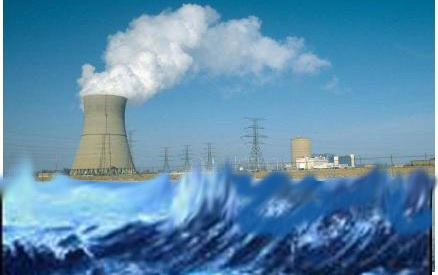
    nuke-&-seaLRising tides threaten communities on the beach — and far from it, too USA Today, Matt Alderton, Green Living  April 19, 2014  The mud in Folsom Lake, near Sacramento, Calif., is dry and chapped, like cracked heels. The bottom of the reservoir, once under water, now is largely barren, save for its shallow center and a smattering of stray puddles.

    That’s because California is in the midst of one of the worst droughts in state history. Conditions are so bad that
    Gov. Jerry Browndeclared a state emergency in January. He urged state residents to voluntarily reduce personal water consumption by 20 percent.

    In the context of having so little water, it might seem strange to worry about having too much. And yet, that’s exactly the dilemma facing California today. Even as it reels from drought, it must begin planning for floods. And make no mistake: Floods are coming. Not only to California, but to coastal cities across the country and around the world, which face a certain influx of water as oceans rise under the specter of climate change.

    “We analyzed 55 different water level stations throughout the United States and found that for about two-thirds of them, sea level rise from climate change has already more than doubled the risk of extreme flooding,” says Dr. Ben Strauss, director of the Program on Sea Level Rise at Climate Central, a nonprofit organization dedicated to communicating the science and effects of climate change.

    Based on the analysis, Climate Central developed Surging Seas, an interactive website (sealevel.climatecentral.org) that maps the flood threats from sea level rise and storm surges. The map shows how more than 3,000 coastal communities in the contiguous United States would be affected if sea levels were to rise from 1 to 10 feet.

    “Sea level rise is already happening, and its continuation is inevitable,” Strauss says. “At some point it will be obvious to every family living in a coastal area, and every community will be looking to protect itself.”

    A scary proposition

    Multiple forces are colluding to make the oceans swell.

    One is warming oceans. “Because of that, you have an expansion of ocean waters, and the only place they can go is up,” says Rachel Cleetus, a senior economist in the Climate and Energy Program at the Union of Concerned Scientists, an alliance of citizens and scientists who collaborate on solutions to global problems.

    Another is melting land-based ice forms such as glaciers and ice sheets. “You’re adding volume to the world’s oceans, and that’s causing them to rise,” Cleetus says.

    Because the rate of ice loss is accelerating, oceans are rising faster than ever before. Cleetus says sea level could rise anywhere from 8 inches to 6.5 feet by the end of the century. Some scientists put estimates as high as 10 or 15 feet. That’s on top of approximately 8 inches of sea level rise already logged in the last century.

    “Those 8 inches of sea level rise from climate change are already making every single coastal flood bigger, deeper and more damaging,” Strauss says.

    Although scientists typically project sea level rise through the year 2100, communities likely will be impacted much sooner than that. The culprit? Incremental storm surges……….

    Ultimately, then, the best solution might be the hardest to swallow: retreat.

    “We need to pull back, in essence, from the shore,” says environmental and land-use planning consultant Barry Chalofsky. “If you live (in a coastal floodplain) and you’re counting on your house to be your nest egg when you retire, or you want to pass it on to your children, I would strongly think about elevating your property, then selling it over the next five to 10 years.” http://www.usatoday.com/story/life/2014/04/19/green-living-coastal-communities/7871349/

    April 21, 2014 – Posted by | climate change, USA

    No comments yet.

    Leave a Reply

    « Previous | Next »

    This Month

    Mari Takenouchi has her Google Mail tampered with. As the Social Media sockpuppets are asked to withdraw from harassing her the establishment steps up the attack on web freedoms.. More to follow? Arclight2011part2

    Video evidence..  short video

    text-cat-questionWhat do you think of the nuclear lobby’s latest marketing gimmick?

    reactors-floating


    Websites

    of the week

    Fukushima Nuclear Informations

    https://www.rebelmouse.com/fukushimainformations