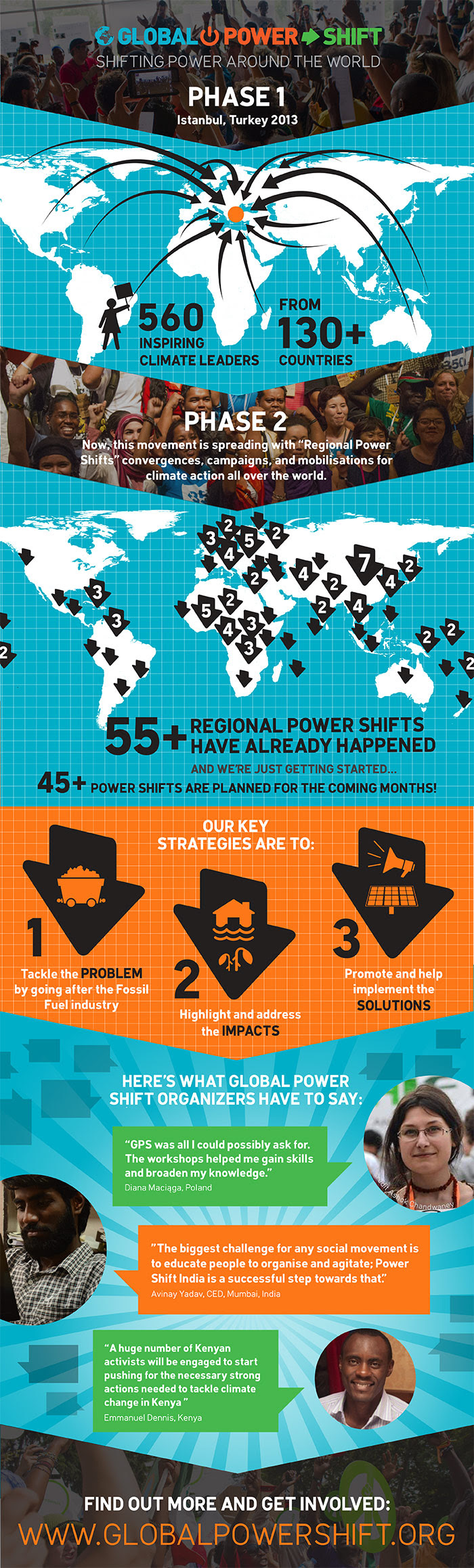
Usually we email you about campaigns and events in Australia. But today, we’re taking a moment to share exciting news about the momentum that is growing globally for the climate movement. Last year 350.org launched an initiative, Global Power Shift, to globally scale up the climate movement. I won’t say much more, as the infographic below tells the story of what has happened in the last year.
If you are having trouble viewing the image, click here.
From national summits to weeks of action, these teams are building innovative, bold climate activism in their regions. They are exposing fossil fuel corporations and pressuring their leaders to take serious action. They are promoting and implementing clean, renewable energy, reaching and engaging frontline communities, and highlighting climate impacts. They’re working with well established partners and articulating effective, coordinated campaigns to tackle climate change.
Here in Australia, phase two of Global Power Shift involved AYCC’s Power Shift event in Melbourne last year, and then the Summer Heat campaign that recently wrapped up. We’re now working on campaigns to stop the Maules Creek coal mine in NSW, the Galilee Basin Coal Mines in QLD and massive gas and coal expansion plans in WA.
Our thanks go out to all the partner organisations we work with, all the local groups, and all the individuals like yourself that are fuelling this movement forward. We still have a long way to go, but the momentum we are building together is powerful, inspiring, and rising fast.
Daily update: Households invest billions in solar as utilities stall on big projects
Inbox
x
Renew Economy editor@reneweconomy.com.au via mail351.us3.mcdlv.net
1:17 PM (4 hours ago)
to me
Households invest billions ins solar as utilities stall on big projects, ACT opens up auction process for 200MW of wind farm capacity, Unisuper taps World Bank’s firs Australian Green Bond issue, Green bonds hit Australian market via Unisuper, HSBC says wind and solar best picks in climate stocks, Australia’s biggest coal project already at risk, Germany takes energy transition away from grass-roots movement, Huge methane leaks add doubt on gas as ‘bridge’ fuel, Can business save us from climate change? and Fossil fuels should be for making stuff – not for energy.
Australian households invested nearly $3 billion in rooftop solar in 2013, and have accounted for nearly all clean energy investment in the country in 2014, as utilities pull the plug on large scale projects. Australian households are still adding rooftop systems at a rate of 13,000 a month.
Australia’s largest coal infrastructure project – the $4bn+ Wiggins Island export terminal and rail – faces major financial risks even before it’s commissioned.
Over the winter, as polar vortices plunged the U.S. Midwest into weeks of unceasing cold, the icy covers of the Great Lakes started to make headlines. With almost 96 percent of Lake Superior’s 32,000 miles encased in ice at the season’s peak, tens of thousands of tourists flocked to the ice caves along the Wisconsin shoreline, suddenly accessible after four years of relatively warmer wintery conditions.
The thing is, all of that ice takes a long time to melt. As of April 10, 48 percent of the five lakes’ 90,000-plus square miles were still covered in ice, down from a high of 92.2 percent on March 6 (note that constituted the highest levels recorded since 1979, when ice covered 94.7 percent of the lakes). Last year, only 38.4 percent of the lakes froze over, while in 2012 just 12.9 percent did — part of a four-year stint of below-average iciness.
And as the Great Lakes slowly lose their historically large ice covers over the next few months, the domino effects could include lingering cold water, delayed seasonal shifts, and huge jumps in water levels.
Already, the impact of this icy blockade can be felt. On March 25, five days after the official beginning of spring, the Soo Locks separating Lake Superior from the lower Great Lakes opened for the season. But after a long and harsh winter, Lake Superior’s nearly 32,000 square miles were still nearly entirely covered in ice. It would be another 11 days before the first commercial vessel fought its way across Lake Superior — with the aid of several dedicated ice breakers — and down through the locks.
Detroit District, U.S. Army Corps of Engineers FacebookThe trip across Lake Superior to the Soo Locks, which usually takes 28 hours, took these first ships of the season nine days. A third ship had to return to Duluth after being damaged by the ice.
More than 200 million tons of cargo, mostly iron ore, coal, and grain, travel across the Great Lakes throughout the year. Even a little ice can make a big dent on this total. Only three shipments of coal were loaded up during March — 69 percent less, by volume, than last year. Shipments of iron ore from the northern reaches of Minnesota were so low that the U.S. Steel plant in Gary, Ind., had to scale back production significantly in early April.
A sluggish start to the shipping season is just one of the cascading effects of the Midwest’s cold and icy winter. Some are good, and will allow the region to recover from years of historically low water levels. Others, like this delayed shipping season, less so.
Like the shipping troubles, some of the more unexpected things the lakes and their ecosystems could face in the next few months are the direct result of the lingering ice and cold:
Throughout the winter, huge numbers of ducks that feed by diving below the water for fish ended up starving to death. Connie Adams, a biologist in New York’s Department of Environmental Conservation, told the AP that the die-off was “unprecedented.”
Next in line for concern are a huge number of the Lakes’ fish species. Warming water temperature often biologically triggers migration to traditional spawning grounds, and experts expect that northern pike, lake sturgeon, steelhead, and rainbow trout could make moves far later this year. As Shedd Aquarium research scientist Solomon David told Michigan Radio, later egg laying could mean younger and far weaker fish come next winter, leading to an even longer impact.
Other changes will come about long after the ice melts, as water levels are predicted to rebound to levels not seen in the last few years. Seasonal shifts in water levels, with winter lows and summer highs, are normal. “If things stayed in sort of a balance, we would see all the Lakes’ water levels going up and then going down. Every year: up, down; up, down,” says Drew Gronewold, a scientist with NOAA’s Great Lakes Environmental Research Laboratory. But, “when water levels change a lot over time, something is happening in one of those two parts of the season.”
Over the last few years, the summer highs and winter lows have both been well below their long-term average, as climate change produced far more rapid rates of evaporation. In December 2012, the Michigan-Huron system set a new low, breaking a record that had stood since the 1960s, according to Keith Kompoltowicz, the chief of watershed hydrology for the Army Corps of Engineers’ Detroit District.
A three-year look at water levels in Lakes Michigan and Huron, including a six-month forecast, from the U.S. Army Corps of Engineers Detroit District. The solid red line marks recorded levels, the red vertical lines a range of six-month projections, and the blue shows the long-term averages. The black bars indicate record highs and lows.
Though Kompoltowicz says the usual March and April rise in water levels is occurring later than usual this year, already the lakes are seeing water levels that they haven’t had for several years. This past March marked the first time since April of 1998 that Lake Superior had reached its long-term average. And over the next few months, melting snow will feed the lakes and colder water could lower the rates of summer and fall evaporation. The amount of rain could either add to or subtract from this total. The Army Corps of Engineers and the National Oceanic and Atmospheric Administration generally forecast water levels six months out, and predicted levels for this September, Kompoltowicz says, range from 10 to 13 inches higher than lake levels were a year ago.
Here’s what higher lake levels could mean:
Shippers may be hurting now, but higher lake levels will allow them to load more cargo per boat later this year, according to the Chicago Tribune. These higher water lines also mean that those who manage the Great Lakes’ harbors won’t have to invest huge sums of money in dredging out the bottom. Ships will carry more, at less of a cost, once the ice melts.
Fluctuations in water levels could also help maintain the diversity of plant and animal species along many coastal wetlands, according to Kurt Kowalski, a wetland ecologist at the U.S. Geological Survey’s Great Lakes Science Center. Too many years of consistently low water allows certain species, often non-native plants, to take over.
And even far less large-scale ripple effects will matter. Scott Stevenson, the executive vice president of the company that manages Chicago’s harbors, told the Tribune that higher water levels will allow them to rent out 100 expensive slips along the lakefront that shallow water took out of commission last year.
Though water level changes even over a several year period are normal, the rebound from record-low water levels is going to be a relief from the hand-wringing of the last few years. But it will likely be a temporary one. A hot summer with little precipitation could mute the effects of the icy winter. And, even if the lakes have more water this year, 2014 could be nothing more than a blip as climate change continues to wreak havoc. “We don’t know, as this winter really exemplified, what’s going to happen,” Gronewold says. “If we’re going to have three more severe winters, or flip back to three more winters like we’ve had the past few years.”
This winter’s natural gas withdrawal season saw the largest storage withdrawal on record. Historically, winter stock withdrawals average around 2 Tcf. However, this winter much of the country experienced sustained colder-than-normal temperatures, and almost 3 Tcf of gas has been withdrawn from storage as of the end of March.
“Scientists investigated the factors that influence forest cover in California’s Sierra Nevada. Bedrock may be as important as temperature and moisture, they found, in regulating the distribution of trees and other vegetation across mountain slopes.” Quoted from the National Science Foundation press release.
An article in The Bellingham Herald gives details on several very large landslides that dwarf the Oso Slide and all involved sudden, unpredictable collapse.
“By analyzing samples from the Greenland ice sheet, University of Washington atmospheric scientists found clear evidence of the U.S. Clean Air Act. They also discovered a link between air acidity and how nitrogen is preserved in layers of snow.” Quoted from the University of Washington press release.
In their Report on the State of Geothermal Energy in California, the Geothermal Energy Association says…. “Geothermal power generated 4.4% of total system power in California in 2012, but could have generated substantially more […] about half of California’s identified geothermal resources are still untapped, and significant resources may remain undiscovered.”
“Researchers led by a Washington State University biologist have found that arid areas, among the biggest ecosystems on the planet, take up an unexpectedly large amount of carbon as levels of carbon dioxide increase in the atmosphere.” Quoted from the Washington State University press release.
“A fossil creature buried in an “invertebrate version of Pompeii” more than half a billion years ago reveals the first-known cardiovascular system in exquisitely preserved detail.” Quoted from the University of Arizona News.
MyTopo recently upgraded and enhanced their satellite imagery. Now, you can order custom satellite prints of the same image quality you see on sites like Bing, Zillow, and Google.
Center the image anywhere you want in either landscape or portrait format.
Get a custom print of your favorite park, lake, peak, farm, neighborhood, hunting cabin, or baseball field (yep, that’s Fenway Park for you Red Sox fans).
Prices start at just $59.95 plus shipping. MyTopo will print your map promptly and have it delivered straight to your door – rolled in a sturdy map tube.
We are affiliates of MyTopo and receive a commission on sales.
from universities, journals, and other organizations
European climate at the 2 degrees Celsius global warming threshold
Date:
April 15, 2014
Source:
Uni Research
Summary:
A global warming of 2 degrees Celsius relative to pre-industrial climate has been considered as a threshold which society should endeavor to remain below, in order to limit the dangerous effects of anthropogenic climate change.
A global warming of 2 °C relative to pre-industrial climate has been considered as a threshold which society should endeavor to remain below, in order to limit the dangerous effects of anthropogenic climate change.
However, a new study shows that, even at this threshold, substantial and robust changes may be expected across Europe. Most of Europe will warm more than the global average with increases over +3 degrees over Northern Europe in winter and Central-Southern Europe in summer.
Similar increases are also shown for extremes of temperature. Precipitation patterns at +2C global warming show the now familiar wet-north and dry-south patterns and increasing heavy precipitation across much of Europe in both winter and summer.
These conclusions appear in a new study published in Environmental Research Letters in March and recently highlighted in Nature. Stefan Sobolowski at Uni Research and the Bjerknes Centre is co-author in the study led by Robert Vautard at the Pierre-Simon Laplace Institute in Gif-sur-Yvette, France.
This research was performed as part of an EU-FP7 project called IMPACT2C, which investigates the potential impacts in Europe and abroad even if society manages to keep globally averaged warming to around 2 degrees celsius. Crossing the +2 degree threshold is essentially a mid-century or earlier event under both the older IPCC scenarios and the new representative concentration pathways (RCPs).
Weather and climate is experienced locally The only way it is avoided is under the very aggressive, and increasingly unlikely, RCP2.6 scenario. The patterns of change, with the exception of regional variations, are now well known. What is new in this study is the fact that it can be shown that even at the global threshold of +2C substantial regional to local scale changes occur.
A global warming of +2C is somewhat abstract concept to many people. We do not experience weather and climate globally, we experience it locally. And this study places these changes in a spatial context that is relevant for the public.
Further, this study shows that these changes not as far away as we might think; a few decades at most.
“To put this in perspective,” Dr. Sobolowski says, “this will be about the time that my daughter reaches adulthood.”
Story Source:
The above story is based on materials provided by Uni Research. Note: Materials may be edited for content and length.
Journal Reference:
Robert Vautard, Andreas Gobiet, Stefan Sobolowski, Erik Kjellström, Annemiek Stegehuis, Paul Watkiss, Thomas Mendlik, Oskar Landgren, Grigory Nikulin, Claas Teichmann, Daniela Jacob. The European climate under a 2 °C global warming. Environmental Research Letters, 2014; 9 (3): 034006 DOI: 10.1088/1748-9326/9/3/034006
This is an urgent request. BHP are planning on digging the largest underground coal mine in the world under our very best farmlands, on the Liverpool Plains in north-west NSW. Submissions on the groundwater assessment for this mine are due on the 23rd February – that is just 6 days away. Can you help?
The Namoi Alluvial Aquifer that the mine will impact on is a high-yielding and heavily-used water source that is needed for irrigation, stock and domestic and town water supplies.
The Liverpool Plains is so important and unique because it combines exceptionally fertile volcanic soils with high output aquifers and reliable summer and winter rainfall.
Each year, the Plains produces enough grain for 365 million loaves of bread, 62.5 million packets of pasta, and 58 million boxes of cornflakes. It is feeding the nation.
But all that is at risk from this staggeringly large underground coal mine. A mine that will cut through aquifers and risk draining the precious groundwater.
Most extraordinary is the fact that BHP has decided that the mine will NOT have a significant impact on water resources and has told the Federal Government that it doesn’t trigger the water clauses in the Federal environment laws.
This is the very mine that triggered the reforms of Federal laws to include a scientific assessment of impacts on water resources just last year. And now BHP are saying they don’t need to abide by the new rules or refer the mine to the Independent Expert Scientific Committee. If you need some background information, you can find it here.
The local community have been fighting this dangerous mine proposal for more than 5 years. They really need your support now.
Make sure this enormous coal mine is subject to independent scrutiny and assessed using the best scientific methods.
Thanks so much,
Phil Laird
Lock the Gate Alliance
PS – You might have noticed that NSW Premier, Barry O’Farrell announced today that he will resign next week, after evidence emerged at a corruption inquiry about a gift he recieve from a lobbyist. The corruption inquiry has exposed the secret, tangled relationships between corporate lobbyists and our politicians, which is undermining our democracy. Therefore, we’re calling on the incoming Premier to act urgently to put strict new rules on corporate lobbyists. Check out our press release here, and stay tuned for more on this soon.
Lock the Gate Alliance http://www.lockthegate.org.au/