Category: Uncategorized

  • Climate Change Is Going To Make Us All Very Hungry, And We’re Not Doing Anything To Stop It

    Ad placeholder

    Oxfam just released a report explaining how climate change is going to affect food–and how we’re not ready for it.
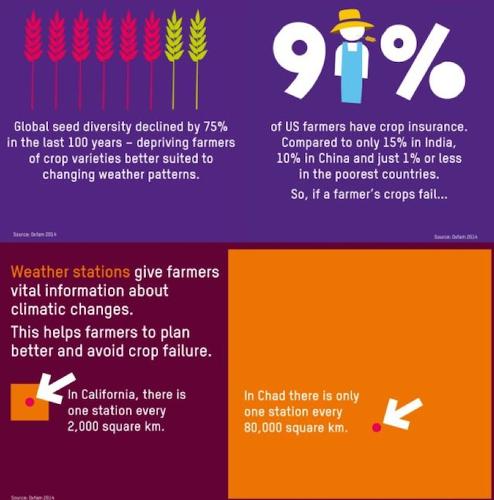
    Oxfam has highlighted 10 areas in which governments are falling far behind, including adaptation finance, gender equity, and social safety nets.

    The organization predicts that people who spend most of their paychecks on food will be the worst affected, and access to school nutrition and guaranteed employment for the most vulnerable communities will become especially critical.

    Ad placeholder

    Oxfam just released a report explaining how climate change is going to affect food–and how we’re not ready for it.

    Climate Change Is Going To Make Us All Very Hungry, And We’re Not Doing Anything To Stop It

    Impending food crises may arrive sooner than we think. Here are 10 ways the world–especially the developing world–is woefully unprepared

    • 0 Notes
    • /
    • 0 Pin
    • /
    • 10 Plus
    • /
    • 104 Tweet
    • /
    • 6 Like
    • /
    • 6 Share

    Next week, the Intergovernmental Panel on Climate Change, the scientific body that meets to release periodic assessments on the state of the world’s mutating climate, will release its fifth, and likely most concerning, report. Leaked copies have shown that governments, and especially poor countries, might have less time to adapt than previously thought.

    One of the main the effects of this shortened horizon for climate disaster is that climate-charged severe hunger will be felt within the next 30 years. Oxfam estimates that, because of climate change, 25 million children under five will experience malnutrition or severe hunger in 2050. In response, the organization has highlighted 10 areas in which governments are falling far behind, including adaptation finance, gender equity, and social safety nets. All of which are going to make the hunger problem even worse.

    In 2009, wealthy countries pledged to help poor countries reduce emissions and prepare for climate change by contributing $100 billion to a mitigation fund over several years. To date, however, those donations are far behind schedule. “Countries have only provided 2% in terms of the need,” explains Oxfam climate policy manager Heather Coleman. Without this money, countries set to experience the worst climate impacts are particularly ill-equipped.

    A lack of policies that empower women will also weaken countries’ abilities to feed populations in the face of shifting climactic conditions. Women make up 43% of the worldwide agricultural workforce in the developing world, but they’re also often shut out from the systems that alert them to extreme weather warnings, which occur in almost exclusively male spheres.

    In addition, Oxfam highlighted gaps in countries’ social safety nets as harbingers of crisis. The organization predicts that people who spend most of their paychecks on food will be the worst affected, and access to school nutrition and guaranteed employment for the most vulnerable communities will become especially critical.

    Some 20,000 fishing households in the Philippines are already living that reality. After Typhoon Haiyan destroyed coastal communities, local fisherman have seen entire mangroves and coral reefs that host important fish stocks wiped out.

    But while many of the harshest impacts will be felt in the developing world, wealthy countries won’t be exempt from the food crisis either. Food prices, according to Oxfam, will likely be some of the first shocks to the global system. The world experienced food price increases in 2008, 2010, and 2012, but the organization predicts that those will only become more severe in the next three decades–and more frequent.

    “With the hundred-year drought we’ve seen in California, and California being the largest source of fruit and vegetables in the United States, that will clearly affect food prices in the U.S.,” Coleman says. “And those spikes lead to instability. We’ve seen studies linking some of the uprisings around the Arab Spring, for example, linked to rising food prices.

    [Image: Cracked earth via Shutterstock]

  • West Antarctic Glaciers Speeding Toward the Sea, Study Finds

    1.1k

    West Antarctic Glaciers Speeding Toward the Sea, Study Finds

    3_28_14_andrew_nycsandy

    This aerial photo of Wednesday, Oct. 31, 2012, shows the New York skyline and harbor after Superstorm Sandy struck the city.
    Image: Mark Lennihan/Associated Press
    By Andrew Freedman10 hours ago
    Bad news from the Southern Hemisphere: the West Antarctic ice sheet is shedding ice at an accelerating rate, with six large glaciers in this region discharging nearly the same amount of ice as the entire Greenland ice sheet, according to a new study.

    The study is the first to combine observations from satellites, radar data, and other remote sensing methods to construct a long-term record of ice movement trends for six of the fastest-flowing glaciers in Antarctica.

    Published this week in the journal Geophysical Research Letters, the study examines glaciers in the Amundsen Sea Embayment of West Antarctica. The glaciers in this region include the Pine Island Glacier, which made headlines in recent years by discharging massive icebergs into the ocean.

    This region also encompasses the Thwaites, Haynes, Smith, Pope and Kohler glaciers, each of which are behemoths in their own right.

    A research team from the University of California at Irvine and NASA found that the total amount of ice coming off these glaciers has increased by 77 percent since 1973, with much of that increase coming since 2000. Together, these glaciers drain one-third of the West Antarctic Ice Sheet, or about 158 million square miles of ice, the study said.

    We need to know how quickly and extensively parts of Antarctica as well as the Greenland ice sheet are melting in order to accurately project how high global sea levels are likely to rise during the next several decades. It’s melting land-based ice, not the melting North Pole sea ice, that contributes to rising seas.

    Pine Island Glacier

    A massive crack running about 18 miles Pine Island Glacier’s floating tongue in 2011.

    Image: NASA

    According to a 2013 report from the U.N. Intergovernmental Panel on Climate Change (IPCC), average global sea level rise will likely be in the range of 10.2 to 32 inches by the end of the century, depending on the amounts of greenhouse gas emissions between now and then.

    If emissions continue on a business as usual path, which has been the trend in recent years, the IPCC said global average sea level rise could be closer to 40 inches — which would doom some low-lying coastal cities and nations, from Bangkok to Miami and Bangladesh.

    Illustrating the high stakes involved in the fate of West Antarctica, the study found that these six glaciers contributed about 10% of all the global average sea level rise that occurred between 2005 and 2010. If all six glaciers were to melt completely (which is not expected to happen during this century), global average sea level would rise by a catastrophic 3.9 feet, the study said.

    The new study also found, for the first time, that West Antarctic glaciers are not only flowing faster at the point where their base meets the ocean, which is known as the grounding line. Instead, areas as far inland as nearly 160 miles are also speeding up their march to the sea.

    Until this study, it was not known that sections of glaciers deep into the interior are also speeding up their movement. This is a troubling sign because of what it implies for sea level rise in the future, according to the study’s lead author, Jeremie Mouginot of the University of California at Irvine.

    “Increased ice discharge will have an impact on how [much] the sea level is going to rise,” Mouginot told Mashable.

    Mouginot says most of the action is taking place at the grounding line, then having ripple effects inland.

    In the same way that plaque slowly rots a tooth until it falls out, mild ocean temperatures are thought to be causing ice to thin and retreat where these glaciers meet the sea. This is likely setting in motion a chain of events that results in a far more unstable glacier.

    Sea level rise

    Projections of global mean sea level rise over the 21st century, depending on greenhouse gas emissions.

    Image: U.N. Intergovernmental Panel on Climate Change

    The grounding line positions of these glaciers have been retreating at a rate of 0.6 miles per year, the study found, which is among the fastest rates of glacier retreat in the world.

    According to Mouginot, all six of the glaciers in this study come into contact with the same body of water, which indicates that higher sea surface temperatures are likely playing a role in speeding up melting. Other studies have found evidence for this in other parts of the globe, including Greenland, and in other parts of Antarctica.

    “I think there is more warm ocean going beneath the ice shelf,” Mouginot says.

    It’s not absolutely clear exactly what is causing ocean temperatures to increase in that area — but global warming from the increased amount of greenhouse gases in the atmosphere, is almost certainly playing a role.

    “What I can say is, if you look at Greenland, it is changing, and West Antarctica is changing a lot,” Mouginot says. “And they are really far apart from each other. I don’t think it’s a regional change occurring. I think it’s more global.”

    The IPCC is scheduled to release another major climate report on Sunday evening eastern time, which is expected to detail some of the likely impacts of global sea level rise during the next several decades, among other findings.

    Have something to add to this story? Share it in the comments.

  • “Be Worried: Climate Scientists Under Attack”

    Be Worried: Climate Scientists Under Attack

    Share:

    facebook icon twitter icon google plus icon

    060403_TimeCoverClimate scientists are under attack like never before for telling the truth about about the growing dangers posed by unrestricted carbon pollution.

    Anyone who wishes can help climate scientists in their quest to provide humanity the information we need to save ourselves by supporting the Climate Science Legal Defense Fund (CSLDF). To find out how, go here.

    Eight years ago this week, Time magazine launched the bluntest cover story on climate change ever published by a major news outlet. Like the best science journalism, it was based on interviews with many of the world’s leading climate scientists. The article’s online sub-hed was especially blunt:

    Polar Ice Caps Are Melting Faster Than Ever… More And More Land Is Being Devastated By Drought… Rising Waters Are Drowning Low-Lying Communities… The climate is crashing, and global warming is to blame. Why the crisis hit so soon–and what we can do about it.

    For a time it seemed as if the public and policymakers were actually listening, as awareness of the climate crisis grew and leading politicians from both parties called for action. Then came the the vicious backlash — the most successful disinformation campaign in history, funded by fossil fuel companies and making use of tactics developed by the tobacco industry. Scientists were vilified and cyber-bullied.

    Scientists are far more worried than they were in 2006 — since emissions have soared, and the overwhelming majority of recent studies show the reality of climate change is far worse than what we suspected a decade ago — see this review of over 60 studies. See also the uncharacteristically blunt 2014 report from the American Association for the Advancement of Science, as well as the 2013 report from the U.N. Intergovernmental Panel on Climate Change. The IPCC’s next report, due out this weekend, appears no less alarming.

    And because the stakes are higher, the intimidation and cyber-bullying of climate scientists continues unabated. Doing something about it is easy, though.

    Climate Progress readers have been among the biggest supports of the important work of the Climate Science Legal Defense Fund (CSLDF). Prof. Scott Mandia explains what supporters have helped accomplish so far:

    But this has all been done by Mandia and Joshua Wolfe “from their kitchens.” They both have “full-time jobs and families with small children and neither receives compensation for their time.”

    So now they would like readers’ support to “go professional” to “hire a full-time Executive Director who will manage the day-to-day operations of providing legal help to our experts as well as increasing fundraising efforts. Having the full-time professional helps to assure that CSLDF will be there for our scientists years down the road. After all, climate change is not going anywhere and the sad fact is that neither will the legal attacks on our scientists.”

    Scientists are the thin blue line helping protect us from a world ruled by superstition and “might makes right.” If anyone wants to know how they can help climate scientists, they can go here.

  • UPDATE: Roseanne

    Why this ad?
    Drug and Alcohol Coursewww.seeklearning.com.au/Counselling – Alcohol And Drug Counselling Course Nationally Recognised & Accredited

    UPDATE: Roseanne

    Inbox
    x

    Ian Mckinlay via Change.org mail@change.org

    12:29 PM (24 minutes ago)

    to me
    Change.org
    NEVILLE — 

    I’m just back from Canberra, and I wanted to update you. It was a huge day of meetings – and yesterday’s headline in The Australian tells of some progress we made: “Peris backs jail audit over disability prisoners”

    We’ve now got support from all sides of politics. The Indigenous Affairs Minister Nigel Scullion, the PM’s advisor Warren Mundine, Senator Nova Peris, Senator Siewert and Boyce and others we met have all shown support for the release of Roseanne. And we’re closer than ever to a national audit and policy to end this shameful practice.

    I’m hopeful the Federal Government can show some leadership on this. It’s one thing to say they agree – now it’s time for them to respond with real action to end the use of indefinite prison sentences as ‘care’ for intellectually disabled people found ‘unfit to plead’.

    The response by Senator Scullion was very encouraging; he had a deep knowledge of issues and the effects of foetal alcohol harm. He should be thanked for his concern and encouraged as Minister of Aboriginal Affairs to push for the reforms needed to end this unjust imprisonment. Please help me thank the Indigenous Affairs Minister Nigel Scullion for meeting us – and urge him to immediately begin an inquiry and develop a policy. 

    Here’s where you can send him a quick email saying just that: Nigel.Scullion@ia.pm.gov.au

    Roseanne’s release is progressing, with the NT and WA beginning to work on a care plan and her transfer to Alice Springs. She phones me nearly everyday asking when she will be released. I look forward to having a date before too long.

    After decades of inaction, we’re finally bringing this issue out into the light. Thank you for signing my petition – and I’ll be in touch with more updates soon. 

    Thank you.

    Ian

    P.S. Some of you may have heard of Marlon Noble’s case. He spent 10 years in prison without conviction after being found “unfit to plead” just like Roseanne. If you want to watch his incredible story, recorded by the

  • Australian for Climate Action open letter.

    1 of 41
    Why this ad?
    Forklifts 96721968www.forkserve.com.au – Service & repairs Sydney All Areas, Competitive rates

    Thanks for taking action!

    Inbox
    x

    GetUp!

    10:05 AM (38 minutes ago)

    to me
    Dear Neville,

    Thank you for taking signing on to the Australian for Climate Action open letter.

    You’ve joined tens of thousands of Australians in demanding more ambitious action to reduce our emissions and transition away from dirty fossil fuels toward renewable energy.

    This campaign is growing by the day, with dozens of high-profile musicians, actors, former politicians, churches, journalists, celebrity chefs, athletes, scientists, comedians, academics and other trusted Australians adding their names to this critical call to action. By signing on thousands of every day Australians from around the nation, we can demonstrate the enormous and broad support for decisive action on climate change, a powerful rebuttal to the inaction of our leaders.

    But we need your help to take it to the next level. Can you share the website with your friends?


    Share on Facebook

    Tweet about the campaign

    Thanks for your support,

  • March in March Gold Coast: Down with the corporatists

    March in March Gold Coast: Down with the corporatists

    0
    Delicious Add
    David Donovan addresses the Gold Coast March in March in Surfers Paradise today (22/03/14, image via @P4217)

    In a speech to the Gold Coast March in March today, managing editor David Donovan minces no words in explaining why it is important Australians reject Abbott and his “corporatist” neoliberal agenda.

    IN 1996, after his election loss to John Howard, Paul Keating famously said:

    “When you change the Government, you change the country.”

    He was right.

    During John Howard’s seemingly endless rule, the country changed profoundly.

    John Howard coveted the popularity of Pauline Hanson and so, after he had put her in gaol and stolen all of her supporters, he adopted her ugly, divisive, racist, small-minded policies as his own.

    It worked well for him.

    The country was changed forever.

    Indigenous Australians, asylum seekers, multiculturalism, scientists, academics, artists — anyone opposing Howard and his big financial supporters were in his sights.

    And who were his big financial supporters? The graspers, the grifters, the plutocrats, the big corporations — all the people who fund the Liberal Party for millions every year.

    Let’s call them ‘the corporatists’.

    Howard said he wanted to make Australians “relaxed and comfortable”, and so to do that he spent the profits of the mining boom buying the votes of upper-middle bogans and cutting the taxes of his financial supporters.

    Building Australia didn’t get a look in. He may have put up a few flagpoles — but not much else.

    By 2005, the people who were paying the Liberal Party’s bills wanted more.

    It was time for Howard to pay back more of his debt to them. And how did they want it repaid? They wanted to pay their workers less, of course.

    And so Howard brought in WorkChoices.

    WorkChoices, let’s be very clear, was about nothing else other than paying working men and women less and taking away their entitlements and conditions. This was something the corporatists had always wanted — both ideologically and financially.

    Howard tried to give it to them. But he failed.

    To save his miserable carcass, in the 2007 campaign against Rudd, Howard even tried to use the same phrase as Keating:

    “When you change the Government, you change the country.”

    But unluckily for him, the people said:

    “Exactly!”

    Howard tried to give the corporatists cheap people. But, thankfully, he couldn’t manage it.

    After a brilliant campaign by the trade unions of Australia, the Australian people voted Howard out.

    And there was much rejoicing.

    And the country did change with Rudd — for a while.

    Before six months had elapsed in his prime ministership, Rudd had said sorry to the Stolen Generations. He had abolished the Pacific Solution. He had ratified the Kyoto Protocol.

    He had, most importantly, started spending money on home insulation and vital school infrastructure, which also managed to save Australia from the Global Financial Crisis.

    We were getting our country back. We were regaining the respect of the world. We were working to solve the problems besetting humanity. We were building assets for our families and communities, which we could all use and about which we could be proud.

    The corporatists gritted their teeth.

    Then Rudd went further — too far for them.

    He wrote an essay in The Monthly decrying neo-liberalism. Warning bells rang for the corporatists.

    The alarms moved up an octave when Rudd tried to bring in an ETS. The Liberal Party leader of the day, Malcolm Turnbull, also supported action on climate change, but the corporatists pulled one of their dirty tricks with Godwin Grech and got rid of him with ease, bringing in a thick-headed compliant stooge in the shape of Tony Abbott.

    Mining heiress Gina Rinehart addresses an anti-mining tax rally in Perth (Photo: Sharon Smith via smh.com.au)

    Then Rudd tried to bring in a mining tax, so we could all get a fair share of Australia’s mineral wealth. The alarms moved to DEFCON 4.

    The extremists, the plutocrats, the corporatists who really run Australia ‒ the miners, the bankers, the foreign media moguls ‒ they all got together and hounded Rudd out of office.

    In came Julia Gillard — so they used the obvious dissension in the Labor Party to undermine her as well.

    She wasn’t meant to win in 2010, but she did — just. And she and the Independents did a good job in shepherding Australia through the last three years.

    But you wouldn’t have heard that from the biased, yellow, Tory press.

    A U.S. national, with far too much interest in Australian domestic affairs, set to work vilifying and destroying Australia’s first female Prime Minister. And the level of misogyny, bigotry and hatred stunned everyone with a shred of decency in their soul.

    It may not be a popular thing to say, but Australia was well-run by Julia Gillard.

    Can we say the same today?

    With Murdoch running the PR for the Liberals and the Abbott camp, there was never any doubt he would become PM. The vitriol and bias from the owner of 70% of Australia’s press was beyond anything we have ever seen — anywhere in the world.

    The front page that sticks in my mind is the one saying: ‘Kick this mob out’.

    Media bias doesn’t get much cruder than that.

    And so Abbott was installed above us as Australian Prime Minister.

    Now allow me to let you in on a secret. I think the people who put Abbott in power know he won’t stay there very long. He is too bigoted, too awkward, too unpopular, too strange, too aggressive, too extreme, too out of touch with the mainstream of Australian society…

    In short, he is too much of a dickhead to be Australian prime minister for long.

    So the people who really run this nation need to get their neoliberal agenda through as quickly as possible.

    And we have seen that in the first six months of Abbott’s Government.

    Keating and Howard said, when you change the Government you change the country — well, everything is changing very quickly under Abbott.

    The auto industry has gone, penalty rates are going, the Barrier Reef is about to wear a layer of sludge, and Gina Rinehart looks like she will get her wish and soon be able to pay no tax at all. Oh, and Rupert Murdoch will soon be able to own every newspaper, television station and radio station in Australia.

    The corporations ‒ the ones who really run things ‒ have got their dream by having Tony Abbott in power. They think they have won.

    We must make them think again.

    It is us ‒ the people who have marched in March all over Australia, 100,000 of us and more ‒ who will stop their evil plans for Australia.

    They think they’ve got us on the run. But who do they think they’re kidding?

    Their time is coming swiftly to an end.

    It is time for us to say: Down with the oligarchs. Down with the plutocrats. Down with the people who will make your children work for $2 a day.

    Down with Gina Rinehart. Down with the IPA.

    Down with the mindless media that will fill your head with propaganda and rubbish. Down with Murdoch.

    Down with Abbott and his neoliberal henchmen.

    Down with dickheads.

    Thank you.

    You can follow David Donovan on Twitter @davrosz.

    Creative Commons Licence
    This work is licensed under a Creative Commons Attribution-NonCommercial-NoDerivs 3.0 Australia License

    David Donovan: “The people who put Abbott in power know he won’t stay there long.” @davrosz at #marchinmarch #AusPol pic.twitter.com/SPIwO7f503

    — Kiera (@KieraGorden) March 22, 2014