Tag: NewEconomy
-
Geoff Jnr on deGrowth
A much younger Geoff Ebbs discusses a Zero Growth economy in 2010 -
The Small Business advantage
Globalisation, online competition, energy prices, low economic growth: we are all aware of the challenges.
Small business has a natural advantage, however. We are embedded in our community and have the opportunity to build and reinforce our networks of stake holders.
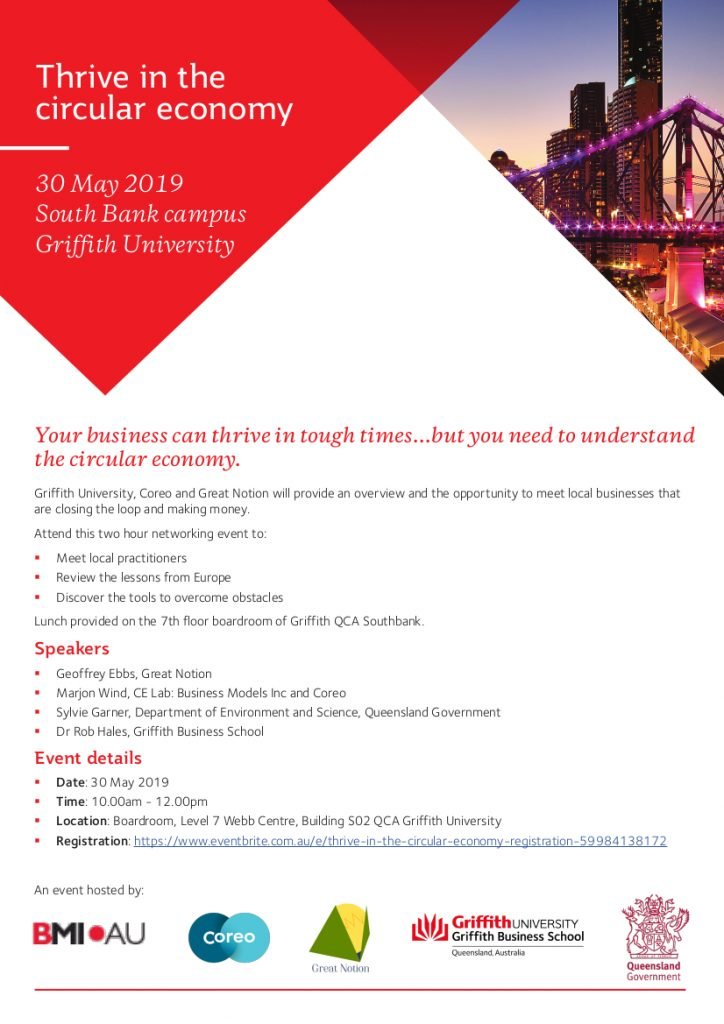
Great Notion, Griffith University and the Circular Economy Labs have put together a networking opportunity and lunch at Soutbank during Small Business Week to discuss the role of small business in the circular economy.
Come to the Executive Boardroom on the 7th floor of QCA at 226 Grey St for a two hour session starting at 10am on Thursday 30th May. Thrive in the circular economy will give small business the chance to discuss the opportunities with the Queensland Government, the Circular Economy Labs and local practitioners.
Hosted by Great Notion and Griffith University, this is a unique opportunity to talk to the practitioners and the people who are testing the business models and training the practitioners.
#circulareconomy #stablestate #neweconomy
-
Unpacking the Circular Economy
The circular economy differs from a linear economy because the output of one process is the input of another.
The available outputs of the food production are uneaten vegetable matter and sewage from which we can harvest nutrients, energy, water and solid waste. Natural ecosystems are circular in that plants and animals accumulate nutrients and grow during their life, and then release those nutrients back to the environment as they excrete, or when they die.
An ecosystem is a circular economy built of component linear processes. An ant nest organizes and concentrates nutrients that form a valuable supply for nearby trees or scavenging beetles. A tree accumulates resources and stores them in the form of timber.
A specific ecology may also rely on external cycles. A rainforest, for example, relies on a larger circular system for its water. The water cycle injects water into the rainforest which releases it to the sea. The rainforest is also a net user of energy. Sunlight powers the growth of the forest, and is the primary source of energy for all other life forms.
Of course, sunlight also powers the water cycle, evaporating water and driving the winds that move clouds around the earth. Our fossil fuels come from ancient forests. The only sources of energy on earth that are not derived from sunlight are the gravitational pull of the tides and the geothermal energy from our molten core.
When planning a circular economy, it is critical that we take note of this net use of energy, and the reliance on larger cycles, so that we do not cripple each component of the ecosystem with artificial constraints. Linear processes can participate in a circular economy if their waste provides valuable inputs to other areas of the economy.
Read earlier articles in this series
