Author: admin

  • On thin ice: Time-frame to save the Arctic is melting away

    On thin ice: Time-frame to save the Arctic is melting away

    Posted: 05 Sep 2012 01:27 AM PDT

    By David Spratt, first published by ReNew Economy on 5 September 2012

    Something extraordinary is happening when graphs of melting Arctic sea-ice have their vertical axis redrawn because the data are falling off the chart.
    But that’s what has occurred in the last 10 days, since the extent of floating Arctic sea-ice broke the satellite-era minimum record on 24 August. On that date it was 4.2 million square kilometres, according to data from the Japan Aerospace Exploration Agency.
    Since then, an additional half a million square kilometres of sea-ice has melted. The extent on 4 September was just half of the average minimum extent of the 1980s. At the current rate of loss, with one to three weeks left in the northern melt season, the minimum may well shrink below 3.5 million square kilometres. This is an astounding story.
    Whilst there was modest media coverage of the record being broken, the unprecedented further melting has barely rated a mention – despite the profound consequences for both the climate and policy-making. Two weeks ago on these pages I wondered whether policy makers really want to know.
    And it’s not just the extent of the ice. It’s now much thinner: new figures of modelled data from PIOMAS show the volume on 25 August was around 3,600 cubic kilometres. This is just one-quarter of the volume twenty years ago. This fits with datafrom the first purpose-built satellite launched to study the thickness of the Earth’s polar caps showing that the rate of Arctic summer sea ice loss is 50 per cent higher than predicted.
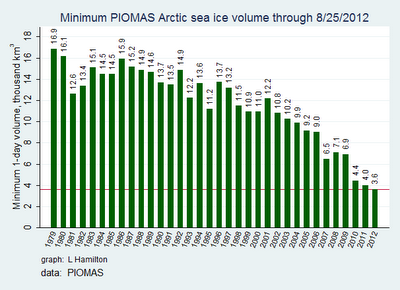
    Arctic sea-ice volume 1979–25 August 2012. Data: PIOMAS. Graph: L. Hamilton

    As the ice becomes thinner and vulnerable to break-up from more severe Arctic storms, there are predictions of a summer Arctic Ocean free of sea-ice as early as 2015-16. A week ago ReNew Economy reported on the “big call”of the Cambridge Professor and Arctic expert Peter Wadhams who predicts Arctic summer sea ice “all gone by 2015”, except perhaps for a small multi-year remnant.
    Other Arctic specialists are now saying we will see an ice-free Arctic in summer within a decade or so. Some, relying on global generalised climate models which have a poor record for modelling and projecting Arctic sea-ice loss, are sticking to a 2030-2040 projection, but lament that “We just don’t know exactly why this (sea-ice loss) is moving so fast”.
    With three-quarters of sea-ice by volume gone in the past 20 years and the rate of loss accelerating, Wadhams’s prediction seems well founded. And because the consequences are so great, sensible risk management suggests that this scenario should be taken very seriously and its implications be well understood:

    • Regional and global warming: A 2011 studyfound that if the Arctic were ice-free for one month a year plus associated ice-extent decreases in other months then, without taking cloud changes into account, the global impact would be about 0.2 degrees Celsius [ºC] of warming. If there were no ice at all during the months of sunlight, the impact would close to 0.5ºC of global warming.
    • With Greenland passing its previous record melton 8 August 2012 – with more than a month of the melt season left – it seems to be an extraordinary year, but the record suggests this may be the new norm as the Arctic warms at two-to-four timesthe global average, and increasing areas of exposed sea are absorbing vast amounts of energy that would previously have been reflected by ice. Greenland ice mass loss is accelerating, with big implications for sea-level rises.
    • Extremes: There is evidence connecting sea-ice loss to the more severe and extreme weather patterns in Europe and north America, consistent with research from the US National Oceanic and Atmospheric Administration.
    • Carbon stores: Melting of Arctic permafrost has dramatic consequences, as explained in an interview with Bloomberg on 16 August by NASA’s top climate scientist, James Hansen. A paperpublished last week in Nature shows that an ancient and large permafrost carbon pool is releasing greenhouse gases along the 7000-km coast of northernmost Siberian Arctic.

    The 2007 IPPC report suggested that by 2100 Arctic sea-ice would likely exist in summer, though at a much reduced extent. Because many of the Arctic’s climate system tipping points are significantly related to the loss of sea-ice, the implication was that the world had some reasonable time to eliminate greenhouse emissions, and still be on time to “save the Arctic”.The 2007 IPCC-framed goal of reducing emissions 25 to 40 per cent by 2020 and 80 per cent by 2050 would “do the job” for the Arctic.
    But the physical world didn’t agree. By 2006, scientist Richard Alley had observedthat the Arctic was already melting “100 years ahead of schedule”. But the Arctic is not melting 100 years ahead of schedule: the climate system appears to be more sensitive to perturbations than anticipated, with observations showing many climate change impacts happening more quickly and at lower temperatures that projected, of which the Arctic is a prime example.
    Politically, we are 100 years behind where we need to be on emissions reductions.
    Yet the policy discourse about climate impacts and political action is still in the 2007 IPCC frame.
    Our scientists, and Australia’s Climate Commission, must lead by presenting today’s climate observations as the necessary basis for resetting the political and policy frame. Their role is crucial.
    In a forthright assessment in the current issue of Nature Climate Change, leading British researchers Kevin Anderson and Alice Bows describe A new paradigm for climate change, saying that:

    How climate change science is conducted, communicated and translated into policy must be radically transformed if ‘dangerous’ climate change is to be averted.

    They demonstrate that climate science has become intertwined with politics “to the extent that providing impartial scientific analysis is increasingly challenging and challenged” and point to “the scale of the discontinuity between the science (physical and social) underpinning climate change and the economic hegemony”. The challenge to their colleagues is unambiguous:

    Civil society needs scientists to do science free of the constraints of failed economics. It also needs us to guard against playing politics while actively engaging with the processes of developing policy; this is a nuanced but nonetheless crucial distinction. Ultimately, decisions on how to respond to climate change are the product of many constituencies contributing to the debate. Science is important among these and needs to be communicated clearly, honestly and without fear.

    RELATED POSTS

    You are subscribed to email updates from Climate Code Red
    To stop receiving these emails, you may unsubscribe now.
    Email delivery powered by Google
    Google Inc., 20 West Kinzie, Chicago IL USA 60610
  • Qld warned to get storm-ready

    Climate change to hit poor through food price hikes: Oxfam
    Sydney Morning Herald
    More frequent extreme weather events will create shortages, destabilise markets and precipitate price spikes on top of projected structural price rises of about 100 percent for staples such as maize over the next 20 years, the charity said in a report
    See all stories on this topic »
    DNC organizers keep close eye on weather conditions for Thursday
    WSOC Charlotte
    Severe Weather Center 9 Meteorologist Keith Monday said there is a chance for storms Thursday night. If the president’s speech is moved from the stadium, it would most likely be moved to Time Warner Cable Arena. Organizers said they would only move the
    See all stories on this topic »
    Qld warned to get storm-ready
    Herald Sun
    He urged homeowners to trim tree branches growing near power lines, secure outdoor furniture, stock an emergency kit including a torch and sign up to early warning alerts. “Severe weather events are an inevitable part of living in Queensland, and now
    See all stories on this topic »
    Threat of severe weather postpones Linton Rotary Ride
    Greene County Daily World
    and severe weather Saturday forced the Linton Rotary Ride to be postponed. “I had emails all week from those from out of town checking on the ride. We thought in regards to those people who live outside of town we should postpone the event a day
    See all stories on this topic »
    House burns down as severe fire danger conditions hit state
    Sydney Morning Herald
    A grass fire in southern NSW is expected to hit isolated properties this afternoon, with reports that an old house has burnt down, as firefighters work in warm, dry and windy conditions. The Rural Fire Service issued an emergency warning for properties
    See all stories on this topic »
  • New model: Coastline erosion due to sea level rise greater than previously thought

    New model: Coastline erosion due to sea level rise greater than previously thought
    Phys.Org
    The anticipated rise in sea levels due to climate change will result in coastlines receding worldwide through erosion. This is a known phenomenon that can in principle be calculated and predicted based on a given sealevel rise, by means of the so
    See all stories on this topic »
    Potential rise in sea level from polar melt ‘very serious’
    Voxy
    University of Canterbury’s (UC) Antarctic head Bryan Storey is worried that not enough notice is being taken of the potential threat of rising sea level in the rebuild of Christchurch. Sea levels are predicted to rise up to 60 centimetres in the next
    See all stories on this topic »
    Report makes dire predictions for Assateague
    Tasley Eastern Shore News
    The 77-page report presents findings on how climate change, sparked by greenhouse gas emissions, is causing high rates of sea level rise at the seven national Atlantic seashores from Cape Cod, Mass., to Cape Canaveral, Fla. According to the report,
    See all stories on this topic »
    ODU presents study to VB council
    WAVY-TV
    (WAVY) – Professors from Old Dominion University presented a sea level rise report to Virginia Beach council members Tuesday evening. “In the long run, there are going to be more flooding events,” ODU professor Larry Atkinson said. “You’re going to see
    See all stories on this topic »
  • Plan to turn buses around before they hit city

    Plan to turn buses around before they hit city

    Date
    September 5, 2012 – 4:25PM
    • 136 reading now
    • 224

    Thousands of bus commuters to Sydney’s CBD would need to hop off at major interchanges on the outskirts of the city before arriving at their desks in the morning, under proposals outlined in yesterday’s draft transport master plan.

    The interchanges might be an inconvenience. But they might also be necessary, with the city already groaning under an unsustainable volume of bus traffic.

    Yesterday’s plan puts the creation of new bus routes and interchanges some years away. Yet it also outlines the philosophy that would be adopted if a government was ever brave enough to redesign the city’s bus network.

    In short, the philosophy recognises a simple trade-off: to have more frequent bus services, bus commuters would also need to get out and change more often.

    Fewer bus routes would take people all the way from their home to their final destination.

    This is how the master plan puts it: “The current radial one-seat bus service network, which attempts to provide single-service bus transport from many origins to many destinations, has little capacity for growth and is not adequate to the task of meeting complex 21st century travel patterns.”

    The frequency of buses on major cross-city routes will increase.

    But “this will be enabled in part by consolidating some existing low frequency bus routes onto major corridors, and by reallocating resources to provide higher frequency on trunk corridors and their rearranged intersecting feeder routes”, the plan says.

    “The need for interchange may be increased, but the inconvenience of interchange is reduced due to higher service frequencies.”

    All this is years away. The draft transport master plan puts “moving from a radial to a networked bus system” into the 10 years and more bracket.

    But the sheer weight of numbers might force the government into overhauling the manner in which buses move through Sydney’s CBD much earlier than that.

    During the busiest two hours of the morning, 1500 buses converge on a few narrow and congested corridors in the middle of Sydney.

    And around York Street and Wynyard Station, the roads are already demonstrably at choking point.

    To cope, the transport plan proposes turning more buses around before they hit the city. And it proposes running some buses on different roads into and out of the city.

    “The reconfigured bus network will be planned around the principles of ‘near-side’ termination and some through-routing, rather than ‘far-side’ termination,” the plan says.

    “Instead of the current arrangement under which many bus routes enter the CBD, travel through and terminate at the opposite side of the CBD, creating congestion and layover challenges, the future network will see additional cross-city Metrobus-style routes that traverse the CBD, terminating at destinations beyond,” it says.

    “Local routes will terminate just inside the CBD [the ‘near side’], allowing passengers to connect to other high-capacity modes such as rail or light rail, or to walk a short distance to their final destination.”

    This is the sort of policy that has been championed by the lord mayor, Clover Moore.

    But Cr Moore, like many others, is frustrated it will take so long to implement, with the draft transport plan putting it off for at least five years.

    She is also frustrated that there is as yet no policy on fares – no policy that would not penalise people who get out of one bus and transfer to another.

    “While it’s great the government is looking at the way buses operate in our CBD, the plan is light on detail and commitment,” Cr Moore said.

    “The City [of Sydney] strongly supports integrated fares but there is no commitment in the plan to ensure that people do not have to pay more if they require two different transport modes to complete their journey,” she said.

    “And there’s no commitment to matching the frequency of different modes of transport. This is important because research shows that people will only change modes if there is a tangible benefit in travel time to their final destination.”

    The Greens transport spokeswoman, Cate Faehrmann, is another calling for faster action.

    “New bus interchanges in the city should be fast tracked in order to ensure our city doesn’t come to a complete standstill when these new buses come on line,” Ms Faehrmann said.

    “I doubt frustrated commuters would mind having to alight a few stops earlier at an interchange because right now they are spending an inordinate amount of time at a standstill and this will only get worse.”

    Read more: http://www.smh.com.au/nsw/plan-to-turn-buses-around-before-they-hit-city-20120905-25e6p.html#ixzz25ZuQ8aT2

  • Stop the huge fishing trawler

    Rebecca Hubbard marine@et.org.au via sendgrid.me

    12:56 PM (2 hours ago)

    to me

    Dear friends,

    Federal Environment Minister Tony Burke has responded to community concerns about the super trawler saying he is powerless to stop it, instead introducing a series of conditions to minimise the impact of the trawler on listed threatened species. Whilst it’s good to see Minister Burke using his powers to act, the conditions put in place will not stop this super trawler (or others) destroying our marine life and fisheries. Here’s why:
    The conditions do nothing to address the concerns of conservationists and recreational or commercial fishers about local over exploitation of fish stocks
    Most of the conditions are standard for all trawlers – such as management plans for sea birds – but this does not stop protected bird species being caught in the first place
    The conditions allow up to 10 seals to be killed every day, if more are killed the a simple ‘review’ is triggered and the trawler is required to move 50 nautical miles. Trawlers can cover these distances in a few hours and given marine wildlife such as seals, dolphins and turtles are highly mobile this does nothing to protect them.
    The conditions do not address the flow on effect of localised depletion of fish stocks on the marine environment or the flow on effects to other marine wildlife who may lose their food source such as penguins, tuna, seals, whales and dolphins.

    It is now time for Joe Ludwig to use his powers as Fisheries Minister to stop super trawlers destroying our fisheries – he should use his powers under section 91 of the Fisheries Management Act, which allow him to take action in ‘exceptional circumstances’ like this to ban super trawlers from our waters.

    Tell Joe Ludwig it’s time to protect Australia’s fisheries and marine life from super trawlers – email him here:

    http://stopthetrawler.net/take-action/

    The Margiris arrived in Port Lincoln in remote South Australia six days ago, and is undergoing a makeover (including an insulting name-change to the ‘Abel Tasman’) to try and secure final approval to fish in Australian waters. Minister Joe Ludwig is the one person with the power to stop the trawler and has yet to make a decision. He has the power, in exceptional circumstances, to direct the Australian Fisheries Management Authority what to do – but he won’t use that power unless he continues to hear from all of us.

    Thanks to the generous contributions of 643 people, we can continue the campaign to stop the super trawler and ramp up the pressure on the Fisheries Minister. We are organising a huge ‘No Super Trawlers’ rally in Hobart on Saturday 15 September. We’ve chosen Hobart despite Seafish Tasmania changing the docking location of the super trawler a number of times (most recently to Queensland) – it is clear they want to avoid public events near the Margiris. This campaign is a national movement now, but began in Tasmania with a Tasmanian company at the centre of the debate. Stay tuned to www.stopthetrawler.net for more details on the event.

    It has been a busy time since the trawler arrived in Australian waters. 

    Late last week Greenpeace activists attempted to stop the super trawler from docking in Port Lincoln, South Australia. It is clear that the company avoided original ports in Tasmania and Western Australia after hearing about significant public opposition there! Since that time, South Australian fishers and conservationists have been coming together to show their opposition with events being held throughout this week. This culminated yesterday in Parliament with the SA Environment Minister tabling a statement that calls on the Federal Minister for Fisheries Joe Ludwig to not allow the FV Margiris to operate in the Small Pelagic Fishery at all.

    You may have seen that on Monday GetUp, Greenpeace and Environment Tasmania ran a full page ad in The Australian that highlighted the threat of the super trawler to protected species like dolphins, seals and seabirds and urged readers to contact the Fisheries Minister.

    Let’s keep the momentum up – contact Joe Ludwig here.

    Thanks for being a part of this incredible movement,

    Rebecca

  • Minister to speak on contract for closure

    Minister to speak on contract for closure

    Date
    September 5, 2012 – 9:14AM
    • 20 reading now
    • 39

    AAP

    Environment groups say if owners of Australia’s dirtiest coal-fired power stations don’t accept payments to close down generation they shouldn’t receive any other carbon tax compensation.

    Energy Minister Martin Ferguson will make an announcement about the so-called contract for closure negotiations in Melbourne on Wednesday morning.

    The program seeks to support the closure of around 2000 megawatts of highly emissions-intensive generation capacity by 2020.

    But a June 30 deadline for locking in a deal has already been and gone.

    “At the moment it looks as though neither the federal government nor the coal generators are trying very hard to reach agreement,” Environment Victoria campaign director Mark Wakeham said in a statement.

    He argues any decision to rule out contracts for closure for Hazelwood or Yallourn power stations would make achieving the 2000 MW commitment impossible because the other three power stations in the process only generate 600 MW combined.

    “If these facilities now claim they have a profitable future and their asset values remain high then there is no public policy justification for the compensation payments that are coming at great cost to Australian taxpayers.”

    Coal generators are expected to share some $5.5 billion in compensation over five years.

    © 2012 AAP
    Brought to you by aap