Author: admin

  • Under-resourced firefighters heightens risk of bushfires to Queensland homes

    Under-resourced firefighters heightens risk of bushfires to Queensland homes
    Herald Sun
    And the state’s rapid population growth in rural-urban fringe areas has left thousands of households exposed, with fire services already battling with the lowest level of funding per head – around $110 per person – in Australia. The number of frontline
    See all stories on this topic »

  • US Military Build-up against China

    US Military Build-up against China

    Region:
    US Military Build-up against China

    A paper by the Washington think tank, the Centre for Strategic and Independent Studies (CSIS), entitled “US Force Posture Strategy in the Asia Pacific Region: An Independent Assessment,” provides what amounts to a blueprint for the Obama administration’s military preparations for conflict with China.

    While the CSIS is a non-government body, its assessment was commissioned by the US Defense Department, as required by the 2012 National Defense Authorisation Act, giving semi-official status to its findings and proposals. The paper involved extensive discussions with top US military personnel throughout the Pentagon’s Pacific Command. The CSIS report was delivered to the Pentagon on June 27, but gained media coverage only after its principal authors—David Berteau and Michael Green—testified before the US House Armed Services Committee on August 1.

    The report featured prominently in the Australian media, which headlined one of its proposals: to forward base an entire US aircraft carrier battle group at HMAS Stirling, a naval base in Western Australia. If implemented, the recommendation would transform the base, and the nearby city of Perth, into a potential target for Chinese and Russian nuclear missiles. The proposal serves to underscore the far-reaching implications of the CSIS assessment, which is in line with Obama administration’s confrontational “pivot” to Asia, aimed against China.

    The CSIS assessment declares that the underlying US geostrategic objective in the Asia-Pacific region has been to prevent “the rise of any hegemonic state from within the region that could threaten US interests by seeking to obstruct American access or dominate the maritime domain. From that perspective, the most significant problem for the United States in Asia today is China’s rising power, influence, and expectations of regional pre-eminence.” In other words, the prevailing American hegemony in the region must continue.

    The document recognises that military strategy is bound up with economic imperatives. It identifies “trade agreements such as the Trans-Pacific Partnership (TPP) and the U.S.-Korea Free Trade Agreement” as crucial to “a sustainable trans-Pacific trade architecture that sustains U.S. access and influence in the region.” While declaring that the US “must integrate all of these instruments of national power and not rely excessively on US military capabilities,” it is precisely America’s relative economic decline that is driving the use of military power to maintain its dominance in Asia, as in the Middle East.

    Having identified China as the chief potential rival, the report rules out any repeat of the US containment strategy employed to isolate the Soviet Union during the Cold War—thus pointing to the United States’ economic dependence on China. Significantly, the authors reject a power-sharing arrangement with China, or, as described to the armed services committee, “a bipolar condominium that acknowledges Beijing’s core interests and implicitly divides the region.” This latter conception, in one form or another, is being promoted by some strategic analysts in the US and Australia as the only means of preventing war. The CSIS report rejects any pull back by the US from Asia, which would effectively cede the region to China.

    Having ruled out peaceful alternatives, the CSIS paper sets out a military strategy. The authors do not openly advocate war with China, declaring that “the consequences of conflict with that nation are almost unthinkable and should be avoided to the greatest extent possible, consistent with U.S. interests.” They do not exclude the possibility of conflict in the event that US interests are at stake, however, adding that the ability to “maintain a favourable peace” depends on the perception that the US can prevail in the event of conflict. “U.S. force posture must demonstrate a readiness and capacity to fight and win, even under more challenging circumstances associated with A2AD [anti-access/area denial] and other threats to U.S. military operations in the Western Pacific,” the report states.

    Thus, in the name of peace, the US is preparing for a catastrophic war with China. US strategic planners are especially concerned with China’s so-called A2AD military capacities—the development of sophisticated submarines, missiles and war planes capable of posing a danger to the US navy in the Western Pacific. While the US habitually presents such weaponry as a “threat” to its military, in reality China is defensively responding to the presence of overwhelming American naval power in waters close to the mainland. US naval preponderance in the East China Sea, the South China Sea and key “choke” points such as the Malacca Strait, menaces the shipping lanes from the Middle East and Africa on which China relies for energy and raw materials.

    The CSIS report approves of the repositioning and strengthening of US military forces in the Western Pacific that has accelerated under the Obama administration’s “rebalance” to Asia. This includes: consolidating US bases, troops and military assets in Japan and South Korea; building up US forces on Guam and Northern Mariana Islands, strategically located in the Western Pacific; stationing in Singapore littoral combat ships—relatively small, fast, flexible warships capable of intelligence gathering, special operations and landing troops with armoured vehicles; and making greater use of Australian naval and air bases and positioning 2,500 Marines in the northern city of Darwin. In addition, the paper confirms that the US has held discussions with Thailand, the Philippines and Vietnam over possible access to bases and joint training.

    The document also reviews US efforts to strengthen military ties throughout Asia—from India, Bangladesh and Sri Lanka to Burma, Indonesia and New Zealand—as well as with its formal allies. Significantly, in ranking military contingencies from low to high intensity, it identifies Australia, Japan and South Korea as critical allies “at the higher spectrum of intensity”—in other words, military conflict with China—“with other allies and partners at the lower spectrum of intensity.”

    While broadly dealing with all contingencies, the CSIS assessment is primarily focussed on “high intensity.” Its recommendations involve the further development of military arrangements with South Korea, Japan and Australia, and also between these allies. It recommends the implementation of the latest military agreements with Japan and South Korea. In relation to Japan, the document makes the strategic significance of Okinawa clear. It is “centrally located” between Northeast Asia and maritime Southeast Asia, and “positioned to fight tactically within the A2AD envelope in higher intensity scenarios”—that is, it is crucial in any war with China. The Obama administration has intransigently opposed Japanese government calls to relocate the large US Marine base at Futenma off Okinawa.

    The CSIS document is not the official policy of the Obama administration: its findings are couched as recommendations. It considers all scenarios, including maintaining the status quo and winding back US forces from the Asia Pacific region, neither of which it favours. However, the most ominous aspect of the report deals with a substantial list of steps that could be taken to markedly strengthen the US military throughout the region.

    As well as basing a US nuclear aircraft carrier in Western Australia, these include: doubling the number of nuclear attack submarines based at Guam; deploying littoral combat ships to South Korea; doubling the size of amphibious forces in Hawaii; permanently basing a bomber squadron on Guam; boosting manned and unmanned surveillance assets in Australia or Guam; upgrading anti-missile defences in Japan, South Korea and Guam; and strengthening US ground forces. While recommending consideration of all these options, the CSIS specifically calls for more attack submarines to be placed at Guam—that is, within easy striking distance of Chinese shipping routes and naval bases.

    Any of these moves will only heighten tensions with China and the danger of an arms race and conflict in the Asia Pacific region. The CSIS assessment points to potential flashpoints, from the Korean peninsula and the Taiwan Strait to the South China Sea and the disputed borders between India and China. The report clearly represents the thinking more broadly within the Obama administration, and top US military and intelligence circles that are recklessly preparing and planning for war with China.

  • Arctic sea-ice melt record smashed

    Arctic sea-ice melt record smashed

    Climate change impacts are frequently happening more quickly and at lower levels of global warming than scientists expected, even a decade or two ago. And this week the Arctic has provided a dramatic and deeply disturbing example.
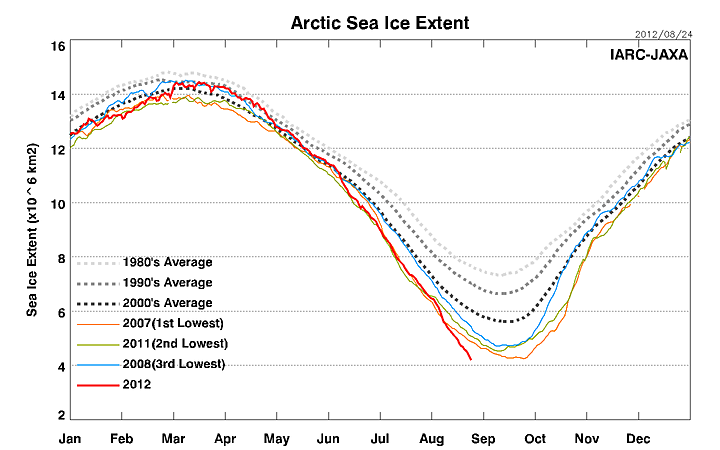
    According to IARC/JAXA satellite data at Arctic Sea-ice Monitor from the Japan Aerospace Exploration Agency, the sea-ice extent of 24 August 2012 of 4,189,375 square kilometres broke the previous record in the satellite era of 4,254,531 square kilometres set on 24 August 2007. Back then the were scientific gasps that the sea ice was melting “100 years ahead of schedule”.
    [The 24 August figure is subject to revision the next day, the but point remains that record has been broken or will be broken in next day or two. The NSIDC chart using 5-day running averages, so it is a few days behind.]

    JAXA Arctic sea ice extent to 24 August 2012. Updates: http://www.ijis.iarc.uaf.edu/en/home/seaice_extent.htm

    What is astounding is that the record has been broken with three to four weeks of the melt season to go, and that the rate of melting this month is unprecedented in the modern record. Check the chart above (click to enlarge), with the red line mapping 2012 sea-ice extent. The slope of the line is much steeper than in previous years for August.

    For full article click here.

  • Western Antarctic Ice Shield

    Western Antarctic Ice Shield

    Geoff Thomas has written: Something receiving little attention world wide that would seem to me very important is the Western Antarctic Ice Shield, (WAIS)
    as it could soon contribute over 3 metres of ocean rise and in the long term almost 5 metres, – I have been watching the WAIS situation as possible over the last few years and the situation there has deteriorated, particularly with the instability of the ice shields into the Amundsen sea and the increasing flows from the Thwaites, Smith and Pine Island Glaciers, which are now contributing an increasing portion of the world annual sea rise, – should those Ice Shields blocking flow from those three glaciers into the Amundsen Sea significantly collapse, a process already happening with no reliable prediction method to know how quickly or when, a good metre of sea level rise could happen in a month or two, as the unimpeded glaciers accelerate into the ocean.
    Those three glaciers drain area containing ice total that would cause 2 metres in sea level rise if completely melted, so just how much would let go is hard to know, – we do know the Antarctic Archipeligo broke up very quickly.
    In my opinion, if one or two of those glaciers accelerated enough to cause say half a metre in sea level rise I believe that would wake up the world without wiping it out, – I find myself actually wishing such a milder calamity would occur, to perhaps cause humanity to act enough to be spared far far worse.
  • Methane from Arctic permafrost is the most feared tipping point

    Methane from Arctic permafrost is the most feared tipping point

    These reports on thawing Siberian permafrost are signs that the tipping point may have been reached. This is when through feedback there is no stopping runaway global heating. They are chilling because methane is more than twenty times more powerful in global warming than carbon dioxide. Also, over hundreds of millions of years spikes in global temperature have always been associated with spikes in methane release.

    Methane turns into CO2. There is twice as much carbon held in permafrost than in the atmosphere. The Arctic region is experiencing twice the global average of climate warming. Add these figures up, and ask why we are doing so little.

    Carbon release in Siberia.

    Less carbon being absorbed in Arctic.

    Arctic warming feedback loops.

    Abrupt permafrost thawing.


  • Hundreds battle fires threatening coastal Spain

    More severe weather events/ severe flooding in England , heat and wildfires in the US. Our turn will come next summer.


    Hundreds battle fires threatening coastal Spain

    Updated 18 minutes ago

    A huge bushfire is threatening the wealthy Spanish resort of Marbella.

    Unusually dry weather has contributed to a series of fires in the country after a prolonged heatwave left much of Spain’s countryside tinder-dry.

    At least one person has died in the fires at Spain’s popular upmarket holiday destination, Costa del Sol.

    Around 800 people – firefighters and emergency military personnel, backed by 31 planes and helicopters – battled the blaze, which was fanned by warm, dry winds in southern Spain, officials said.

    Flames licked the tree tops, lighting up the sky in the early hours as a 12 kilometre line of fire glowed across the Sierra Negra mountains by the Costa del Sol resort.

    The inferno, which reportedly forced up to 5,000 people from their homes, also left a couple with major burns, and sent a mother and her two children scurrying into a cave to escape the danger.

    A British man’s corpse was found in a small rural home near Ojen, not far from Marbella, despite an evacuation order the previous night, a spokesman for the Andalusia regional government said.

    The 78-year-old man’s burnt corpse was found near the remains of the house, which had been consumed by flames.

    A search of the ruins found no other victims.

    Another five people were taken to hospital, among them a Spanish couple in their 50s, who sustained second and third-degree burns over about two-thirds of their bodies, the government spokesman said.

    “They are in a serious state with mechanical ventilation,” he said.

    The flames reached their chalet in the district of Rosario in the foothills of the mountains overlooking long white beaches along the Mediterranean coast, Spanish media said.

    A 40-year-old mother and her two children, one aged three and the other 11, took refuge from the inferno in a cave, and were treated for bruises and given oxygen in hospital, officials said.

    High fire risk


    The inferno broke out on Thursday afternoon (local time) and rapidly gained strength into the night.

    “The whole mountainside was burning,” one evacuated resident, Catherina, told Spanish news agency Europa Press.

    “At dusk you could see the full glare of the fire and the sky was entirely covered in red,” a resident from near Marbella said.

    Early Friday morning, the wind died down and a brief sprinkling of rain fed hopes for relief.

    Ojen’s 3,000 residents were all evacuated as a thick cloud of smoke billowed in the cinder-clogged air. Surrounding trees were blackened by the fire.

    However, residents in other parts of the scorched region were allowed to return home.

    In the late afternoon, firefighters were focussing on hotspots near Ojen and trying to prevent the fire spreading into new areas after it jumped a highway, officials said.

    Spain’s major Mediterranean motorway was briefly cut off, but reopened in the afternoon.

    Marbella’s beaches and vibrant night life attract about 1.5 million foreign tourists a year, mostly Britons but also Nordic visitors and Germans, French, Italians, Dutch and Belgians.

    Spain is at particularly high risk of fires this summer after suffering its driest winter in 70 years, and blazes have broken out in various parts of the country in recent days.

    Flames destroyed more than 153,000 hectares of land between January 1 and August 26, three times the amount during the same time last year and the highest amount in a decade, according to agriculture ministry figures.

    There have been major wildfires in northern Catalonia, near the Pyrenees, and on La Gomera, in the Canary Islands.

    ABC/AFP

    Topics:fires, disasters-and-accidents, spain

    First posted 1 hour 58 minutes ago