Author: admin

  • Uphill battle for electricity eating trains

    Uphill battle for electricity eating trains

    0
    cityrail train

    CityRail has to limit the number of Waratahs because the trains are too power hungry. Picture: John Grainger Source: The Daily Telegraph

    THE problem-plagued Waratah train will not regularly be seen on two of Sydney’s busiest train lines for at least two years because of power problems.

    CityRail has to limit the number of Waratah trains running up hill on the North Shore Line because the power-hungry trains draw too much energy on the climb towards Hornsby.

    The problem will also affect passengers catching trains on the Western Line because the two lines are linked.

    It means only a certain number of Waratah trains can be on the line at any one time, with passengers destined to be crammed on to 30-year-old non-airconditioned trains more often until the problem is fixed.

    RailCorp is upgrading power supply across the network, but work is not expected to be completed on the North Shore Line for at least two years.

    “The North Shore Line is the worst affected because of the steep grades and the trains have to use much more power,” one source said. “Why they would leave that line for so long before upgrading is anyone’s guess.”

    The power supply problem is similar to one that affects newer trains in the Epping to Chatswood tunnel, where the steep grades means more modern trains are unable to access the line.

    Other glitches continue to plague the new trains, with Downer EDI installing new software to try to fix a fault that causes the doors between carriages to open by themselves.

    A spokesman for CityRail said a program of infrastructure works was being carried out across the network, including on the North Shore Line, to upgrade the electrical systems for the Waratah trains as they are rolled out.

    Software upgrades were “routine” across all train fleets, she said.

    CityRail has taken possession of 12 of the new trains from Downer EDI’s Hunter Valley workshop, with 11 in operation across the network.

    But the program continues to slip behind schedule. In February Downer EDI promised to deliver 12 trains by June 30, but the last train arrived in July.

    The company will provide a full update when it announces its full year results today.


  • Coal dust causes concern in the playground

    Coal dust causes concern in the playground

    Date
    August 13, 2012
    • 10 reading now
    • 44

    Alison Branley

    Repeat offender ... coal railways in the Hunter affect more than 23,000 students.

    Repeat offender … coal railways in the Hunter affect more than 23,000 students. Photo: Dean Osland

    MORE than 23,000 students at about 60 Hunter schools within 500 metres of the region’s coal railway spend their lunchtimes breathing air filled with coal dust from passing trains.

    Many also spend their days in classrooms without airconditioners or air filters to protect them from damaging particulates in the dust.

    Singleton GP Dr Tuan Au has been investigating a link between open-cut mining operations and rising respiratory illness in his community and has thrown his support behind a campaign to put covers on the trains.

    The Maitland-Newcastle Diocese Catholic Schools Office said two primary schools, St James in Muswellbrook and St Joseph’s Denman, had dust-monitoring devices. Precautions were also taken at St Catherine’s Catholic College in Singleton, where staff brought students indoors when it was windy or dusty.

    ”The Catholic Schools Office and its schools follow the advice of Hunter New England Health, however [they] are open to all initiatives that lead to cleaner air,” an office spokeswoman said.

    A NSW Education Department spokesman said it had not been approached by any school raising coal dust as a health issue.

    ”The department and schools would co-operate with the health or environmental authorities if they saw schools as having a role to play,” he said. ”Any parents with concerns are advised to seek medical advice.”

    The chief executive of the NSW Minerals Council, Stephen Galilee, said it was important to monitor air quality and establish the facts.

    ”We’re keeping a close eye on the progress of this work so we can develop the right response and implement better methods of dust suppression,” he said.

    Dr Au said the longer children were exposed to pollution, the more lung damage was caused.

    Read more: http://www.smh.com.au/environment/coal-dust-causes-concern-in-the-playground-20120812-242kp.html#ixzz23NXBG2vh

  • Report undermines need for power sale

    Report undermines need for power sale

    Date
    August 13, 2012
    • 17 reading now
    • 34
    alt

    “It’s now official, NSW does not need any baseload generation for at least 10 years” … opposition energy spokesman, Luke Foley. Photo: Janie Barrett

    NSW will not need a new power generator for another 10 years, says a report that has raised questions about the government’s decision to sell the state’s generators to avoid the need to spend billions of dollars on boosting future supply.

    A report commissioned by the Labor government in 2007 predicted NSW would need a new generator by 2014 to avoid blackouts, prompting Labor’s decision to privatise power generation.

    The O’Farrell government has continued to argue NSW would need to spend $6 billion to $7 billion on new baseload power generation unless state-owned generators were privatised.

    The opposition energy spokesman, Luke Foley, said forecasts for energy supply needs had fallen in the past four years for a range of reasons, including the global financial crisis, a decrease in energy use due to higher bills, and an increased uptake of solar energy.

    The Australian Energy Market Operator released a report last week that says NSW does not need to increase its power supply until 2022.

    ”It’s now official, NSW does not need any new baseload generation for at least 10 years,” Mr Foley said. ”Mr O’Farrell’s argument that more than $6 billion needs to be spent on new baseload has been blown out of the water. That argument for privatisation of generation no longer exists.”

    However, the Treasurer, Mike Baird, yesterday stood by what he said in late May, when Parliament passed legislation to allow the state’s power generators to be sold. He maintains the privatisation will avoid the need for the government to invest more than $6 billion on future baseload generation and that the money would be better spent on much-needed infrastructure.

    Mr Baird said yesterday that forecasts of demand for electricity supply had fallen as a result of the global financial crisis and price increases, to which the federal government’s carbon tax would also contribute. But while it was impossible to know whether the economy would improve during the next five years, planning could not be postponed.

    He said it was ”rubbish” to suggest the government did not need to start planning for electricity needs for another 10 years.

    ”It takes four to six years to get a generator up and running,” he said. ”We can’t wait for the supply and demand intersection to occur before we start planning.

    ”The forecast is there will be a supply and demand mismatch just after 2020. A prudent manager wouldn’t wait for the mismatch; they would ensure a buffer before it eventuated.

    ”The government’s view remains that outlay is best left to the private sector.”

    Read more: http://www.smh.com.au/environment/energy-smart/report-undermines-need-for-power-sale-20120812-242vq.html#ixzz23NWURzvJ

  • tHEY’RE FORCING US OFF OUR LAND (avaaz)

    Dear friends,


    Middle Eastern kings and princes are about to force up to 48,000 people in Tanzania from their land to make way for corporate-sponsored big game hunting. But Tanzanian President Kikwete has shown before that he will stop deals like this when they generate negative press coverage. Click to deliver a media blitz that will push President Kikwete to stop the landgrab and save these Maasai.


    At any moment, a big-game hunting corporation could sign a deal which would force up to 48,000 members of Africa’s famous Maasai tribe from their land to make way for wealthy Middle Eastern kings and princes to hunt lions and leopards. Experts say the Tanzanian President’s approval of the deal may be imminent, but if we act now, we can stop this sell-off of the Serengeti.


    The last time this same corporation pushed the Maasai off their land to make way for rich hunters, people were beaten by the police, their homes were burnt to a cinder and their livestock died of starvation. But when a press controversy followed, Tanzanian President Kikwete reversed course and returned the Maasai to their land. This time, there hasn’t been a big press controversy yet, but we can change that and force Kikwete to stop the deal if we join our voices now.


    If 150,000 of us sign, media outlets in Tanzania and around the world will be blitzed so President Kikwete gets the message to rethink this deadly deal. Sign the petition now and send to everyone:


    http://www.avaaz.org/en/save_the_maasai_a/?bhPqncb&v=17057


    The Maasai are semi-nomadic herders who have lived in Tanzania and Kenya for centuries, playing a critical role in preserving the delicate ecosystem. But to royal families from the United Arab Emirates, they’re an obstacle to luxurious animal shooting sprees. A deal to evict the Maasai to make way for rich foreign hunters is as bad for wildlife as it is for the communities it would destroy. While President Kikwete is talking to favoured local elites to sell them on the deal as good for development, the vast majority of people just want to keep the land that they know the President can take by decree.


    President Kikwete knows that this deal would be controversial with Tanzania’s tourists — a critical source of national income — and is therefore trying to keep it from the public eye. In 2009, a similar royal landgrab in the area executed by the same corporation that is swooping in this time generated global media coverage that helped to roll it back. If we can generate the same level of attention, we know the pressure can work.


    A petition signed by thousands can force all the major global media bureaus in East Africa and Tanzania to blow up this controversial deal. Sign now to call on Kikwete to kill the deal:


    http://www.avaaz.org/en/save_the_maasai_a/?bhPqncb&v=17057


    Representatives from the Maasai community today urgently appealed to Avaaz to raise the global alarm call and save their land. Time and again, the incredible response from this amazing community turns seemingly lost causes into legacies that last a lifetime. Lets protect the Maasai and save the animals for tourists that want to shoot them with camera lenses, rather than lethal weapons!


    With hope and determination,


    Sam, Meredith, Luis, Aldine, Diego, Ricken and the rest of the Avaaz team


    For More Information:


    The Guardian: “Tourism is a curse to us”

    http://www.guardian.co.uk/world/2009/sep/06/masai-tribesman-tanzania-tourism


    News Internationalist Magazine: “Hunted down”

    http://www.newint.org/columns/currents/2009/12/01/tanzania/


    Society for Threatened People: Briefing on the eviction of the Loliondo Maasai

    http://lib.ohchr.org/HRBodies/UPR/Documents/session12/TZ/STP-SocietyThreatenedPeople-eng.pdf


    FEMACT: Report by 16 human rights investigators & media on violence in Loliondo

    http://www.pambazuka.org/en/category/advocacy/58956/print


    Voices of Loliondo: Short film from Loliondo on impact of eviction on Maasai


    Support the Avaaz Community!


    We’re entirely funded by donations and receive no money from governments or corporations. Our dedicated team ensures even the smallest contributions go a long way.


    Avaaz.org is a 15-million-person global campaign network that works to ensure that the views and values of the world’s people shape global decision-making. (“Avaaz” means “voice” or “song” in many languages.) Avaaz members live in every nation of the world; our team is spread across 19 countries on 6 continents and operates in 14 languages. Learn about some of Avaaz’s biggest campaigns here, or follow us on Facebook or Twitter.


    You are getting this message because you signed “Save our dying planet!” on 2011-12-08 using the email address nevilleg729@gmail.com.

    To ensure that Avaaz messages reach your inbox, please add avaaz@avaaz.org to your address book. To change your email address, language settings, or other personal information, https://secure.avaaz.org/act/index.php?r=profile&user=6be3e9aa63582c9b1397464fcc49baa9&lang=en, or simply go here to unsubscribe.


    To contact Avaaz, please do not reply to this email. Instead, write to us at www.avaaz.org/en/contact or call us at +1-888-922-8229 (US).

  • Why the EU will not Survive

    Why the EU will not Survive


    Posted: 10 Aug 2012 03:35 PM PDT


    The problem, I think, is much more serious than Rajoy’s flunking hard choices, and I don’t think there was anything he could do to increase the country’s credibility in a significant way. We have long passed that stage.?Why? Because, as I have been suggesting for the last six to twelve months, Spain has already started on its downward spiral and there is almost nothing Rajoy or anyone else can do to prevent all parts of the economy – workers, small businesses, large businesses, creditors, depositors, and yes, policymakers…

    Read more…

  • CLIMATE CODE RED Extensive melt over the Greenland Ice Sheet.

    Climate News

    Posted: 11 Aug 2012 08:13 PM PDT

    Week ending 12 August 2012

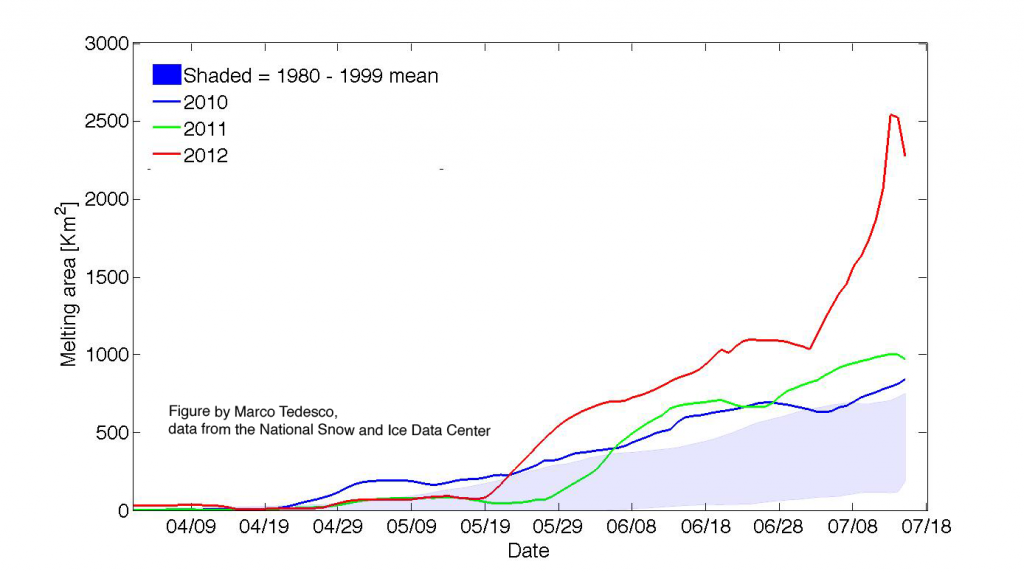
    Extensive melt over the Greenland Ice Sheet. This figure shows the daily, cumulative area of the Greenland ice sheet showing surface melt for 2012, 2011, 2010 and for the 1980 to 1999 mean. While melt was unusually extensive through May and June of 2012, the melt area increased rapidly in early July in response to an unusually warm weather event. Source: http://nsidc.org/arcticseaicenews/2010/08/a-most-interesting-arctic-summer/figure6-2/