Author: admin

  • TIPPING POINTS-THE FACTS. COURTESY of DR JOHN JAMES

    TIPPING POINTS-THE FACTS. COURTESY of DR JOHN JAMES

    When the temperature gets high enough to cause forests to give up their CO2 rather than sequest it, then every tonne of gas given up to the air increases the temperature and causes even more gas to be given up. This is a tipping point – an irreversible moment when the dreaded feedback loop begins.

    This is now the central issue for the scientific community: have humans already have gone too far, and may we now be helpless to stop abrupt and runaway global warming.

    These ten major tipping points are are right at this moment being triggered.

    • Melting glaciers will raise sea levels so that less heat is reflected out to space
    • Decline of the flow of fresh water from the Arctic will collapse the Gulf Stream
    • Forests will no longer absorb carbon, but become a source.
    • Methane clathrates held in the mud under the sea begin to burp
    • Melting permafrost releases vast quantities of methane
    • Drought kills the Amazon forest and its carbon sink is released
    • The benefits of being shielded by global dimming ceases
    • Bush fires increase the carbon load and reduce the storage capacity of forests
    • As oceans warm the seas absorb less carbon
    • All the above plus disastrous weather and coral bleaching and acidification of the oceans disrupt food production

    Triggering any one of these ten carbon sinks would cause
    runaway greenhouse warming.
    The triggering of any one of them would start off the others.

    The earth has over eons stored greenhouse gasses in forests, the soil and in the oceans. Recent scientific research has shown that small rises in temperature can trigger these sinks into becoming sources, and thus tip the scales against our survival.

    Only now, in the past five years, has the scientific community begun to pat serious attention to them. We do not know if they will be triggered today or in decades, It seems there is a ten percent possibility that feedback loops from glacial-meltdown, permafrost methane burping and/or rainforest collapse will commence within the next few years.

    Only intense and immediate action beyond anything the
    world has ever done can stop this.

    If all the good intentions from the Kyoto and Montreal meetings were to be executed in full and immediately, they would not alter the outcome. Like Munich, these agreements were set by politicians playing for time. This is discussed in Footprints #2.

    The graph shows the range of temperatures possible by the end of the century from computer modeling. The latest ICCC meeting added 50% to these figures.

    Taken together, concentrations of CO2 and methane have passed the threshold of 400ppm set as the upper limit of safety by the International Conference on Climate Change. This is of the most enormous significance.

    It means we have actually entered the era of dangerous climate change.

    We have already reached the point where our children
    can no longer count on a safe environment.

    The Earth is about to be trapped in a vicious cycle of positive feedback, which is why the issue is so serious and urgent. Any extra heat from any source (especially human activity) is amplified, and as it is added this sets off other processes so that heating is accelerating.

    It is the self-regulating mechanism of Gaia itself that, perversely, will make it hard to master global warming – because the system contains feedback mechanisms that in the past have acted in concert to keep the Earth much cooler than it otherwise would be. Now, however, they could easily combine to amplify the warming being caused by our activities.

    It is NOT too late to minimise the risks – read what YOU can do
    Personally and Politically

    Tragically, there are no large negative feedbacks that would reverse the heating process – save the weathering of rocks and occasional fierce tropical storms. Neither can compete.

    We are interfering with the natural regulating systems of the planet by increasing our own input while limiting the natural systems that would regulate it.

    Global warming will submerge many low-lying island nations in an unstoppable process. Increased numbers of cyclones, droughts and floods are making life unviable for the people on the Carteret atolls in Papua New Guinea. Already 980 have had to be evacuated. Many were starving because rising salt water has destroyed their trees and stopped them growing greens and breadfruit. Next may be the small island nation of Kiribati of 33 small atolls, none of which is more than 2 meters above the Pacific. It is only a matter of time before the entire country is submerged by the rising sea. Also the Tuvalu people have had to arrange for the evacuation of the entire 10,000 population to New Zealand.

    For these people, the tipping point has already occurred.

  • X-Rays Show Origins of Volcano Hot Spots

    X-Rays Show Origins of Volcano Hot Spots
    iScienceTimes.com
    Most volcanoes are found where continental tectonic plates push or pull against one another, but volcanic hot spots are formed completely differently because they are found far away from plate boundaries. The chain of Hawaiian islands are thought to
    See all stories on this topic »

    iScienceTimes.com
    Volcano activity of July 18, 2012 – Merapi, Nyiragongo, Bagana, Dukono 
    Earthquake Report
    Volcano-tectonic seismicity remains high at Popocatepetl (Mexico) today (events on the seismogram between 15 UTC and 18 UTC are repeating due to a software “glitch”, not natural causes). Exhalations of gas and ash are also more numerous, averaging 
    See all stories on this topic »

    Earthquake Report
  • Environmental concerns increasing infectious disease in amphibians, other animals

    ScienceDaily: Earth Science News


    Environmental concerns increasing infectious disease in amphibians, other animals

    Posted: 18 Jul 2012 11:36 AM PDT

    Climate change, habitat destruction, pollution and invasive species are all involved in the global crisis of amphibian declines and extinctions, researchers suggest in a new analysis, but increasingly these forces are causing actual mortality in the form of infectious disease.

    X-rays illuminate the origin of volcanic hotspots

    Posted: 18 Jul 2012 10:17 AM PDT

    Scientists have recreated the conditions at Earth’s core-mantle boundary 2,900 km beneath the surface. Using X-rays at the European Synchrotron Radiation Facility, they probed tiny rock samples at extreme temperature and pressure showing for the first time that partially molten rock under these conditions is buoyant and should segregate towards the surface. This observation is strong evidence for the theory that volcanic hotspots like the Hawaiian Islands originate from mantle plumes generated at the core-mantle boundary.
    You are subscribed to email updates from ScienceDaily: Earth Science News
    To stop receiving these emails, you may unsubscribe now.
    Email delivery powered by Google
    Google Inc., 20 West Kinzie, Chicago IL USA 60610
  • China’s online population rises to 538 million, driven by rapid growth

    News 10 new results for POPULATION GROWTH
    China’s online population rises to 538 million, driven by rapid growth of mobile 
    Washington Post
    BEIJING — China’s population of Internet users, already the world’s biggest, has risen to 538 million, driven by rapid growth in wireless Web surfing, an industry group said Thursday. The latest figure represents an 11 percent increase from a year earlier, 
    See all stories on this topic »
    PRB 2012 World Population Data Sheet: Poor Countries Grow as Rich Countries 
    MarketWatch (press release)
    WASHINGTON, July 18, 2012 /PRNewswire via COMTEX/ — Nearly all future population growthwill be in the world’s less developed countries, and the poorest of these countries will see the greatest percentage increase. In contrast, developed countries as a 
    See all stories on this topic »
    BMO: Hot Halifax economy could be sunk by stalled population growth
    TheChronicleHerald.ca
    A new report examining Halifax’s economy paints a portrait of a city with surging employment, a flourishing private sector and a red-hot housing market. But reconciling a massive job boom with sputtering population growth threatens to take the wind out of 
    See all stories on this topic »
    Homeopaths in the US Industry Market Research Report Now Available from 
    San Francisco Chronicle
    The aging population and struggling US economy have fostered mounting interest in homeopathic healing methods. This trend has spurred growth in the Homeopaths industry, with double-digit salesgrowth in recent years. Although significant concerns 
    See all stories on this topic »
    Census 2011: Leader believes Peterborough population growth larger than 
    Peterborough Telegraph
    Huge levels of migration have been highlighted as the main reason why Peterborough local authority area saw the ninth largest population rise between 2001 and 2011 in England and Wales. The number of people living in the area rose to 183600 as of 
    See all stories on this topic »
    Dubai’s Population To Grow 4%
    Gulf Business News
    “This is an ambitious but realistic goal which would see the population increase on average by four per cent, which will, in turn, drive further economic growth,” it said. Stephen Pettyfer, head of MENA Research at BofA Merrill Lynch Global Research said: 
    See all stories on this topic »

    Gulf Business News
    Jordan- ‘Family planning most effective solution to rapid population growth
    MENAFN.COM
    He added that promoting the use of modern family planning through “up-to-date”, easily accessible and easily understood health communication materials is one of the most effective means of achieving lower fertility rates and slower population growth.
    See all stories on this topic »

    MENAFN.COM
    Apple Valley Population Growth in Metro-Area Top 10 for 2010-11
    Patch.com
    From 2010 to 2011, Rosemount added 255 people to its population, according to Met Council statistics. In a statement, Met Council Chair Susan Haigh said she’s “pleased to see growthoccurring primarily where there’s infrastructure to support it. “Growth that 
    See all stories on this topic »
    Baby boom to boost populations of some of poorest countries
    Washington Times
    The world now averages about 267 births per minute, with nearly all the growthattributed to the world’s poorest countries in the developing world, according to thePopulation Reference Bureau’s (PRB) 2012 World Population Data Sheet. The world’s 
    See all stories on this topic »

    Washington Times
    Dubai set to beat projections
    Khaleej Times
    The global bank, in its latest report, observed Dubai’s superior infrastructure investment and robust population growth have established solid foundations for its economic trajectory. Stephen Pettyfer, head of Mena Research at BofA Merrill Lynch Global 
    See all stories on this topic »

    Khaleej Times


    Tip: Use quotes (“like this”) around a set of words in your query to match them exactly. Learn more.

    Delete this alert.
    Create another alert.
    Manage your alerts.

  • Dumping iron at sea can bury carbon for centuries, study shows

    Dumping iron at sea can bury carbon for centuries, study shows

    Iron fertilisation creates algae blooms that later die off and sink, taking the absorbed carbon deep towards the ocean floor

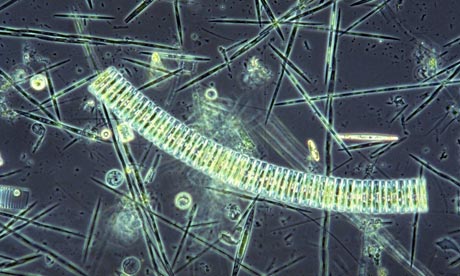
    Damian on Plankton  fertilisation with iron on the research vessel 'Polarstern' of the AWI

    A magnified view of the plankton three weeks after its fertilisation with iron. Photograph: Philipp Assmy/Awi/EPA

    Dumping iron into the sea can bury carbon dioxide for centuries, potentially helping reduce the impact of climate change, according to a major new study. The work shows for the first time that much of the algae that blooms when iron filings are added dies and falls into the deep ocean.

    Geoengineering – technologies aimed at alleviating global warming – are controversial, with critics warning of unintended environmental side effects or encouraging complacency in global deals to cut carbon emissions. But Prof Victor Smetacek, at the Alfred Wegener Institute for Polar and Marine Research in Germany, who led the new research, said: “The time has come to differentiate: some geoengineering techniques are more dangerous than others. Doing nothing is probably the worst option.”

    Dave Reay, senior lecturer in carbon management at the University of Edinburgh, said: “This represents a whole new ball game in terms of iron fertilisation as a geoengineering technique. Maybe deliberate enhancement of carbon storage in the oceans has more legs than we thought but, as the scientists themselves acknowledge, it’s still far too early to run with it.”

    A 2009 report from the Royal Society, the UK’s science academy, concluded that while cutting emissions is the first priority, careful research into geoengineering was required in case drastic measures – such as trying to block sunlight by pumping sulphate into the atmosphere – were one day needed.

    Prof John Shepherd, chair of the report, said on Wednesday: “It is important that we continue to research these technologies but governance of this research is vital to protect the oceans, wider environment and public interests.”

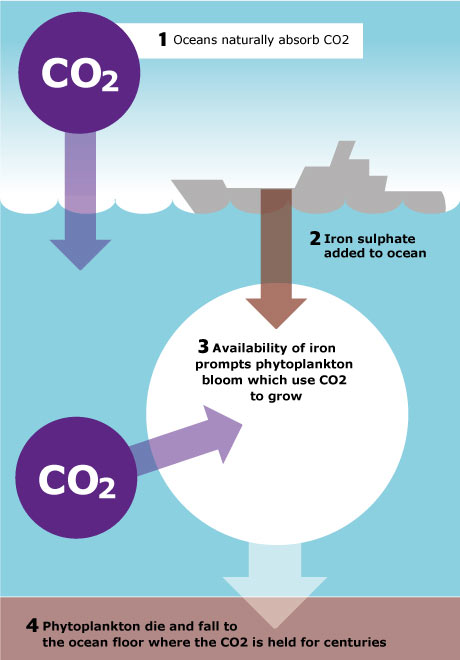
    Smetacek’s team added seven tonnes of iron sulphate to the ocean near Antarctica, where iron levels are extremely low. The addition of the missing nutrient prompted a massive bloom of phytoplankton to begin growing within a week. As the phytoplankton, mostly species of diatom, began to die after three weeks, they sank towards the ocean floor, taking the carbon they had incorporated with them.

    The scientists chose the experiment location carefully, within a 60km-wide self-enclosed eddy in the ocean that acted as a giant “test tube”. This meant that it was possible to compare what happened within the eddy with control points outside the eddy. After a month of monitoring nutrient and plankton levels from the surface to the depths the team concluded at least half of the bloom had fallen to depths below 1,000m and that a “substantial portion was likely to have reached the sea floor” at 3,800m.

    The scientists conclude in the journal Nature that the carbon is therefore likely to be kept out of the atmosphere for many centuries or longer.

    A dozen other experiments have shown that iron can prompt phytoplankton blooms, but this is the first study to show that the carbon the plants take up is deeply buried. Other researchers recognise the significance of this but warn of other issues that might prevent the iron fertilisation of the ocean as being a useful geoengineering technique.

    “The ocean’s capacity for carbon sequestration in low-iron regions is just a fraction of anthropogenic CO2 emissions, and such sequestration is not permanent — it lasts only for decades to centuries,” said Ken Buesseler, at the Woods Hole Oceanographic Institution in the US.

    Smetacek said ocean iron fertilisation could bury at most 1 gigatonne of CO2 per year compared to annual emissions of 8-9Gt, of which 4Gt accumulates in the atmosphere. But sequestering some CO2 could make the difference between crossing a climate “tipping” point, where feedback effects lead to runaway global warming, he said: “I don’t see what will stop Arctic sea ice from decreasing.”

    Michael Steinke, director of marine biology at the University of Essex, said: “Will this open up the gates to large-scale geoengineering using ocean fertilisation? Likely not, since the logistics of finding the right spot for such experiments are difficult and costly.”

    Smetacek responded that ocean iron fertilisation is much cheaper than other possible geoengineering techniques. He acknowledged more experiments were needed over longer periods to examine, for example, how many of the diatoms were eaten by krill, and then by whales, meaning they did not fall to the ocean floor.

    On the ethics of geoengineering, Smetacek, who is a vegetarian, told the Guardian: “We could reduce emissions significantly and increase the scope for sequestration on land [by freeing grazing land for forestry] if we managed to convert the global population to vegetarianism. Would that be geoengineering?”

    Iron filings and carbon burial Iron filings and carbon burial Illustration: guardian.co.uk

  • Number of boat arrivals tops 6,000 for year

    Number of boat arrivals tops 6,000 for year

    Updated July 19, 2012 10:56:51

    Immigration Department figures show more than 6,000 asylum seekers have arrived by boat this year.

    A boat carrying 25 people was stopped near Christmas Island last night – the eighth to be intercepted in the past six days.

    More than 4,000 people are in detention.

    Darwin’s Wickham Point facility and the Christmas Island Centre both hold more than 1,000 asylum seekers.

    The passengers from the latest boat are being taken to Christmas Island for health and security checks.

    Topics:refugees, christmas-island-6798, australia, darwin-0800

    First posted July 19, 2012 10:31:47

    Updated July 19, 2012 10:56:51

    Immigration Department figures show more than 6,000 asylum seekers have arrived by boat this year.

    A boat carrying 25 people was stopped near Christmas Island last night – the eighth to be intercepted in the past six days.

    More than 4,000 people are in detention.

    Darwin’s Wickham Point facility and the Christmas Island Centre both hold more than 1,000 asylum seekers.

    The passengers from the latest boat are being taken to Christmas Island for health and security checks.

    Topics:refugees, christmas-island-6798, australia, darwin-0800

    First posted July 19, 2012 10:31:47

    Updated July 19, 2012 10:56:51

    Immigration Department figures show more than 6,000 asylum seekers have arrived by boat this year.

    A boat carrying 25 people was stopped near Christmas Island last night – the eighth to be intercepted in the past six days.

    More than 4,000 people are in detention.

    Darwin’s Wickham Point facility and the Christmas Island Centre both hold more than 1,000 asylum seekers.

    The passengers from the latest boat are being taken to Christmas Island for health and security checks.

    Topics:refugees, christmas-island-6798, australia, darwin-0800

    First posted July 19, 2012 10:31:47