Author: admin

  • Landfills Contain Precious Metal Deposits 40-50 Times Richer than Mines

    From Arab Spring to American Summer: The Politics of Power Outages

    Posted: 09 Jul 2012 03:11 PM PDT

    Amidst record-high temperatures and a very anti-climactic 4th of July, power outages have left millions without air-conditioning and even water in rural areas where households rely on electric pumps.  At least 52 people have died from heat and three million people are still without power. No it’s not Yemen, where power outages in the capital Sana’a have sparked a new round of protests. It’s the United States of America, where corruption converges with a moribund electricity distribution system to produce increasingly frequent…

    Read more…

    Denmark to Lead EU in Going Green

    Posted: 09 Jul 2012 03:02 PM PDT

    Amidst the on-going roiling European Union debate over the organization’s crisis, politicians in Brussels have been scrambling to construct a fiscal policy that will shore up the organization’s common currency, the Euro.But the on-going hardball fiscal discussions have laid bare the fact that, quite aside from a common financial policy, the EU suffers from a number of sovereign disconnects as well, and one of the most notable of these is energy policy.In Spain, the government is preparing to raise taxes on renewable energy generation…

    Read more…

    Cold Fusion: Progress Report

    Posted: 09 Jul 2012 02:57 PM PDT

    Your humble writer has been watching for the news out of the International Low Energy Nuclear Reactions Symposium, ILENRS-12 held at The College of William and Mary Sadler Center early last week.  At long last, after years of little available event news we’re getting some interesting bits out.The process of Low Energy Nuclear Reactions  (LENR) or Cold Fusion or your choice on an array of ideas on what to call it, have required the element palladium as a catalyst, that isn’t consumed, but represents an expensive initial outlay. …

    Read more…

    Shell’s Arctic Oil Spill Recovery Barge Refused Coast Guard Certificates

    Posted: 09 Jul 2012 02:43 PM PDT

    In the event of an offshore oil spill in the Arctic, Shell has previously admitted it can only “encounter” most of the oil in the frigid, pristine waters — not clean it up. However, it may lack the resources to do even that.As Shell’s fleet sails north to prepare offshore drilling in Arctic waters, Shell’s oil spill recovery barge, the Arctic Challenger, remains docked in northern Washington after failing to receive Coast Guard certification. The Los Angeles Times reports:The delay in certification adds another notch…

    Read more…

    Changing the Definition of ‘Oil’ to Make the Figures Look Better

    Posted: 09 Jul 2012 02:34 PM PDT

    Everyone knows that world oil production has been running between 88 and 89 million barrels per day (mbpd) this year because government, industry and media sources tell us so. As it turns out, what everyone knows is wrong.It’s wrong not because the range quoted above can’t be found in official sources. It’s wrong because the numbers include things which are not oil such as natural gas plant liquids and biofuels. If you strip these other things out, then world oil production has been running around 75 mbpd this year. The main thing you need to know…

    Read more…

    Norwegian Oil Companies to Shutdown All Oil Production at Midnight

    Posted: 09 Jul 2012 02:19 PM PDT

    The strike between offshore Norwegian oil workers and the oil companies is now into its third week with little progress made in the talks over pensions. The oil companies have been hoping that the Norwegian government will step in to force a resolution to the problem, however the Labour-led coalition government has been reluctant to intervene due to the upcoming elections at the end of this year, in which the trade unions are wield a lot of power.In order to try and force the governments hand a little Eli Ane Nedreskaar, a spokeswoman for the Norwegian…

    Read more…

    Landfills Contain Precious Metal Deposits 40-50 Times Richer than Mines

    Posted: 09 Jul 2012 02:18 PM PDT

    Technology advances at a phenomenal rate in the consumer electronic device market, with more efficient, faster, lighter, more powerful devices being released each year. This means that each year thousands of tonnes of devices are discarded as newer versions replace them, in fact e-waste is one of the fastest growing components of human waste. Not only is the quantity of waste vast, but also the value in terms of precious metals and plastics, which could be recovered and recycled. According to experts at the first ever Global e-Sustainability Initiative…

    Read more…

  • Nuclear waste-burning reactor moves a step closer to reality

    Nuclear waste-burning reactor moves a step closer to reality

    Feasibility study shows GE-Hitachi’s proposed Prism fast reactor could offer a solution to the UK’s plutonium waste stockpile

    Nuclear MOX plant : recycling nuclear waste : Submerged Spent Fuel Elements with Blue Glow

    Spent nuclear fuel elements spend two years submerged in a special storage tank. A plan to burn Britain’s radioactive nuclear waste as fuel in a next-generation reactor moved a step closer to reality on Monday. Photograph: Roger Ressmeyer/Corbis

    A plan to burn Britain’s radioactive nuclear waste as fuel in a next-generation reactor moved a step closer to reality on Monday when GE-Hitachi submitted a thousand-page feasibility report to the UK’s Nuclear Decommissioning Authority (NDA).

    The UK has a large stockpile – around 100 tonnes – of plutonium waste. This is considered a security risk and the government is considering options for its disposal. The current “preferred option” is to convert the plutonium into mixed-oxide fuel (Mox) for use in conventional nuclear reactors.

    But a previous Mox plant in the UK was deemed a failure, and GE-Hitachi claims that its Prism fast reactor – a completely different design fuelled by plutonium and cooled by liquid sodium – offers a more attractive solution.

    One of the potential benefits of fast reactors is that they could extract large quantities of energy from nuclear waste. In February, David MacKay, the chief scientist at the Department of Energy and Climate Change (Decc) told the Guardian there was enough energy in the UK’s waste stockpile to power the country for more than 500 years.

    The NDA initially dismissed fast reactors as being decades from commercial viability. But after the Prism proposal was submitted by GE-Hitachi, the NDA agreed to review the evidence. Monday’s report – a summary of which has been seen by the Guardian – is designed to persuade the NDA that the Prism is technically credible and commercially attractive.

    The report includes an assessment from consultancy firm DBD Limited that suggests there are “no fundamental impediment(s)” to the licensing of the Prism in the UK. It also includes an outline of the proposed business plan, which would involve the plant being owned by a private company and the government paying a fee for each tonne of plutonium processed.

    Senior figures at GE-Hitachi told the Guardian that this “service model” was designed to reduce the risk to the taxpayer. But they declined to give any detailed cost estimates and acknowledged that the government would still need to contribute towards the cost of building the plant.

    The NDA has also received three other proposals for disposing of the plutonium. Two were from individuals and weren’t considered credible. The third involves burning Mox fuel in a Canadian-style Candu reactor. A detailed feasibility report on this option is currently being prepared.

    A spokesman for the NDA said it will review the Prism and Candu reports and update its advice to the government towards the end of the year. The government will then make a final decision and the proposal selected will be referred to the Office of Nuclear Regulation.

    Whichever technology is selected, there will be an extensive licensing and consultation process. This and the construction of the new facility will most likely take around 10 years, according to the NDA, which said it expects the new plant to be up and running in “the early years of the next decade”.

  • Julia Gillard in need is a Green friend indeed


    Julia Gillard in need is a Green friend indeed

    0
    Gillard

    NSW Labor’s broadside against the Greens has left PM Julia Gillard marooned. Picture: AFP Source: AFP

    NSW Labor’s massive broadside against the Greens has left Julia Gillard looking like a general who wasn’t told the war had started.

    The move by the party machine to preference the Greens last is about the long-term future of Labor, beyond the current commander.

    It left the prime minister marooned, left to make deflective noises about how it was a matter for the party’s organisational wing.

    The only thing keeping her company are the policies she has given life to in order to appease the Greens, most notably the deeply unpopular carbon tax.

    Photos of the PM sitting with former Greens leader Bob Brown, both wearing sprigs of wattle as a happy Wayne Swan and a collection of Greens MPs watched on, can only haunt Gillard all the more now as the party machine try to chart their own course.

    Labor MPs were furious with the Greens for failing to back an effective offshore asylum policy during the last parliamentary sitting week before the long winter break.

    Their blinkered commitment to onshore processing with just vague policy hopes of stopping boats through an ill-defined regional co-operation scheme was called “loopy” by Swan this week.

    But party operatives aren’t just looking to touch up the Greens over that, they are declaring the friendship over – Labor style.

    Sections of the party in NSW want the links to the Greens to end in a bloodbath for the minority party.

    It would signal a shift away from inner city boutique issues and back to Labor’s heartland of workers and battlers.

    Their gamble is the Greens would be so desperate for the minority government – in which they have the balance of power in the senate and share it in the house of representatives – to continue for as long as possible they won’t pull out of a deal to prop up the Gillard government.

    Labor machine men believe the Greens could be left with as few as two senators if the ALP preferences them last.

    “We have to stop treating them like they are part of the family, we need to treat them like a cold calculating political party, which is what they are,” one said yesterday.

    NSW Labor Secretary Sam Dastyari will move a motion at this weekend’s Labor conference to stop the “automatic preferential treatment in any future preference negotiations”.

    The Coalition has decried the move as like stage-managed world championship wrestling.

    But while chest-thumping about dumping the Greens from the Labor family is a political tactic, the startling element is that it does not appear Gillard was in on the plan.

    Dastyari has the support of union chief Paul Howes, who helped Gillard rise to PM, because he says the Greens are “cannibalising the progressive vote”.

    Labor’s chief government whip Joel Fitzgibbon has also questioned Labor’s links with the Greens.

    Dastyari’s move would also settle an old score for the NSW wing of Labor.

    At the 2011 state election the Greens effectively preferenced Labor in the same spot as One Nation in the legislative council, meaning their preferences exhausted before delivering any benefit to Labor, leaving it almost wiped out as a major party.

    The party interpreted the move as a “cold, calculated political decision to inflict maximum damage to NSW Labor at its worst point” – a gesture the party would now happily return.

    NSW has also had more experience of some of the zanier Greens policies, where Greens MPs have often looked not just like “watermelons” – green on the outside but red on the inside – but simply red all the way through.

    One example cited by one Labor source was NSW Greens senator and former communist Lee Rhiannon’s contribution to the second airport debate for Sydney.

    The senator sent out a press release in April headed “Sydney Airport solution”.

    Except it wasn’t much of a solution. Her plan was to close down Kingsford Smith and move it outside the Sydney basin and connect to it via high speed rail.

    There were no costings, not even a location for this airport the Greens want.

    It was the lofty idealism of the Greens’ asylum policy which led Victorian Opposition Leader Daniel Andrews to declare yesterday the Greens are on a “different planet”.

    “Their (the Greens’) main game is holding themselves hostage if you like … an evangelical idealism that achieves nothing,” he said.

    But the difficulty for Gillard is that while the party dumps the Greens, she is welded to them thanks to the carbon tax and her minority government deal.

    And while she may have launched a few broadsides at them herself, to outside observers the Prime Minister has looked like a very good friend to the Greens.
     

  • ALP rallies as coalition leads poll

    LABOR IS IT’S OWN WORST ENEMY

    ALP rallies as coalition leads poll

    By Paul Osborne, AAP Senior Political Writer, AAPJuly 10, 2012, 6:35 pm


    Senior Labor figures are rallying to find new ways to boost support for the governing party, as a new poll shows the federal coalition retaining a landslide-winning lead.

    The latest Newspoll puts the coalition on 56 per cent of the two-party vote and Opposition Leader Tony Abbott overtaking Julia Gillard as preferred prime minister 39-36.

    The poll emerged as Ms Gillard continued a week-long tour of Queensland to highlight health and education policies and sell Labor’s carbon pricing scheme, and Mr Abbott visited Perth to talk up the impact of the carbon tax on jobs and investment.

    In a bid to meet the prime minister’s target of 8000 new ALP members this year and boost party morale, the NSW branch this weekend at its annual conference is to look at introducing direct election of parliamentary leaders.

    Grassroots members are involved in selecting labour-based party leaders in Britain, France and Canada, but in the ALP leaders are elected by parliamentary caucuses.

    The concept of state and federal parliamentary leaders elected by the rank and file has the backing of NSW ALP leader John Robertson and party secretary Sam Dastyari, but there is division over how it should be progressed.

    One of the branches promoting the motion, Paddington in inner-city Sydney, said the move also would empower members “at a time of crisis in party membership” as well as free the leader from factional shackles.

    The ALP has also launched its first national survey of members – a recommendation of a review led by ALP stalwarts Steve Bracks, John Faulkner and Bob Carr following the 2010 federal election.

    Meanwhile, the debate over the role of the Australian Greens in dragging down Labor’s standing continued, with the minor party’s leader Christine Milne saying the “crisis” in the ALP was of its own making.

    Many Labor figures are angry that the Greens failed to cooperate in finding a solution in parliament to people smuggling, but Senator Milne said her party was standing by its principles.

    “Labor doesn’t actually stand for anything any more,” she said.

    Mr Abbott said the problems stemmed back to Ms Gillard’s post-election deal with the Greens.

    “Every single member of the Labor Party who criticises the deal with the Greens is effectively criticising the prime minister, who did that deal to stay in office,” Mr Abbott said.

    Labor MPs talked down the poll results, with cabinet secretary Mark Dreyfus saying Mr Abbott’s “scare campaign” over the carbon tax would wane over coming months.

    However, Liberal figures said it was clear voters were not conned by cash handouts and tax cuts.

  • Rising ocean acid levels are ‘the biggest threat to coral reefs’

    OCEAN ACIDIFICATION LEVELS CERTAINLY ARE A MAJOR PROBLEM

    Rising ocean acid levels are ‘the biggest threat to coral reefs’

    The speed by which oceans’ acid levels have risen has caught scientists off-guard, says the head of NOAA

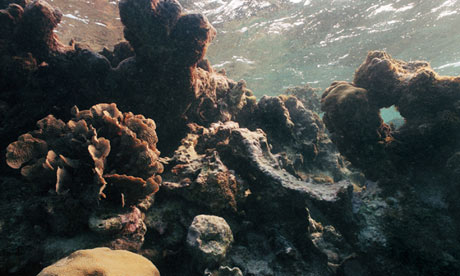
    ‘Bleached’ coral reef off Caye Caulker, Belize. Oceans’ rising acid levels are one of the biggest threats to coral reefs, scientists say. Photograph: Str/Reuters

    Oceans‘ rising acid levels have emerged as one of the biggest threats to coral reefs, acting as the “osteoporosis of the sea” and threatening everything from food security to tourism to livelihoods, the head of a US scientific agency said Monday.

    The speed by which the oceans’ acid levels has risen caught scientists off-guard, with the problem now considered to be climate change‘s “equally evil twin,” National Oceanic and Atmospheric Administration (NOAA) chief Jane Lubchenco told The Associated Press.

    “We’ve got sort of the perfect storm of stressors from multiple places really hammering reefs around the world,” said Lubchenco, who was in Australia to speak at the International Coral Reef Symposium in the northeast city of Cairns, near the Great Barrier Reef. “It’s a very serious situation.”

    Oceans absorb excess carbon dioxide in the atmosphere, leading to an increase in acidity. Scientists are worried about how that increase will affect sea life, particularly reefs, as higher acid levels make it tough for coral skeletons to form. Lubchenco likened ocean acidification to osteoporosis a bone-thinning disease because researchers are concerned it will lead to the deterioration of reefs.

    Scientists initially assumed that the carbon dioxide absorbed by the water would be sufficiently diluted as the oceans mixed shallow and deeper waters. But most of the carbon dioxide and the subsequent chemical changes are being concentrated in surface waters, Lubchenco said.

    “And those surface waters are changing much more rapidly than initial calculations have suggested,” she said. “It’s yet another reason to be very seriously concerned about the amount of carbon dioxide that is in the atmosphere now and the additional amount we continue to put out.”

    Higher acidity levels are especially problematic for creatures such as oysters, because they slow the growth of their shells. Experiments have shown other animals, such as clown fish, also suffer. In a study that mimicked the level of acidity scientists expect by the end of the century, clown fish began swimming toward predators, instead of away from them, because their sense of smell had been dulled.

    “We’re just beginning to uncover many of the ways in which the changing chemistry of oceans affects lots of behaviors,” Lubchenco said. “So salmon not being able to find their natal streams because their sense of smell was impaired, that’s a very real possibility.”

    The potential impact of all of this is huge, Lubchenco said. Coral reefs attract critical tourism dollars and protect fragile coastlines from threats such as tsunamis. Seafood is the primary source of protein for many people around the world. Already, some oyster farmers have blamed higher acidity levels for a decrease in stocks.

    Some attempts to address the problem are already under way. Instruments that measure changing acid levels in the water have been installed in some areas to warn oyster growers when to stop the flow of ocean water to their hatcheries.

    But that is only a short-term solution, Lubchenco said. The most critical element, she said, is reducing carbon emissions.

    “The carbon dioxide that we have put in the atmosphere will continue to be absorbed by oceans for decades,” she said. “It is going to be a long time before we can stabilise and turn around the direction of change simply because it’s a big atmosphere and it’s a big ocean.”

  • Nitrogen dioxide air pollution lessens in parts of US and Europe, increases in Middle East and parts of Asia

    Pompeii-style volcanic ash fall preserved ‘nursery’ of earliest animals

    Posted: 09 Jul 2012 02:26 PM PDT

    A volcanic eruption around 579 million years ago buried a ‘nursery’ of the earliest-known animals under a Pompeii-like deluge of ash, preserving them as fossils in rocks in Newfoundland, new research suggests.

    Winds played important role in keeping oil away from South Florida

    Posted: 09 Jul 2012 10:35 AM PDT

    Winds played an important role in keeping oil from the Gulf oil spill away from South Florida.

    Nitrogen dioxide air pollution lessens in parts of US and Europe, increases in Middle East and parts of Asia

    Posted: 09 Jul 2012 06:30 AM PDT

    Satellite measurements show that nitrogen dioxide in the lower atmosphere over parts of Europe and the US has fallen over the past decade. More than 15 years of atmospheric observations have revealed trends in air quality. As the world’s population increases, economies in many countries are also growing and populations are concentrating in large cities. With the use of fossil fuels still on the rise, pollution in large cities is also increasing.
    You are subscribed to email updates fromScienceDaily: Earth Science News
    To stop receiving these emails, you may unsubscribe now.
    Email delivery powered by Goog