Author: admin

  • First evidence of ocean acidification affecting live marine creatures in the Southern Ocean

    First evidence of ocean acidification affecting live marine creatures in the Southern Ocean

    Posted: 26 Nov 2012 08:09 AM PST

    The shells of marine snails — known as pteropods — living in the seas around Antarctica are being dissolved by ocean acidification, according to a new study. These tiny animals are a valuable food source for fish and birds and play an important role in the oceanic carbon cycle.

  • ‘Middle ground’ of sea-level change: ‘Intra-seasonal’ variability impacts forecasting and ecosystems

    ‘Middle ground’ of sea-level change: ‘Intra-seasonal’ variability impacts forecasting and ecosystems

    Posted: 27 Nov 2012 08:13 AM PST

    The effects of storm surge and sea-level rise have become topics of everyday conversation in the days and weeks following Hurricane Sandy’s catastrophic landfall along the mid-Atlantic coast. Researchers are throwing light on another, less-familiar component of sea-level variability — the “intra-seasonal” changes that occupy the middle ground between rapid, storm-related surges in sea level and the long-term increase in sea level due to global climate change.

  • UN report into permafrost thaw

    UN report into permafrost thaw

    38 page  pdf report prepared by the UN explining the scientific reports on Permafrost Melt

    for lay people to understand.

  • Pesticide is killing Barrier Reef: WWF

    Pesticide is killing Barrier Reef: WWF

    AAPNovember 28, 2012, 5:45 pm

    A environmental group says Australia’s refusal to ban a toxic pesticide is placing the health of residents and the Great Barrier Reef at risk.

    WWF says the decision by the Australian Pesticides and Veterinary Medicines Authority (APVMA) on Wednesday to reduce the levels of diuron which can be used doesn’t go far enough.

    Diuron is classified by the US Environmental Protection Agency as a likely carcinogen and has been linked to coral bleaching and the death of seagrass on the Great Barrier Reef, according to WWF.

    Spokesman Nick Heath says the pesticide is so toxic, one gram in four Olympic-sized swimming pools would be enough to damage seagrass.

    “The APVMA has again failed to protect the Great Barrier Reef,” he said in a statement.

    “We call on the minister and the prime minister to intervene and give the APVMA stronger powers and an obligation to ban these dangerous chemicals.”

  • China planning ‘huge fracking industry’

    China planning ‘huge fracking industry’

    Chinese plans to expand fracking for shale gas prompt fears over local water and international climate impacts

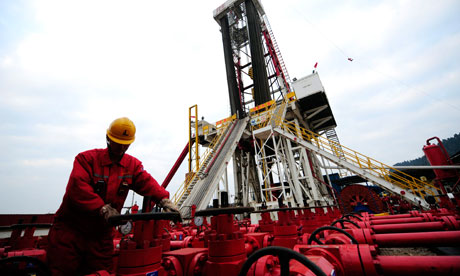
    Shale gas in China : natural gas appraisal well of Sinopec in Langzhong county, Sichuan

    A worker performs a routine check to the valves at a natural gas appraisal well of Sinopec in Langzhong county, Sichuan province, March 1, 2011. Photograph: Stringer /Reuters

    China is ratcheting up its fracking ambitions with virtually no regard for groundwater protection or other environmental safety measures, according to a new investigation by the independent publication Caixin. The report points to an 24 October white paper on energy development released by China’s top cabinet which “calls for ramping up the industry and pumping 6.5 billion cubic meters of natural gas from underground shale formations by 2015.”

    “The model for China’s anticipated success is the US shale gas sector,” the article states. “Geologists estimate the nation’s recoverable reserves at about 25 trillion cubic meters, on par with the United States.”

    Fracking has particular appeal in China because it provides an alternative to burning coal, which currently supplies about 70 percent of the nation’s consumed energy. Because natural gas can generate electricity at half the greenhouse gas emissions of coal, some see it as a way to reduce China’s carbon footprint.

    But fracking isn’t without environmental problems, as I and my colleagues at Mother Jones have reported before. And Caixin‘s review of government documents as well as interviews with industry sources, government officials, and environmental advocates reveal that fracking’s risks have not come under public scrutiny the way they have in the US, “much less addressed by the [Chinese] government or controlled via environmental laws.”

    If fracking takes off in China as planned, it will likely exacerbate the nation’s existing water crisis. “Most of the nation’s shale gas lies in areas plagued by water shortages,” the report says. With about 20 percent of the world’s population and only 6 percent of the world’s water resources, China is one of the least water-secure countries in the world. Its water shortages are made worse by pollution: According to the Ministry of Water Resources about 40 percent of China’s rivers were so polluted they were deemed unfit for drinking, while about 300 million rural residents lack access to safe drinking water each year.

    In order to reach the government’s annual shale gas production goal of 6.5 billion cubic meters by 2015, as many as 1,380 wells will need to be drilled across the country, requiring up to 13.8 million cubic meters of water, an industry source told Caixin. China’s industrial sector already consumes about 35 billion cubic meters of water a year. That amount of water would fill about 14 million Olympic-size swimming pools.

    There’s also serious risk of water contamination, as seen in the US fracking experience. Multiple studies in recent years including those by the EPA, Pennsylvania, and Duke University have concluded that shale gas drilling releases methane which can contaminate nearby water supplies. A 2009 ProPublica investigation found methane contamination from fracking was widespread in Colorado, Ohio, and Pennsylvania. But as Caixin reports, “there would be no legal reason to limit methane emissions at a shale gas well because China’s pollution standards do not cover methane.” One Ministry of Environmental Protection source told the publication that writing a new standard into law would take three years, “which helps explain why the State Council’s decision to fast-track the nation’s fledgling shale gas industry is making a lot of people nervous.”

    Groundwater in 57 percent of China’s 660 cities have already been significantly polluted, according to the Ministry of Environmental Protection.

    An unidentified source at China’s Ministry of Land Resources told Caixin that as shale gas development accelerates the government will likely introduce specific environmental policies to address fracking, such as groundwater protection. But these are not likely to be legally binding, an industry source told the publication.

    Perhaps a bigger concern is that China’s main energy and economic planning agencies, including the Ministry of Land Resources, seem to view fracking’s environmental risks as minimal or inflated:

    The MLR geological department source said, for example, that China’s shale gas is at least 3,000 meters and sometimes 4,000 meters underground—significantly deeper than aquifers, and separated from underground water by impermeable rock.

    Other industry sources argue that fracking fluids, which are mainly comprised of water and sand, break down naturally over a short time. And chemical additives make up less than 0.5 percent of what’s injected, they say.

    Similarly upbeat arguments against environmental fretting can be found in the government’s development plan for the period ending in 2015. It was jointly issued by four agencies including the National Development and Reform Commission and National Energy Bureau.

    Meanwhile, Caixin reported that one test fracking operation in Shaanxi Province—a major coal region in China’s dry North—recently “went awry, forcing local officials to temporarily cut a nearby city’s water supply.”

    Commercial fracking operations in China have not yet started, according to Caixin‘s report, but some Chinese companies have drilled test wells, and the government has begun selling chunks of designated fracking territory. In its latest round of auctioning shale-gas exploration blocks, for example, the Ministry of Land Resources awarded two blocks to Sinopec and Henan Coal Seam Gas Development and Utilization Co, in deals worth an estimated $128.5 million.

    Foreign companies including Royal Dutch Shell are also showing interest in China’s fracking plans. Shell announced earlier this month that it had shale gas agreements with three major Chinese oil companies. Caixin also reported in September that Shell was in talks with one company about a shale gas joint venture. ExxonMobil, BP, Chevron, and France-based Total are also working to form shale gas partnerships with Chinese oil and gas companies, according to an August National Geographic report.

  • UN: methane released from melting ice could push climate past tipping point

    UN: methane released from melting ice could push climate past tipping point

    Doha conference is warned that climate models do not yet take account of methane in thawing permafrost

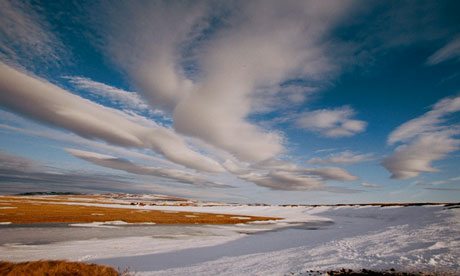
    Siberia

    Frozen ground in Siberia. Permafrost covers nearly a quarter of the northern hemisphere. Photograph: Francis Latreille/Corbis

    The United Nations sounded a stark warning on the threat to the climate from methane in the thawing permafrost as governments met for the second day of climate change negotiations in Doha, Qatar.

    Thawing permafrost releases methane, a powerful greenhouse gas, but this has not yet been included in models of the future climate. Permafrost covers nearly a quarter of the northern hemisphere at present and is estimated to contain 1,700 gigatonnes of carbon – twice the amount currently in the atmosphere. As it thaws, it could push global warming past one of the key “tipping points” that scientists believe could lead to runaway climate change.

    The UN Environment Programme (UNEP) called for the effect to be studied in detail by the Intergovernmental Panel on Climate Change (IPCC), the body of top climate scientists convened by the UN to provide governments with the most up-to-date and comprehensive knowledge on climate change. The next IPCC report will be published in several parts from next year.

    Achim Steiner, executive director of UNEP, said: “Permafrost is one of the keys to the planet’s future because it contains large stores of frozen organic matter that, if thawed and released into the atmosphere, would amplify current global warming and propel us to a warmer world. Its potential impact on the climate, ecosystems and infrastructure has been neglected for too long.”

    UNEP said warming permafrost could also “radically alter ecosystems and cause costly infrastructural damage due to increasingly unstable ground” and called for national monitoring systems to be put in place by countries with permafrost, including Russia, Canada, China and the US.

    Most of the current permafrost formed during or since the last ice age and extends to depths of more than 700 metres in parts of northern Siberia and Canada. Permafrost consists of an active layer of up to two metres in thickness, which thaws each summer and refreezes each winter, and the permanently frozen soil beneath. As temperatures in the Arctic are rising faster than elsewhere, this could increase the danger of permafrost melting. Warming permafrost could emit 43 to 135 gigatonnes of carbon dioxide equivalent by 2100 and 246 to 415 gigatonnes by 2200, according to the report, and emissions could start within the next few decades. Permafrost emissions could ultimately account for up to 39% of total emissions, according to the report.

    UNEP’s report came as governments argued over the future of the Kyoto protocol at the Doha climate talks. One of the main aims of the talks is an agreement to continue the protocol beyond the end of this year, when its current provisions and targets expire. But only the EU and a handful of other relatively small emitters, including Australia, Norway and Switzerland, have agreed.

    Japan was once a strong defender of the protocol, taking pride in the fact that it was negotiated there. But the country has now abandoned it, in part because of fears that its neighbour, China, has taken a competitive advantage because it is not obliged to reduce its emissions.

    Masahiko Horie, of the Japanese negotiating team, said: “Only developed countries are legally bound by the Kyoto protocol and their emissions are only 26% [of global emissions]. If we continue the same, only one quarter of the world is legally bound and three quarters of countries are not bound at all.”

    He said it was more important to Japan to formulate a new framework that would require action on emissions from developing as well as developed countries. At the talks, governments are expected to draw up a work plan that would set out how they will draw up such a new global agreement by 2015, coming into force in 2020.

    But many developing countries want developed countries to continue with Kyoto beyond 2012 as part of any deal. Andre Correa do Lago, head of the Brazilian delegation, said: “If rich countries which have the financial means, have technology, have a stable population, already have a large middle class, think they cannot reduce [emissions] and work to fight climate change, how can they ever think that developing countries can do it? That is why the Kyoto protocol has to be kept alive. If we take it out, we have what people call the Wild West. You are not going get the [emissions] reductions necessary.”

    The talks will continue until the end of next week.