Author: admin

  • Ban Ki-moon: the momentum for change at Rio+20 is irreversible

    Ban Ki-moon: the momentum for change at Rio+20 is irreversible

    There may be disagreement between nations going into the Rio Earth summit, but much has been achieved already

    MDG : Rio+20 : flags of participating countries

    Some of the flags of participating countries in this week’s Rio+2- Earth summit. Photograph: Antonio Lacerda/EPA

    This week, world leaders gather for a momentous occasion – the United Nations Conference on Sustainable Development in Rio de Janeiro. Will it be a success? In my opinion, yes. To be sure, the negotiations have been lengthy. Even now there is more disagreement than agreement on the details of the so-called “outcome document” that will emerge. Yet that will not be the defining measure. Far more important is what the Rio conference has already accomplished. And that is to build a global movement for change.

    Rio+20 is a milestone on a long road. The famous 1992 Earth summit put sustainable development on the global agenda. Today, we have come to a broader and more nuanced understanding of this age-old imperative: how to better balance the development needs of a growing world population – so all may enjoy the fruits of prosperity and robust economic growth – with the necessity of conserving our planet’s most precious resources: land, air and water.

    At Rio, more than 100 heads of state and government will join an estimated 25,000 participants to map our way ahead. For too long we have sought to burn and consume our way to prosperity. That model is dead. At Rio, we must begin to create a new one – a model for a 21st century economy that rejects the myth that there must be a zero-sum trade-off between growth and the environment. Increasingly, we understand that, with smart public policies, governments can grow their economies, alleviate poverty, create decent jobs and accelerate social progress in a way that respects the earth’s finite natural resources.

    In this larger sense, I believe that momentum for change is already irreversible. The evidence is all around, hiding in plain sight in countries large and small, rich and poor. Barbados, Cambodia, Indonesia, the Republic of Korea and South Africa, among many others, are already adopting “green growth” strategies that use limited natural resources more efficiently, create jobs and promote low-carbon development. Armenia, Azerbaijan, Egypt, Kenya, Jordan, Malaysia, Mexico, Nepal, Senegal and Ukraine are applying new green-growth technologies in a variety of industries, from agriculture to tourism. China has committed to supply 16% of its energy needs from renewable sources by 2020 and plans to invest more than $450bn in waste recycling and clean technologies under its current five-year plan.

    In Brazil, waste management and recycling employs more than 500,000 people, most of whom live on society’s margins. Under its new National Rural Employment Guarantee Act, India has begun paying people to better manage natural resources, such as forests and fresh water. Wherever you look, national and local authorities are adopting principles and practices that, taken together, could help move us from a prospect of environmental ruin and growing social inequality toward a new era of inclusive and balanced sustainable growth.

    Governments and nation-states are not alone in driving this transformation. At Rio, more than 1,000 corporate leaders from all continents will deliver a common message: business as usual no longer works. Many are members of the United Nations Global Compact – volunteers in a growing private-sector movement that understands that 21st century corporate responsibility means corporate sustainability. Thus Nike has initiated a new programme called Mata no Peito – a Portuguese colloquialism for “taking on a challenge” by helping protect Brazilian forest ecosystems. Unilever has pledged to source all its raw materials from sustainable sources by 2020. Kenya’s mobile network provider Safaricom has integrated gender equality into its internal policies to create a mother-friendly environment.

    Meanwhile, Microsoft has announced it will soon go carbon-neutral. China’s Broad Group produces non-electric air conditioning units that are 200% more energy efficient; it is now diversifying into other energy-saving products and sustainable buildings. ToughStuff from Mauritius seeks to bring affordable and reliable solar energy to 33 million people in Africa by 2016, and the Abu Dhabi Future Energy Company is working to provide rural electrification in Afghanistan and the South Pacific island nation of Tonga.

    Energy will be a major focus at Rio. I call it the “golden thread” that connects the dots to a sustainable future – the key driver for development, social inclusion and environmental protection, including climate change. That is why, in 2011, I established a new initiative called Sustainable Energy for All. Our aim: to ensure universal access to modern energy services for the one in five people worldwide who lack them; to reduce energy waste by doubling energy efficiency; and to double the share of renewables in the global energy mix. In Rio, leaders from government, business and civil society will announce a galaxy of actions to advance these goals, from promoting cleaner, more efficient cook-stoves to helping governments scale up their geothermal and other renewable energy potential.

    Sustainable Energy for All is the partnership model of the future. The principle is simple but powerful: the United Nations uses its unrivalled convening power to bring all relevant actors to the table so they can work in common cause for the common good. At heart, this is what Rio+20 is all about.

    Yes, the negotiations themselves are very important. Agreements that can be committed to paper today will shape the debates of tomorrow. But Rio+20 goes beyond that. It is the expression of a dynamic global movement for change – and a big step forward toward the future we want.

  • Have we reached the tipping point?

    Have we reached the tipping point?

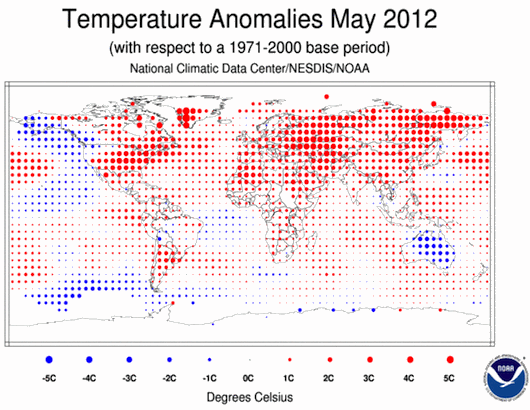
    Today is a pivotal point in human history. We are now living in the Anthropocene: humans are the main driver of planetary change. We’re pushing global temperatures, land and water use beyond anything our species has experienced before. We’re polluting the biosphere, acidifying the oceans, and reducing biodiversity. At the same time, our global population will grow from seven billion to nine billion by 2050, and all will need food, water and clean air.

    As if to illustrate the point further, last month Arctic monitors showed the concentration of carbon dioxide in the atmosphere has passed 400 parts per million (before the Industrial Age, carbon dioxide levels were 275 ppm). New data shows the rate of climate change could be even faster than thought.

    Perhaps most worryingly of all, 22 scientists warned last week we are approaching a planetary tipping point, beyond which environmental changes will be rapid and unpredictable. Basing their alarming conclusion on studies of ecological markers from species extinction rates (currently 1,000 times the usual rate, and comparable to those experienced during the demise of the dinosaurs) to changes in land use (more than 40% of land is dominated by humans and we affect a further 40%), these scientists fear we will enter a new, unknown state, and one which threatens us all.

    Click here for more.

  • 30,000 drones to monitor US citizens

    30,000 drones to monitor US citizens

    A recent Department of Defense report to Congress as well as a number of media investigations have exposed government plans to deploy tens of thousands of drones over the US mainland in the coming years.

    An investigative report published over the weekend by the Christian Science Monitor cited the government’s own estimates that “as many as 30,000 drones could be part of intelligence gathering and law enforcement here in the United States within the next ten years.”

    Since Obama signed the bill, hundreds of drones have already begun flying over the US to spy on and monitor the population. A recent ABC News investigative report entitled “UAVs: Will Our Civil Liberties Be Droned Out?” outlined the possibility of drones buzzing overhead becoming “a fact of daily life.”

    ABC News reported: “Drones can carry facial recognition cameras, license plate scanners, thermal imaging cameras, open WiFi sniffers, and other sensors. And they can be armed.”

    “Among the most eager to fly domestic drones are America’s police departments,” the report stated. “In Texas, a Montgomery county sheriff’s office recently said it would deploy a drone bought with money from a Department of Homeland Security grant and was contemplating arming the drone with non-lethal weapons like tear gas, rubber bullets or Taser-style rounds.”

    The ABC News report identified “political protests” as one of the activities that can be monitored by drones.

    Read whole article here.

  • The mendacity of Hope – George Monbiot

    The mendacity of Hope – George Monbiot

    Worn down by hope. That’s the predicament of those who have sought to defend the earth’s living systems. Every time governments meet to discuss the environmental crisis, we are told that this is the “make or break summit”, upon which the future of the world depends. The talks might have failed before, but this time the light of reason will descend upon the world.

    We know it’s rubbish, but we allow our hopes to be raised, only to witness 190 nations arguing through the night over the use of the subjunctive in paragraph 286. We know that at the end of this process the UN secretary-general, whose job obliges him to talk nonsense in an impressive number of languages, will explain that the unresolved issues (namely all of them) will be settled at next year’s summit. Yet still we hope for something better.

    This week’s earth summit in Rio de Janeiro is a ghost of the glad, confident meeting 20 years ago. By now, the leaders who gathered in the same city in 1992 told us, the world’s environmental problems were to have been solved. But all they have generated is more meetings, which will continue until the delegates, surrounded by rising waters, have eaten the last rare dove, exquisitely presented with an olive leaf roulade. The biosphere, that world leaders promised to protect, is in a far worse state than it was 20 years ago(1). Is it not time to recognise that they have failed?

    These summits have failed for the same reason that the banks have failed. Political systems which were supposed to represent everyone now return governments of millionaires, financed by and acting on behalf of billionaires. The past 20 years have been a billionaires’ banquet. At the behest of corporations and the ultra-rich, governments have removed the constraining decencies – the laws and regulations – which prevent one person from destroying another. To expect governments funded and appointed by this class to protect the biosphere and defend the poor is like expecting a lion to live on gazpacho.

    You have only to see the way the United States has savaged the earth summit’s draft declaration to grasp the scale of this problem(2). The word “equitable”, the US insists, must be cleansed from the text. So must any mention of the right to food, water, health, the rule of law, gender equality and women’s empowerment. So must a clear target of preventing two degrees of global warming. So must a commitment to change “unsustainable consumption and production patterns” and to decouple economic growth from the use of natural resources.

    Most significantly, the US delegation demands the removal of many of the foundations agreed by a Republican president in Rio in 1992. In particular, it has set out to purge all mention of the core principle of that earth summit: common but differentiated responsibilities(3). This means that while all countries should strive to protect the world’s resources, those with the most money and who have done the most damage should play a greater part.

    This is the government, remember, not of George W Bush but of Barack Obama. The paranoid, petty, unilateralist sabotage of international agreements continues uninterrupted. To see Obama backtracking on the commitments made by Bush the elder 20 years ago is to see the extent to which a tiny group of plutocrats has asserted its grip on policy.

    While the destructive impact of the US in Rio is greater than that of any other nation, this does not excuse our own failures. The UK government prepared for the earth summit by wrecking both our own climate change act(4,5) and the European energy efficiency directive(6). David Cameron will not be attending the earth summit. Nor will the energy and climate change secretary Ed Davey (which is probably a blessing, as he’s totally useless). Needless to say Cameron, with other absentees such as Obama and Merkel, are attending the G20 summit in Mexico, which takes place immediately before Rio. Another tenet of the 1992 summit – that economic and environmental issues should not be treated in isolation(7) – goes up in smoke.

    The environmental crisis cannot be addressed by the emissaries of billionaires. It is the system that needs to be challenged, not the individual decisions it makes. The struggle to protect the biosphere is in this respect the same as the struggle for redistribution, for the protection of workers’ rights, for an enabling state, for equality before the law.

    So this is the great question of our age: where is everyone? The monster social movements of the 19th century and first 80 years of the 20th have gone, and nothing has replaced them. Those of us who still contest unwarranted power find our footsteps echoing through cavernous halls once thronged by multitudes. When a few hundred people do make a stand – as the Occupy campers have done – the rest of the nation just waits for them to achieve the kind of change that requires the sustained work of millions.

    Without mass movements, without the kind of confrontation required to revitalise democracy, everything of value is deleted from the political text. But we do not mobilise, perhaps because we are endlessly seduced by hope. Hope is the rope on which we hang.

    Full article here.

  • Expansion of forests in the European Arctic could result in the release of carbon dioxide

    Expansion of forests in the European Arctic could result in the release of carbon dioxide

    Posted: 17 Jun 2012 11:25 AM PDT

    Carbon stored in Arctic tundra could be released into the atmosphere by new trees growing in the warmer region, exacerbating climate change, scientists have revealed.
    You are subscribed to email updates from ScienceDaily: Earth Science News
    To stop receiving these emails, you may unsubscribe now.
    Email delivery powered by Google
    Google Inc., 20 West Kinzie, Chicago IL USA 60610