Author: admin

  • Seeping Arctic methane has serious implications for Florida coastline

    ScienceDaily: Oceanography News


    May 2012 global temperatures second warmest on record

    Posted: 18 Jun 2012 12:27 PM PDT

    The globally-averaged temperature for May 2012 marked the second warmest May since record keeping began in 1880. May 2012 also marks the 36th consecutive May and 327th consecutive month with a global temperature above the 20th century average.

    Seeping Arctic methane has serious implications for Florida coastline

    Posted: 18 Jun 2012 06:50 AM PDT

    All of the methane escaping into the atmosphere causes more melting ice, oceanographers say, which causes sea levels to rise and could affect coastal real estate values — sooner rather than later.
    You are subscribed to email updates from ScienceDaily: Oceanography News
    To stop receiving these emails, you may unsubscribe now.
    Email delivery powered by Google
    Google Inc., 20 West Kinzie, Chicago IL USA 60610
  • Rio+20 Summit Overshadowed by Global Economy

    Alert Name: CLIMATE CHANGE NEWS
    June 19, 2012 Compiled: 1:07 AM

    By SIMON ROMERO and JOHN M. BRODER (NYT)

    The meeting will address poverty, energy, the environment and the links between them. But the conference is overshadowed by economic and political crises around the world.

    By CHRISTIAN AZAR, THOMAS STERNER and GERNOT WAGNER (NYT)

    Carbon emissions have increased by 50 percent since the first Earth Summit meeting in Rio de Janeiro, but the rapid development of wind and solar energy offers hope.

    By GRO HARLEM BRUNDTLAND (NYT)

    Our generation is the first to understand the risks facing humanity. At Rio +20 world leaders must act decisively.

    About This E-mail

    You received this e-mail because you signed up for NYTimes.com’s My Alerts tool. As a member of the TRUSTe privacy program, we are committed to protecting your privacy.

  • You’re empowered to give tax the flick with The Daily Telegraph’s People Power campaign.UPDATE

    The responses to this are phenominal. Target of 25.000 reached in under 24 hours. now 34.000 and still climbing. This shows the anger and concerns in the community and sends a message to the Govt.

    You’re empowered to give tax the flick with The Daily Telegraph’s People Power campaign.UPDATE

    3

    Big Electricity Switch: Campaign launch

    One Big Switch wants 25,000 signatures to secure big discounts on power bills for Australians. Hear campaign director Christopher Zinn laun…

    Big Electricity Switch: Neutralise the power rise

    Want to save on your power bill? One Big Switch’s Christopher Zinn shows you how by logging onto the One Big Switch website www.bigelectric…

    Christopher Zinn

    Big Electricity Switch campaign director Christopher Zinn. Picture: Toby Zerna Source: The Daily Telegraph

    MORE than 34,000 households and small businesses turned anger into action by joining The Daily Telegraph’s People Power campaign for more affordable electricity.

    The campaign aims to neutralise price rises caused by the carbon tax.

    Federal Treasury estimated the “price on pollution” will add as much as 10 per cent to bills from July 1. But using People Power, we hope bulk discounts of at least 12 per cent can be negotiated.

    And yesterday, as the campaign launched, demand for a better deal was such that there was a registration every four seconds between 6am and 6pm.

    Then when TV ran stories on the plan, the sign-up site – www.bigelectricityswitch.com.au – went into meltdown as support surged towards 15,000.

    www.bigelectricityswitch.com.au..

    SUPPORT THE CAMPAIGN HERE

    Households can register to join in the deal by logging on HERE by midnight on July 15

    The original target was to gather 25,000 registrations within a month.

    That goal was reached at 9.20am today.

    Leading consumer advocate and One Big Switch campaign director Christopher Zinn said: “We’re incredibly energised by the enthusiasm of people right around Australia to put their hand up and want to be part of something different. The numbers speak for themselves.

    “People feel incredibly frustrated and powerless with what’s happening, and here’s one thing they can be part of. It’s not a magic bullet, but it can hopefully offer a little relief.

    “That’s very exciting.”

    Signatories to the campaign are not obliged to switch power provider. They can use it to negotiate a better deal with their existing supplier.

    While NSW households have had the ability to change electricity retailers since 2002, the practice has only just taken off due to market privatisation last year and the emergence of more substantial discounts.

    According to the Australian Energy Market Operator, 20 per cent of NSW customers – about 660,000 – have switched in the last year compared to just 12 per cent in March 2011.

    Meanwhile new research from global energy think tank VaasaETT shows four Australian states – NSW, Victoria, Queensland and South Australia – were now among 10 regions with the highest “churn rates” last year. NSW was 10th on that list. And about 1.2 million families are still on default regulated rates.

    IPART chairman Dr Peter Boxall said more than 40,000 consumers searched for better energy deals on the regulator’s electricity price comparison website www.myenergyoffers.nsw.gov.au since January. “IPART encourages NSW energy consumers to compare offers from retailers and ensure they have the most appropriate, and cost-effective, service for their needs,” he said.

    Power comparison website GoSwitch.com.au chief executive Ben Freund said changing was an easy process that could save hundreds of dollars.

    “There are highly informed people in the community who simply don’t know what their options are or there’s a reluctance to change. Some people think they have a relationship with their power provider which is absurd,” he said.

    “It’s very easy to switch, over the phone or a website.”

    A poll at thetelegraph.com.au yesterday found almost 90 per cent said they would be willing to switch power providers to beat the carbon tax.

  • NASA Selects Low Cost, High Science Earth Venture Space System

    NASA News Services nasa_subscriptions@service.govdelivery.com
    2:29 PM (1 hour ago)

    to me

    You are subscribed to Earth News for NASA. This information has recently been updated, and is now available.

    06/18/2012 12:00 AM EDT

    NASA has selected an ocean wind study proposal led by the University of Michigan from among 19 submitted to the agency’s Announcement of Opportunity for small spaceflight investigations of the Earth system.

    Bookmark and Share

    This e-mail update was generated automatically based on your subscriptions. Some updates may belong to more than one category, resulting in duplicate notices.

    Click this link to sign up instantly to receive Science & Tech updates as well as the award winning newsletter from our partners at USA.gov or click this link to see all available options from USA.gov. USA.gov logo

    NASA Questions? Contact Us
    STAY CONNECTED:
    Visit us on YouTube Visit us on Facebook Visit us on Twitter Visit Our Blogs Visit us on Flickr Sign up for email updates


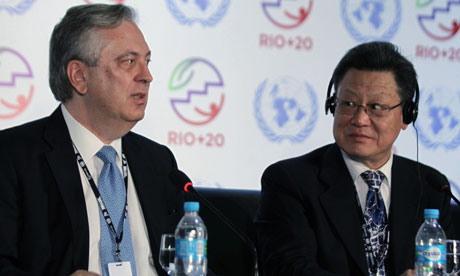
  • Rio+20 negotiators accused of strong-arm tactics

    Rio+20 negotiators accused of strong-arm tactics

    Delegates considering blocking proposed text because of its lack of ambition and ‘aggressive’ tactics employed by Brazil

    UN Conference on Sustainable Development Rio+2

    Sha Zukang, and Rio+20 Brazilian ambassador, Luiz Figueiredo Machado, attend a press conference in Rio de Janeiro, Brazil. Photograph: Antonio Lacerda/EPA

    Brazilian negotiators have been accused of using strong-arm tactics at Rio+20 to secure a deal before heads of state start arriving for the Earth Summit later this week.

    The ghost of the Copenhagen talks — which ended with disappointment and recriminations — is driving the attempt to force through an agreement, despite risks it could backfire spectacularly, said a senior source at the negotiations.

    Brazil‘s spokesman said on Monday he was optimistic a compromise text could be approved by Tuesday evening.

    But frustrated delegates are now considering blocking the proposed text because of its lack of ambition and the “aggressive” tactics employed by the host nation.

    “They are doing this more because of how they will look in the eyes of the heads of state and their desire to show a successful conference in the sense that it did not break down or that there was no outcome,” said the source. “If they carry on with these tactics the risk is that some delegations will feel they may need to block this because it is not ambitious enough.”

    Luiz Alberto Figueiredo, the Brazilian foreign ministry spokesman said on Tuesday that consensus was close on proposals to strengthen Unep, manage the world’s oceans and establish sustainable development goals.

    This appeared to mark progress after weeks of procedural wrangling and divisions between rich and developing nations, but the host’s tactics are now being questioned.

    “They are speaking with two tongues; on the political level they say they want ambition and on the civil servants level they are being extremely aggressive in closing down the conversation,” said the source. “For the Brazilians, it is more important that the process is seen to be efficient rather than effective. The reality is that the Brazilians are around during the negotiations, then they go back to their room and they say they have taken all the comments and thoughts into account and then just produce their own text.”

    The hosts denied bullying tactics. “The Brazilian role in the consultations has been praised by the UN and by virtually all countries. The developed countries also seem to be satisfied,” said a senior official.

    Other delegates were more sympathetic to Brazil’s efforts to reach a compromise, saying the host had done its best to incorporate a wide range of views. But there was widespread frustration at the weakness of the compromise document and its lopsided emphasis on the economy above than the environment.

    “We want there to be more ambition so that it actually leads to sustainable development. At the moment, there is a risk that instead of the future we want, we will go back to the past we had,” said an EU official.

    Several member states are concerned that a weak outcome is becoming inevitable. Little is expected from the US, which is preoccupied with a presidential election and strong domestic hostility to action on climate and other environmental issue. The G77 is divided on several major issues.

    Europe, South Korea and Japan have told the Brazilian government they would like to see more concrete goals, timelines and measures to achieve a “green economy”, and argued that the current draft is inadequate to counter the risks posed by degrading ecosystems and diminishing resources that could be approaching a tipping point. Other nations, including New Zealand, are also pushing for more ambition on issue like the removal of fossil fuel subsidies.

    Civil society has criticised the watered-down document.

    “What we are seeing in Rio are incredibly weak negotiations which do not produce the results required to lift people out of poverty and stop environmental degradation. Rio+20 is creating a black hole of low ambition and little substance,” says Kit Vaughan, CARE’s Climate Change Advocacy Coordinator.

    Lasse Gustavson, head of WWF’s delegation, said: “While we think some of the new text is a good base for the future, such as the language on oceans, we see a lopsided victory of weak words over action words ,with the weak words winning out at 514 to 10.”

  • You’re empowered to give tax the flick with The Daily Telegraph’s People Power campaign

    This movement is gaining momentum. Sign in to be part of it

    You’re empowered to give tax the flick with The Daily Telegraph’s People Power campaign

    1

    Big Electricity Switch: Campaign launch

    One Big Switch wants 25,000 signatures to secure big discounts on power bills for Australians. Hear campaign director Christopher Zinn laun…

    Big Electricity Switch: Neutralise the power rise

    Want to save on your power bill? One Big Switch’s Christopher Zinn shows you how by logging onto the One Big Switch website www.bigelectric…

    Christopher Zinn

    Big Electricity Switch campaign director Christopher Zinn. Picture: Toby Zerna Source: The Daily Telegraph

    MORE than 25,000 households and small businesses turned anger into action yesterday by joining The Daily Telegraph’s People Power campaign for more affordable electricity.

    The campaign aims to neutralise price rises caused by the carbon tax.

    Federal Treasury estimated the “price on pollution” will add as much as 10 per cent to bills from July 1. But using People Power, we hope bulk discounts of at least 12 per cent can be negotiated.

    And yesterday, as the campaign launched, demand for a better deal was such that there was a registration every four seconds between 6am and 6pm.

    Then when TV ran stories on the plan, the sign-up site – www.bigelectricityswitch.com.au – went into meltdown as support surged towards 15,000.

    www.bigelectricityswitch.com.au..

    SUPPORT THE CAMPAIGN HERE

    Households can register to join in the deal by logging on HERE by midnight on July 15

    The original target was to gather 25,000 registrations within a month.

    That goal was reached at 9.20am today.

    Leading consumer advocate and One Big Switch campaign director Christopher Zinn said: “We’re incredibly energised by the enthusiasm of people right around Australia to put their hand up and want to be part of something different. The numbers speak for themselves.

    “People feel incredibly frustrated and powerless with what’s happening, and here’s one thing they can be part of. It’s not a magic bullet, but it can hopefully offer a little relief.

    “That’s very exciting.”

    Signatories to the campaign are not obliged to switch power provider. They can use it to negotiate a better deal with their existing supplier.

    While NSW households have had the ability to change electricity retailers since 2002, the practice has only just taken off due to market privatisation last year and the emergence of more substantial discounts.

    According to the Australian Energy Market Operator, 20 per cent of NSW customers – about 660,000 – have switched in the last year compared to just 12 per cent in March 2011.

    Meanwhile new research from global energy think tank VaasaETT shows four Australian states – NSW, Victoria, Queensland and South Australia – were now among 10 regions with the highest “churn rates” last year. NSW was 10th on that list. And about 1.2 million families are still on default regulated rates.

    IPART chairman Dr Peter Boxall said more than 40,000 consumers searched for better energy deals on the regulator’s electricity price comparison website www.myenergyoffers.nsw.gov.au since January. “IPART encourages NSW energy consumers to compare offers from retailers and ensure they have the most appropriate, and cost-effective, service for their needs,” he said.

    Power comparison website GoSwitch.com.au chief executive Ben Freund said changing was an easy process that could save hundreds of dollars.

    “There are highly informed people in the community who simply don’t know what their options are or there’s a reluctance to change. Some people think they have a relationship with their power provider which is absurd,” he said.

    “It’s very easy to switch, over the phone or a website.”

    A poll at thetelegraph.com.au yesterday found almost 90 per cent said they would be willing to switch power providers to beat the carbon tax.

    people power terms

    people power terms
    Source: The Daily Telegraph


    1 comment on this story