Climate change is affecting all regions in Europe, causing a wide range of impacts on society and the environment. Further impacts are expected in the future, potentially causing high damage costs, according to the latest assessment.
The northward shift of Norway’s oil industry means it must adjust to temperatures down to -30°C, storms, sleet and snow, and drift ice. And to the blackest night.
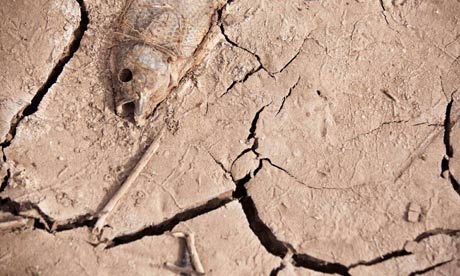
A dead fish on the bed of a reservoir on the drought-stricken island of Gran Canaria. Europe is already feeling the effects of climate change. Photograph: Borja Suarez/Reuters
The world is straying further away from commitments to combat climate change, bringing the prospect of catastrophic global warming a step closer, a UN report said on Wednesday. The warning came as nearly 200 governments prepare to meet in Qatar for international climate negotiations starting next Monday.
The gap between what world governments have committed to by way of cuts in greenhouse gases and the cuts that scientists say are necessary has widened, but in order to stave off dangerous levels of global warming, it should have narrowed. There is now one-fifth more carbon in the atmosphere than there was in 2000, and there are few signs of global emissions falling, according to the new report from the United Nations Environment Programme (Unep).
The warning of increasing emissions came as fresh evidence was published showing the last decade was the warmest on record for Europe. The European Environment Agency (EEA) said all parts of the region had been affected, with higher rainfall in northern Europe and a drying out in the south, bringing flooding to northern countries including the UK, and droughts to the Mediterranean.
According to the United Nations report, drawing on research from more than 50 scientists, the widening gap between countries’ plans and scientific estimates means that governments must step up their ambitions as a matter of urgency to avoid even worse effects from warming. “The transition to a low-carbon, inclusive green economy is happening far too slowly and the opportunity for meeting [scientific advice on emissions targets] is narrowing annually,” said Achim Steiner, executive director of Unep.
The explicit goal of international policy is to prevent global warming of more than 2C above pre-industrial levels, which scientists say is the limit of safety beyond which climate change is likely to become irreversible and catastrophic. That goal that has been roughly translated as a concentration of carbon in the atmosphere of no more than 450 parts per million. To meet this, governments would have to ensure that no more than 44 gigatonnes (Gt) of carbon dioxide equivalent (CO2e) is emitted per year by 2020. The UN’s latest research, published on Wednesday as the Emissions Gap Report 2012, shows that on current trends, emissions by 2020 will be 58 Gt CO2e.
This gap between the cuts needed and the cuts planned brings the prospect of dangerous levels of climate change – entailing more extreme weather including floods, droughts and fiercer storms, such as those witnessed this year – much closer.
Even if countries manage to change direction in time and meet the emissions-cutting targets they have committed to in the past three years, the gap will still be large – about 8 Gt by 2020. To meet scientific advice, countries would have to agree to much bigger curbs on emissions than they have yet done – and there is little chance of that happening at the next round of annual climate negotiations, which begin on Monday in Doha, Qatar. At the fortnight-long talks, ministers are expected to set out a few more details of how they will work towards their agreed plan of drawing up a new global climate change treaty by 2015, to come into effect from 2020.
Despite the slow pace of progress, Steiner said there was still a chance for the world to obey scientific advice. He said: “Bridging the gap remains do-able with existing technologies and policies.” He said many of the measures governments were undertaking, from investments in renewable energy to public transport and higher energy efficiency standards for buildings, were yet to bear fruit, and their effects should start to be seen in the next few years.
But he warned that countries must avoid being “locked in” to high-carbon infrastructure – power stations and buildings constructed today will still be in operation and spewing out carbon decades from now, and that will be unsustainable. It would be cheaper to make sure that all such infrastructure is low-carbon from the start, than to abandon it or refurbish in years to come.
Christiana Figueres, the UN’s top climate official, who will head next week’s talks, said: “Time is running out, but the technical means and the policy tools to allow the world to stay below 2C [of warming] are still available to governments and societies.”
Environmental groups warned that the UN report showed governments were failing. Jennifer Morgan, director of the climate and energy programme at the World Resources Institute, said: “This report is another harsh reminder that the world is simply not moving aggressively enough to tackle the climate challenge. The gap is growing and carbon dioxide levels continue to rise, yet the current pledges and commitments by countries remain sorely inadequate. We are already seeing how climate change – with more extreme weather events, rising seas and more droughts – is taking its toll on people, property and our economy. Without a rapid change in direction, the world is headed more and more firmly down a path to even more severe changes that will be felt around the globe.”
In Europe, the EEA said land temperatures in the decade from 2002 to 2011 were 1.3C warmer than the pre-industrial average. Europe could be between 2.5C and 4C warmer from 2050, according to projections. The study found heat waves have increased in frequency and length, while river droughts have been more severe and frequent in southern Europe. Glaciers in the Alps have lost about two-thirds of their volume since 1850.
Prof Jacqueline McGlade, executive director of the EEA, said: “Climate change is a reality around the world, and the extent and speed of change is becoming ever more evident. This means that every part of the economy, including households, needs to adapt as well as reduce emissions.”
Cardinal George Pell, Catholic Archbishop of Sydney Source: The Sunday Telegraph
AUSTRALIA’S most senior Catholic showed a “sociopathic lack of empathy” in dealing with victims raped by clergy, an inquiry heard yesterday.
Cardinal George Pell, the Archbishop of Sydney, had tried to compel victims into silence when confronted with evidence of wrongdoing by parish priests when he was the Archbishop of Melbourne, the Victorian parliamentary inquiry into child sexual abuse was told.
Anthony Foster recalled meeting Cardinal Pell to discuss a priest who had repeatedly raped two of his daughters when they were at primary school.
He told the inquiry that Cardinal Pell said: “If you don’t like what we’re doing, take us to court,” and did not appear distressed by the incidents.
“In our interactions with the now-Cardinal Archbishop Pell, we experienced a sociopathic lack of empathy, typifying the attitude and responses of the church hierarchy,” Mr Foster said.
THE Catholic Church is not sheltering paedophiles – and Cardinal George Pell says he’s confident a Commission of Inquiry into sex abuse claims won’t expose any ongoing offending by priests.
THE country’s highest-ranked Catholic has refused to name and shame priests who admit to paedophilia during confessional in order to preserve the rite’s sanctity.
Meanwhile the detective whose claims of a church cover-up of child sex abuse led to the announcement of the federal royal commission is seeking special whistleblower legislation protection from threats.
NSW Detective Chief Inspector Peter Fox said yesterday he and his wife had received hate mail and other threats.
His lawyer last week wrote to Police Commissioner Andrew Scipione seeking his support for Insp Fox to be registered as a whistleblower under the Public Interest Disclosures Act.
Support groups say they have been overwhelmed with phone calls from sexual assault victims since a royal commission into institutional abuse was announced more than a week ago.
The volume is such that some calls are going unanswered, and now the Federal Government is giving $200,000 to three groups to help them keep up with demand.
Bravehearts’ executive director Hetty Johnston says the number of calls is up 82 per cent since the royal commission was announced last week.
“We are struggling to keep up, definitely,” she said.
“We just can’t keep up, it’s as simple as that – at some point we’re going to burn out. It’s impossible to sustain.”
She says often the line is busy or there is no one to answer, and victims have to leave a message.
“We had a call the other day from a child – we don’t know, maybe eight, nine, 10, like that – private number, couldn’t trace it, she didn’t leave her number.
“And that was an after-hours call. We need to be able to answer these phones.”
Ms Johnson says the callers are both people reporting fresh abuse and people like teachers or nurses reporting cases they have come across.
The Federal Government has given Bravehearts a one-off grant of $75,000 to help it cope with the increased demand.
That will pay for three extra people on the phones for the next three months.
“It’s not going to be enough. It’ll alleviate it in the short term, but it’s still not going to be enough,” Ms Johnson said.
Calls unanswered
Adults Surviving Child Abuse and the Care Leavers Australia Network are two other support groups that have won grants from the Government.
Adults Surviving Child Abuse president Cathy Kezelman says her organisation has also been swamped with calls.
“Initially it was a 400 per cent increase, with the initial announcement,” she said. ‘That’s settled down a bit now.”
Dr Kezelman says at the moment they can only pay for staff to take calls four hours a day.
“Some of them will be going unanswered – they’re obviously returned as soon as we can,” she said.
“We don’t have someone there, certainly not 24/7, not even seven days a week at this point.
“But we’re working with Government to increase capacity as rapidly as we can.”
Ms Johnston is not expecting demand to die down any time soon.
“This is only going to get worse as the royal commission goes forward,” she said.
“When I say worse, it’s actually better, because it’s wonderful that we’re breaking the silence.
“And it’s wonderful that people are feeling so inspired by this whole process that they would finally tell somebody.”
Healing process
One of those who called Bravehearts since hearing about the royal commission is Richard Parker, who was sexually abused by a teacher in regional New South Wales in the 1970s.
It took him decades to report it to the police, but the teacher was jailed two years ago.
“[I called Bravehearts] not to complain, but to assist them, and say, ‘look I’m here, this happened to me, this is what I can offer you, and offer the Commission for that matter’ – a voice of experience, unfortunately, but for the betterment of others,” he said.
Mr Parker says sexual assault victims like him need more support.
“The thing we can do as a society is to believe, regardless of the age of the person reporting it, is to believe what they say, because that does a lot for the healing process,” he said.
Community Services Minister Jenny Macklin was not available for an interview, but a spokeswoman says the Government is considering ongoing support needs.
To drive the Hume Highway between Melbourne and Sydney next to a B-double truck is invariably to question your place in the world and the security of your future in it. It is unpleasant.
The trip might become more unpleasant next year. The Victorian and NSW governments are talking about allowing B-triples on the highway – road trains.
They need to upgrade a few patches first but the momentum is with the B-triples. Based on its new draft freight strategy, NSW is gunning for road trains on the Hume some time next year.
Is there no alternative? Is there no other way to get goods from Melbourne to Sydney without freaking out motorists by making them drive next to massive trucks?
Advertisement
Maybe not any time soon. But there is work under way on a new project that would make it a lot easier to carry some of the freight load with genuine trains – 1.8-kilometre things that run on steel tracks, and which can each do the job of 110 Hume Highway trucks.
The trouble is this project risks getting cruelled in a debate that confuses self-interest with efficiency. The project could get stalled or vetoed in decisions that mistake expedience for common sense.
The project is in the west of Sydney but it has national implications. It relates to two large parcels of land at Moorebank, just by the used car yard that is Sydney’s M5 motorway.
One 220-hectare parcel of land at Moorebank is owned by the federal government. Since World War II, this land has been home to the Australian Defence Force School of Military Engineering.
There’s a nine-hole golf course there, and fields of barbed wire. There are pits for trainee engineers to bridge. There are sniffer dogs on their way to Afghanistan, learning the scent of explosives.
But the engineers and the sniffer dogs have agreed to move. The army says it will be out of Moorebank and at new facilities by the end of 2014.
Across the road from the 220-hectare site is another parcel of land, also occupied by Defence. This site is smaller, at 80 hectares, and is used for storage. Defence has agreed to move from here, too, but with a looser time frame.
This site is not owned by the federal government, but by a consortium led by Qube Logistics, a rapidly growing industrial company chaired by Chris Corrigan.
The federal government and Qube have similar plans for their two, adjacent, sites.
Both want to establish ”intermodal” terminals on them. These are places where freight trains can enter, be unpacked, and their cargo of 20-metre boxes either stored or driven elsewhere in Sydney by truck.
But it looks difficult for both to happen at the same time.
To connect to the nearby train line, Qube has been pushing to lay tracks across a portion of the Commonwealth’s larger site. But Canberra has refused, on the grounds the larger facility may need to use the area that Qube wants access to.
The result has been an escalation of hostilities, with Qube accusing the government of wilfully blocking an independent proposal that could be delivered at no cost to the taxpayer.
”This is a government that doesn’t want to compete,” Corrigan declared last month.
”We are happy to run our own operation, we are happy for them to operate next door, but they are scared we will do a far better job than they will,” he said.
The managing director of Qube, Maurice James, said the company could lose a year of planning while waiting for a change of government. The Opposition Leader, Tony Abbott, has already signalled he would not support development of the government site, deriding its proposal as ”another victory for Labor’s born-again socialists”.
So what’s going on? Why would Labor, desperate to save cash for a surplus, want to spend around $1 billion on something Corrigan and Co are happy to pay for themselves on a site just across the road?
There are a couple of reasons.
One is about competition. Canberra is not proposing to run a freight terminal. That would be strange and not with the times.
But it wants to run a tender so that any company that wants to build, operate, finance or use the terminal can bid for the right to. Far from advancing some sort of socialist agenda, the government is, in effect, privatising a very large plot of strategically-placed land. But it is doing so in a way the Department of Finance thinks defensible.
Qube, which has been buying up much of rail freight operations around Sydney, would probably end up running the terminal on the larger site. It would just need to bid for it.
The second reason is about size. Qube, and its junior partner QR National, propose to use the smaller site to load and unload shuttle trains running to and from Sydney’s Port Botany.
The government envisages a similar operation across the road.
But the larger site, two kilometres long, will also be capable of loading and unloading 1.8-kilometre interstate freight trains. This would not be possible at the Qube site.
And although there is not expected to be much demand for these larger interstate freight trains on Australia’s eastern seaboard for another decade or so, Canberra wants to ensure that any terminal at Moorebank is built to be able to handle them.
I think this makes sense. There are few large plots of land with major industrial potential in Australia’s big cities. Why not make sure they are capable of fulfilling the needs of another decade? Business is forever chiding governments for not thinking long term – here one is.
If the only major freight terminal being planned for Sydney’s west is going to be incapable of handling interstate freight trains, it will be a sellout with long-term consequences and a concession that didn’t have to be made.
 Email
Email