Author: admin

  • Though Greens sometimes get their science wrong, they’re better than most

    Though Greens sometimes get their science wrong, they’re better than most

    Some have threatened to quit the party for its stance on GM food, but scientists need to learn to engage with politics

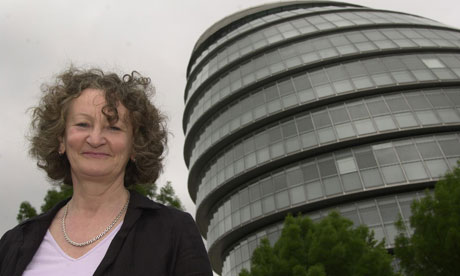
    • Green London assembly member Jenny Jones at City Hall

      Green London assembly member Jenny Jones said she was planning to attend the ‘Take the Flour Back’ protest at Rothamstead Research. Photograph: Johnny Green/PA

      On a regular basis I see someone complaining they won’t be supporting the Green party because it’s “anti-science”. This isn’t true of course. After some well-deserved criticism, party activists have taken steps to change those stances.

      Yet some scientists keep attacking them. Yesterday, the Green London assembly member Jenny Jones said she was planning to attend the “Take the Flour Back” protest at Rothamstead Research, which is against genetically modified foods. Naturally a mini-storm of criticism on Twitter followed.

      Green supporter Tom Chivers at the Telegraph vowed to stop voting Green and several people resigned from the party.

      “Take The Flour Back” are opposed to GM wheat. They aim to visit Rothamsted Park, where it is being grown as part of an experiment, and destroy the crops. In an unusual step, the scientists involved have tried to engage with the protesters too, to little avail.

      In this case I’ll agree with the scientists that many of the assertions made about the GM trial are false. The Greens should accept that, even if they remain opposed to GM foods more broadly.

      But some of the criticism is unfair.First, the Conservatives and Ukip are far more scientifically illiterate than the Greens. They are actively trying to sabotage the debate on how to deal with climate change, and most deny it is even taking place.

      Given that scientists are utterly failing to engage or lead the debate on climate change – why not spend more time dealing with that bigger problem than attacking Greens over small things? Our planet is dying thanks to global warming and some scientists think this GM outrage should be a top priority? Really?

      Second a newsflash for scientists: none of the major political parties will take on board all your recommendations. If you want one, then vote for the minuscule Science party. Every political party has to weigh up a range of interests that sometimes conflict with each other.

      Last night I attended a talk entitled “Science Communication and Political Divides” (Storifyed here) and I was relieved to hear one scientist admit: “Scientists are not very good at doing politics.” She went on to say: “Evidence has to be considered in a public light,” which is exactly right. They were referring to drugs policy in that context (Prof David Nutt and his firing around drugs policy), but the point was the same: don’t expect politicians and the public to formulate policy merely on the basis of scientific evidence.

      Science has real world results. In the case of GM foods, the industry has become concentrated in the hands of a few companies that have started patenting and exploiting farmers and consumers from developing countries.

      The divide is not between “pro-science” and “anti-science” political parties at all. Rather, politicians and parties will always side with science when it suits their constituency or aligns with their interests.

      Conservatives and Republicans will side with scientists when big corporations benefit (GM foods, nuclear power) and oppose it when big corporates are losing out (renewable energy). Greens support the science on climate change, but oppose GM food research and development for economic and sustainability reasons. Whether scientists like it or not, voters are also swayed by those concerns.

      The challenge for scientists isn’t to merely focus on what the evidence says. It is also to convince the public that their suggested course of action is the right one, even when the public is sceptical for perfectly valid reasons. Ignoring those concerns and calling them “luddites” just doesn’t work. Perhaps this is why scientists are failing to get faster action on climate change.

      • Follow Comment is free on Twitter @commentisfree
  • Humanity is Reaching its Limits – Oil, Debt, Population, etc.

    Humanity is Reaching its Limits – Oil, Debt, Population, etc.

    Posted: 24 May 2012 03:37 PM PDT

    The world is clearly reaching many limits. This graphic below shows how I see man interacting with natural systems, back before man discovered fire and back before man became intelligent enough to kill off whole species.Figure 1. My view of man’s relationship to natural systems, in the beginning.In these earliest days, human systems were a part of the natural system. Humans behaved like other animals, and fit easily into the natural order. There weren’t many humans–probably under 100,000 total in the whole world.This is the way…

    Read more…

  • Solar plane begins first flight from Europe to Africa

    Solar plane begins first flight from Europe to Africa

    Single-seater aircraft with 207ft wingspan aims to reach Morocco via Madrid and is being seen as a trial for a round-the-world flight

    • guardian.co.uk, Thursday 24 May 2012 14.21 BST
    • Solar plane

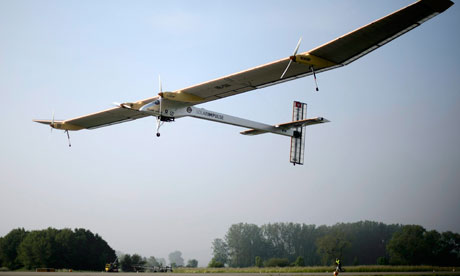
      Solar plane ‘Solar Impulse’ takes off for its first intercontinental flight to Morocco from Payerne, Switzerland. Photograph: Laurent Gillieron/EPA

      An experimental solar-powered airplane took off from Switzerland on its first transcontinental flight on Thursday, aiming to reach North Africa next week.

      Pilot Andre Borschberg will fly the jumbo jet-size Solar Impulse plane on its first leg to Madrid, Spain, by Friday. His colleague Bertrand Piccard will take the helm of the aircraft for the second stretch of its 1,554mile journey to the Moroccan capital Rabat.

      Fog on the runaway at its home base in Payerne, Switzerland, delayed the take off by two hours, demonstrating how susceptible the prototype single-seater aircraft is to adverse weather.

      “We can’t fly into clouds because it was not designed for that,” Borschberg said as he piloted the plane with its 63meter (207ft) wingspan towards the French city of Lyon at a cruising speed of just 43.5mph.

      Before landing in Madrid in the early hours of Friday, Borschberg will face other challenges, including having to fly over the Pyrenees mountains that separate France and Spain. He has a parachute inside his tiny cabin that he hopes never to use.

      Piccard – the son of an undersea explorer Jacques Piccard and grandson of balloonist Auguste Piccard – will have to cross the windy Straits of Gibraltar from Europe to Africa.

      The team has been invited to Morocco by the country’s King Mohammed VI to showcase the cutting edge of solar technology.

      Morocco is about to start construction on a massive solar energy plant at Ouarzazate, part of a country-wide solar energy grid with a capacity of 2000MW by 2020.

      The solar flight is described as a trial for a round-the-world flight with a new aircraft in 2014. That trip will include stops in the US, said Borschberg.

      In 2010, the Swiss flew non-stop for 26-hour to demonstrate that the 12,000 solar cells attached to the aircraft can soak up enough sunlight to keep the plane airborne through the night. A year later, he took Solar Impulse on its first international flight to Belgium and France. The project began in 2003 and is estimated to cost about $100m (£67m) over 10 years

    Single-seater aircraft with 207ft wingspan aims to reach Morocco via Madrid and is being seen as a trial for a round-the-world flight

    • guardian.co.uk, Thursday 24 May 2012 14.21 BST
    • Solar plane

      Solar plane ‘Solar Impulse’ takes off for its first intercontinental flight to Morocco from Payerne, Switzerland. Photograph: Laurent Gillieron/EPA

      An experimental solar-powered airplane took off from Switzerland on its first transcontinental flight on Thursday, aiming to reach North Africa next week.

      Pilot Andre Borschberg will fly the jumbo jet-size Solar Impulse plane on its first leg to Madrid, Spain, by Friday. His colleague Bertrand Piccard will take the helm of the aircraft for the second stretch of its 1,554mile journey to the Moroccan capital Rabat.

      Fog on the runaway at its home base in Payerne, Switzerland, delayed the take off by two hours, demonstrating how susceptible the prototype single-seater aircraft is to adverse weather.

      “We can’t fly into clouds because it was not designed for that,” Borschberg said as he piloted the plane with its 63meter (207ft) wingspan towards the French city of Lyon at a cruising speed of just 43.5mph.

      Before landing in Madrid in the early hours of Friday, Borschberg will face other challenges, including having to fly over the Pyrenees mountains that separate France and Spain. He has a parachute inside his tiny cabin that he hopes never to use.

      Piccard – the son of an undersea explorer Jacques Piccard and grandson of balloonist Auguste Piccard – will have to cross the windy Straits of Gibraltar from Europe to Africa.

      The team has been invited to Morocco by the country’s King Mohammed VI to showcase the cutting edge of solar technology.

      Morocco is about to start construction on a massive solar energy plant at Ouarzazate, part of a country-wide solar energy grid with a capacity of 2000MW by 2020.

      The solar flight is described as a trial for a round-the-world flight with a new aircraft in 2014. That trip will include stops in the US, said Borschberg.

      In 2010, the Swiss flew non-stop for 26-hour to demonstrate that the 12,000 solar cells attached to the aircraft can soak up enough sunlight to keep the plane airborne through the night. A year later, he took Solar Impulse on its first international flight to Belgium and France. The project began in 2003 and is estimated to cost about $100m (£67m) over 10 years.

  • Volcano Crystals Hold Clues to Next Big Eruption

    Google Alert – volcanoes

    Inbox
    x

    Google Alerts googlealerts-noreply@google.com
    6:09 PM (2 hours ago)

    to me
    News 9 new results for volcanoes
    Crystals can help predict volcano eruptions, scientists say
    Los Angeles Times
    The findings, published in Friday’s edition of the journal Science, link the movement of underground magma to earthquakes, gas emissions and other warning signs that are more accessible to experts who monitor active volcanoes above ground.
    See all stories on this topic »
    Volcano Crystals Hold Clues to Next Big Eruption
    BusinessWeek
    By Elizabeth Lopatto on May 24, 2012 Crystals formed in the molten rock of a volcano may help predict the next eruption of Mount St. Helens or Mount Vesuvius as far as a year in advance, researchers said. Drawing from data of the explosions of Mount
    See all stories on this topic »
    Can a Volcano’s Past Predict Its Future?
    Popular Mechanics
    New research going deep into the heart of Mount St. Helens could eventually help to predict when it and other volcanoes will erupt. By Miriam Kramer No one can forecast exactly when the next big volcanic eruption is going to happen.
    See all stories on this topic »

    Popular Mechanics
    Autopsy of a eruption: Linking crystal growth to volcano seismicity
    Eureka! Science News
    A forensic approach that links changes deep below a volcano to signals at the surface is described by scientists from the University of Bristol in a paper published May 24 in Science. The research could ultimately help to predict future volcanic
    See all stories on this topic »
    Will a Volcano Erupt? The Answer’s in the Crystals
    Science AAAS
    Active volcanoes often send out signals advertising that they are awake: small earthquakes and venting gasses usually aren’t good news. But often, the messages aren’t clear. Now, researchers have another tool to help predict when a volcano may blow.
    See all stories on this topic »
    Magma crystals hold valuable clues to volcanic eruptions
    msnbc.com
    More than 500 million people live close to volcanoes that could erupt with little or no clear warning, causing widespread devastation and even global effects on climate, as in the case of the 1991 eruption of Mount Pinatubo. Although scientists keep an
    See all stories on this topic »

    msnbc.com
    Rolex Volcano Race : Jethou overall winner
    BYM News (press release)
    Sir Peter Ogden’s 60-foot Mini Maxi Jethou (GBR) is the overall winner of the 2012 Rolex Volcano Race. Jethou was the third boat to finish the Leg Two of the offshore race which concluded yesterday evening following a 300-nautical mile round trip from
    See all stories on this topic »
    Carbon in rocks from Mars comes from volcanoes, not life
    Ars Technica
    And it would have had to reside in the mantle to come shooting out of a volcano mixed with molten rock later. Also, the metal oxides encasing the carbon are among the first to solidify as the molten volcanic rock cools. That means the carbon clusters
    See all stories on this topic »

    Ars Technica
    Landmark Volcano Study Brings to Life Huge Alaska Eruption on its Centennial
    United States Geological Survey (press release)
    This massive volcanic event once again comes alive for scholars and enthusiasts in a new centennial volume by two US Geological Survey scientists whose work has made major contributions to volcano science. “The Novarupta-Katmai Eruption of 1912
    See all stories on this topic »
  • Seismic hazard: Faults discovered near Lake Tahoe could generate earthquakes ranging from 6.3 to 6.9

    ScienceDaily: Earth Science News


    Seismic hazard: Faults discovered near Lake Tahoe could generate earthquakes ranging from 6.3 to 6.9

    Posted: 24 May 2012 09:32 AM PDT

    Results of a new US Geological Survey study conclude that faults west of Lake Tahoe, Calif., referred to as the Tahoe-Sierra frontal fault zone, pose a substantial increase in the seismic hazard assessment for the Lake Tahoe region of California and Nevada, and could potentially generate earthquakes with magnitudes ranging from 6.3 to 6.9.

    El Niño weather and climate change threaten survival of baby leatherback sea turtles

    Posted: 24 May 2012 06:29 AM PDT

    When critically endangered leatherback turtle hatchlings dig out of their nests, they enter a world filled with threats to survival. Now, Drexel University researchers have found that the climate conditions at the nesting beach affect the early survival of turtle eggs and hatchlings. They predict, based on projections from multiple models, that egg and hatchling survival will drop by half in the next 100 years as a result of global climate change.
    You are subscribed to email updates from ScienceDaily: Earth Science News
    To stop receiving these emails, you may unsubscribe now.
    Email delivery powered by Google
    Google Inc., 20 West Kinzie, Chicago IL USA 60610
  • Iran talks with world powers hit snag over sanctions

    News 6 new results for DANGER TO US NUCLEAR PLANTS
    Spent-Fuel Pool Concern At US Reactor
    Wall Street Journal (blog)
    Dangerous overheating begins … It’s a Fukushima-like tale, with a much more benign ending. The incident happened at a nuclear plant in the US last year after an electrical fire. Workers at the Fort Calhoun plant near Omaha, Neb., restored power after
    See all stories on this topic »
    Focus Grows on Nuclear Plant
    Wall Street Journal
    By KEITH JOHNSON AP The Fort Calhoun, Neb., nuclear-power plant was surrounded by floodwaters last June. A fire at the plant helped center attention on the industry. At 9:27 am on June 7, 2011, operators of the Fort Calhoun nuclear-power plant near
    See all stories on this topic »

    Wall Street Journal
    US, Europe and Australia trying to evade climate commitments: climate
    The Australian
    Recommended Coverage Japan hopes resting on nuclear JAPAN will not be able to cut its carbon emissions by any more than 11 per cent by 2020 if it is unable to restart any of its 50 nuclear reactors. End of sidebar. Return to start of sidebar.
    See all stories on this topic »
    Iran, big powers agree to hold more nuclear talks in June
    The West Australian
    The powers want to avert the danger of a new Middle East war raised by Israeli threats to bomb Iran, while Tehran also wants to avoid a looming Western ban on its oil exports. After discussions in Baghdad extended late into an unscheduled second day on
    See all stories on this topic »
    Iran, big powers extend talks despite split over sanctions
    euronews
    By Andrew Quinn and Justyna Pawlak BAGHDAD (Reuters) – Iran accused world powers on Thursday of creating “a difficult atmosphere” in talks on its atomic energy programme, signalling a setback in efforts to reach an agreement that would allay their
    See all stories on this topic »

    euronews
    Iran talks with world powers hit snag over sanctions
    euronews
    The powers also want Iran to send its stocks of higher-refined uranium abroad and close an underground plant devoted to 20 percent enrichment and largely invulnerable to air strikes. In return, the United States, Russia, China, France,
    See all stories on this topic »

    euronews


    This once a day Google Alert is brought to you by Google.

    Delete this alert.
    Create another alert.
    Manage your alerts.