Author: admin

  • Fastest growing volcano found

    Fastest growing volcano found
    ScienceAlert
    Scientists have found a submarine volcano in New Zealand waters that has undergone the fastest episode of collapse and growth ever recorded at a volcano. The Monowai Cone, part of the Monowai Volcanic Centre, is a giant submarine volcano about 1000km
    See all stories on this topic »

    ScienceAlert

    Volcano puts on a spectacular lightning show
    USA TODAY
    By Doyle Rice, USA TODAY The violent 2009 eruption of the Mount Redoubt volcano in southern Alaska gave scientists a rare chance to study volcanic lightning, which can pose a threat to air traffic near volcanic hotspots around the world.
    See all stories on this topic »

  • Sumatra faces yet another risk: Major volcanic eruptions

    Sumatra faces yet another risk: Major volcanic eruptions

    Posted: 16 May 2012 11:01 AM PDT

    The early April earthquake of magnitude 8.6 that shook Sumatra was a grim reminder of the devastating earthquakes and tsunami that killed tens of thousands of people in 2004 and 2005. Now a new study shows that the residents of that region are at risk from yet another potentially deadly natural phenomenon — major volcanic eruptions.
    You are subscribed to email updates from ScienceDaily: Earthquake News
    To stop receiving these emails, you may unsubscribe now.
    Email delivery powered by Google
    Google Inc., 20 West Kinzie, Chicago IL USA 60610
  • Humanmade pollutants may be driving Earth’s tropical belt expansion: May impact large-scale atmospheric circulation

    ScienceDaily: Severe Weather News


    Humanmade pollutants may be driving Earth’s tropical belt expansion: May impact large-scale atmospheric circulation

    Posted: 16 May 2012 11:00 AM PDT

    Black carbon aerosols and tropospheric ozone, both humanmade pollutants emitted predominantly in the Northern Hemisphere’s low- to mid-latitudes, are most likely pushing the boundary of the tropics further poleward in that hemisphere, new research shows. While stratospheric ozone depletion has already been shown to be the primary driver of the expansion of the tropics in the Southern Hemisphere, the researchers are the first to report that black carbon and tropospheric ozone are the most likely primary drivers of the tropical expansion observed in the Northern Hemisphere.

    Ancient tree-ring records from southwest U.S. suggest today’s megafires are truly unusual

    Posted: 16 May 2012 09:03 AM PDT

    Today’s mega forest fires of the southwestern U.S. are truly unusual and exceptional in the long-term record, suggests an unprecedented study that examined 1,500 years of ancient tree ring and fire data from two distinct climate periods. Researchers constructed and analyzed a statistical model and found that today’s dry, hot climate combined with the past century of human fire suppression is causing megafires.
    You are subscribed to email updates from ScienceDaily: Severe Weather News
    To stop receiving these emails, you may unsubscribe now.
    Email delivery powered by Google
    Google Inc., 20 West Kinzie, Chicago IL USA 60610
    Reply
    Forward
    Click here to Reply or Forward
  • Australasia has hottest 60 years in a millennium, scientists find

    Australasia has hottest 60 years in a millennium, scientists find

    Study of tree rings, corals and ice cores find unnatural spike in temperatures that lines up with manmade climate change

    • guardian.co.uk, Thursday 17 May 2012 07.52 BST
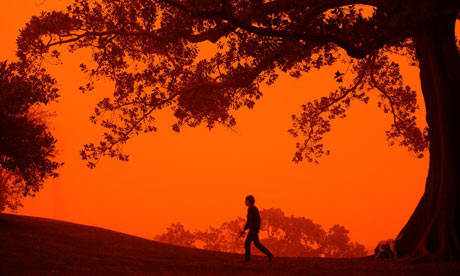
    • Red dust blown in from Australia's parched interior blankets Sydney in 2009

      Red dust blown in from Australia’s parched interior blankets Sydney in 2009. Australia and its region are experiencing the hottest 60 years in a millennium, scientists have determined. Photograph: Greg Wood/AFP/Getty

      The last 60 years have been the hottest in Australasia for a millennium and cannot be explained by natural causes, according to a new report by scientists that supports the case for a reduction in manmade carbon emissions.

      In the first major study of its kind in the region, scientists at the University of Melbourne used natural data from 27 climate indicators, including tree rings, corals and ice cores to map temperature trends over the past 1,000 years.

      “Our study revealed that recent warming in a 1,000-year context is highly unusual and cannot be explained by natural factors alone, suggesting a strong influence of human-caused climate change in the Australasian region,” said the study’s lead researcher, Dr Joelle Gergis.

      The climate reconstruction was done in 3,000 different ways and concluded with 95% accuracy that no other period in the past 1,000 years match or exceeded post-1950 warming in Australia.

      The study, published in the Journal of Climate, will be part of Australia’s contribution to the fifth Intergovernmetal Panel on Climate Change report, due in 2014.

      As part of the study, climate modellers used the natural data to analyse the impact of both natural events, like volcanic eruptions in the pre-industrial era, and the impact of human-induced climate change such as greenhouse gasses emissions on temperatures in the last millennium.

      Dr Steven Phipps, from the Climate Change Research Centre at the University of New South Wales, who carried out the modeling, said the study demonstrated strong human influence on the climate in the region.

      “The models showed that prior to 1850 there were not any long-term trends and temperature variations were likely to be caused by natural climate variability which is a random process,” he said.

      “But [the modeling showed] 20th-century warming significantly exceeds the amplitude of natural climate variability and demonstrates that the recent warming experience in Australia is unprecedented within the context of the last millennium.”

      Annual average daily maximum temperatures in Australia have increased by 0.75C since 1910. Since the 1950s each decade has been warmer than the one before it.

      Australia’s peak scientific body, the CSIRO, has said temperatues will rise by between 1C and 5C by 2070 when compared with recent decades. It predicts the number of droughts in southern Australia will increase in the future and that there will be an increase in intense rainfall in many areas.

  • NASA Science News for May 16, 2012

    NASA Science News for May 16, 2012

    NASA has just released a new count of asteroids that come close to the orbit of Earth and could survive entry through our planet’s atmosphere. The data, gathered by an infrared space telescope named WISE, reveal important new information about the origin and make-up of these potentially hazardous space rocks.

    FULL STORY: http://science.nasa.gov/science-news/science-at-nasa/2012/16may_pha/

    You are currently subscribed to snglist as: nevilleg729@gmail.com.

    This is a free service.

  • Nuclear Safety Debate Between Industry, Regulators Focuses On Radiation Filters

    Nuclear Safety Debate Between Industry, Regulators Focuses On Radiation Filters
    Huffington Post
    Nuclear safety advocates, however, argue that the industry is simply jockeying to avoid added costs as the commission begins to implement tougher safety guidelines for US reactors in the aftermath of last year’s meltdown at a Japanese power plant.
    See all stories on this topic »