Author: admin

  • This is the fracking truth

    This is the fracking truth

    Even if the shale-gas men don’t rupture aquifers or pollute our tap water, no politician will be safe

    • fracking public meeting

      A public meeting held after the Blackpool quakes to discuss shale gas drilling and fracking near Balcombe, Sussex. Photograph: Martin Godwin for the Guardian

      Just when we’re told drought has become endemic in the UK, the Department of Energy and Climate Change has given the go-ahead for a process that will desiccate us more than any we’ve tried before on these islands: hydraulic fracturing, or fracking.

      High-volume fracking needs between 1.6m and 2.5m gallons (between seven and 11m litres) of water for a single well. All that water is smashing rock. All those millions of litres are giving the shale rock a BTEX injection; BTEX is benzene, toluene, ethylbenzene and xylene.

      If a political cell were to threaten to poison our drinking water by setting off depth charges near subterranean faultlines, and then further threatened to pump in radioactive isotopes, should such a cell be asked to help compile the government report into their activities? It is indeed a bizarre report that the Department of Energy and Climate Change has put out, a bit like an inquiry into Syria focusing on the effect of the pollen count on the dictatorship.

      Nary a mention of volatile organic compounds contaminating aquifers, so busily are the authors consumed by counting all the holes caused by fracking in Lancashire – until they triumphantly conclude that fracking poses scant risk of earthquake.

      To which I say well, not ones that will topple the Blackpool Tower, maybe. Not seismic tremors you can feel beneath your feet, but earthquakes all the same. Earthquakes by definition, in fact. For fracking works by detonating shale rock thousands of feet underground, and for all that the shale gas industry may say these are controlled explosions, there is, however, no such thing as a controlled earthquake.

      The department has overturned the borehole ban while allowing a hosepipe ban to stand. This was a mistake. Never come between a vixen and her cub, nor between the British and their love of gardening and clean water.

      Even in the best-case scenario in which the frackers don’t, by some miracle, rupture aquifers and pollute drinking water, the process itself will drain us dry in the vain hope that it might earn us enough foreign capital to pay for the imports of Volvic and Evian that we will need to put on our crops.

      And what if fracking does pollute our fragile aquifers, as it has done in Pennsylvania and Wyoming? Well, here the timing of the report happily coincides with another topical emergency apart from drought – and that is debt. The financial crisis. Our skintness.

      The words of the US governments’s Environmental Protection Agency should chill every British bone to the marrow when they say that ground water contaminated by fracking is “typically too expensive to remediate or restore”. (And if you want a glimpse of the appalling powerlessness of fracking-afflicted communities in the United States then watch the Sundance-award documentary Gasland.)

      In Europe, meanwhile, Bulgaria has became the second EU country after France to ban fracking. The Bulgarians’ indefinite moratorium followed a campaign which ranged across the whole political spectrum.

      In any British electoral constituency where fracking is proposed, the issue will be every bit as much of a political earth-mover as in Bulgaria. People will vote against type, and against party loyalty. No MP, MEP or councillor will dare follow the party whip in the teeth of civil ire that will ignite like methylated tap water in a Pennsylvania kitchen, an anger which even the gas firms’ PR teams will not be able to extinguish. In any constituency where fracking is proposed, you can forget about psephology. Fracking will not just undermine the shale geology of Britain but may sink half the recognisable political landscape too. That’s the hope, at least.

  • E.P.A. Caps Emissions at Gas and Oil Wells

    Alert Name: CLIMATE CHANGE NEWS
    April 19, 2012 Compiled: 1:10 AM

    By JOHN M. BRODER (NYT)

    The Environmental Protection Agency issued its first standards for oil and gas companies covering air pollution from hydraulic fracturing, or fracking.

    About This E-mail


    You received this e-mail because you signed up for NYTimes.com’s My Alerts tool. As a member of the TRUSTe privacy program, we are committed to protecting your privacy.

  • Nuclear safety and expenses becomes more problematic

    News 2 new results for DANGER TO US NUCLEAR PLANTS
    Op-Ed: Nuclear safety and expenses becomes more problematic
    DigitalJournal.com
    Today reactors built in the United States and elsewhere finds problematic safety concerns contributing to nuclear expenses during an era of earthquakes and natural disasters. In addition, Japan seeks to restart some nuclear power plants,
    See all stories on this topic »

    DigitalJournal.com
    US Chemical Weapons Disposal Slippage ‘No Surprise,’ Expert Says
    National Journal
    This article was originally published in Global Security Newswire, produced independently by National Journal Group under contract with the Nuclear Threat Initiative. NTI is a nonprofit, nonpartisan group working to reduce global threats from nuclear,
    See all stories on this topic »
  • Request from Norway and Response (Dr James Hansen)

    James Hansen jimehansen@gmail.com via mail20.us2.mcsv.net
    12:37 PM (1 hour ago)

    to me
    Email not displaying correctly? View it in your browser.
    1. Request from Norway and Response

    Request received (from Norway, regarding e-mail titled “Grandparents Oppose Tar Sands”):

    Thanks.  I have seen them in the news here in Norway as well about the Tar Sands.

    Question:  When you send us these emails, can you include some sort of picture with each article, paper, etc. so that it is more eye-catching on Facebook when I repost it?

    I am able to share a lot of information with my students and colleagues with Facebook.   I also share information from friends & news-media in my classes that are shared on Facebook.    One of the curses & benefits of modern communication.  Thanks again.

    Response: below is a note and photo received from one of the grandparents:

    I am enclosing a photo from today’s presentation by Norwegian Grandparents Climate Campaign – GCC to Statoil main office in Oslo of letter signed by 28 organizations and political parties demanding that Statoil withdraw from Canadian tar sand. Grandparent Bente Bakke was joined by Anne Dalberg, chair of the Sami Church Council.  Norway’s First Nation – the Sami -showing solidarity with Canadian First Nations. Money may rule, but morals may be stronger!

    ~Jim Hansen

  • When will Energy Independence Arrive?

    When will Energy Independence Arrive?

    Posted: 17 Apr 2012 03:20 PM PDT

    The good news, the U.S. is reducing its consumption of foreign oil. The bad news, the Titanic may make it to port before the U.S. becomes truly energy independent. This is meant not to disrespect the 1,514 who died sailing in the Titanic 100 years to the day. November 7, 1973 is a day that should live in infamy. On this day, President Richard M. Nixon announced “Project Independence,” a sweeping initiative to achieve energy self-sufficiency for the United States by 1980. “The idea of energy independence was first conceived in…

    Read more…

  • Germany’s careful toilet-flushing is a drop in the water-conservation ocean

    Germany’s careful toilet-flushing is a drop in the water-conservation ocean

    Germans are way ahead of Brits when it comes to saving water domestically. But politicians avoid the big issue: agricultural use

    • guardian.co.uk, Wednesday 18 April 2012 12.34 BST
    • Article history
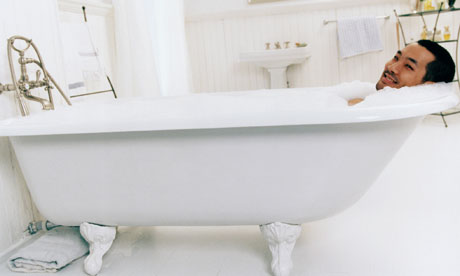
    • Man in bath

      On average humans are responsible for 1.4m litres of water usage per year – that’s around 8,600 bathtubs. Photograph: Getty

      While Britain frets about the drought, Germany can’t get enough of saving water. Germans are good at saving water, so good in fact that they have created a problem for their canalisation system: many pipes are clogged with grease, excrement and leftovers because they aren’t being flushed sufficiently with water. Especially in the summer, gutters in German cities can reek horribly. In some parts of the country, water suppliers even have to flush their pipes artificially with hundreds of thousands of litres of water.

      We Germans have always been keen to be best in class when it comes to saving water. Our toilets have a special water-saver button for flushing after you have a wee, we switch off the tap when we brush our teeth, we try hard not to splash too much when we wash our cars. Last year Germany only used 124 litres of water per head per day – down from 144 litres in 1991. In Britain the current figure is 150 litres.

      That might be very impressive on Germany’s part, and shaming on Britain. But the real question is whether small gestures like that really make a difference. In the long run, the few drops you save when drinking, cooking, flushing or washing up are of little importance.

      It is products, not activities that waste most water. Making a a 200g bag of crisps uses 135 litres, a beefburger 2,400 and a steak 4,000. A cotton T-shirt gulps up 4,100 litres, a brand new car as much as 450,000.

      Of course you can argue with the details here – there are always slightly greener alternatives. But you can’t argue much with the so-called water footprint which shows how carelessly we treat Earth’s most valuable resource. On average, every person on this planet is responsible for an incredible 1.4m litres of water usage per year: that’s 8,600 bathtubs with 160 litres of water each. Ninety per cent of this is employed in agriculture: that’s where proper water-conservation needs to happen. But apparently politicians care little to do anything about it, be it in London, Berlin or Brussels.

      It’s quite possible that there will be more frequent drought warnings in the future. National governments will have to find ways of dealing with the problem. The first step might have to be a fight with the farmers, industrialists and lobbyists, and not just those on their doorstep.

      And there are plenty of proposals on the table that politicians should consider: be it a water tax, whereby those who used rivers to cool their factories will have to cough up, using agricultural subsidies as rewards for careful water usage, or a water limit across the industry. Instead, environment secretary Caroline Spelman seems to be focusing on telling ordinary people to have fewer baths.

      Her German counterparts, who pride themselves on their teacher’s-pet reputation, are no better in that respect, by the way. Angela Merkel may have listened to environmentalist concerns once she realised that popular opinion in Germany was against nuclear power. But she doesn’t look keen to boost her green credentials any further. It’s the same across the globe: politicians like giving people the feeling that they are doing something good for the environment when they turn off their taps. But sadly that’s not enough. In the long term, feel-good environmentalism won’t save the planet.

      • Follow Comment is free on Twitter @commentisfree