Author: admin

  • NASA views our perpetual ocean

    ScienceDaily: Earth Science News


    NASA views our perpetual ocean

    Posted: 09 Apr 2012 05:44 PM PDT

    The swirling flows of tens of thousands of ocean currents were captured in a scientific visualization created by NASA’s Goddard Space Flight Center.
    You are subscribed to email updates from ScienceDaily: Earth Science News
    To stop receiving these emails, you may unsubscribe now.
    Email delivery powered by Google
    Google Inc., 20 West Kinzie, Chicago IL USA 60610
  • ScienceDaily: Severe Weather News

    ScienceDaily: Severe Weather News


    Rough terrain can channel a tornado’s damaging winds, new research suggests

    Posted: 09 Apr 2012 01:41 PM PDT

    A doctoral student noticed storm damage far from the path a tornado took through hilly Alabama terrain. He’s using a tornado simulator to confirm rough terrain can channel a tornado’s damaging winds.
    You are subscribed to email updates from ScienceDaily: Severe Weather News
    To stop receiving these emails, you may unsubscribe now.
    Email delivery powered by Google
    Google Inc., 20 West Kinzie, Chicago IL USA 60610
  • Union corruption: don’t shoot messenger

    Union corruption: don’t shoot messenger

    Kathy Jackson

    April 10, 2012

    Opinion

    Craig Thomson.Prior warning … Craig Thomson. Photo: Alex Ellinghausen

    When, in May 2009, I brought evidence of what I thought to be financial impropriety by Craig Thomson to the Health Services Union national executive, most of them were stunned.
    Everyone knew these allegations were very bad news for the union and would be magnified by Thomson’s role as a man on the rise in the federal Labor caucus. The executive commissioned an exhaustive investigation by solicitors and accountants, at a cost of more than $250,000, which it provided to Fair Work Australia.

    Advertisement: Story continues below

    We also warned Labor. When the then-future NSW state secretary, Sam Dastyari, contacted me before preselection for the 2010 federal elections, I said the Thomson allegations were likely to be publicly established during the life of the next Parliament. Other senior ALP figures were given similar warnings.
    It was one of the labour movement’s worst-kept secrets, which makes the ACTU’s grandstanding – four years later – even more galling.
    Where has the ACTU been for the past four years, when we needed them? For example, after I took allegations about HSUeast, the branch of the union that covers NSW, to NSW police in September, did the ACTU join me in calling for an independent inquiry? Not on your life. Indeed, several senior officials of ACTU affiliates joined the whispering campaign that it was just part of “faction fighting”.
    My threat of a members’ plebiscite finally forced what became the Temby inquiry, but with no help from the ACTU. The ACTU never joined the pleas of HSU officials for Fair Work to quickly finish its separate inquiry.
    Even at Thursday’s ACTU executive meeting, where the still-secret Fair Work report was used as the pretext to suspend the HSU, there was no call for the report to be released. The ACTU secretary, Jeff Lawrence, says that the union must demonstrate that it now has its house in order, but in the past four years he has never remotely interested himself in the measures we’ve already taken to do so.
    But the ACTU’s leadership did know what was going on. I met Lawrence and the president, Ged Kearney, months ago and briefed them, particularly, on my allegations about HSUeast. Yet the ACTU has uttered not one word of support for my stand in the seven months since I went to the police.
    So why the suspension of our union now? It’s thought that the report of Ian Temby, QC, is imminent and will bring worse news than even the Thomson allegations. So the ACTU is belatedly scrambling to look proactive on corruption. In effect, the ACTU has suspended the federal HSU for the anticipated corruption findings against a NSW union (HSUeast) unaffiliated to the ACTU. It’s a complicated point and the ACTU is relying on the media and the public not to get it. When they do, the farce becomes even clearer.
    But HSUeast is affiliated to Unions NSW, so I’m hoping the NSW body will not ape the ACTU suspension. Ideally, they’ll work instead with the HSU’s majority of honest officials to help the union rebuild.
    What should the ACTU do to really address corruption? First, it could call for a regulator with teeth. Fair Work has shown itself, at best, incompetent. It’s in unions’ own interest that there’s a regulator with beefed-up powers of investigation, enforcement and, particularly, prosecution.
    Second, it could develop its own standards for affiliates, tougher even than the regulator requires. An ACTU committee of accountants and lawyers would supervise compliance. The Thomson allegations themselves would have caused a more effective ACTU leadership to commence on this path years ago.
    Third, it’s time to look at elections. Big-money union elections and the advantages of incumbency have combined to ensure that many unions have, essentially, ”one-party” government. That’s unhealthy.
    Corruption has existed in the HSU national body but was flushed out from 2007 onwards.
    Other unions are right to be concerned that my union’s controversy will unfairly affect them. But what happened at the ACTU executive on Thursday gave only the appearance of action and hurt those in the HSU who are fighting corruption.
    The measures I’d like to see might be difficult, even controversial. But we need true ”zero tolerance” measures that will last for a generation, not just until the next press conference.
    Kathy Jackson is the national secretary of the Health Services Union.
    twitter Follow the National Times on Twitter: @NationalTimesAU

  • Nuclear google alerts

    Reports: North Korea planning a new nuclear test (+video)
    Christian Science Monitor
    The threat of such a test, coming amid plans to test a controversial rocket this week, is seen as an effort by North Korea to extort more aid from the international community. By Tom A. Peter, Correspondent / April 9, 2012 A soldier stands guard in
    See all stories on this topic »

    Christian Science Monitor

    The Ideology of Catastrophe
    Wall Street Journal
    natural disasters will multiply, the climate will bring us to war, and nuclear plants will explode. Man has committed the sin of pride; he has destroyed his habitat and ravaged the planet; he must atone. My point is not to minimize our dangers.
    See all stories on this topic »

  • Balanced view: Population education. (Kelvin Thomson)

    Balanced View: Population education — promoting awareness about sustainable population to benefit everyone.

    Inbox
    x

    Hamilton, Tim (K. Thomson, MP) Tim.Hamilton@aph.gov.au
    10:44 AM (43 minutes ago)

    to Tim

    Tim Hamilton
    Electorate Officer
    Office of Kelvin Thomson MP
    Member for Wills
    (P) 9350 5777
    (M) 0424 138 558

    Bal View Mar-2012- Final-PDF.PDF Bal View Mar-2012- Final-PDF.PDF
    511K   View Download
  • Italy’s high-speed train line under the alps gathers pace

    Italy’s high-speed train line under the Alps gathers pace

    After 20 years of protest against the tunnel, excavation for the TAV rail scheme is due to begin in the Susa valley near Turin

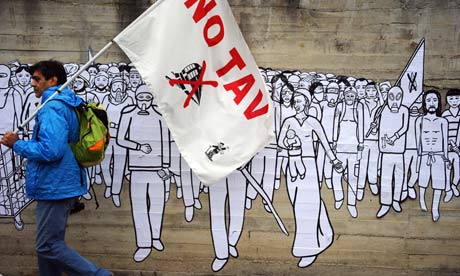
    • A No TAV demonstrator

      An Italy’s high-speed train (TAV) line at a protest in Chiomonte. Photograph: Olivier Morin/AFP/Getty Images

      It is a project of extravagant dimensions and it has been blocked for almost 20 years by a protest of epic tenacity and occasional violence.

      But this week, Italian plans for a 35-mile rail link under the Alps, four miles longer than the Channel tunnel and linking Turin to Lyons, will move into a new and possibly decisive phase.

      Officials are due to expropriate a stretch of sloping grassland near the Alpine village of Chiomonte, outside Turin, where work will begin on Italy‘s side of the border. The first planned excavation is of an access tunnel to allow geologists to test conditions.

      When the site was fenced off last summer, almost 400 people were injured in the resulting clashes between demonstrators and police. Twenty-six people accused of taking part in the violence have since been jailed.

      The authorities have declared the site of national strategic interest and made it subject to the same legislation that applies to army barracks. But part of the land has been bought by the protest movement, and Lele Rizzo, a prominent figure on its more radical wing, said that when the expropriations begin “we shall try to be there, on our property.”

      The first demonstration against the high-speed train (Treno Alta Velocità, TAV) route was in 1995. The resistance has continued ever since and, in February, almost claimed a life when an activist who climbed an electricity pylon fell after being severely burned.

      Taken aback by the intensity of the protests, successive governments in Rome have havered and dallied. But Mario Monti‘s non-party government appears determined. It came into office in November charged with reanimating Italy’s moribund economy and, said Mario Virano, special commissioner for the tunnel, “infrastructure is considered as a mechanism for the creation of economic growth”.

      Virano is charged with persuading local people and their representatives of TAV’s merits. Last month, he was summoned to Rome and was astonished to find on the other side of the table, in addition to Monti, no fewer than four members of his cabinet. According to Virano, at the end of a meeting lasting several hours, Monti declared: “We want to go ahead with [the TAV project], not because we inherited it but because we believe in it.”

      So why does the scheme arouse such passionate feelings? All Alpine landscapes have a certain grandeur. But while the Susa valley contains important historical monuments and archaeological remains, it is not the prettiest.

      Apart from the existing train line, it is dotted with quarries and factories. The land on which last year’s pitched battle was fought lies in the shadow of an array of monstrous concrete pillars that hold up part of the A32 motorway, built in the 1980s.

      “That is the real abomination. Yet it was put up without any resistance,” said Renzo Pinard, the mayor of Chiomonte and one of only two local authority chiefs along the proposed TAV route who back it.

      Environmentalists have said that the mountains through which the tunnel will be dug contain deposits of uranium and asbestos. Massimo Zucchetti, who lectures on nuclear engineering at the Polytechnic University of Turin, is an adviser to the Susa valley authority, whose president is a leading opponent of the scheme.

      But even he says: “I don’t think that the uranium, nor even the asbestos, represents the main reason for not carrying out this project.” The hazards of digging out the minerals could be eliminated by the use of powerful extractor fans.

      Nor is there a danger of lorries, heavy with rocks and dust, rumbling through the valley’s peaceful villages: it has been agreed the waste will be removed via the motorway. So what is the problem?

      This is an odd conflict, in which the normal roles are reversed: it is the proponents of the scheme who are the dreamers (or visionaries, depending on your point of view). And it is the opponents, including a fair share of anarchists and environmentalists, who argue for financial necessity and fiscal prudence.

      The two camps disagree over the project’s net, long-term balance of carbon emissions. But, said Rizzo: “While the No TAV movement began as an environmental protest, today – I have to say – it is the economic arguments that take priority. The tunnel would be an utter waste of public funds. The existing railway line could support any possible increase in traffic. The scheme continues to be based on projections made 20 years ago.”

      A document produced by the government in support of the project counters that it will slash the journey time between Paris and Milan from seven hours to four, bring about “a significant increase in the volume of freight transport” and halve the cost of transporting goods by rail. It could also bring about “a notable reduction in the number of lorries on the roads in the delicate Alpine environment”.

      But these and other assertions are impossible to test, because the Italian government has never published a cost-benefit analysis. Virano said his office had completed one, but was waiting for it to be formally unveiled in Rome by the appropriate minister.

      He said that the outcome, using the European Union’s central macro-economic scenario, was environmentally “very positive” and financially “slightly positive”. But, say the tunnel’s proponents, projections based solely on today’s facts and figures miss the point: that “Italy’s Channel tunnel” is intended to create its own, new reality.

      Virano points to the experience of Switzerland, which doubled its rail system traffic by excavating tunnels through the Alps. More importantly perhaps, TAV is fundamental to a vision of Europe conceived in Brussels, where Monti spent almost 10 years as an EU commissioner.

      The Susa valley lies on a proposed rail corridor which, before the Portuguese pulled out, was intended to run from the Atlantic to Ukraine’s border. By linking Turin to Lyon, moreover, it would connect the two biggest cities in a region the Eurocrats have dubbed AlpMed.

      Whether this region exists in any meaningful sense is debatable. On the Italian side, the A32 is all but deserted: a journey from the start to the last exit before the French border was shared with fewer than 20 vehicles.

      But put these objections to Virano and he hands over a map that appears to show the main rail links in today’s Italy. In fact, it was drawn in 1846 by the Count of Cavour, one of the architects of Italian unification. “If Cavour had taken into account commercial relations between the various cities then he would never have put in these lines,” said Virano. “Some were in countries that were at war at the time.”

      Engineering, in other words, can make dreams come true. And in this case, it may have to. Much of the work on the French side has already been done and, were Italy to pull out, say officials, it would face a huge bill for damages of at least €1bn (£820m).