Author: admin

  • World Water Forum will pander to corporate self-interest, say critics

    World Water Forum will pander to corporate self-interest, say critics

    Campaigners pan global water conference for allowing business access to senior government officials and raise concerns that delegates are watering down human rights commitments

    • guardian.co.uk, Monday 12 March 2012 13.00 GMT
    • Article history
    • MDG : Water shortage in Tuvalu

      Drought on the Polynesian island of Tuvalu offers a stark reminder of the deprivations caused by water scarcity, the theme of the World Water Forum. Photograph: 350.org

      Diplomats, business leaders, and scientific experts are gathering in southern France this week for an international conference billed as a “platform for solutions” to the global water crisis, but denounced by critics for lacking legitimacy and promoting the interests of large transnational corporations.

      Organisers say more than 20,000 delegates from 180 countries will attend the six-day World Water Forum (WWF) in Marseille. French president Nicolas Sarkozy is expected to attend, along with European Commission president José Manuel Barroso, King Mohammed VI of Morocco, and the CEOs of Nestlé and Coca-Cola.

      The meeting comes amid growing global concern about resource scarcity and future water shortages. The UN’s world water development report, published on Monday, warned that unprecedented growth in the demand for water is threatening global development goals and will exacerbate inequalities between and within countries.

      “Because allocation will inevitably go to the highest paying sector or region, this may result in an increasingly significant portion of people not being able to satisfy their basic needs for food, energy, water and sanitation. This would not be mere stagnation, but would likely take the form of a distinctly regressive trend compared to current conditions,” said the report.

      It added that it is no longer sufficient for water experts to draft technical proposals behind closed doors. Instead, it is necessary to open up water management to society as a whole, and recognise that “efficiency and productivity gains alone cannot alter global patterns of unequal supply of resources and consumption or access to benefits”.

      A separate OECD study on global water challenges, published last week, said rapid urbanisation, climate change and shifts in the global economy will push demand for water up by 55% by 2050, when it expects more than 40% of the world’s population to live in areas of severe “water-stress”.

      Both reports say rising resource scarcity will make it more difficult, and more urgent, to address competing demands from farmers, energy producers, and other water users.

      Organisers of the water forum say the event will bring together delegates from government ministries, civil society groups, the private sector and the scientific community to promote concrete proposals for tackling global water issues including access to water and sanitation.

      Some forum delegates view the meeting as an important step on the road to the Rio+20 summit on sustainable development in June.

      But critics say the forum, which costs as much as 700 euros for full access, caters to the interests of big business and gives corporations opportunities to advance their interests by facilitating direct access to high-ranking government officials. Starting on Wednesday, activists are staging an Alternative World Water Forum to promote alternatives to privatisation and share experiences on how to promote public and community-led water management from the bottom-up.

      On Friday, UN special rapporteur Catarina de Albuquerque warned that government delegates to the WWF appeared to be watering down their human rights commitments to water and sanitation. These rights, formally recognised by the UN in 2010, must form the basis of any proposals to expand access to essential services, said De Albuquerque in a statement.

      A draft of the declaration from government ministers gathering at the WWF, seen by the Guardian, fails to explicitly reaffirm the human rights to water and sanitation. Instead, it commits signatories to pursue the implementation of “human rights obligations relating to access to safe and clean drinking water and sanitation”.

      While the declaration, due to be released on Tuesday, will not be legally binding, campaigners argue that this language inserts loopholes for countries to dodge their legal and financial obligations to uphold these rights.

      NGOs, advocacy groups, and civil society organisations said the draft declaration is dangerously ambiguous and that “a small number of states will use [this] to try to undermine progress on the right to safe drinking water and sanitation at the United Nations level and in other international processes”.

      At the 2009 forum in Istanbul, Turkey, which saw riot police turn water cannons on protesters opposing the privatisation of water utilities, delegates opted to describe water as a “basic human need” rather than a right.

      Last week, the UN announced that the international target to halve the number of people without access to safe drinking water – part of the millennium development goals (MDGs) – had been met, five years ahead of the 2015 deadline. The news was tempered, however, with a warning that nearly 800 million people are still without access to safe water and that the MDG target to improve basic sanitation, such as latrines and hygenic waste collection, is still far from being met.

  • California’s snow not disappearing despite drought

    ScienceDaily: Severe Weather News


    California’s snow not disappearing despite drought

    Posted: 12 Mar 2012 07:14 AM PDT

    During some winters a significant amount of snow falls on parts of California. During other winters — like this one (so far) — there is much less snow. But more than 130 years of snow data show that over time snowfall in California is neither increasing nor decreasing.
    You are subscribed to email updates from ScienceDaily: Severe Weather News
    To stop receiving these emails, you may unsubscribe now.
    Email delivery powered by Google
    Google Inc., 20 West Kinzie, Chicago IL USA 60610
  • Nitrous oxide emissions are no laughing matter

    ScienceDaily: Earth Science News


    First consumption of abundant life form, Archaea, discovered

    Posted: 12 Mar 2012 11:03 AM PDT

    Scientists have documented for the first time that animals can and do consume Archaea – a type of single-celled microorganism thought to be among the most abundant life forms on Earth. Archaea that consume the greenhouse gas methane were in turn eaten by worms living at deep-sea cold seeps off Costa Rica and the West Coast of the United States.

    Nitrous oxide emissions are no laughing matter

    Posted: 12 Mar 2012 07:19 AM PDT

    While many are acquainted with the problems caused by CO­­2 emissions, the harmful effects of the release of nitrous oxide into the atmosphere have been far less well known. Only in recent years has the international scientific community begun to understand the scope of the threat posed by N­­2O emissions.  

    California’s snow not disappearing despite drought

    Posted: 12 Mar 2012 07:14 AM PDT

    During some winters a significant amount of snow falls on parts of California. During other winters — like this one (so far) — there is much less snow. But more than 130 years of snow data show that over time snowfall in California is neither increasing nor decreasing.

    Sea ice drives arctic air pollutants, NASA finds

    Posted: 01 Mar 2012 08:11 AM PST

    Drastic reductions in Arctic sea ice in the last decade may be intensifying the chemical release of bromine into the atmosphere, resulting in ground-level ozone depletion and the deposit of toxic mercury in the Arctic, according to a new NASA-led study.
    You are subscribed to email updates from ScienceDaily: Earth Science News
    To stop receiving these emails, you may unsubscribe now.
    Email delivery powered by Google
    Google Inc., 20 West Kinzie, Chicago IL USA 60610
    Reply
    Forward
    Click here to Reply or Forward
  • Greenland ice sheet may melt completely with 1.6 degrees of global warming

    ScienceDaily: Oceanography News


    First consumption of abundant life form, Archaea, discovered

    Posted: 12 Mar 2012 11:03 AM PDT

    Scientists have documented for the first time that animals can and do consume Archaea – a type of single-celled microorganism thought to be among the most abundant life forms on Earth. Archaea that consume the greenhouse gas methane were in turn eaten by worms living at deep-sea cold seeps off Costa Rica and the West Coast of the United States.

    Greenland ice sheet may melt completely with 1.6 degrees of global warming

    Posted: 11 Mar 2012 09:32 PM PDT

    The Greenland ice sheet is likely to be more vulnerable to global warming than previously thought. The temperature threshold for melting the ice sheet completely is in the range of 0.8 to 3.2 degrees Celsius of global warming, with a best estimate of 1.6 degrees above pre-industrial levels, shows a new study.

    Sea ice drives arctic air pollutants, NASA finds

    Posted: 01 Mar 2012 08:11 AM PST

    Drastic reductions in Arctic sea ice in the last decade may be intensifying the chemical release of bromine into the atmosphere, resulting in ground-level ozone depletion and the deposit of toxic mercury in the Arctic, according to a new NASA-led study.
    You are subscribed to email updates from ScienceDaily: Oceanography News
    To stop receiving these emails, you may unsubscribe now.
    Email delivery powered by Google
    Google Inc., 20 West Kinzie, Chicago IL USA 60610
  • Post-Fukushima world must embrace Thorium. not ditch nuclear

    Thorium is much cheaper and more plentiful- but is it better than Uranium ? India is considering using Thorium. because of the economics.

    Post-Fukushima world must embrace thorium, not ditch nuclear

    The man whose inventions led to nuclear power proliferation knew thorium was preferable to uranium – it’s time we caught up

    What is thorium and how does it generate power?

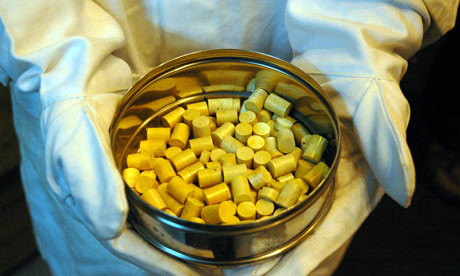
    • India nuclear plans: Thorium pellets at the Bhabha Atomic Research Centre (BARC) in Mumbai

      Thorium pellets at the Bhabha Atomic Research Centre (BARC) in Mumbai, India. Photograph: Pallava Bagla/Corbis

      A year ago this Sunday, a dreadful and terrifying natural disaster was sweeping a trail of death and destruction along the north-eastern coast of Japan. The Tohoku earthquake and ensuing tsunami claimed an estimated 20,000 lives, washing away entire towns and wreaking havoc with the nation’s infrastructure. An oil refinery was set ablaze leading to the death of six workers and a reservoir also failed, killing a further four people. The nuclear reactors at Fukushima experienced a partial meltdown causing the release of radiation, but killing no one.

      The media’s treatment of the entire disaster, however, was completely out of kilter with these facts. The unfolding events at the stricken power station quickly dominated the coverage, ousting the actual earthquake and its dreadful aftermath from the headlines and, it seems, our collective memories. A year later we talk of the anniversary of the Fukushima disaster, not the far, far greater tragedy of the Tohoku earthquake.

      In no way do I wish to make light of the suffering of the thousands evacuated from the exclusion zone around the power station, nor to undervalue the immense bravery of the workers who, under extreme pressure, worked tirelessly to minimise the impact of the accident. But we need to keep things in perspective. This was a terrible event, caused by a much more terrible event, which again brought to the surface the many troubling aspects of how the nuclear industry operates.

      For instance, the siting of reactors on the eastern seaboard of a country highly vulnerable to earthquakes ought to have necessitated far more preventative measures or, better yet, the decision not to build there at all. The reactor itself was over 40 years old and operating company Tepco had been criticised ahead of the accident for lax safety standards.

      The events in Fukushima do not justify a wholesale rejection of nuclear power. We have been able to harness the fissioning of the nucleus of an atom for good and evil, for life-saving medical treatments and to create the atom bomb. Somewhere on this scale of achievements lies our use of nuclear energy. And even within this, not all nuclear power is equal.

      The inventor of the technology upon which most of today’s operating nuclear power stations are based, Alvin Weinberg, was all too aware of this. He worried about some of the safety issues involved in using solid uranium fuel in his water-cooled reactors. He believed this configuration, though useful for creating materials for nuclear weapons, posed too many safety risks and created too much hazardous waste for widespread civilian use. As a result, he also directed a research team that invented a radically differently designed reactor, based on using chemically stable liquid salts as the coolant, and thorium as the fuel. Sadly, though he advocated safer, cleaner nuclear designs for the rest of his life, the world took no heed and the reactors we live with today are still fundamentally the same as those that he considered unnecessarily complex and vulnerable to accident.

      Fortunately, one of the legacies of Fukushima is that while investment in today’s current reactor designs may have slowed, there is a renewed interest in Alvin’s alternative designs and in other fundamentally different approaches. In China, a major R&D programme into thorium molten salt reactors is underway, with the first test reactors to be completed in 2015 and a larger-scale demo ready by the end of the decade. In the US, safer, molten salt cooled pebble bed reactors are being developed. In Europe, there are various research programmes into new designs. Even here in the UK, where nuclear R&D has been starved of investment, important but fragmented research is underway and, with the help of the Weinberg Foundation, I have helped to set up an all-party parliamentary group dedicated to exploring the potential of thorium-based energy.

      Fukushima must mark a turning point in the history of nuclear power. The proponents of the existing technologies should be chastened by the reminder it provided of how things can go wrong. Even if they are not, the providers of investment, both public and private, have had a wake-up call and will proceed with far greater caution.

      But the twin concerns of climate change and energy security mean we cannot afford to turn our back on nuclear altogether, as there is no greater potential source of energy on the planet. It is still an amazing achievement to have harnessed the vast energy forged into the heart of an atom during the dying moments of a star, and a safer, cleaner form of nuclear power is possible. As we move forward we need to admit to the failings of the current technologies and commit to developing new ones now.

      To try to use Fukushima to justify a complete disavowal of the use of nuclear power would be a gross distortion of the extent of the threat it posed. It would also consign the world to greater use of fossil fuels and higher concentrations of greenhouse gases, unleashing many more natural disasters with huge loss of life. This is the real risk we need to be vigilant against.

  • Tracking Antarctic Krill as more is harvested for Omega-3 Pills

    Alert Name: CLIMATE CHANGE NEWS
    March 13, 2012 Compiled: 1:02 AM

    By SUSAN MORAN (NYT)

    Fishing companies are increasingly drawn to the Southern Ocean, where the krill population is one of the least exploited.

    About This E-mail


    You received this e-mail because you signed up for NYTimes.com’s My Alerts tool. As a member of the TRUSTe privacy program, we are committed to protecting your privacy.