Author: admin

  • Earth on acid: Present & future of global acidification

    ScienceDaily: Earth Science News


    Strange diet for methane-consuming microorganisms

    Posted: 06 Nov 2012 08:41 AM PST

    Methane is formed under the absence of oxygen by natural biological and physical processes, e.g. in the sea floor. It is a much more powerful greenhouse gas than carbon dioxide. Thanks to the activity of microorganisms, this gas is inactivated before it reaches the atmosphere and unfolds its harmful effects on Earth’s climate. Researchers have now demonstrated that these microorganisms are quite picky about their diet.

    Earth on acid: Present & future of global acidification

    Posted: 06 Nov 2012 06:27 AM PST

    Climate change and extreme weather events grab the headlines, but there is another, lesser known, global change underway on land, in the seas, and in the air: acidification.
    You are subscribed to email updates from ScienceDaily: Earth Science News
    To stop receiving these emails, you may unsubscribe now.
    Email delivery powered by Google
    Google Inc., 20 West Kinzie, Chicago IL USA 60610
  • Greens claim hidden NSW tobacco investment

    Greens claim hidden NSW tobacco investment

    by state political reporter Sarah Gerathy, ABCNovember 7, 2012, 8:56 am

    The Greens say they have obtained figures which show the New South Wales Government has invested at least $28.7 million in tobacco products through fund managers.

    Greens MP John Kaye’s obtained figures from Treasury which show that $2 billion of government money is sunk into trusts, which in turn hold between 1.3 and 1.7 per cent of their assets in the tobacco industry.

    He says that adds up to $28.7 million the government has invested in tobacco.

    The Government says it does not directly invest in such companies, but employs fund managers to decide what shares should be bought.

    Dr Kaye says New South Wales should follow the ACT’s policy on ethical investments.

    “(It should) turn around to its investment managers and say very clearly ‘we don’t want anything to do with the tobacco industry, don’t sell us a product that has tobacco shares in it’,” he said.

    Dr Kaye says its hypocritical behaviour from a Government that criticised its Labor predecessor for investing in tobacco.

  • Demography, development and citizen’s rights

    Demography, development and citizen’s rights
    Jakarta Post
    The inclusion of individual rights in the praxis of population and development was a result of strong lobbying from feminist groups who perceived that family planning programs, as the main device to control population growth, grossly violated the human
    See all stories on this topic »

  • Struck Dumb MONBIOT

    Monbiot.com


    Struck Dumb

    Posted: 05 Nov 2012 12:30 PM PST

    Why, even now, climate change cannot be mentioned in the presidential election.


    By George Monbiot, published in the Guardian 6th November 2012.

    Here’s a remarkable thing. Neither Mitt Romney nor Barack Obama – with the exception of one throwaway line each(1,2) – have mentioned climate change in the wake of Hurricane Sandy.

    They are struck dumb. During a Romney rally in Virginia on Thursday, a protester held up a banner and shouted “What about climate? That’s what caused this monster storm”(3). The candidate stood grinning and nodding as the crowd drowned out the heckler by chanting “USA!, USA!”. Romney paused, then resumed his speech as if nothing had happened. The poster the man held up? It said “End climate silence.”

    While other Democrats expound the urgent need to act, the man they support will not take up the call. Barack Obama, responding to his endorsement by the mayor of New York, mentioned climate change last week as “a threat to our children’s future”(4). Otherwise, I have been able to find nothing; nor have the many people I have asked on Twitter. Something has gone horribly wrong.

    There are several ways in which the impacts of Hurricane Sandy are likely to have been exacerbated by climate breakdown. Warmer oceans make hurricanes more likely and more severe(5,6). A warmer atmosphere holds more moisture, increasing the maximum rainfall(7). Higher sea levels aggravate storm surges. Sandy might not have hit the United States at all, had it not been for a blocking ridge of high pressure over Greenland, which diverted the storm westwards. The blocking high – rare there at this time of year – could be the result of the record ice melt in the Arctic this autumn(8).

    This might sound like the wisdom of hindsight. But in February the journal Nature Climate Change published an article which warned that global warming is likely to “increase the surge risk for New York City”(9). As storms intensify and the sea level rises, it predicted, storm surges previously described as 100-year events would become between five and thirty times as frequent.

    Four years ago, Obama pledged that “my presidency will mark a new chapter in America’s leadership on climate change”(10). He promised a federal cap and trade system and “strong annual targets” to reduce carbon pollution. But he ran into a ridge of high pressure. His cap and trade bill was killed in the Senate in 2010. By then, he had wilted in the rising heat.

    At a meeting in the White House in 2009, his strategists decided that climate change was a banned topic: it caused too much trouble(11). From then onwards, Obama would talk about clean energy and green jobs and improvements in fuel economy, but would seldom explain why these shifts were necessary. The problem with this approach is that you cannot engineer a sustained reduction of greenhouse gas emissions only by getting into clean energy: you also have to get out of dirty energy. And that requires statesmanship: active and persuasive engagement with the public.

    In April, Obama told an interviewer that global warming “will become part of the campaign” and that he would be “very clear” in explaining how he would deal with it(12). It hasn’t happened. There were a couple of non-committal paragraphs in his speech to the national convention, during which he also boasted that “we’ve opened millions of new acres for oil and gas exploration in the last three years, and we’ll open more.”(13) There was more of the same in the Democratic platform (the party’s manifesto)(14). Otherwise this remains the issue that dare not speak its name. For the first time since 1984, climate change was mentioned in none of the presidential debates. It is a forbidden land, into which you shall not wander.

    This, remember, is after a year of climate disasters: the droughts and wildfires that devastated much of the continental interior of the United States, the Arctic meltdown, the superstorm that ripped through the Caribbean before piercing the financial and spiritual heart of the nation. You wonder what it takes.

    As for Romney, his contribution has been confined to mockery. Even as Hurricane Isaac cut short the Republican national convention, he ridiculed Obama, to the delight of the delegates, for wanting to stop the sea level from rising(15). It was a revolting spectacle, which, in the aftermath of Sandy, would have become a major liability, had climate change not been taboo.

    In the Republican party platform, “climate change” – yes, in quotes – is mentioned only once, and only to attack Obama for taking it seriously(16). The platform commits the party to blocking all effective measures to curb it, and to developing new coal (which Romney now professes to “love”(17)), the Keystone XL tar sands pipeline and oil drilling on the outer continental shelf and in the Arctic National Wildlife Refuge. Planetary ruin, for the Republicans, seems no longer to be an unfortunate side-effect of development: now it looks almost like a desirable end in itself, a test of manhood and corporate muscle.

    Successive polls show that an effective response to climate breakdown will not lose votes(18,18a,19). Votes are not the problem: the problem is money and traction. Anyone who tries to address this subject encounters a storm surge of attack ads, obstruction and manufactured fury.

    During the crucial year – 2009 – in which the cap and trade bill was struggling through Congress and governments were preparing for the summit in Copenhagen, environmental groups threw everything they had at climate change. After massive fundraising efforts, a coalition of green NGOs managed to find $22m for federal lobbying(20). But Exxon alone outspent them with a casual flick of the wallet. The $27m it dropped into the counter-campaign represented half of one day’s profits(21). The other fossil fuel companies threw in a further $150m(22). Without a major reform of both lobbying and campaign finance, the big money will keep winning; everyone else will keep losing. Protecting the planet and its people is impossible in a plutocracy.

    The Republicans in Congress have no choice but keep obstructing or filibustering every means of addressing our foremost global crisis, for to alter their position would be to jeopardise their political funding(23). As David Roberts of grist.org points out, Obama has little incentive to talk about climate change when he knows that any promise he makes will be thwarted. All he can do is to “fight for gridlock because gridlock is better than the alternative.”(24)

    So the two candidates remain struck dumb. Speech fails them, action is abominable, they will not even raise their hands in self-defence. The world’s most pressing crisis, now breaking down the doors of the world’s most powerful nation, cannot be discussed.

    References:

    1. Obama’s sole statement can be read here: http://www.nytimes.com/2012/11/02/nyregion/bloomberg-endorses-obama-saying-hurricane-sandy-affected-decision.html

    2. Romney’s can be read here: http://www.huffingtonpost.com/2012/11/02/mitt-romney-climate-change_n_2068608.html

    3. http://grist.org/news/romney-grins-awkwardly-as-his-audience-shouts-down-climate-activist/

    4. http://www.nytimes.com/2012/11/02/nyregion/bloomberg-endorses-obama-saying-hurricane-sandy-affected-decision.html

    5. ftp://texmex.mit.edu/pub/emanuel/PAPERS/wcas_2011.pdf

    6. http://myweb.fsu.edu/jelsner/PDF/Research/ElsnerTrepanierStrazzoJagger2012.pdf

    7. http://www.skepticalscience.com/hurricane-sandy-climate-connection.html

    8. http://thinkprogress.org/climate/2012/11/03/1125981/jeff-masters-why-did-hurricane-sandy-take-such-an-unusual-track-into-new-jersey/

    9. http://www.nature.com/nclimate/journal/v2/n6/abs/nclimate1389.html

    10. http://change.gov/newsroom/entry/president_elect_barack_obama_to_deliver_taped_greeting_to_bi_partisan_gover/

    11. http://www.guardian.co.uk/environment/2012/nov/01/obama-strategy-silence-climate-change

    12. http://www.rollingstone.com/politics/news/ready-for-the-fight-rolling-stone-interview-with-barack-obama-20120425

    13. http://www.whitehouse.gov/the-press-office/2012/09/07/remarks-president-democratic-national-convention

    14. http://assets.dstatic.org/dnc-platform/2012-National-Platform.pdf

    15. http://www.huffingtonpost.com/2012/08/31/mitt-romney-obama-climate-change_n_1846440.html

    16. http://www.gop.com/wp-content/uploads/2012/08/2012GOPPlatform.pdf

    17. http://www.bbc.co.uk/news/science-environment-20181029

    18. http://thinkprogress.org/climate/2011/10/13/343020/democrats-green-climate-change-won/

    18a. http://thinkprogress.org/climate/2011/09/08/314629/polling-obama-climate-change-public-opinion/

    19. http://ecoaffect.org/2012/08/16/new-poll-pro-climate-political-leaders-win-with-majority-of-americans/

    20. http://www.opensecrets.org/news/2010/08/pro-environment-groups-were-outmatc.html

    21. http://www.guardian.co.uk/business/2010/feb/01/exxonmobil-oil-profits-slump

    22. http://www.opensecrets.org/news/2010/08/pro-environment-groups-were-outmatc.html

    23. http://www.monbiot.com/2012/08/02/dance-with-the-one-who-brung-you/

    24. http://grist.org/climate-energy/the-futility-of-climatespotting-no-matter-what-he-says-obama-cant-make-big-moves-on-climate/

    You are subscribed to email updates from George Monbiot
    To stop receiving these emails, you may unsubscribe now.
    Email delivery powered by Google
    Google Inc., 20 West Kinzie, Chicago IL USA 60610
  • A storm of stupidity? Sandy, evidence and climate change

    A storm of stupidity? Sandy, evidence and climate change

    Posted: 04 Nov 2012 10:03 PM PST

    By Stephan Lewandowsky via the Conversation

    “It’s global warming, stupid” – Bloomberg’s Businessweek cover last week left little doubt about their opinion concerning “Frankenstorm” Sandy. The accompanying tweet anticipated that the cover might “generate controversy, but only among the stupid.”
    These frank words about the Frankenstorm are perhaps long overdue in light of the general failure of American politicians to show leadership on this issue.
    But is it really a matter of mere “stupidity” to deny the link between climate change and Sandy’s fury — a link that has been drawn carefully but quite explicitly by scientists around the world, including in Australia?
    No, it is not a matter of stupidity.
    On the contrary, it takes considerable, if ethically disembodied, intelligence to mislead the public about the link between climate change and Sandy as thoroughly as our national “news”paper has done for the umpteenth time.
    It is not a matter of stupidity. It is a matter of ideology.
    People who subscribe to a fundamentalist conception of the free market will deny climate change irrespective of the overwhelming strength of the scientific evidence. They will deny any link between climate change and events such as the unprecedented Frankenstorm Sandy, or the unprecedented Texas drought, or the unprecedented series of Derechos, or the unprecedented flooding in Tennessee, or the unprecedented Arctic melt, or the unprecedented retreat of Alpine glaciers, or the unprecedented tripling of extreme weather events during the last 30 years.
    There is no longer any reasonable doubt that climate change is happening all around us. There is also no doubt that ideology is the principal driver of climate denial.
    So what effect will Sandy have on public opinion?
    On the one hand, the deniers will likely double down and their claims will become ever more discordant with the reality on this planet. Their denial will continue even if palm trees grow in Alaska and if storms such as Sandy — or far worse — have become commonplace.
    On the other hand, the vast majority of people who are not in the clutches of a self-destructive ideology will likely wake up and smell the science. Even before Sandy, a recent Pew poll (PDF) revealed that acceptance of climate change among the American public rebounded by 10 percentage points in the last few years. There is every reason to expect that Sandy will accelerate this trend towards acceptance of the dramatic changes our planet is undergoing.
    Much research has shown that people’s attitude towards climate change depends on specific events and anecdotal evidence. For example, people are more likely to endorse the science on a hot day than on a cool day, all other things being equal. Even a seemingly trivial stimulus such as a dead plant in an office can enhance people’s acceptance of the science (three dead plants are even better). This human tendency to focus on scientifically irrelevant anecdotes rather than on data can be unfortunate, especially because it lends itself to exploitation by propagandists who haul out every cool day in Wagga Wagga as “evidence” that climate change is a hoax.
    However, people’s propensity to learn from specific events rather than scientific data and graphs can also be beneficial. For example, a national survey in the UK revealed that people who personally experienced flooding expressed more concern over climate change and, importantly, felt more confident that their actions will have an effect on climate change.       Similar data have been reported in Australia. Respondents who attributed salient events to climate change were found to be better adapted to climate change, they reported greater self-efficacy, and they were more concerned with climate change.
    There is little doubt that Americans, too, will connect the dots between Frankenstorm Sandy and the reality of climate change. They will also likely recognise how drastically wrong the deniers were when they shrugged off sea level rise and how it might contribute to a flooding of New York City.
    The moment the public recognises the link between climate change and Sandy, they will clamor for action. Just like New York City’s mayor, Michael Bloomberg, when he endorsed President Obama for re-election because he was more likely to address climate change.
    Salient events carry a message.
    People understand that message.
    After all, it’s global warming, stupid.

    • Stephan Lewandowsky does not work for, consult to, own shares in or receive funding from any company or organisation that would benefit from this article, and has no relevant affiliations.The Conversation
    • This article was originally published at The Conversation. Read the original article.
  • Obama and Romney remain silent on climate change, the biggest issue of all

    Obama and Romney remain silent on climate change, the biggest issue of all

    Despite hurricane Sandy, neither Obama nor Romney will speak about global warming. The danger this poses is huge

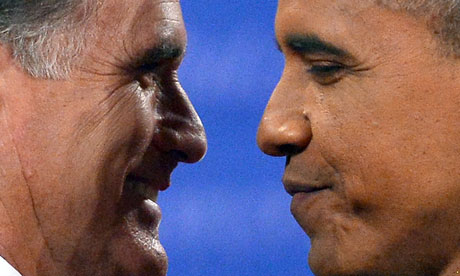
    US President Barack Obama (R) shakes han

    ‘For the first time since 1988, climate change wasn’t mentioned in any of the presidential debates.’ Photograph: Jewel Samad/AFP/Getty Images

    Here’s a remarkable thing. Neither Mitt Romney nor Barack Obama – with the exception of one throwaway line each – have mentioned climate change in the wake of hurricane Sandy.

    They are struck dumb. During a Romney rally in Virginia on Thursday, a protester held up a banner and shouted “What about climate? That’s what caused this monster storm”. The candidate stood grinning and nodding as the crowd drowned out the heckler by chanting “USA! USA!”. Romney paused, then resumed his speech as if nothing had happened. The poster the man held up? It said “End climate silence”.

    While other Democrats expound the urgent need to act, the man they support will not take up the call. Barack Obama, responding to his endorsement by the mayor of New York, mentioned climate change last week as “a threat to our children’s future”. Otherwise, I have been able to find nothing; nor have the many people I have asked on Twitter. Something has gone horribly wrong.

    There are several ways in which the impact of hurricane Sandy is likely to have been exacerbated by climate breakdown. Warmer oceans make hurricanes more likely and more severe. A warmer atmosphere holds more moisture, increasing the maximum rainfall. Higher sea levels aggravate storm surges. Sandy might not have hit the United States at all, had it not been for a blocking ridge of high pressure over Greenland, which diverted the storm westwards. The blocking high – rare there at this time of year – could be the result of the record ice melt in the Arctic this autumn.

    This might sound like the wisdom of hindsight. But in February the journal Nature Climate Change published an article warning that global warming is likely to “increase the surge risk for New York City”. As storms intensify and the sea level rises, it predicted that storm surges previously described as 100-year events would become between five and 30 times as frequent.

    Four years ago, Obama pledged that “my presidency will mark a new chapter in America’s leadership on climate change”. He promised a federal cap and trade system and “strong annual targets” to reduce carbon pollution. But he ran into a ridge of high pressure. His cap and trade bill was killed in the Senate in 2010.

    At a meeting in the White House in 2009, his strategists decided that climate change was a banned topic: it caused too much trouble. From then onwards, Obama would talk about clean energy and green jobs and improvements in fuel economy, but would seldom explain why these shifts were necessary. The problem with this approach is that you cannot engineer a sustained reduction of greenhouse gas emissions only by getting into clean energy: you also have to get out of dirty energy. And that requires statesmanship: active and persuasive engagement with the public.

    In April, Obama said that global warming “will become part of the campaign” and that he would be “very clear” about how he would deal with it. It hasn’t happened. There were a couple of noncommittal paragraphs in his speech to the national convention, during which he also boasted that “we’ve opened millions of new acres for oil and gas exploration in the last three years, and we’ll open more.” There was more of the same in the Democratic platform (the party’s manifesto). Otherwise, this remains the issue that dare not speak its name. For the first time since 1988, climate change wasn’t mentioned in any of the presidential debates.

    This, remember, is after a year of climate disasters: the droughts and wildfires that devastated much of the continental interior of the United States, the Arctic meltdown, the superstorm that ripped through the Caribbean before piercing the financial and spiritual heart of the nation. You wonder what it takes.

    As for Romney, his contribution has been confined to mockery. Even as hurricane Isaac cut short the Republican national convention, he ridiculed Obama, to the delight of the delegates, for wanting to stop the sea level from rising. It was a revolting spectacle, which, in the aftermath of Sandy, would have become a major liability, had climate change not been taboo.

    In the Republican party platform, “climate change” – yes, in quotes – is mentioned only once, to attack Obama for taking it seriously. The platform commits the party to blocking all effective measures to curb it, and to developing new coal (which Romney now professes to “love”), the Keystone XL tar sands pipeline and oil drilling on the outer continental shelf and in the Arctic National Wildlife Refuge. Planetary ruin, for the Republicans, seems no longer to be an unfortunate side-effect of development: now it looks almost like a desirable end in itself; a test of manhood and corporate muscle.

    Successive polls show that an effective response to climate breakdown will not lose votes. Votes are not the problem: the problem is money and traction. Anyone who tries to address this subject encounters a storm surge of attack ads, obstruction and manufactured fury.

    During the crucial year – 2009 – in which the cap and trade bill was struggling through Congress and governments were preparing for the summit in Copenhagen, environmental groups threw everything they had at climate change. After massive fundraising efforts, a coalition of green NGOs managed to find $22m for federal lobbying. But Exxon alone outspent them with a casual flick of the wallet. The $27m it dropped into the counter-campaign represented half of a day’s profits. The other fossil fuel companies threw in a further $150m. Without a major reform of both lobbying and campaign finance, the big money will keep winning. Protecting the planet and its people is impossible in a plutocracy.

    The Republicans in Congress have no choice but to keep obstructing or filibustering every means of addressing our foremost global crisis, for to alter their position would be to jeopardise their political funding. As David Roberts of grist.org points out, Obama has little incentive to talk about climate change when he knows that any promise he makes will be thwarted. All he can do is to “fight for gridlock because gridlock is better than the alternative”.

    So the two candidates remain struck dumb. Speech fails them, action is abominable, they will not even raise their hands in self-defence. The world’s most pressing crisis, now breaking down the doors of the world’s most powerful nation, cannot be discussed.

    • Read a fully referenced version of this article at www.monbiot.com