Author: admin

  • More roads will just lead us nowhere

    More roads will just lead us nowhere

    Date
    November 1, 2012
    Category
    Opinion
    Elizabeth Farrelly

    Elizabeth Farrelly

    Sydney Morning Herald columnist, author, architecture critic and essayist

    View more articles from Elizabeth Farrelly

    Advertisement

    Will WestConnex (despite its horrible name) save NSW’s ailing economy, as its proponents testily insist? Or is it, in the words of transport elder Ron Christie, “back to the 1950s … a real LA-type solution”?

    It happened that, on the tram en route to that Meeting of the Tims, I met an elderly couple from Vancouver. They sought somewhere ”interesting” for their last half-day in Sydney. Darling Harbour? I suggested. Pyrmont? Barangaroo?

    As I sketched the background they were dismayed by how far and how recently Sydney has cleansed itself of industry.

    “In Vancouver,” they said, “we’re trying to keep this stuff in the city so that people, and freight, don’t need to travel so far.”

    In Sydney, I was ashamed to realise, just voicing such ideas still brands you as a boat-rocking leftie. How did our urban debate become so polarised? Can anyone still think that environment and economy are foes, instead of short-term and long-term views of the same thing?

    The Committee for Sydney reincarnates Rod McGeoch’s 1997 creature of the same name. Remember that lobby group for those least in need, the rich and powerful? I thought it had finally vanished from lack of interest but apparently not, for the new committee gleams stiffly like a Thatcher hairdo, stiff with the same old power-myopia.

    It’s very open. Anyone can join, for a mere ten grand (plus GST). And anyone can speak, as long as they’re CEO of a multi-million dollar corporation.

    The committee, whose board includes Sally Loane (now spin-meister for those well known philanthropic urbanists Coca-Cola Amatil) and former Howard hatchet-man Max Moore-Wilton, proudly spruiks such membership benefits as the “opportunity to meet … key decision makers”, “access to leaders in private, public and not-for profit sectors” and the capacity to “influence key policies”. (Does saying something three times in different words mean it’s hyper-important?)

    It has not been idle. Last month alone the committee hosted five events: a briefing with the Network Rail CEO, David Higgins, lunch with Qantas CEO Alan Joyce, drinks for the London & Partners CEO Gordon Innes, drinks for Asian Cup Football CEO Michael Brown, and lunch with Landcom CEO John Brogden.

    Whew. Talk about big issues. Just keeping track of which friend is CEO of what, this week, would fill those little gaps between your investment decisions all by itself.

    The committee also blogs, with posts like ”CFS congratulates Business Events Sydney” or ”CFS commends Planning Minister”. Surprisingly, there are no comments. (Well, there’s one, in six months, a spirited discussion on intermodal freight interchange by the smart and indefatigable social activist Lynda Newnam. But she’s no CEO, and there’s no response).

    As to policy, it’s a bit thin. On transport, Sydney’s bleeping-red issue, Tim #1 concedes that “the car … is now seen as a liability.” Yet he insists that WestConnex is “an inevitability,” not worth discussing. A $10 billion inevitability.

    So that’s city-planning orthodoxy; top-down stuff, forbiddingly abstract. Super Sydney inverts and subverts this model. Tim Williams #2, having lived and worked in Paris, developed it from a couple of Parisian projects – Sarkozy’s 2009 Grand Paris, and the current, 196-council Paris Metropole.

    Compared with Paris’s 196 councils, Sydney’s 42 seems modest. Still, over several months, interviewers headed to each of them, filming 12 conversations with 12 people about what people wanted for their city. The full, 504-video collection is available on the website.

    My favourite so far is Ben from Marrickville, who says, somewhat bashfully: “I’d like to see public treehouses … really big ones, and you can, like rent it for a couple of hours and go up there … ”

    Beauty’s quite big, parks and fountains. (Locals love Blacktown and Mount Druitt, in particular, for their visual charms). Diversity, community, arts, friendliness and safety all figure highly. I haven’t heard any calls for roads, although I believe there are some. But the overwhelming consensus is a clarion call for transport.

    On this, vox pop accords with every visiting urbanist this year (and there have been a few). London School of Economics Professor Ricky Burdett, New York City chief urban designer Alex Washburn, and the deputy mayor of Paris, Pierre Mansat (in launching Super Sydney last week); each, unprompted, offered the same insight. Sydney desperately needs public transport.

    So why this massive road project?

    Infrastructure NSW argues thus: “Sydney’s road network serves 93 per cent of passenger journeys, and most growth in transport demand over the next 20 years will be met by roads.”

    Especially, of course, if you keep building more roads.

    This is the essence of conservative thinking. It’s why top-down produces business as usual, because that’s what feeds it.

    But in fact we don’t need more roads: if anything we should convert Parramatta Road to full-on public transport. As a former Federal Court judge, Murray Wilcox, AO, QC, argues, this project demands we ask, “who benefits?”

    “If it’s commuters,” he said, “wouldn’t they benefit more from public transport? If not commuters, then why do it at all?”

    An answer is provided by EcoTransit’s satirical WasteConnex vid, available on YouTube.

    “WasteConnex,” croons the voice over, “is the highest priority project … sucking $10 billion out of public transport and freight rail projects and delivering it to construction, consulting, and finance.”

    That’s your “inevitable.” Frankly, I’d prefer public tree houses.

    Follow the National Times on Twitter


    Read more: http://www.smh.com.au/opinion/society-and-culture/more-roads-will-just-lead-us-nowhere-20121031-28k3k.html#ixzz2AvE2ctC4

  • Did climate change create the ‘Frankenstorm’? It didn’t help

    Scientist predict sea level rise from burning of all Earth’s fossil fuels
    Phys.Org
    The implied steric sea level rise ranged from 0.7 metres to 5 metres if all the planet’s conventional fossil fuel reserves were burned – representing a cumulative emission of about five trillion tonnes of carbon – which could happen 500 years or more
    See all stories on this topic »
    Did climate change create the ‘Frankenstorm’? It didn’t help
    Crikey (blog)
    Secondly, physics dictates that a warmer planet will mean land-bound ice will melt and seawater will experience thermal expansion — this means sea levels will rise. We can be reasonably confident that the degree of sea level rise will be substantial
    See all stories on this topic »
    Is Sandy a taste of things to come?
    CNN
    The New York State Sea Level Rise Task Force translated that into a local projection of 2 to 5 inches by the 2020s, and with rapid Arctic ice melt the rise could be as much as 5 to 10 inches over the next fifteen years. Combine that with a trend toward
    See all stories on this topic »
    31.10.2012Awaiting a Superstorm Fate Far Worse Than Sandy: Asian Megacities
    FatCat
    “These cities are undergoing very rapid expansion and they are not only exposed to sealevel rise, they are also exposed to tropical cyclones,” said Bob Ward, director of policy at the Grantham Research Institute on Climate Change and the Environment
    See all stories on this topic »

    FatCat
    Sandy’s legacy and sea level rise
    The Progressive Pulse
    Affecting NC public policy through informed, energetic and progressive conversations. Home · About · Archives. a blog from. Home > Uncategorized > Sandy’s legacy and sea level rise. |; Older »
    See all stories on this topic »
  • NASA satellites capture Hurricane Sandy’s massive size

    ScienceDaily: Severe Weather News


    NASA satellites capture Hurricane Sandy’s massive size

    Posted: 30 Oct 2012 11:32 AM PDT

    NASA’s Aqua satellite captured a visible image Sandy’s massive circulation. Sandy covers 1.8 million square miles, from the Mid-Atlantic to the Ohio Valley, into Canada and New England.

    Superstorm Sandy: Eight to ten million cumulative power outages predicted

    Posted: 30 Oct 2012 11:22 AM PDT

    An engineer is predicting power outages for 8 to 10 million people in the aftermath of Superstorm Sandy.

    Economists weigh in on Sandy’s impending financial fury

    Posted: 30 Oct 2012 11:22 AM PDT

    In addition to the immediate physical impacts Hurricane Sandy promises the Northeast, economists say the storm also will bring intrinsic financial effects that are sure to unfold over the next few days and linger through the coming months.

    New England poultry producers may see effects from Sandy

    Posted: 30 Oct 2012 11:22 AM PDT

    Instead of an early snowfall this time of year, farmers along the eastern seaboard are dealing with flood waters and wind damage from Superstorm Sandy, which is expected to affect everything from poultry production to grocery prices.
    You are subscribed to email updates from ScienceDaily: Severe Weather News
    To stop receiving these emails, you may unsubscribe now.
    Email delivery powered by Google
    Google Inc., 20 West Kinzie, Chicago IL USA 60610
  • Methane hydrates found in EEZ

    Methane hydrates found in EEZ
    The Japan Times
    Methane hydrates, viewed as a next-generation energy source, have been found under the sea in two areas of Japan’s exclusive economic zone, a group of researchers said. The group also said it has collected methane hydrates in layers several meters
    See all stories on this topic »

  • Death and destruction: US begins clean-up after Sandy causes chaos

    Death and destruction: US begins clean-up after Sandy causes chaos

    Date
    October 31, 2012 – 9:18AM
    • 868 reading now
    Paul McGeough

    Paul McGeough

    Chief foreign correspondent


    Video settings

    Please Log in to update your video settings

    Video settings

    Please Log in to update your video settings

    Daylight reveals Sandy’s wrath

    Americans woke to scenes of destruction wrought by monster storm Sandy after it smashed into the eastern United States.

    Video will begin in 1 seconds.

    • Interactive map: the disaster zone
    • 17 people killed in New York
    • Millions likely to be without power for days
    • Nuclear power plant “not a danger”
    • Obama to visit New York disaster zone

    The president pulled an all-nighter. But as the northeast corner of the US shook itself out of a hurricane-induced daze today, there was a sense that Sandy’s catastrophic winds might have wrought much more damage – but that the billions worth it did in eight states was quite enough, thank-you.

    The most important message I have for them is that America is with you.

    Barack Obama

    The eye of the storm was elsewhere – heading for Canada. But the focus of emergency relief attention was the Manhattan pressure-cooker, where traffic bridges that lash the island to the rest of the US were re-opening, but slowly; and all local mass transit and New York city’s three airports remained closed.

    Residents stand over vehicles which were submerged in Lower Manhattan.

    Residents stand over vehicles which were submerged in Lower Manhattan. Photo: Reuters

    Not since the blackouts of 2003 – almost a decade back – were the sheath-like towers of the city’s iconic skyline etched in such deep black, as opposed to their customary high-wattage glitter.

    “We expected an unprecedented storm impact in New York City,” mayor Michael Bloomberg said. “That’s what we got.”

    Amidst torrential rain and as much as 50cm of snow in high-country blizzards, the dawn tally was gob-smacking in a storm path sweeping from the New Jersey coast and up through New York state and central Pennsylvania.

    A resident looks over the remains of burned homes in the Rockaways section of New York.

    A resident looks over the remains of burned homes in the Rockaways section of New York. Photo: Reuters

    There were almost 40 storm related deaths – 18 of them in New York, including two boys hit by a falling tree in suburban Westchester.

    Elsewhere, the dead included a 90-year-old woman and a firefighter killed in separate incidents in Connecticut; two adults dead in storm-related traffic accidents in Maryland; and a 40-year-old woman killed while driving in storm-induced snow in West Virginia.

    Now 8.5 million homes in 16 states and the District of Columbia are without power – including 250,000 in the southern half of Manhattan, where a series of spectacular explosions at an electrical facility doused the lights; and in the entire cities of Newark and Jersey City.

    The coastline of New Jersey in the aftermath of Sandy.

    The coastline of New Jersey in the aftermath of Sandy. Photo: Reuters

    A spokesman for Con Edison says the challenge to restore power in the city that never sleeps is “unprecedented in scope.” Initial predictions that power would be back in 2-3 days quickly stretched to 3-4 days … and then to ‘maybe’ 4-5 days.

    There was general cause for anxiety, with flood-warnings still in place for low-lying coastal areas that are home to hundreds of thousands. But perhaps the greatest worry, if only until there has been sufficient public communication to shut it down as an issue, is the safety of the country’s oldest nuclear power plant – on the New Jersey coast, at Oyster Creek, 95km east of Philadelphia.

    An abnormal storm surge of almost 2m reportedly pushed water levels at the plant, ‘potentially’ impacting a “water intake structure” that circulates cooling water through the plant’s repository of spent fuel rods, according to a spokesman for the US Nuclear Regulatory Commission.

    A resident assists in rescue efforts with his jet-ski in New Jersey.

    A resident assists in rescue efforts with his jet-ski in New Jersey. Photo: Reuters

    Exelon Corp, the operator of the 43-year-old plant, insists there is no danger to equipment and no threat to public health or safety – and that the formal ‘alert’ notice was second from the bottom of a list of four that must be issued in the case of such incidents.

    More than 80 cheek-by-jowl homes were gutted by fire at Breezy Point, in the New York borough of Queens, before hundreds of firemen managed to bring the blaze under control.

    Almost 6000 flights were cancelled on Tuesday – on top of as many as 10,000 scrapped on Monday. Thereby, last year’s Hurricane Irene was edged out of the record books for the greatest number if US flights disrupted by a weather event.

    A woman paddle-boards down a flooded city street in the aftermath of Hurricane Sandy in Bethany Beach, Delaware.

    A woman paddle-boards down a flooded city street in the aftermath of Hurricane Sandy in Bethany Beach, Delaware. Photo: Reuters

    Comparisons with the failed emergency services response to Hurricane Katrina, in 2005 on the watch of former Republican President George Bush, were inevitable and, it has to be said of the first 72 hours, were a striking contrast.

    So much so that when a reported suggested to New Jersey governor Chris Christie, a stout defender of Mitt Romney and long reckoned as a possible vice presidential running mate for the Republican challenger for the presidency, Christie made a surprise lurch across the political spectrum to praise President Barack Obama.

    “I have to say, the administration, the president, himself and FEMA Administrator Craig Fugate have been outstanding with us so far,” Christie told ABC’s Good Morning America. “We have a great partnership with them.”

    Destruction ... homes wrecked by Sandy in the Queens borough of New York.

    Destruction … homes wrecked by Sandy in the Queens borough of New York. Photo: AFP

    Christie spoke of how Obama had called him Monday night, offering to help in any way he could. As a result, New Jersey had been declared a major disaster area, for which federal funding would flow.

    Smacking down a suggestion that he should invite Romney to New Jersey for a post-hurricane photo-op, Christie instead gave Obama another smooch – “I want to thank the president personally for his personal attention to this.”

    With Obama’s disaster declarations still in force in New York, adjacent Long Island and in parts of New Jersey, the New York Stock Exchange announced plans to open as usual at 9.30am on Wednesday – but it was testing its contingency plan as well, “just in case.”

    Homes devastated by fire and the effects of Hurricane Sandy in Queens, New York.Click for more photos

    Hurricane Sandy strikes US coast

    Homes devastated by fire and the effects of Hurricane Sandy in Queens, New York. Photo: Reuters

    The evacuation at the height of the storm of more than 200 patients from the NYU Langone Medical Center, in Manhattan, when backup power system failed was managed without incident. Backup power reportedly failed at another city hospital – but after patients had been removed to other facilities.

    New York City officials expected the Manhattan, Brooklyn, Williamsburg and Ed Koch Queensboro Bridges to reopen late on Tuesday morning. The Brooklyn-Battery Tunnel and Queens-Midtown Tunnel remain closed and the Lincoln Tunnel was open throughout the storm.

    As cars floated down city streets late on Monday, the storm surge poured water into the Brooklyn-Battery Tunnel, flooding it “from end to end” only hours after State Governor Mario Cuomo had ordered it closed to traffic. Water also seeped into seven subway tunnels under the East River.

    “In 108 years, our employees have never faced a challenge like the one that confronts us now,” Mr Joseph Lhota, head of the New York Metropolitan Transit Authority told reporters. “Our electrical systems, our alarm systems, tell us when there’s water down there –basically shut off in relatively quick fashion. They would only shut off if there was water down there.”

    Governer Cuomo promised that bus services would be back by 5pm Tuesday.

    As superstorm Sandy weakens – its winds have dropped to 65mph as it spews torrential rain and blizzard-like snow on a swathe through Pennsylvania and towards the Great Lakes – President Obama told its victim: “America is with you.”

    “Obviously this is something that is heartbreaking for the entire nation,” he said while warning of possibly months of chaos ahead during a visit a Red Cross center in Washington.

    “We certainly feel profoundly for all the families whose lives have been upended and are going to be going through some very tough times over the next several days, and perhaps several weeks and months.

    “The most important message I have for them is that America is with you. We are standing behind you and we are going to do everything we can to help you get back on your feet.”

    Mr Obama is to tour the crisis zones of New Jersey with state governor Chris Christie on Wednesday. But he said he had told local officials in the battered states, “If they are getting no for an answer somewhere in the federal government, they can call me personally at the White House – my message to the federal government is no bureaucracy, no red tape. Get resources where they are needed as fast as possible, as hard as possible, and for the duration.”

    Read more: http://www.smh.com.au/environment/weather/death-and-destruction-us-begins-cleanup-after-sandy-causes-chaos-20121031-28ieh.html#ixzz2ApClS4H0

  • Hurricane Sandy blows away election ephemera, leaving stark choice

    • RE: Hurricane Sandy blows away election ephemera, leaving stark choice‏

    9:45

    To ‘NEVILLE GILLMORE’, ‘John James’
    From: Andrew Glikson (Geospec@iinet.net.au)
    Sent: Tuesday, 30 October 2012 9:45:15 PM
    To: ‘NEVILLE GILLMORE’ (arthursleang@hotmail.com); ‘John James’ (gothic@johnjames.com.au)
    Hotmail Active View
    “The Choice” – Obama For America TV Ad
    Read the President’s Plan: http://OFA.BO/MX3Ss8 “Over the next four months you have a choice to make. Not just between two political parties or even two people. It’s a choice between two very…
    00:01:02
    Added on 23/07/2012
    2,986,831 views
    .ExternalClass .ecxshape {;} .ExternalClass p.ecxMsoNormal, .ExternalClass li.ecxMsoNormal, .ExternalClass div.ecxMsoNormal {margin-bottom:.0001pt;font-size:12.0pt;font-family:”Times New Roman”,”serif”;} .ExternalClass h1 {margin-right:0in;margin-left:0in;font-size:24.0pt;font-family:”Times New Roman”,”serif”;font-weight:bold;} .ExternalClass a:link, .ExternalClass span.ecxMsoHyperlink {color:blue;text-decoration:underline;} .ExternalClass a:visited, .ExternalClass span.ecxMsoHyperlinkFollowed {color:purple;text-decoration:underline;} .ExternalClass p {margin-right:0in;margin-left:0in;font-size:12.0pt;font-family:”Times New Roman”,”serif”;} .ExternalClass span.ecxHeading1Char {font-family:”Cambria”,”serif”;color:#365F91;font-weight:bold;} .ExternalClass span.ecxfacebook-share {;} .ExternalClass span.ecxfacebook-share-icon {;} .ExternalClass span.ecxfacebook-share-label {;} .ExternalClass span.ecxfacebook-share-count {;} .ExternalClass span.ecxcomment-count-text {;} .ExternalClass span.ecxcomment-count-val {;} .ExternalClass span.ecxEmailStyle25 {font-family:”Calibri”,”sans-serif”;color:#1F497D;} .ExternalClass .ecxMsoChpDefault {font-size:10.0pt;} @page WordSection1 {size:8.5in 11.0in;} .ExternalClass div.ecxWordSection1 {page:WordSection1;} .ExternalClass ol {margin-bottom:0in;} .ExternalClass ul {margin-bottom:0in;}

    It is well known Obama has some of the best scientists to advise him on climate change (John Holdren, Steve Chu) but has been politically unable to carry his climate mitigation legislation through Congress, whereas Romney et al. do not accept the essential scientific evidence.

    From: NEVILLE GILLMORE [mailto:arthursleang@hotmail.com]
    Sent: Tuesday, October 30, 2012 9:37 PM
    To: John James
    Cc: Andrew Glikson
    Subject: Hurricane Sandy blows away election ephemera, leaving stark choice


    A toss a coin in the air perhaps. Obama will pick some votes from his actions in the current disaster. But who is the correct choice???

    Neville

    Hurricane Sandy blows away election ephemera, leaving stark choice

    Some things truly transcend politics: a hurricane emergency is one. But Sandy also asks what kind of leader we really want

    • Ana Marie Cox

    ·

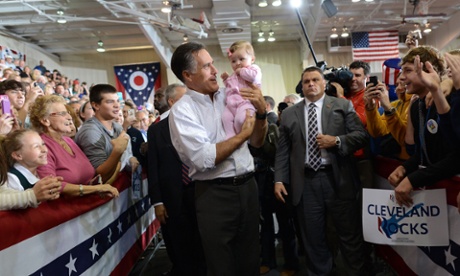
    US Republican presidential candidate Mitt Romney holds a supporter's baby during a campaign rally at Avon Lake High School in Avon Lake, on Ohio.

    US Republican presidential candidate Mitt Romney holds a supporter’s baby during a campaign rally at Avon Lake High School in Avon Lake, on Ohio. Photograph: Emmanuel Dunard/AFP/Getty Images

    In any election, politicians’ pretty much always-false modesty prompts them to exclaim that they themselves are playing but a part in the march of history. Obama cut an ad that admitted:

    “Sometimes, politics can seem very small – but the choice you face? It couldn’t be bigger.”

    Last week, Paul Ryan made a feint at bipartisanship with a similar argument:

    “Mitt and I have a message that’s bigger than party.”

    Hurricane Sandy reminds us of what truly monumental events, and the decisions we make in the face of them, look like.
    Sandy is not just bigger than any campaign and powerful enough to banish all the feeble fantasies humans s have about our relationship to the physical world. Though Sandy may finally bring a discussion about the environment to the forefront of politicians’ minds, one of humanity’s only creations that’s almost impervious to the kind of force battering the US east coast is denial. (Then again, note the Earth’s stubborn, intractable reactions to our abuse.)
    We can talk about “man-made” climate change, but there’s a difference between having control over something and taking responsibility for it. Our part in global warming is more like that of someone dropping a lit cigarette in the forest, rather than someone starting a fire for heat.
    As for arguments about who did or didn’t “build that” – Sandy don’t care. Buildings are flimsy and our plans even more insubstantial; our opinions revealed to be nothing more than spit and a wish for wind in the right direction.
    You can sense among political professionals a vague sense of panic about Sandy, which is ancillary to the more specific and very real worries that they harbor about loved ones and their own, mostly likely east coast, lives.
    We don’t yet know Sandy’s precise impact on the election – on a practical level, the storm will disrupt early in-person voting, rallies in east-coast states will go unattended, ads may be inescapable when people are driven indoors, or they may be unwatched in places that lose power. Beyond that immediate effect, will Sandy wash away political trivia and remind voters of the true stakes of picking a president? Will these disruptions freeze the race where it is, or will Sandy remind people of the stakes involved in picking a leader, swaying them toward the one who seems the safer choice?
    The magnitude of the storm should underscore, not contrast, the relationship between the people’s will and predictions that existed before. It’s not as though pundits and pols had any better idea of what would happen prior to Sandy’s landfall. This election has been unprecedented on so many levels, you couldn’t even tweet them all: the amount of money being spent, the ideological divide between the parties, the infuriating vagueness of one candidate’s ideas.
    Sandy is just another element beyond control: you can’t even poll a storm – much like the ideas of low-information, undecided voters, it’s nothing but a resounding, echoing howl.
    The Frankenstorm – an appellation that would make Mary Shelley wince at the lack of a possessive, though she might approve of the sentiment – is an immediate, measurable reminder that politics is, in the end, not about messaging and postures and positioning, but the structure of people’s lives: who they can turn to when they have no resources left themselves, who they can look to when all the options are bad, and what they can do with what they have left when it seems like nothing at all.
    We’re not choosing the nation’s CEO, a boss-in-chief. Mitt Romney‘s approach to poor performance is eliminating jobs, it’s only Federal Emergency Management Agency (Fema) employees he could fire – and he’s said he wants to – not the natural disaster itself. You can’t put the bravery of first responders on a balance sheet, or quantify human loss.
    Whoever becomes president, the job is really that of a community organizer – whether that’s the role they’re prepared for or not.