Author: admin

  • Oil companies going unpunished for thousands of North Sea spills

    Oil companies going unpunished for thousands of North Sea spills

    Fines issued for only seven of 4,123 oil spills since 2000, with no company having to pay more than £20,000

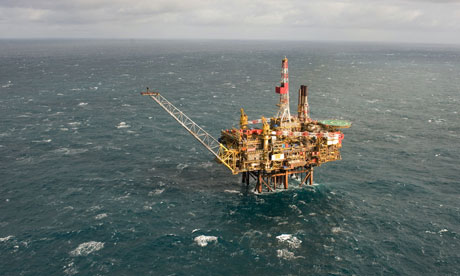
    Gannett Alpha oil platform in the North Sea

    Shell’s Gannett Alpha oil platform, which leaked oil into the North Sea in 2011. Photograph: Ho/Reuters

    Oil companies operating in the North Sea have been fined for oil spills on just seven occasions since 2000, even though 4,123 separate spills were recorded over the same period, the Department of Energy and Climate Change (Decc) has confirmed.

    The disclosure came as Decc said on Thursday that the government had offered a “record-breaking” 167 new licences to oil and gas companies seeking to drill in the North Sea. A further 61 “blocks”, or licences, are under environmental assessment.

    Total fines resulting from prosecutions between 2000 and 2011 came to just £74,000 and no single oil company had to pay more than £20,000.

    Two companies received fines of £20,000: BP, for causing 28 tonnes of diesel to spill into the sea in 2002 from the Forties Alpha platform, and, a year later, Total E&P, for causing six tonnes of diesel to enter the sea during a transfer between fuel tanks on the Alwyn North platform.

    Information about the fines was released by Decc after a freedom of information request and further inquiries by the Guardian.

    The smallest fines over this period were those imposed on two companies, Venture North Sea Oil and Knutsen OAS Shipping, of £2,000 each, after 20 tonnes of crude oil was spilt during a tanker transfer on the Kittiwake platform.

    In total, 1,226 tonnes of oil were spilt into the North Sea between 2000 and 2011, according to Decc’s archives. Decc said there is no “volume threshold” determining whether a company will be prosecuted over a spill at sea, although a spill of less than five tonnes is unlikely to go to court.

    A tonne of crude oil is broadly equivalent to seven barrels, or, more precisely, 1,136 litres.

    Decc said its inspectors, all of whom have enforcement powers, judge each case separately to assess the circumstances and the seriousness of the alleged offence.

    Slightly different arrangements exist in Scotland from those in England, Wales and Northern Ireland, for pursuing a prosecution.

    A Decc spokesman said: “The UK has one of the toughest and most successful oil and gas regimes in the world and we work closely with industry to ensure the highest standards of environmental protection are in place and enforced.

    “There are a number of enforcement options available to Decc, with court action reserved for serious offences. On the rare occasions legal proceedings have been deemed necessary, it is for the court to decide the level of fines to hand down.”

    Environmental campaigners said it was worrying that Decc viewed itself as operating the global gold standard of offshore regulation, especially as oil companies were now pressing for permission to drill in extreme and vulnerable environments such as the Arctic.

    Vicky Wyatt, a Greenpeace campaigner, said: “Ministers and oil companies can spout all the carefully crafted quotes they like to tell us how safe drilling at sea is. But while they’re spouting these words, their rigs are all too often spouting oil into our oceans. The government should hit these companies who pollute the oceans in this way with meaningful fines.

    “A few grand is not even a slap on the wrist for companies who pocket millions of pounds every hour.

    “It’s both staggering and wrong that some of these companies are now also drilling in the fragile and pristine Arctic, where a similar oil leak would be catastrophic.”

    Speaking about the issuing of new drilling licences, the energy minister, John Hayes, said: “Fortune has favoured the UK. Oil and gas from our waters provides around half the energy we need to heat our homes, fuel our cars and power our industry.

    “It is the single largest industrial UK investor, supporting 440,000 jobs, and benefits the UK’s trade balance to the tune of £40bn.”

    He added: “This successful licensing round shows we are taking the right action to offer certainty and confidence to investors. Our fiscal regime is now encouraging small fields into production and our licensing regime supports new faces as well the big players to invest. Importantly, we are guaranteeing every last economic drop of oil and gas is produced for the benefit of the UK. It is our work with industry that is cultivating this precious resource, making our seas a fertile landscape for investors for many years to come.”

    Fined North Sea oils spills since 2000

    Kerr McGee North Sea (UK) Ltd – 22 October 2000

    Release of about 400 tones crude oil to sea from subsea pipeline: £10,000 fine. Pipeline between NW Hutton platform and Hutton TLP, northern North Sea.

    BP Exploration Operating Company – 2 December 2002

    Release of approximately 28 tonnes diesel to sea due to accidental draining of fuel to open drain system and sea sump: £20,000 fine. Forties Alpha platform, central North Sea.

    Total E&P UK PLC – 17 June 2003

    Release of about 6 tonnes diesel after diesel transfered from tanks via valve not identified as dump valve: £20,000 fine. Alwyn North, northern North Sea.

    Shell UK Ltd – 12 May 2003

    Release of 7.5 tonnes diesel to sea during bunkering operations – return path for diesel supply system found to be closed and plant condition not as expected: £7,000 fine. Comorant Alpha, northern North Sea.

    Amoco (UK) Exploration Company – 1 July 2004

    Release of 31 tonne diesel to sea from day tank during bunkering operations: £12,000 fine. Lomond, central North Sea.

    Shell UK Ltd – 10 November 2004

    Release of 7.33 tonnes oil-based mud to sea during bunkering operations. £3,000 fine. North Cormorant, northern North Sea.

    Venture North Sea Oil Ltd and Knutsen OAS Shipping AS – 5 April 2007

    Release of 20 tonnes crude oil to sea from SAL [single anchor loading] during transfer onto tanker. £2,000 fine each. Kittiwake, central North Sea.

  • Greens to decide ACT’s next government

    Greens to decide ACT’s next government

    AAPUpdated October 27, 2012, 5:21 pm
    The Greens will hold the balance of power in the ACT Legislative Assembly.

    AAP © Enlarge photo

    The Greens will hold the balance of power in the ACT Legislative Assembly, after Labor and the Liberals won eight seats each, resulting in a hung parliament.

    Greens MLA Shane Rattenbury is the sole remaining representative of the minor party, and is now expected to begin negotiations to decide who will form the territory’s next government.

    Elections ACT completed counting the vote on Saturday, a week after the election.

    Electoral Commissioner Phil Green announced the names of the candidates who were elected to the 17-member parliament.

    With several close races for the final places in the three multi-member electorates, the make up of the assembly has not been clear for much of the week.

    Labor and the Liberals each won 38.9 per cent of the primary vote.

    On numbers, the Liberals were a mere 41 votes ahead, out of more than 221,000 formal ballots cast.

    The Greens won 10.7 per cent of the primary vote – a 4.9 per cent rebuff from the 2008 election.

    The formal declaration of the poll is likely to happen on Wednesday.

  • David Attenborough: US politicians duck climate change because of cost

    David Attenborough: US politicians duck climate change because of cost

    The naturalist warned it would take a terrible example of extreme weather to wake people up to global warming

    The broadcaster and naturalist Sir David Attenborough says scientists and environmentalists have been cautious of overstating the dangers of global warming Link to this video

    One of the world’s leading naturalists has accused US politicians of ducking the issue of climate change because of the economic cost of tackling it and warned that it would take a terrible example of extreme weather to wake people up to the dangers of global warming.

    Speaking just days after the subject of climate change failed to get a mention in the US presidential debates for the first time in 24 years, Sir David Attenborough told the Guardian: “[It] does worry me that most powerful nation in the world, North America, denies what the rest of us can see very clearly [on climate change]. I don’t know what you do about that. It’s easier to deny.”

    Asked what was needed to wake people up, the veteran broadcaster famous for series such as Life and Planet Earth said: “Disaster. It’s a terrible thing to say, isn’t it? Even disaster doesn’t do it. There have been disasters in North America, with hurricanes and floods, yet still people deny and say ‘oh, it has nothing to do with climate change.’ It visibly has got [something] to do with climate change.”

    But some US politicians found it easier to deny the science on climate change than take action, he said, because the consequence of recognising the science on man-made climate change “means a huge section from the national budget will be spent in order to deal with it, plenty of politicians will be happy to say ‘don’t worry about that, we’re not going to increase your taxes.’”

    Neither Barack Obama or Mitt Romney mentioned climate change in three TV debates, despite a summer of record temperatures and historic drought in the US.

    Romney used Obama’s commitment to taking action on climate change as a joke in his convention speech. The president later hit back by saying “and yes, my plan will continue to reduce the carbon pollution that is heating our planet because climate change is not a hoax. More droughts and floods and wildfires are not a joke.” However, environmentalists have been critical of Obama’s silence on the subject and the Green party presidential candidate, Jill Stein, went as far as saying it meant he was, in effect, “another climate denier”.

    Attenborough said he thought the US’s attitude towards climate change and the environment was not just because of politics, but because of the country’s history. “[It’s] because they’re a pioneer country. There has been the wild west, the western frontier… that’s still there, you see it in the arms business, the right for everyone to bear arms. It’s part of the pioneer stuff that you’ve [Americans] grown up with.”

    By contrast, he said, people in the UK had “grown up with a mythology of black industry and wrecking the countryside.”

    The current financial crisis has made it problematic for politicians to show leadership on climate change, Attenborough acknowledged. “Well it’s a very difficult time to do it [show leadership]. In times of recession, it’s a very difficult time to advance these arguments [on the urgency of tackling climate change] that mean you have to spend even more money and take money from taxes to do things,” he said.

    Yet he also warned that it was becoming clear the impacts of climate change were worst than had been expected. Talking about the record Arctic sea ice melt this summer, he said: “The situation is worse than we thought [in the Arctic]. The processes of melting are more volatile than we thought. More complicated. The ice cap is really melting faster than we thought.”

    The 86-year-old naturalist, who is also a patron of the charity Population Matters, said many of the environmental problems the world faced could be helped by addressing human population, which is believed to have reached the 7 billion mark last year, and is forecast to reach 10 billion by the middle of the century.

    The solution, he said, was to raise living standards and increase democracy in developing countries. “The only way I can think of it [tackling population] is by giving women the rights to control their own bodies and control how many children they have. In every circumstance where women have that right, where they have the vote, where they are proper medical facilities, where they are literate, where they are given the choice, the birth rate falls,” he said. “That is a good start, if that could be spread.”

    • You can read more of Sir David Attenborough‘s views on climate change and animals in this Sunday’s Observer magazine

  • Rising sea levels prompt action

    Rising sea levels prompt action
    Daily Press
    “Localized projections of sealevel rise are needed to guide the regional planning and adaptation measures that are being pursued with increasing urgency in many coastal localities,” Boon said. Boon’s findings, which are published online in the Journal
    See all stories on this topic »
    LETTER: Where do presidential candidates stand on Florida’s sea level rise?
    Walton Sun
    In Florida, climate change and sea level rise is here, now, and very real. Sea level rose 8-9 inches in Florida over the last 100 years, and the U.S. Army Corps of Engineers projects another 9-24 inches of sea level rise by 2060. We are already feeling
    See all stories on this topic »
    Weigh-in reveals Antarctica’s losing 190 million tonnes a day
    The Conversation
    Rising temperatures has driven thermal expansion of the oceans and the overwhelming and dramatic retreat of small glaciers. Melting of Greenland due to warming of the atmosphere and oceans is now causing sea levels to rise from this source alone by
    See all stories on this topic »
    Residents question timing of Scarborough floodplain rules
    The Forecaster
    “Count on a foot increase (in sea level) by 2050 and a 2-foot increase by 21oo,” Slovinsky said in a workshop Wednesday about proposed changes to town floodplain management ordinances. Don Hamill, who owns property on Pine Point and off Broadturn
    See all stories on this topic »


    Web 2 new results for SEA LEVEL RISE
    SEA LEVEL RiSE MAPS Terrigal Lagoon – RTA
    SEA LEVEL RiSE MAPS. Terrigal Lagoon. 0 100 200 300 400 500m. 41. 30. 52. 53. 31. LOCALITY MAP. DISCLAIMER. These maps have been compiled from
    www.rta.nsw.gov.au/…/appendix_g_gcc_sea_level_rise_map_…
    NASA climate chief demolishes denialist claims on sea levels
    1a, would have made clear that the rate of sea level rise is not declining. The recent rate of sea level rise corresponds to 3.1 meters per millennium, which is at
    www.climatecodered.org/…/nasa-climate-chief-demolishes-den…


    Tip: Use site restrict in your query to search within a site (site:nytimes.com or site:.edu). Learn more.

    Delete this alert.
    Create another alert.
    Manage your alerts.

  • Family planning, lower birth rate

    Family planning, lower birth rate
    Lompoc Record
    In six editions of “An Essay on the Principle of Population,” his major theory was that population sooner or later would be decreased by famine, disease, and wars — “population does invariably increase when the means of subsistence increase and that
    See all stories on this topic »

    Rental market hits the two-speed accelerator
    Sydney Morning Herald
    The outlook for rental growth across the nation remains mixed. Recent population growth data released by the Australian Bureau of Statistics revealed a strengthening of population growth across the nation in the year to March 2012, led by rapid growth
    See all stories on this topic »
  • Cameron’s Contagion MONBIOT

    Cameron’s Contagion

    Posted: 25 Oct 2012 07:16 AM PDT

    That’s what we should call the devastating ash disease now spreading across Britain.


    By George Monbiot, published on the Guardian’s website 25th October 2012

    There couldn’t be a clearer case of shutting the stable door after the horse has bolted. For the past three years there have been clear and unequivocal warnings that ash die-back could come to Britain. If action was not taken, ecologists, foresters and even some importers warned, the disease would arrive here through imports of infected seedlings from the Continent. But neither this government nor its predecessor saw fit to ban them.

    In February, the first case was confirmed in Britain: in imported seedlings in a tree nursery in Buckinghamshire. Yet still the government failed to ban imports. The disease then appeared in nine more sites: all of them containing recently imported trees. Amazingly, the government still failed to act. It promised a consultation, which would report at the end of this month: only then would it decide what to do.

    Yesterday, the warnings were horribly vindicated, when the fungus was found, for the first time in Britain, in mature trees growing in the wild, in Norfolk and Suffolk. Now there might be no stopping it. The disease has already killed 90% of the ash trees in Denmark: here too it could do to the countryside what Dutch Elm Disease did in the 1960s.

    Something else happened yesterday: the government announced that it’s considering an imminent ban on imports of infected seedlings.

    You couldn’t satirise this decision. The government waits until the disease is established to take the measures required to prevent its establishment.

    The Country Land and Business Asssociation – with which I seldom find myself in agreement – has got this dead right. It’s symptomatic of a wider failure to take exotic threats to our wildlife seriously.

    “For far too long successive governments have failed to tackle the growing threat of tree diseases. Phytophthora ramorum [the disease sometimes known as sudden oak death] has spread like wildfire up the west coast of Britain, from Cornwall to Scotland, killing hundreds of thousands of larch trees, and it is now moving eastward. Yet a mere £4million a year has been earmarked to fight it.”

    Both Gordon Brown’s administration and the current government – in particular the former environment secretaries Hilary Benn and Caroline Spelman – have a lot of explaining to do. But the overriding responsibility lies with the coalition, which, perhaps through an ideological fixation with unimpeded commerce, failed to respond even as the warnings became stark and unmistakable.

    I propose a new name for this disease, which reflects the government’s astonishing and disgraceful failure to act. I think we should call it Cameron’s Contagion.

    www.monbiot.com

    You are subscribed to email updates from George Monbiot
    To stop receiving these emails, you may unsubscribe now.
    Email delivery powered by Google
    Google Inc., 20 West Kinzie, Chicago IL USA 60610