Author: admin

  • Why Solar Works Where It Snows


    And then the Sheriff came to town.

    Regan pulled the plug and the solar tax credits that have built up the industry came to a screeching halt. Most of the companies fell off the turnip truck like an accident during harvest season. The industry in the Northeast crashed and the road was a mess.

    Only a few companies survived these bleak days, usually through clever service contracts, branching out to passive solar work or creativelty partnering and developing new programs and seeking out new renewable energy opportunities throughout the region.

    Now what?

    Solar is back thanks to creative financing options, great rebate and tax credits, and the international support of top-notch manufacturing and material science. However, the distrust has not subsided. The burn felt from the early maelstrom of activity has not been easily forgotten.

    In the Northeast, where fuel oil prices are poised to rise significantly again, where electricity rates are some of the highest in the nation and rising rapidly, there is no better time to better examine these objections than now.

    1. It’s too expensive.

    The cost of inaction is even more expensive, but much harder to quantify in a simple way. However, the good news is that due to the rising costs of fuel oil and electricity, the falling costs of solar equipment, and the increased level of employee training and certification for installers are all contributing to making solar much more cost effective.

    Even further, financing programs like power purchase agreements (PPAs) and residential solar electricity programs like SunRun are making solar a low-cost, low-to-no-risk proposition. If you could put a complete solar electric system on your home or business for less than $3,000, would you consider doing it today?

    2. It’s not reliable.

    Sure as the sun comes up every morning, solar energy is there working for you. The question of reliability is really a question of “how do I know if it is actually working?” Just think, would you drive a car with no fuel gage or spedometer? The great news is many companies are offering easy-to-use and understand monitoring equipment that can help you see real time data about the performance of either your solar electric or solar hot water system. You’ll know immediately if something is wrong. In many cases, systems can automatically notify your installer of a problem before you even know. Monitoring technology has come a long way since the 1970’s to help people have a little peace of mind.

    3. No one will be around to support it.

    Many companies providing solar energy solutions have or are building full support and service centers to help customers understand problems with their systems or just to be there when confusion arises. Installers are improving their websites; taking notes from the successes in the IT industry and providing online databases of frequently asked questions, online support forums, user forums, and much more.

    Many companies, too, are at the point where they have a significant history behind them- 10, 20, even 30 years of combined experience in installation, program management, and industry experitise. Do your homework on your installer if you are worried about whether or not they will be there for you in 5 years or 20 years.

    4. We get too much snow- it doesn’t work in the winter.

    Many people in the Northeast don’t realize that we have a wonderful solar resource available. In fact, Germany, arguably the world leader in acceptance and deployment of photovoltaics, receives less average solar insolation anually than the Northeast.[*]

    So while it snows in the winter, just remember- after the snow falls, the sun comes out and the sky is clearer than on those hazy July days. Soon the snow will be sliding right off your panels and you’ll be back to producing clean, renewable power. The average roof pitch of most Northeast homes is quite ideal to solar installation, too, and will encourage snow to shed from panels.

    Examine your objections. Make the right choice.

    There are many more reasons why people object to solar power, but as the industry and its people supporting it continue to provide better service, offer better financial deals, and continue to exceed the expectations of the doubting public we hope you will join us a become another gleaming solar roof from space and a proud part of our clean energy future.
     

  • White farmers ‘ being wioed out’


    Death has stalked South Africa’s white farmers for years. The number murdered since the end of apartheid in 1994 has passed 3,000.

    In neighbouring Zimbabwe, a campaign of intimidation that began in 2000 has driven more than 4,000 commercial farmers off their land, but has left fewer than two dozen dead.

    The vulnerability felt by South Africa’s 40,000 remaining white farmers intensified earlier this month when Julius Malema, head of the African National Congress’s (ANC’s) youth league, opened a public rally by singing Dubula Ibhunu, or Shoot the Boer, an apartheid-era anthem, that was banned by the high court last week.

    Malema’s timing could hardly have been worse. Last weekend in the remote farming community of Colenso, in KwaZulu-Natal, Nigel Ralfe, 71, a dairy farmer, and his wife Lynette, 64, were gunned down as they milked their cows. He was critically injured; she died.

    That same day a 46-year-old Afrikaner was shot through his bedroom window as he slept at his farm near Potchefstroom. A few days later a 61-year-old was stabbed to death in his bed at a farm in Limpopo.

    The resurrection of Dubula Ibhunu, defended by senior ANC officials as little more then a sentimental old struggle song, has been greeted with alarm by Tom Stokes, of the opposition Democratic Alliance. He said the ANC’s continued association with the call to kill Boers could not be justified.

    “Any argument by the ANC that this song is merely a preservation of struggle literature rings hollow in the face of farming families who have lost wives, mothers and grandmothers,” he added.

    He was supported by Anton Alberts of the right-wing Freedom Front Plus party: “Malema’s comments are creating an atmosphere that is conducive to those who want to commit murder. He’s an accessory to the wiping out of farmers in South Africa.”

    Rossouw Cillier, Pieter’s brother, bristled as he pointed to the bullet holes in the panelled kitchen of the farmhouse near Ceres in the Western Cape. “They shot him through the fridge from the back door — the bullets came straight through here, into his heart. He never had a chance,” he said.

    A successful apple and pear grower, he believes his community is living on borrowed time: “More white farmers have been killed than British soldiers in Afghanistan and Iraq. Yes, we are at war here.”

    His brother’s farmhouse is now shuttered and empty. “I can’t spend time here. We’ll have to sell. This farm has been in our family for generations but it must go. Who’ll manage it? The children will never come back here. They held their own father as he died in front of them. Will they ever get over that?”

    As we walked across the orchard, fruit destined for the shelves of Tesco and Sainsbury’s in the UK was still being picked. A tractor passed a 10ft cross erected in honour of the murdered farmer.

    “It lights up at night,” Rossouw said. “My brother was a religious man. It’s all that’s left of him here.”

    Across South Africa many farmers feel endangered. In Northern Province a tribute has been created beneath an enormous sign with the stark Afrikaans word “plaasmoorde” — farm killings. Thousands of white wooden crosses have been planted across a mountainside, one for each fallen farmer.

    Recently the government’s department of rural development has been airing proposals to nationalise productive farmland as a “national asset”. Critics claim it is designed to deflect criticism from the ruling ANC’s failures.

    “It’s a lot easier talking about nationalising farms than building decent houses, making clean water come out of taps or honouring promises to redistribute farm plots to millions of landless poor,” said a spokesman for AgriSA, the farmers’ union.

    On the outskirts of Ceres there are few groceries in the township store — tins of pilchards, baked beans, some dried biscuits. A group of teenage boys sit on the burnt-out remains of a Ford Escort. This is where Cillier’s killers gathered, in a shebeen, a drinking club, where they fortified themselves with cheap hooch before they set off to rob him. They escaped with nothing.

    According to Rossouw Cillier the most telling detail is that his brother was unarmed when they attacked. “If we brandish a weapon, we’ll go to prison, not them. What did they gain from this murder? It was an act as pointless as their lives.”

  • White farmers ‘being wiped out’

    The attackers, who were drug addicts, simply disappeared into the night. Cillier’s murder, at Christmas, was barely reported in the local press. It was, after all, everyday news.

    Death has stalked South Africa’s white farmers for years. The number murdered since the end of apartheid in 1994 has passed 3,000.

    In neighbouring Zimbabwe, a campaign of intimidation that began in 2000 has driven more than 4,000 commercial farmers off their land, but has left fewer than two dozen dead.

    The vulnerability felt by South Africa’s 40,000 remaining white farmers intensified earlier this month when Julius Malema, head of the African National Congress’s (ANC’s) youth league, opened a public rally by singing Dubula Ibhunu, or Shoot the Boer, an apartheid-era anthem, that was banned by the high court last week.

    Malema’s timing could hardly have been worse. Last weekend in the remote farming community of Colenso, in KwaZulu-Natal, Nigel Ralfe, 71, a dairy farmer, and his wife Lynette, 64, were gunned down as they milked their cows. He was critically injured; she died.

    That same day a 46-year-old Afrikaner was shot through his bedroom window as he slept at his farm near Potchefstroom. A few days later a 61-year-old was stabbed to death in his bed at a farm in Limpopo.

    The resurrection of Dubula Ibhunu, defended by senior ANC officials as little more then a sentimental old struggle song, has been greeted with alarm by Tom Stokes, of the opposition Democratic Alliance. He said the ANC’s continued association with the call to kill Boers could not be justified.

    “Any argument by the ANC that this song is merely a preservation of struggle literature rings hollow in the face of farming families who have lost wives, mothers and grandmothers,” he added.

    He was supported by Anton Alberts of the right-wing Freedom Front Plus party: “Malema’s comments are creating an atmosphere that is conducive to those who want to commit murder. He’s an accessory to the wiping out of farmers in South Africa.”

    Rossouw Cillier, Pieter’s brother, bristled as he pointed to the bullet holes in the panelled kitchen of the farmhouse near Ceres in the Western Cape. “They shot him through the fridge from the back door — the bullets came straight through here, into his heart. He never had a chance,” he said.

    A successful apple and pear grower, he believes his community is living on borrowed time: “More white farmers have been killed than British soldiers in Afghanistan and Iraq. Yes, we are at war here.”

    His brother’s farmhouse is now shuttered and empty. “I can’t spend time here. We’ll have to sell. This farm has been in our family for generations but it must go. Who’ll manage it? The children will never come back here. They held their own father as he died in front of them. Will they ever get over that?”

    As we walked across the orchard, fruit destined for the shelves of Tesco and Sainsbury’s in the UK was still being picked. A tractor passed a 10ft cross erected in honour of the murdered farmer.

    “It lights up at night,” Rossouw said. “My brother was a religious man. It’s all that’s left of him here.”

    Across South Africa many farmers feel endangered. In Northern Province a tribute has been created beneath an enormous sign with the stark Afrikaans word “plaasmoorde” — farm killings. Thousands of white wooden crosses have been planted across a mountainside, one for each fallen farmer.

    Recently the government’s department of rural development has been airing proposals to nationalise productive farmland as a “national asset”. Critics claim it is designed to deflect criticism from the ruling ANC’s failures.

    “It’s a lot easier talking about nationalising farms than building decent houses, making clean water come out of taps or honouring promises to redistribute farm plots to millions of landless poor,” said a spokesman for AgriSA, the farmers’ union.

    On the outskirts of Ceres there are few groceries in the township store — tins of pilchards, baked beans, some dried biscuits. A group of teenage boys sit on the burnt-out remains of a Ford Escort. This is where Cillier’s killers gathered, in a shebeen, a drinking club, where they fortified themselves with cheap hooch before they set off to rob him. They escaped with nothing.

    According to Rossouw Cillier the most telling detail is that his brother was unarmed when they attacked. “If we brandish a weapon, we’ll go to prison, not them. What did they gain from this murder? It was an act as pointless as their lives.”

  • Pew report: China overtakes US as top clean tech investor

    Pew report: China overtakes US as top clean tech investor

    Major new study finds China is fast emerging as new clean tech superpower as US slips down the competitiveness league table, falling below UK, Spain and Germany

    Rachel Fielding for BusinessGreen, part of the Guardian Environment Network

    • Datablog: get the full data behind this story

    Windfarm in China

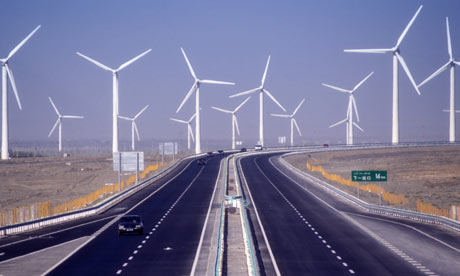
    A windfarm in China – a new report by Pew said the country has overtaken the US as the top clean technology investor. Photograph: Keren Su/Getty Images/China Span RM

    China has overtaken the US for the first time in a league table of investments in low-carbon energy among the G-20, according to a new report by not for profit group the Pew Charitable Trusts published this week.

    The report found that despite an overall 6.6 per cent global decline in clean energy investments last year, China invested almost twice as much as the United States in clean energy during 2009.

    Pew blamed the worst financial downturn in over half a century for the reduction in clean techinvestments, but echoed growing confidence in the sector, predicting investments will bounce nback to around $200bn this year.

    The report, entitled Who’s Winning the Clean Energy Race?, said that last year China invested $34.6bn in the clean energy economy, placing it top of the clean energy investment league and well ahead of the US in second place with investment of $18.6bn.

    Phyllis Cuttino, director of Pew Environment Group’s US Global Warming Campaign, criticised the US government for failing to deliver stronger national policies to support renewable energy. “I’m worried that we are going to fall further down the list next year,” she said. “We really need to pass policy.”

    The US administration has been locked in a year long battle to pass a climate change bill that would impose a national carbon pricing mechanism and introduce new incentives for low carbon projects. However, the bill has faced staunch opposition from Republicans and some Democrats and while a compromise version of the legislation is expected to be unveiled in the next few weeks commentators remain sceptical that the bill can pass this year.

    The Pew report also expressed concern about America’s competitive position in the clean energy marketplace, noting that relative to the size of its economy the US clean energy finance and investments lag behind many of its G20 partners.

    In relative terms, the UK invested three times more than the United States last year, and overall 10 other G20 members devoted a greater percentage of gross domestic product to clean energy than the United States in 2009.

    The Pew report said those countries with strong, national policies aimed at reducing global warming and encouraging the use of renewable energy – including the UK, Germany and Spain – had succeeded in establishing stronger competitive positions in the clean energy economy.

    “Nations seeking to compete effectively for clean energy jobs and manufacturing would do well to evaluate the array of policy mechanisms that can be employed to stimulate clean energy investment,” the report stated. “This is especially true for policymakers in the United States, which is at risk of falling further behind its G20 competitors in the coming years absent adoption of a strong national policy framework to spur more robust clean energy investment.”

  • Rajendra Pachauri: Climate scientists face ‘ new form of persecution’


    Pachauri also accused critics who have used an error in the 2007 IPCC report to question the scientific basis of climate change of “an act of astonishing intellectual legerdemain [sleight of hand]”. Scientific knowledge of climate change, he says, is “something we distort and trivialise at our peril”.

    Pachauri’s comments come after repeated attacks on the credibility of the IPCC following the high-profile discovery of a mistake about melting Himalayan glaciers in its report. The mistake has prompted calls for Pachauri to resign and forced the IPCC to convene an international panel of experts to review the way it operates.

    In the Guardian article, Pachauri writes: “Thousands of scientists from across the world have worked diligently and in an objective and transparent manner to provide scientific evidence for action to meet the growing challenge of climate change. To obscure this reality through misplaced emphasis on an error in a nearly 3,000-page rigorous document would be unfortunate.”

    He adds: “Even more unfortunate is the effort of some in positions of power and responsibility to indict dedicated scientists as ‘climate criminals’. I sincerely hope the world is not witnessing a new form of persecution of those who defy conventional ignorance and pay a terrible price for their scientifically valid beliefs.”

    This appears to be a reference to James Inhofe, a US senator and long-standing climate sceptic, who last month called for a criminal investigation of climate scientists. Inhofe published a minority report from the Senate committee on environment and public works that claimed climate scientists involved with a controversy over emails from the University of East Anglia released online “violated fundamental ethical principles governing taxpayer-funded research and, in some cases, may have violated federal laws”.

    The report named 17 US and British climate experts as “key players” in the affair and highlighted their roles in preparing IPCC reports. The list included Phil Jones and Keith Briffa of the University of East Anglia’s Climatic Research Unit, and Peter Stott, a leading expert at the Met Office.

    Michael Mann, a US scientist at Penn State University, who is on the list, said: “I think the following quote characterises the situation best: ‘Continuous research by our best scientists … may be made impossible by the creation of an atmosphere in which no man feels safe against the public airing of unfounded rumours, gossip, and vilification.’ The quote wasn’t made during the last few months. It was made by US president Harry S Truman in 1948, in response to politically motivated attacks against scientists associated with the dark era of McCarthyism.”

    Mann added: “I fear that is precisely the sort of atmosphere that is being created, and sure, it impacts research. The more time scientists have to spend fending off these sorts of attacks and dealing with this sort of nonsense, the less time is available to them to actually do science, and to push the forefront of our knowledge forward. Perhaps that is the intent?”

    Pachauri says it was “to be expected” that the critical choices that climate change asks of human society “would pose challenges for some stakeholders and sectors of the economy”.

    He added: “But to ignore the IPCC’s scientific findings would lead to impacts that impose larger costs than those required today to stabilise the Earth’s climate.”

  • No stopping controversial dam in Ethiopia

    No stopping controversial dam in Ethiopia

    Ecologist

    26th March, 2010

    Controversial dam project on the Omo River in southern Ethiopia cannot be stopped says African Development Bank

    A soure within the African Development Bank has told the Ecologist that the building of a controversial dam in Ethiopia cannot be stopped and will go ahead with or without international assistance.

    At 240 meters high, the Gibe III dam would be the largest in Africa and would double the country’s electricity generation capacity.  

    Negative impacts

    But NGOs have said it will threaten the livelihoods of 500,000 tribal people and devastate fisheries in Kenya’s Lake Turkana, the world’s largest desert lake.  

    ‘Gibe III is the most destructive dam under construction in Africa. The project will condemn half a million of the region’s most vulnerable people to hunger and conflict,’ said Terri Hathaway, director of International River’s Africa Program.

    Construction on the dam began in 2006 and is now 35 per cent complete, but the Ethopian government is reportedly asking international banks for $1.4 billion to complete the project.

    Foriegn investment

    The African Development Bank (AfDB), the European Investment Bank (EIB) and the World Bank have been conducting their own assessments of the project but have so far not committed to providing finance.  

    However Azeb Asnake, project manager for Gibe III today said that the EIB and AfDB were backing the project.

    ‘When we meet with the EIB and the AfDB they are very supportive. I know that they are going to support this project, they are on board,’ said Asnake.

    Power supplies

    She also rejected claims that the project would adversely affect people downstream in Kenya.

    ‘Kenya is the major beneficiary of this project. We are going to supply them with power. They are working on the agreement to provide power right now.’

    She accused NGOs of ‘going against the spirit of Copenhagen’ by opposing the project and said they were ‘trying to deprive Africans of the right to electrification.’

    In a show of support for the project, the African Development Bank said the dam would improve the lives of people living downstream directly and indirectly.

    ‘It allows the flow of water to be controlled so as to prevent flooding and will actually lead to a greater flow of water into Lake Turkana,’ said a representative from the AfDB.  

    Open bidding

    They also rejected claims from NGOs that the Italian company building the dam had not bid competitively for the project.

    ‘Normally there should be an independent bidding process but Salini were already working in Ethiopia. It’s not unusual to give a company some additional work,’ they said.

    Useful Links
    International Rivers
    Stop Gibe III