Author: admin

  • DEVELOPED COUNTRY EMISSIONS PLEDGES FALL SHORT, ANALYSIS SHOWS


    Comparability of Annex I Emission Reduction Pledges, a new analysis by the World Resources Institute (WRI), examines the pledges made by the European Union, Japan, Russia, New Zealand, Australia, Norway, Belarus, Ukraine and Canada as negotiations on a new global climate agreement near their climax in Copenhagen this December. Also included is the United States’s emission reductions based on the American Clean Energy and Security Act passed by the House of Representatives in June.

    WRI’s analysis reveals that commitments by these industrialized country parties to the UN Framework Convention on Climate Change (UNFCCC) would result in a 10 to 24 percent reduction of global emissions below 1990 levels by 2020.

    This is less than the 25 to 40 percent range of emission reductions that the Intergovernmental Panel on Climate Change (IPCC) states would be necessary for stabilizing concentrations of carbon dioxide at 450ppm, a level associated with a 52 percent risk of overshooting a two degrees Celsius goal. Both the G8 and the Major Economies Forum – representing the world’s 17 leading economies – recently agreed to a goal of limiting average global temperature rise to two degrees Celsius over pre-industrial levels.

    “Our analysis provides a preliminary picture of where the world is headed in the run-up to Copenhagen,” said Jennifer Morgan, director of WRI’s climate and energy program. “While emission reduction commitments by these countries could have an important and potentially substantial impact, they will not be enough to meet recommendations of IPCC’s Fourth Assessment Report. WRI therefore urges industrialized countries to bring forward more ambitious pledges to reduce their greenhouse gas emissions.”

    The report, which covers pledges by countries responsible for 98% of all developed country emissions, uses three metrics to compare country commitments – per capita reductions, emission intensity reductions, and absolute reductions. The 10 to 24 percent reduction is based on the inclusion or omission of factors, such as changes in land use, forestry data and low vs. high pledges. Other key findings include:

    • The choice of metrics used by countries (such as whether to include offsets, land-use change or forestry emissions) can alter their emission reduction calculations significantly.

    • High regulatory standards and robust accounting rules will be critical to ensure that international emission reductions are real and additional.

    This article was shared by our content partner World Resources Institute, a member of the Guardian Environment Network.

  • A history of CO2 emissions


    But historical emissions, like per capita emissions, are a bone of contention in haggling between countries trying to reach a climate deal in Copenhagen this December. Developing countries argue that any CO2 cuts agreed by developed countries at Copenhagen should incorporate the principle of historical responsibility. In other words, the rich should pay in the near future for its considerable past contributions to global warming.

    Data from 1900-2004 supports such an argument, when you keep in mind the size of countries’ populations. The US has the biggest historical share (314,772m metric tonnes of carbon dioxide), while European countries such as Germany (73,625) and the UK (55,163) cast a shadow over developing nations such as India (25,054), Brazil (9,136) and Indonesia (6,167). China is on 89,243.

    It’s also worth bearing in mind that many developed countries’ share of emissions go back before this data begins. As the leader of the industrial revolution, the UK in particular was responsible for significant carbon emissions in the 19th century.

    To get a sense of how such emission debts are influencing the Copenhagen negotiations, consider the rationale given by Yu Qingtai, China’s climate change ambassador, when explaining that China would not drop its demands for tough CO2 cuts from developed countries: “We have all along believed that due to the historical responsibility of the developed nations, they must continue to take the lead with large reductions beyond 2012.” Some commentators say that if social justice is to be achieved at Copenhagen, it’s impossible to argue against rich countries paying for their historic responsibility.

    DATA: Historical total CO2 emissions

    • Can you do something with this data?
    Flickr Please post your visualisations and mash-ups on our Flickr group or mail us at datastore@guardian.co.uk

    Get the A-Z of data
    More environment data
    More at the Datastore directory
    Follow us on Twitter

    Cumulative CO2 emissions, 1900-2004

    Units: Million metric tons of carbon dioxide

    Country
    1900-2004
    Afghanistan 77.1
    Albania 219.2
    Algeria 2161.2
    Angola 249.7
    Antigua and Barbuda 15.3
    Argentina 5505.7
    Armenia 253.1
    Australia 11929.4
    Austria 3928.9
    Azerbaijan 1933.5
    Bahamas 137.5
    Bahrain 392.5
    Bangladesh 562.6
    Barbados 35.5
    Belarus 4031.9
    Belgium 9336.3
    Belize 12.4
    Benin 28.7
    Bhutan 6.3
    Bolivia 260.1
    Bosnia and Herzegovina 666.1
    Botswana 74.7
    Brazil 9136.3
    Brunei 258.3
    Bulgaria 3106.4
    Burma (Myanmar) 300.8
    Burkina Faso 23.7
    Burundi 6.1
    Cambodia 20.5
    Cameroon 161.6
    Canada 23668.6
    Cape Verde 4.7
    Cote d’Ivoire (Ivory Coast) 160.8
    Central African Rep 8.4
    Chad 6.5
    Chile 1673.5
    China 89243
    Colombia 2137.5
    Comoros 2
    Congo (Brazzaville) 60.5
    Congo, Dem Rep 170.4
    Cook Islands 0.9
    Costa Rica 127.6
    Croatia 743.2
    Cuba 1225.5
    Cyprus 169.7
    Czech Rep 9399.6
    Denmark 3355.7
    Djibouti 11.5
    Dominica 2.2
    Dominican Rep 402.8
    Ecuador 575.7
    Egypt 3079.2
    El Salvador 135.2
    Equatorial Guinea 38.2
    Eritrea 9.1
    Estonia 1015.2
    Ethiopia 93.5
    Fiji 32.8
    Finland 2390.5
    Former Serbia and Montenegro 2221.9
    France 28515.3
    Gabon 148.2
    Gambia 6.6
    Georgia 559.1
    Germany 73625.8
    Ghana 157.8
    Greece 2531
    Grenada 4.3
    Guatemala 213.4
    Guinea 44.8
    Guinea-Bissau 6.5
    Guyana 65.8
    Haiti 38.1
    Honduras 115.5
    Hong Kong 1005.3
    Hungary 3856.6
    Iceland 89.8
    India 25054.3
    Indonesia 6167.9
    Iran 7589.7
    Iraq 2186.1
    Ireland 1583.4
    Israel 1434.2
    Italy 17641.9
    Jamaica 306.3
    Japan 42696.2
    Jordan 338.7
    Kazakhstan 9970.3
    Kenya 285.3
    Kiribati 1.1
    Korea, North 3889.2
    Korea, South 9004.4
    Kuwait 1605.3
    Kyrgyzstan 415.7
    Lao People’s Dem Rep 18.8
    Latvia 546.3
    Lebanon 407.9
    Lesotho 4
    Liberia 37.8
    Libya 1158.3
    Lithuania 860.6
    Luxembourg 634.8
    Macedonia, FYR 394.8
    Madagascar 56.8
    Malawi 32.7
    Malaysia 2373.2
    Maldives 6.6
    Mali 17.2
    Malta 65.2
    Mauritania 62.6
    Mauritius 52.1
    Mexico 11458.3
    Moldova, Rep 718.3
    Mongolia 284.3
    Morocco 812.3
    Mozambique 102.7
    Namibia 27.3
    Nauru 4.5
    Nepal 46.1
    Netherlands 8569.4
    New Zealand 1268.1
    Nicaragua 99.6
    Niger 31.2
    Nigeria 2179.3
    Niue 0.1
    Norway 1728.4
    Oman 398.3
    Pakistan 2303
    Palau 3.1
    Panama 167.3
    Papua New Guinea 76.2
    Paraguay 84
    Peru 1044.5
    Philippines 1833.2
    Poland 21262.9
    Portugal 1691.4
    Qatar 586.8
    Romania 6759.2
    Russia 89688.3
    Rwanda 14.7
    Saint Kitts and Nevis 2
    Samoa 4
    Sao Tome and Principe 2.1
    Saudi Arabia 6221.8
    Senegal 106.4
    Seychelles 7.5
    Sierra Leone 25.8
    Singapore 1109.7
    Slovakia 3157.1
    Slovenia 598
    Solomon Islands 4.8
    Somalia 19.6
    South Africa 13241.7
    Spain 9946.4
    Sri Lanka 250.2
    St. Lucia 6.7
    St. Vincent/Grenadines 3.2
    Sudan 203.1
    Suriname 82.2
    Swaziland 18.1
    Sweden 4107.6
    Switzerland 2320.9
    Syria 1096.7
    Taiwan 4736.6
    Tajikistan 511.1
    Tanzania 106.4
    Thailand 3287
    Togo 28.2
    Tonga 2.6
    Trinidad and Tobago 694.3
    Tunisia 490.3
    Turkey 5112.8
    Turkmenistan 1738.5
    Uganda 47.8
    Ukraine 22840.5
    United Arab Emirates 1660.4
    United Kingdom 55163.7
    United States 314772.1
    Uruguay 280.4
    Uzbekistan 5979.5
    Vanuatu 2.8
    Venezuela 5004.4
    Vietnam 1312
    Yemen 323.1
    Zambia 178.8
    Zimbabwe 614.2
  • ETS war heats up on costs as coalition set for talks


    The debate on the emissions trading scheme will enter its endgame next week after a crucial meeting of Coalition MPs on Sunday to sign off on the opposition’s proposed amendments to the Labor legislation.

    Malcolm Turnbull, who has staked his leadership on the partyroom allowing him to negotiate with the government on the amendments to be decided on Sunday, declared again yesterday that the Coalition would not be a credible alternative government if it did not offer amendments to the legislation.

    “A major political party – any political party that aspires to be in government – has to have a clear and credible policy on action on climate change,” said Mr Turnbull, who was environment minister in the Howard government.

    Homing in on hip-pocket concerns, Mr Macfarlane has written to federal Resources Minister Martin Ferguson demanding a full briefing as he drafts the Coalition amendments.

    “From what we can see from Treasury modelling, the price of electricity to industry and households will rise by 30to 40 per cent,” he said – an outcome that would be “obviously devastating” for industry and could mean a power bill slug of up to $20 a week for households.

    But the government says Mr Macfarlane has got his figures and the details of their compensation scheme wrong.

    According to Treasury modelling released last year, the price of electricity will rise by an average of 25 per cent by 2020, with large variations between thestates.

    In the first year, when the carbon price is fixed, household electricity prices could rise by about 7 per cent (an average of $1.50 a week), and in the second year when the market starts, by a further 13 per cent (an average of $2.80 a week). But the government has promised to fully compensate all low-income and middle-income households for CPRS-related rises, with the compensation continually adjusted as the carbon price increases.

    And it is offering $2.75 billion over the first five years of the scheme to help small and medium businesses find energy-efficiency improvements to make up for higher power prices.

    The Coalition is determined to address the compensation issue in the amendments to be presented by Mr Macfarlane and Mr Turnbull to their partyroom on Sunday. If endorsed by the party, negotiations with the government could start almost straight away.

    Mr Turnbull’s colleagues are demanding he drive a hard bargain with the government – particularly in support of the small business sector – before they would consider voting for the scheme.

    The Ozcar affair and the leadership destabilisation surrounding emissions trading have hit Mr Turnbull’s poll ratings, and new modelling by Essential Research yesterday suggests the voter verdict could be permanent, with 58 per cent saying they thought Mr Turnbull did not have “the temperament, patience and judgment to be a leader of a major party” – including 32per cent of Coalition voters.

    Kevin Rudd said the government was “open to good-faith negotiations with all comers when it comes to climate change”.

    The Coalition had hoped to appease the small and medium business sector by endorsing a hybrid emissions trading scheme proposed by Frontier Economics, which would have resulted in lower electricity price rises by reducing the scheme’s impact on electricity generators.

    But the Frontier model failed to win the backing of major business groups and will not be endorsed by the Coalition. The government claims Treasury modelling has found a $3.2billion “black hole” in the Frontier scheme, but has declined to release its modelling.

    Mr Macfarlane says he is also frustrated by the government’s refusal to release a study by the Morgan Stanley investment bank into the compensation offered to coal-fired electricity generators for their loss of asset value under the ETS.

    Meanwhile, the Greens released an alternative climate change plan yesterday to cut Australia’s emissions by a minimum of 25 per cent of 1990 levels by 2020.


  • Monsoon threatens Sri Lankan refugees with ‘humanitarian disaster’, warns UN .


    The government says that the dangers are being exaggerated and that it has dug enough drainage ditches to cope with rising water levels in 90% of the camp. It has also accused the UN of failing to provide adequate accommodation and toilet facilities for those in the camps.

    But the latest assessment of the humanitarian situation by the UN Office for the Co-ordination of Humanitarian Affairs (OCHA) identifies three zones in Menik Farm as being at dire risk in the monsoon season. Gordon Weiss, the UN spokesman in Sri Lanka, said the threat had been obvious: “We have been saying for a while that we think there is going to be a serious problem when the monsoon rains come. There were rains a couple of months ago, which displaced thousands of people in the space of a couple of hours. The monsoon is going to be a much more punishing force.

    “Unless people are moved from these areas, they are going to be in trouble from an inundation of water that will make it impossible to live. Up to 66,000 people will be flooded. The latrines will overflow, water supplies will be unusable and access by wheeled vehicles impossible. It will be pretty unbearable.”

    Last week, Britain’s international development minister, Mike Foster, visited Menik Farm and warned of the threat of disease as a result of the monsoon. Announcing that UK funding would be withheld after the monsoon, he said he was unhappy with the continued detention of many in the camps and 70% should now be allowed to leave. “If we continue to fund day-to-day commitments of running those camps, there is no incentive for the government to encourage people to leave,” he added.

    OCHA’s October 2009 humanitarian report notes that “key priorities for preparedness include moving people out of the most vulnerable zones, decommissioning toilets and bathing areas, as well as implementing mitigating measures, such as extensive drainage works and fencing around ditches”.

    New York-based Human Rights Watch Asia director Brad Adams said yesterday: “If they aren’t out of there before the monsoons hit, their lives and health will be in serious danger.” The group called on donors such as Japan, the US and EU to press Sri Lanka to free the war displaced.

    Weiss said the authorities had started to move some people out of the camps, but the UN had urged it to speed up the process. After the rout of the Tamil Tiger rebels in May, the government pledged that civilians who were interned in the camps after fleeing the fighting would be returned home within 180 days.

    Estimates vary of the numbers of civilians picked up by the military as they fled the fighting, but the total is thought to be close to 300,000. The government argued that it needed to screen them to weed out former Tamil Tiger fighters and others with links to the group. About half are believed to have been screened.

    According to the OCHA report, 253,567 people are interned in the main camps, with another 3,358 in transit camps and 1,984 in hospitals. More than 11,000 people suspected of links with the Tamil Tigers have been sent for “rehabilitation” at camps elsewhere in the country.

    The report said that 6,813 people had returned to their homes and another 7,835 had been released from the camps. Last week, Mahinda Samarasinghe, Sri Lanka’s human rights and disaster management minister, said the latest figures were 10,593 and 22,668 respectively.

    The government says it plans to release thousands more people in the coming weeks. But Rajiva Wijesinha, permanent secretary to Samarasinghe’s ministry, said that there were still security concerns which prevented a more widespread release.

    He disputed the OCHA assessment and criticised some UN agencies for failing to provide adequate facilities for those in the camps, claiming that subcontractors used by Unicef in particular had carried out substandard work. He said the UN agencies had been urged to raise the standard of toilets and accommodation in the camps. Wijesinha said he did not think that so many people would be affected by the rains. “We don’t see this as potentially a major problem, but it is something we have to be careful about,” he said.

    He said some people seemed determined to criticise the government whatever it did: “There are some people who prefer to be prophets of doom.”

    If the camp does flood, moving the worst hit will not be simple because, as the OCHA report highlights, all but one of its eight zones are already overcrowded and the one which is not has room for fewer than another 2,000 people. Reports from people released from the camps, and those still inside, suggest conditions remain difficult, with limited access to water and good sanitation.

    Much of the £12.5m donated to Sri Lanka by Britain in the past year has been used to help people in the camps and another £4.8m has been allocated but not yet spent.

  • Food,famine & climate change: How we feed the world on 85p t


    One month ago, says Jirma, both Barwaco and Mohamed were at death’s door. Their muscles were wasting, their hair was turning orange, and they were showing sure signs of marasmus, a type of malnutrition caused by a diet deficient in protein and carbohydrates. When Jirma first saw them he feared for their lives. Now, with the Plumpy’nut provided by Irish charity Concern Worldwide, they have recovered nearly 10% of their body weight – the difference between life and death for a young child. In another week or two they will move on to a corn and soya blend flour and in two months they should have recovered completely.

    Just 10 years ago, their chances of survival would have been slim unless they had been admitted with their mother to a specialised clinic. The severe malnutrition they have experienced may yet lead to stunting and possibly brain damage, but they will survive without ever knowing how close they came to death.

    Barwaco and Mohamed are the smiling face of starvation averted, but their mother Fatima is one of a new group of people – the 100 million extra who the UN estimates have been left hungry and malnourished in the past year in the wake of the global recession, high food prices and growing environmental disaster.

    We walked with the family several miles down a wide, mountain-ringed valley to their village just over the Ethiopian border. Land that should have been full of crops and livestock was now baked hard in the third major drought to have hit Kenya in less than eight years. Many of the village’s cattle had been sent hundreds of miles away in the hope of finding better pasture. Most of the small animals had been sold or eaten, and all that was left in the village were a few thin chickens and goats and some very hungry people.

    We sat on low wooden stools outside Fatima’s mud and thatched house with three of her other children, Rachna, Alima and Gibril. “What does hunger feel like? Let me tell you,” she said. “For a start, I feel very, very weak. When I wake up I just want to eat something. My stomach cries. And when I go to sleep – well, I never sleep properly. I don’t dream about food, no. But it’s all I think about. I have known droughts before, but this is the hungriest I have ever been. One old man and an old woman have died of hunger in this village this year. There will be more.”

    Only last year she and her husband Emoy had 20 cows and 10 goats – more than enough, she believed, for everyone. But the crops they planted withered when successive rains failed, and one by one the cattle have died. Then personal disaster struck. Just a few weeks ago Fatima’s husband left home, ostensibly to find work in Moyale, a regional market town about 20 miles away. In fact, Fatima knows he is now living there with his second wife, with whom he has had 12 children. Fatima says he is too old to get a job and does not expect to see him again, or be sent any money.

    So she’s been left with a few goats and seven hungry children. Every few weeks she must sell a goat, and at this rate she will have none left by mid-October. “I used to have butter from the cows; we would sell the bulls for a good price and buy good food. A bull used to get us 15-18,000 shillings [£128-153],” she says.
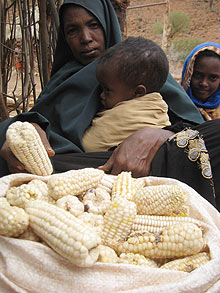
    Observer Food : Plumpy'nut and food crisis in Kenya, Fatima shows her entire food store Fatima with two of her children and her entire food store: one sack of scrawny maize stalks that a neighbour gave her. Photograph: John Vidal

    She brings out her entire food store – one small sack of scrawny maize stalks. “A neighbour gave it to me. In the morning we don’t eat anything. At around 4pm, I will prepare a maize porridge. That means pounding the maize for an hour. Then I mix the maize flour with water, and I will add a few beans and salt. We will eat this evening, but what I cook will never satisfy. It’s a very small amount.” Do the children complain? “Of course they do, all the time, especially when they see our neighbour cooking. Hunger leaves them more open to diseases, like colds and malaria. But they love the Plumpy’nut. They fight over it. I have to stop them.”

    “I really like milk,” says Alima, her eldest daughter. “I want to drink it all the time, but I never get it.”

    Just 15 years ago, the UN, western charities, governments and some food companies all thought that world hunger could be more or less eradicated. Politicians and agronomists reasoned that there had never been so much food grown in the world, and better seeds and improved technologies appeared to be keeping up with rapid population growth. India and China’s dash for economic growth was taking millions of people a year out of out of poverty, trade was booming, and food prices in the global market were declining. There were, said World Bank economists and world leaders, reasonable grounds for thinking that the 750 million hungry people in the world then could be reduced to less than 350 million by 2015. Every rich country dutifully signed up to the millennium development goals and pledged to halve world hunger by 2015.

    Fat chance. What no one foresaw was that oil prices would peak in 2007, and then all grain and fertiliser prices would double. No one expected, either, the credit crunch or the recession, or the massive takeover of cropland in the US and elsewhere to grow fuel for cars. No one thought developing countries would be hit so hard by a recession brought on by the west putting tens of millions of people out of work; or that food prices would not drop when the oil price fell. They were blind to the food riots that took place in more than 30 countries last year, and despite warnings by climate scientists, they did not take into account the deep droughts that have kept hitting major food-growing countries such as Australia and places like Kenya and Texas year after year.

    The world is now officially going backwards on food supplies, with more people malnourished than ever before in history. In August the UN said it expected 642 million people in Asia and 265 million in sub-Saharan Africa – more than one billion people – to go hungry this year. A new World Bank report last month predicted a further 25 million children could be hungry by 2050.

    “A four-decade positive trend of nations pulling themselves out of hunger has been reversed,” says Josette Sheeran, head of the UN’s World Food Programme, which provides emergency food for more than 100 million of the most vulnerable people. “Poor households all over the developing world are eating fewer and less nutritious meals, and many are cutting back on healthcare and schooling for children. Unless the world responds, we are in danger of losing a generation to hunger and malnutrition. We have the know-how, the tools and the technology to feed the world. Let history not say of our generation that we let the opportunity of ending hunger slip through our fingers.”

    But hunger – real, long-term, gnawing hunger, the kind that Fatima’s family knows but no one in Britain ever experiences – is officially on the march from sub-Saharan Africa to Asia. Only in Latin America have absolute numbers reduced in the past 30 years. In September there were food emergencies in Kenya, Yemen, Somalia, Syria, Ethiopia, Chad, Congo DRC, Sudan, Guatemala, Pakistan and a dozen other countries.

    Kenya is particularly worrying because while it has always known droughts, it has seldom been short of food. “The situation here is not good,” says Koki Kaylo, Concern’s nutritionist in northern Kenya, on the frontline of the growing crisis. “Acute malnutrition rates among children under five are over 20% in some areas – well above the 15% emergency threshold. We have seen 300 cases of severely malnourished children like Barwaco and Mohamed in just a few months. Normally you might expect to see only 200 in a year. The situation will certainly get far worse by February [when the next crops can be expected].

    “People are eating nothing but maize porridge now. That’s just carbohydrates and leads to oedema, water retention, swollen legs. It’s the beginning of starvation. Here you mainly see the wasting of muscles. This is very common already.” Malnutrition, she says, is still poorly understood, but is known to lead to stunting of growth, brain impairment, frailty, attention deficit disorder and worse. Even with 29 outpatient therapeutic programme centres and 32 supplementary feeding programmes, she admits it’s only a pinprick in the sea of need. Nearly half of all communities in northern Kenya now officially depend on food aid, either from the UN or from the government, which has appealed for $230m to feed 3.8 million people who they expect to be seriously affected by hunger in the next six months.

    But the world has made progress in at least one respect. “We are not killing people [with hunger] as we did 20 years ago,” says Yves Horent, the European community’s head of humanitarian aid in Nairobi. “Things have improved enormously. We don’t have many deaths from hunger nowadays. We’re become very good at keeping people alive technically with foods like Plumpy’nut. We have techniques to save people. We can keep mortality rates low. It’s incredibly efficient. We can save children, no problem. Just 20 years ago this would not have been possible. The cost of a life saved is now very cheap – €20-€40 will save a life. We can give vouchers, so people can access food easily. Fifteen years ago that would have been unheard of. We can deal with 20 million people. Now where there is free access or there are no blocks [to humanitarian groups] to working in a country, we can move thousands of tonnes of food. We won’t see people dying in thousands again, like in Ethiopia in 1984. People tried their best then, but the science was not as good as now. In the mid-1980s, we had very few professional aid workers and only a few nutritionists,” he says.

    But while the humanitarian groups have become incredibly good at saving people, the worry is that no one is addressing the causes of growing hunger. “Part of the problem is that we have become expert in a very artificial way now. We can take a child who is almost dead and revive her. But we cannot stop it happening again and again. We cannot prevent the problem,” he says.

    The reality of emergency aid today, he says, is that the millions of hungry people who are kept on a drip-feed of food aid from governments and the UN are out of sight. More than 100 million people now depend on UN food aid just to survive, not just to get them over a disaster or a temporary emergency, but to stay alive for years at a time. More than 5 million people in Ethiopia, similar numbers in Southeast Asia and sub-Saharan Africa, 1 million in Kenya and more in Burma, Somalia, Yemen, Chad and India are kept permanently just above the starvation levels. There may be no full-scale humanitarian emergencies any more, but people are left in a perpetual state of chronic hunger.

    Now there are ominous signs that rich countries are withdrawing even this safety net. Following the recession, countries have pledged less than half the money needed to feed the hungry. Even as hunger is increasing, the World Food Programme is nearly $3bn short and is having to close offices, cut operations and slash rations to millions of people who have no way of earning money to buy food. The previous UN minimum daily supply of 2,100 calories has been cut to 1,050 – about three tins of baked beans; the absolute bare minimum for a healthy diet.

    The economic crisis all over the world has pushed incomes down and increased unemployment, says Sheeran. “The food crisis is not over in the developing world. In fact, the situation is more alarming in many countries than it was even a year ago. There’s nothing more basic than food. If people don’t have it, one of three things happen: they revolt, they migrate or they die.”

    Actually UN food supplies never get to everyone in need, and whole communities that are cut off from roads, not favoured by politicians or that are just hard to access get left out of emergency feeding programmes. In Mathare slum in Nairobi – the second largest in the country, with nearly 800,000 people living in desperate poverty in a maze of tin shacks – the chances of food being distributed to the neediest by the government is practically nil. Help is left to charities, churches and individuals.

    Magdaline Gitahe of the Redeemed Gospel Church helped distribute food from Concern Worldwide and other charities to 2,000 people in Mathare in the first week of September. The numbers who are hungry are far greater than the UN or others know, she says. “They have little idea of the size of the problem. There is far more hunger than there was just a year ago. Maize used to cost 40 shillings [34 pence] a pack last year; now it costs 200 [£1.70]. Sugar was 50 [42p]; now it’s 115 [98p].

    “Bread milk, flour, salt – everything has gone up. People are cutting back on food every way they can. We take porridge without sugar, tea is no longer a priority, and instead of buying a big bag of sugar we buy little ones. Water has become very expensive. Last year the government gave out some food. This year we have had nothing. More and more hungry people are coming to us for the first time. Children are dropping out of school because they have empty stomachs. We cannot keep up,” says Gitahe.

    Alice Wanjiru received a bag of maize and some sugar from Gitahe. Alice has eight people to feed, including a disabled daughter who begs in Nairobi city centre, and her dead sister’s three children. She earns no more than £1.25 a day washing clothes and collecting plastic for recycling. “We don’t have food in the morning, just a cup of tea. We cannot afford to cook at lunch. So we eat in the evening but often we go to sleep without food,” she says.

    “People here in Mathare are mostly unemployed and uneducated,” says Gitahe. “They do casual jobs. The women wash clothes, the men work on construction sites. Some hawk, and sell paraffin or water. The situation is very bad. To spread out the benefits, we only give food to one person in each family. Many people are still dying of hunger. I have seen people fall down because they are so weak.”

    Mary Magure, a single mother with five children who lives in one room in the slum, says she speaks for thousands in her situation. “It’s almost impossible to survive now. I buy food in the street so we don’t have to buy paraffin or charcoal. I don’t have lunch, just the occasional meal in the evening. The best meal I could possibly cook now is maize flour. I can’t possibly afford rice – perhaps a packet of maize and some greens. When there’s no food and no money, the family just has to understand,” she says.

    She fears, but she does not know, that her children may be prostituting themselves to eat, and she starts crying. “When you are hungry, you start to imagine things. People become desperate. Everyone here needs food. Right now life is a very big challenge.” OFM

    To donate to Concern Worldwide, go to www. concern.net/en or call 0800 410 510

    PLUMPY’NUT A French scientist trying to fight malnutrition discovered the answer in an unlikely place: his own breakfast table.

    By Rebecca Seal

    Dr André Briend spent years trying to come up with a food that could be fed to seriously malnourished children which didn’t need reconstituting with water. Most therapeutic foods used during famines were expensive powdered milks that relied on clean water – something that tends to be in short supply in places where people are at risk of starvation. Small children fed these products once they returned to their villages from feeding stations could develop water-borne diseases like dysentery – just as likely to kill them as their lack of food.

    Paediatric nutritionist Briend was desperate to change this situation but had no breakthrough until, one morning in 1999, he noticed a pot of Nutella sitting on his kitchen table. The chocolate and nut spread was the inspiration he’d been searching for, and he began experimenting with puréed chocolate bars and sweets, mixed with the kind of vitamins and minerals malnourished children need urgently. Plumpy’nut was the result: a foil pouch the size of an adult fist, filled with peanut butter, sugar and a mixture of other vital nutrients. Each pack contains 500 calories, and with two servings a day, a severely underweight toddler can put on up to 2lb a week. At about £12.50 for 56 packs over four weeks – the most required to get a child back to health, followed by just one pack a day to keep them going – it’s cheaper than milk. No water is required, the packs keep for up to two years (unlike their milky predecessors, which spoilt in the heat). For small children whose tummies have shrunk, the paste can deliver a lot of easy-to-digest mono-unsaturated fats and protein in a small portion. Even better, because parents can take away a week’s supply, most people don’t need to stay in a feeding centre.

    Plumpy’nut is now made by a company called Nutriset in France, but because that’s relatively expensive, they also provide the required “slurry” of nutrients to local partners in places like Niger. Concern Worldwide has developed the idea still further, by working with hundreds of farmers in Malawi, and in future also in Ethiopia and Zambia, to make ready-to-use-therapeutic foods (RUTF) using ingredients like sesame seeds or chickpeas, which further cuts down transport and import costs. The resulting products are usually given names which translate as the local words for medicine. The UN is aiming for 80,000 tons of RUTF to be produced in Africa in the next five years.
  • Recession ‘ threatens UK effort to tackle global warming’

    Recession ‘threatens UK effort to tackle global warming’

    • Investment in green housing, power and transport at risk, says government committee
    • Millions of new electric cars plus rescue of carbon trading schemes among proposed measures

    Carbon trading

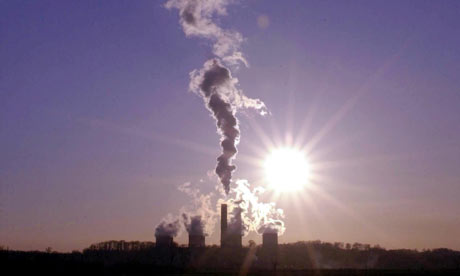
    Europe is relying on carbon trading between polluters to make it cheaper to build wind turbines and develop technology to trap and store gases from power stations. Photograph: HAYDN WEST/PA


    The recession is threatening the vast investment needed in green housing, power and transport and could seriously undermine Britain’s efforts to meet its targets for tackling global warming, the government’s climate change advisers warn today.

    The UK already has the toughest climate change laws in the world but the Committee on Climate Change says that “radical” action is still needed. It highlights the need to rescue carbon trading schemes – a key weapon in the battle to reduce greenhouse gas emissions – from problems caused by the slump.

    The committee demands “dramatic improvements” in the carbon efficiency of cars and measures to cut the growth in traffic, potentially including road pricing. It recommends that there should be 1.7m electric cars, with 3.9m drivers trained in fuel-efficient techniques, by 2020.

    Europe is relying on carbon trading between polluters to make it cheaper to build wind turbines and develop technology to trap and store gases from power stations as part of a promised switch to a low-carbon economy.

    The committee also warns that a “step change” is needed in the pace of UK emissions reductions if the government is to stick to tough new carbon budgets. Annual cuts must increase by at least four times, from the recent rate of 0.5% to 2-3%.The report also demands “more forceful” policy approaches.

    Lord Turner, chair of the committee, said: “The government needs to build on its low-carbon transition plan and put in place a comprehensive delivery framework. What we have proposed is achievable and affordable, but action needs to be taken now if we are to make our contribution to combating climate change.”

    Andy Atkins, head of Friends of the Earth, said: “The Climate Change Act is a world-class piece of legislation, but the true test is the policies put in place to deliver its goals. Crucial strategies on fossil fuels, aviation and energy infrastructure, due out shortly, will demonstrate whether or not the government has heeded the committee’s warnings.”

    With greater effort, the committee says, Britain could be transformed. It calls for a nationwide programme to boost energy efficiency in homes and offices, similar in scale to the installation of natural gas in every house from the late 1960s.It wants to see 10m lofts insulated by 2015 and 12m old boilers replaced by energy-efficient versions by 2022, as well as “significantly” increased numbers of energy-efficient washing machines and refrigerators. New laws may be needed to force private landlords to insulate and upgrade rented homes, the report says.

    The CCC says Britain should slash emissions from the power sector by 50% before 2020 by building 8,000 new wind turbines, alongside four new coal power stations fitted with carbon capture technology and three new nuclear power plants. It also calls for an urgent overhaul of the national grid, to accommodate new windfarms. The report says: “In a world where carbon budgets are achieved, we will meet more of our energy needs from low carbon power, live in well insulated homes with energy efficient boilers and appliances. We will also work in energy efficient offices and drive more carbon efficient cars including hybrids and electric vehicles.”

    David Kennedy, chief executive of the committee, said the recession could demolish such plans. “It’s a very big problem,” he said.

    The fall in economic activity has lowered CO2 emissions in Europe and left companies in the EU’s emissions trading scheme with a surplus of carbon credits. The committee estimates this could result in a carbon price of just €20 a tonne in 2020, rather than the €50 a tonne used for its previous analysis.

    Options to strengthen the carbon price, including the government underwriting a minimum price or intervening in the electricity market, should be “seriously considered”, the committee says. On Friday, a report from Ofgem suggesting domestic energy bills could rise 14-60% by 2020 was seen by energy industry experts as an acceptance that the market-driven system has failed and the government needs to be more interventionist.

    The analysis comes as a separate report from the Aldersgate group of companies says that a more radical approach to financing low carbon projects is needed to ensure carbon targets are met. It argues that a new strategic approach to reduce investor risks, mobilise capital and streamline institutional structures would accelerate the transition to a low carbon economy and reduce costs.

    Emma Howard Boyd, head of socially responsible investment and governance at Jupiter Asset Management, said: “There remains a credibility gap between policy and delivery which has resulted in too much uncertainty and risk for investors to finance at the scale that is required.”