Author: admin

  • Climate insurance: what kind of deal can be made in Copenhagen

    Climate insurance: what kind of deal can be made in Copenhagen?


    One key challenge on the climate change agenda is a fairer system to protect the world’s poorest farmers from failing crops and extreme weather variations. From Climate Feedback part of Guardian Environment Network


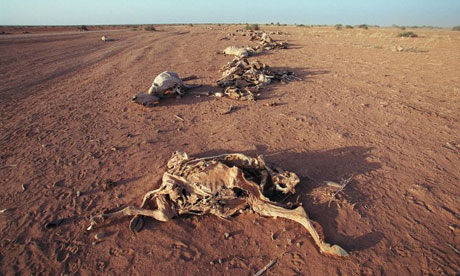
    Katine drought ethiopia

    The results of crop failure from exceptional drought in Ethiopia. Photograph: Joel Robine/AFP


    As even the staunchest advocates will tell you, climate insurance is by no means a magic bullet. But clearly the tools of modern finance could certainly help make poor nations prepare for and respond to all manner of natural disasters big and small.


    We explore some of these ideas in this week’s issue of Nature, taking a quick look at how the insurance debate is playing out in the ongoing United Nations climate talks. The upshot is that some kind of insurance mechanism is likely to make it into whatever climate deal is struck in Copenhagen and beyond.


    One commonly cited option is index insurance, which is tied to things like rainfall that can be measured objectively. This cuts down on costs by eliminating the need for audits and investigations. In the case of something like crop insurance, moreover, it could put money in the hands of farmers immediately after the rains fail – and before the hunger sets in.


    Today these programmes are being paid for largely by the farmers and nations buying the insurance, but industrialised nations would likely subsidise any insurance programme deployed as part of an international climate agreement. The logic is that extreme weather variations – including droughts and heavy storms – are likely to increase in a warmer world, which means that both costs and premiums will rise as well.


    A key challenge moving forward is how to scale up programmes that benefit the world’s poorest farmers and communities. Dan Osgood, a researcher at Columbia University’s International Research Institute for Climate and Society, points out the pilot programmes that are under way today have generally been deployed in areas where information – regarding weather, crops and the like – is available. This means it will only get more difficult moving forward.


    In the case of the Ethiopian project discussed in our story, Osgood only had 15 years of satellite data on rainfall. The team has installed a rain gauge in the village of Adi Ha, which they hope to use in future years, but the team had no choice but to base their rainfall metrics on satellite data this year.


    Osgood says the insurance question could also increase pressure on scientists and insurance companies to tease out the long-term impacts of global warming at very local scales. He was forced to grapple with the problem when he analysed the satellite data and found a slight decline in precipitation around Adi Ha. Scientists can perhaps write that kind of trend off as an uncertainty and wait for more data. Insurance contracts, however, can’t ignore such trends, because they are, by their very nature, priced according to uncertainty. The bigger the risk, the more uncertainty, the higher the price.


    “It could be a climate trend, it could be just noise and uncertainty, or it could be a decadal process,” he says. “What’s cool about it is we don’t need to know in order to write the contract this year.”
    Jeff Tollefson


    • This article was shared by our content partner, Nature’s Climate Feedback blog, part of Guardian Environment Network


  • The plight of Britain’s ancient trees

    The plight of Britain’s ancient trees


    We are home to some 100,000 of the oldest trees in Europe. But is our neglect and ill-treatment in danger of killing them off


    ancient trees

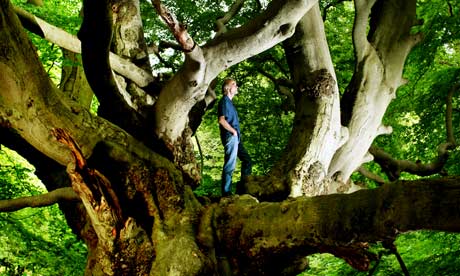
    National Trust’s ancient tree expert Brian Muelaner in the woods in the Chilterns, Photograph: Graeme Robertson


    Above crumpled grey roots like the enormous feet of a prehistoric elephant, leaves form a vaulted roof as grand as a cathedral. Huge limbs stretch out for 24 metres on each side. They smell damp. Stand beneath “the Tree”, as this magical old beech is known to anyone who walks this corner of the Chilterns, and you feel in the presence of something living and breathing. Its trunk is polished smooth from admirers who have scrambled into its embrace, and it has even brought its charisma and great girth to bear on films such as Harry Potter and the Goblet of Fire. This tree has lived for 400 years but now it is dying. Green summer weeds sprout on the ground below its huge canopy, sunlight now penetrating its thinning head of leafy hair. “The tree isn’t capturing all the light that it once did,” explains Bob Davis, head forester for the National Trust’s 5,000-acre estate at Ashridge. “It is slowly shutting down. We’ve decided not to do any surgery on it and allow it to decline naturally into senescence.”


    In its dotage, this great tree is being carefully nurtured. Across the country, however, many of our estimated 100,000 ancient trees – which could represent 70% of all ancient trees in Europe – are neglected or at risk of being felled. This week, they get a new guardian: Brian Muelaner, a forester turned conservationist, is to count all the ancient trees on land belonging to the National Trust, which could turn out to be the largest private owner of ancient and notable trees in northern Europe. Muelaner’s new job as the Trust’s ancient tree officer will help push along the Ancient Tree Hunt, a five-year project led by the Woodland Trust, which for the first time is recording every ancient tree in Britain. “If we don’t know where they are, we can’t protect them,” says Muelaner. “If we can’t protect them, we don’t know if they can survive.”


    A tree is defined as ancient if it is unusually old for its species. It is said that an oak spends 300 years growing, 300 years living and 300 years dying. Such a long-lived species would have to be 600 years old to be classified as ancient. Beeches are prone to fungal attack and are less long-lived: an ancient beech is anything over 300 years old. Birch trees have even shorter lives; one that has lived for two centuries is very old.


    Ancient trees are ecological treasures because they provide unique habitats for rare plants, insects, birds and mammals. When they become ancient, trees such as oaks and sweet chestnuts “grow down”, dying at the top and forming a new crown of leaves below so the tree shrinks and hunches like a very old man. Ancient trees also hollow out: fungi feed on the deadwood in the heart of the tree and invertebrates such as rare beetles move into the hollows, followed by birds and bats. Three-quarters of our 17 species of bat are known to roost in trees. Some plant species can only survive on ancient trees: over time, the pH of bark changes and certain rare lichens only grow on ancient bark.


    With a laughing Buddha around his neck, Muelaner looks like a hippie rock star, but he is not a tree-hugger. “That doesn’t do it for me, but I understand it,” he says. “The mood an ancient tree puts you in, it just takes your breath away; you know you are by something extremely important and significant. When you are under an ancient tree, it’s very good for your soul.” He compares a century-old beech nearby the 400-year-old tree. “It’s like the difference between an 80-year-old man who is full of knowledge and experience and a cocksure 15-year-old who thinks he knows everything. You can discard those people as doddery old folks or you could use them for their knowledge. You can learn so much from ancient trees about how a tree survives. How does an organism survive for 1,000 years in the same spot? It doesn’t get to move to a better position. So it adapts.”


    Standing beneath the huge old beech, contemplating its warty imperfections and huge stretch-marks where its trunk has bent and twisted, it seems incredible that it has stood witness to four centuries of humans scurrying around it. While this example partly owes its long life to being pollarded by humans over the centuries (the traditional way of harvesting its branches at head height, pollarding mimics the natural retrenchment of trees such as oaks, and ensures species like beech don’t grow too tall and fragile), trees have their own clever ways of prolonging their life. They can eat themselves. When fungus attacks the dead heartwood, a tree might send aerial roots into the hollow and start drawing the nutrients out, recycling itself so it lives longer. Trees can also walk. Slowly. If a branch touches the ground, it can send out roots and grow up again.


    Our wealth of long-lived trees is a happy accident: a legacy of our royal hunting forests, our domineering aristocracy and our lack of efficiency – compared with our north European neighbours – in harvesting our forests for timber. The last century, however, has not been kind to ancient trees. We have ploughed too close to them, grazed too intensively around them and used fertilisers and pesticides too wantonly, killing both trees and species of fungi that have a symbiotic relationship with them. Then there was the ripping out of native broad-leaved trees and planting of supposedly more productive non-native conifers after the second world war. “The Forestry Commission, the National Trust, private landowners, everyone was guilty in its day. There was a national drive for it,” says Muelaner. “Now we know the unique historical, cultural and biological importance of these trees, and there is a national movement to reverse the bad management of the past.”


    Trees may be impressively long-lived but they are more fragile than we imagine. Too many livestock sheltering under a tree and defecating there can fatally damage it. Even a footpath under a tree can compress its roots and destroy it. One day, Davis discovered a group of druids worshipping the great beech at Ashridge with a small fire. The tree did not look as if it had been harmed but even a mild scorching – with no visible damage – can cause a tree’s sap to boil and kill it. Ancient trees are often hollow: the holes make fantastic dens but children often light small fires in them. “You lose your ancient tree just like that,” Muelaner snaps his fingers. “We do things inadvertently and it’s gone. We can’t put it back. We can’t recreate that habitat like we can with grassland. If we kill an ancient tree, we have to wait 500 years to restore that habitat.”


    Trees can also die of sunburn. Close to the great beech at Ashridge, another beech is dying because a vast branch of another tree fell nearby, exposing this tree to the sun. Beech has thin bark and, just like a pale-skinned human, if it has grown up protected from the sun and is suddenly exposed, it burns horribly. Grey squirrels stripping bark is an increasing problem: holes in the bark allow fungal diseases in, which can weaken a tree and finally cause it to fall over. Fungal diseases introduced by squirrels also stain the quality beech wood that the Chilterns is renowned for, making it commercially worthless. “It’s a serious economic and ecological issue. It’s a total disaster,” says Muelaner.


    Ancient trees are not merely great statues to biodiversity, they document human history; they have a social and cultural significance, as well as an ecological one. The ancient trunk pictured at the top of this article bears the scars of decades of graffiti. “It is vandalism but then it becomes historic,” he says. During the second world war, American soldiers shot deer, chased local women and prepared for war in the woods at Ashridge. On 4 May 1944, a few weeks before D-Day, when many young men would perish, a group of GIs carved a “V” for victory and the names of their home states – from Texas to South Dakota – into the trunk of another Chiltern beech nearby. It is still there, a memorial in bark, the carving slowly fattening as the tree grows so you can rest a finger in the V now.


    Muelaner, whose post has been funded for three years by the Cadbury family, will accelerate the process of logging our ancient trees. So far, the Woodland Trust has logged 38,000 ancient trees through the work of ecologists and ordinary members of the public, who can record trees at ancient-tree-hunt.org.uk. Our great wealth of ancient trees may not remain unknown for much longer, but they are still relatively unprotected. Other countries preserve ancient trees by listing them like an old house or ancient monument. In Britain, the only protection is a tree preservation order, which can be circumvented by developers if it is proved trees are dead, dying or dangerous (and most ancient trees, by definition, are dying: it just takes them three centuries).


    Muelaner points to the enormous beech at Ashridge. “If France, Germany or the Scandinavian countries had a tree like that, there would be plaques everywhere and it would be a national monument,” he says. As well as better protection, he believes we need to create ancient tree-like habitat by planting young trees such as birches that age quickly and provide dead wood or by deliberately maiming some trees to create hollows and dead areas so beloved of smaller living things.


    “The speed of our societies nowadays mean that trees are that much more important to us as places where we are grounded and are at peace,” says Muelaner. “We need them now more than we ever needed them before”.
  • Tuvalu Sets Goal of 100 Percent Clean Energy by 2020

    July 22, 2009

    Tuvalu Sets Goal of 100 Percent Clean Energy by 2020


    The nation hopes its solar project will inspire climate talks.

    by Ghita Benessahraoui & Terry Collins

    Tuvalu [RenewableEnergyWorld.com]

    Amid worsening climate change-related problems for small island states, Tuvalu has established a national goal of being powered entirely by renewable energy sources by 2020.


    “There may be other, larger solar power installations in the world but none could be more meaningful to customers than this one.”


    Takao Shiraishi, General Manager, Kansai Electric Power Co.


    Government officials and the donors of Tuvalu’s first large-scale solar energy system alike hope the moves help inspire much larger nations later this year in negotiations of a successor to the Kyoto Protocol agreement on climate change.


    The solar system installed on the roof of Tuvalu’s largest football stadium now supplies 5 percent of the electricity needed by that nation’s capital, Funafuti.


    In its first 14 months, the operation has reduced Tuvalu’s consumption of generator fuel, shipped from New Zealand, by about 17,000 litres and reduced Tuvalu’s carbon footprint by about 50 tonnes.


    In the process, it has also reduced the risk of diesel spills around the archipelago of four low-lying coral islands and five atolls.


    Based on the project’s success, the country now aims to be powered entirely by renewable energy sources by 2020, a goal requiring an investment estimated at just over $20 million, according to government estimates.


    At their summit earlier this month in Italy, the richer G8 countries committed to help finance efforts by poorer nations to battle climate change.


    Tuvalu’s first grid-connected, 40-kilowatt solar energy system was implemented under the leadership of Japan’s Kansai Electric Power Co with the support of the Tokyo Electric Power Company, both members of the e8, an international non-profit organization of 10 leading power utilities from G8 countries.


    “There may be other, larger solar power installations in the world but none could be more meaningful to customers than this one,” says Takao Shiraishi, General Manager of the Kansai Electric Power Co.


    “The plight of Tuvalu versus the rising tide vividly represents the worst early consequence of climate change,” he adds. “For Tuvalu, after 3,000 years of history, the success of UN climate talks in Copenhagen this December may well be a matter of national survival.”


    The Tuvalu government is working to expand the initial US $410,000 e8 project from 40 to 60 kilowatts, and will extend solar power to outer islands, starting later this year with the commission of a US $800,000, 46-kilowatt solar power system for the Motufoua Secondary School in Vaitupu, being implemented with the support of the Italian government.


    With a population of 12,000, Tuvalu is halfway between Hawaii and Australia, 26 square km in size, with a maximum elevation of just 4.5 meters and most of its land less than a meter above sea level.


    Tuvalu is already experiencing flooding amid predictions of a large sea level rise this century.


    Says Kausea Natano, Minister for Public Utilities and Industries: “We thank those who are helping Tuvalu reduce its carbon footprint as it will strengthen our voice in upcoming international negotiations. And we look forward to the day when our nation offers an example to all – powered entirely by natural resources such as the sun and the wind.”


    The e8’s Tuvalu project was initiated after a series of regional renewable energy feasibility workshops, jointly organized by the Pacific Power Association (PPA) and the e8.


    e8 members agreed to donate and install the first facility, and are monitoring its success and building local expertise to ensure the project’s sustainability.


    Run by the state-owned Tuvalu Electricity Corporation (TEC), the system in Funafuti today powers households, healthcare facilities, small-and medium-sized enterprises and other facilities.


    Johane Meagher, Executive Director of the e8, expressed thanks for the support of the Pacific Power Association, with whom the e8 has established a long term collaboration to support development of small scale projects in the Pacific Islands and strengthen the capacity of the engineers and technicians of the islands’ utilities to enhance renewable energy power in the Pacific region.


    Meagher said, “We are proud of the role the e8 has played in creating this clean energy project, which was intended to generate far more than just electricity in Tuvalu. It is a message to the world about the urgent need to promote sustainable energy development and reduce greenhouse gas emissions on a massive scale.”


    Ghita Benessahraoui is Communications Coordinator of the e8 General Secretariat, Montreal and Mr. Terry Collins heads a Toronto-based firm specializing in international science communications.


    Sidebar: Who are the e8?


    Created in the wake of the 1992 Rio Summit, the e8 is a non-profit international organization, composed of 10 leading electricity companies from the G8 countries, whose mission is to play an active role in the international debate on global electricity issues and to promote sustainable energy development through electricity sector projects and human capacity building activities in developing and emerging nations worldwide.


    The e8, in partnership with UN agencies, key international organizations and local partners, contributes to enhancing access to energy for some of the two billion people around the world still without access to this essential resource.


    The e8 mission, with the fight against climate change and sustainable development at its core, translates into three key objectives:


    • To contribute to the development of common policies that create the foundations for global cooperation on sustainable energy development and the fight against climate change;
    • To participate in the global debate on key issues relating to the electricity sector, putting forward common positions and becoming a representative voice of the international electricity sector vis-à-vis the G8; and
    • To support developing and emerging countries in the effective and sustainable generation and use of electricity.

    The e8 members are:


    • American Electric Power, USA
    • Duke Energy, USA
    • Hydro-Québec, Canada
    • Ontario Power Generation, Canada
    • EDF, France
    • ENEL S.p.a., Italy
    • RWE AG, Germany
    • JSC “RusHydro”, Russia
    • Kansai Electric Power Company, Inc., Japan
    • Tokyo Electric Power Company, Inc., Japan


  • Scientists explain new Process for Producing Biodiesel from Feather Meal

    July 23, 2009

    Scientists Explain New Process for Producing Biodiesel from Feather Meal


    by The American Chemical Society

    Scientists in Nevada are reporting development of a new and environmentally friendly process for producing biodiesel fuel from “chicken feather meal,” made from the 11 billion pounds of poultry industry waste that accumulate annually in the United States alone. Their study appears in the July 22 issue of ACS’ Journal of Agricultural and Food Chemistry, a bi-weekly publication.


    In the study Mano Misra, Susanta Mohapatra, Narasimharao Kondamudi, and Jason Strull note that chicken feather meal consists of processed chicken feathers, blood and innards that have been processed at high temperatures with steam. Currently feather meal is used as animal feed and fertilizer because of its high protein and nitrogen content. With as much as 12 percent fat content, feather meal has potential as an alternative, nonfood feedstock for the production of biofuel, the report says.


    The researchers describe a new process for extracting fat from chicken feather meal using boiling water and processing it into biodiesel. Given the amount of feather meal generated by the poultry industry each year, they estimate this process could create 153 million gallons of biodiesel annually in the U.S. and 593 million gallons worldwide. In addition, they note that removal of fat content from feather meal results in both a higher-grade animal feed and a better nitrogen source for fertilizer applications.


  • Demographers at odds over population drivers.

    Demographers at odds over population drivers


    By Bronwyn Herbert for PM


    Posted 2 hours 46 minutes ago
    Updated 2 hours 42 minutes ago


    Mark McCrindle says the statistics show a big boom in births.

    Mark McCrindle says the statistics show a big boom in births. (AAP Image: Alan Porritt, file photo)


    Social demographer Mark McCrindle says Australia’s population is set to hit 22 million before the end of the year, 40 years earlier than expected.


    As recently as a decade ago, demographers thought Australia’s population wouldn’t reach 22 million until mid-century.


    But Mr McCrindle says they are rethinking that forecast.


    “Well we certainly hadn’t planned for it. In fact I’ve got here an Australian Bureau of Statistics report back in 1998 and it said that by the middle of this century we would hit perhaps 23-and-a-half million, maybe up to 26 million,” he said.


    “Well we are closing in on 23 million right now, in fact by 2051, we will probably double our population of today, probably be at 44 million then, based on these growth rates.”


    Mr McCrindle says the statistics show a big boom in births.


    “You’ve got the baby bonus which supports people a little bit. We’ve had pretty good economic times which encourages people to take on the risk of an extra one,” he said.


    “And that’s what the demographics point… that’s not as though we have more women having babies that otherwise would not have, it’s that women who have had one are having a second, and women who have had two or having a third, so there’s a swing back to a slightly larger family than we’d seen.”


    He says unlike people in other developed countries, on average, most Australian couples have two children, which is enough to replace them.


    “Northern Territory, Tasmania, WA, Queensland, they all have more than two babies per woman in those states and territories,” he said.


    “Nationally we are at 1.93, so getting close to two babies per woman which is by definition replacement rates.”


    And Mr McCrindle says Tasmanians are breeding on behalf of the nation.


    “Not getting too many people moving to Tasmania from other states but they have the, out of the states the highest fertility rate, so they are breeding their way back up to some numbers it seems down there on the apple isle,” he said.


    Immigration


    Other demographers say the race towards 22 million has much more to do with immigration.


    Peter McDonald is the Director of the Australian Demographic and Social Research Institute at the Australian National University.


    “I don’t think the story is much about births. No I think the number of births will remain roughly where it is. The main story really is about migration,” he said.


    Professor McDonald says specific immigration policies are shaping the nation’s size.


    “Migration to Australia has changed. You know people think about migrants coming to Australia as those coming on the classic government permanent residents program. That’s the skilled migration, family reunion, refugees,” he said.


    “Only 30 per cent of the population increase through migration comes through those sources, the rest of it is from people coming in on temporary visas to Australia and the biggest group is the overseas students and overseas students coming in.


    “We’re desperately trying to keep them coming at the moment in case they get frightened away because it is a big export earner for Australia.”


    Professor McDonald says as the population ages, the birth rate will fall, and Australia’s population growth in 20 years will entirely rely on migration.


    Tags: community-and-society, population-and-demographics, australia

  • Hydropower in Europe: Current Status, Future Opportunities

    July 20, 2009

    Hydropower in Europe: Current Status, Future Opportunities


    by Marla Barnes, Chief Editor, Hydro Group

    Missouri, United States [RenewableEnergyWorld.com]

    By 2020, a fifth of all energy consumption in European Union (EU) member countries must come from renewable sources – hydro, wave, solar, wind, and biomass. This mandate, which EU leaders signed in March 2007, is part of a proposal designed to cut greenhouse gas emissions by 20 percent (compared with 1990 levels).


    The emphasis in Western Europe is retrofitting hydro plants with modern equipment, usually upgrading the capacity of the plant. In Eastern Europe, the focus is rehabilitating aging plants that often were allowed to deteriorate during the era of the Soviet Union.


    For hydroelectric power, this mandate translates to significant growth in development of new capacity and in upgrading of existing facilities throughout Europe.


    Several new conventional hydroelectric projects entered commercial operation in the past few months … something not seen in several decades. Examples of new projects include: Sonna in Norway (270 MW), Glendoe in the United Kingdom (100 MW), and Blanca in Slovenia (42.5 MW).


    For small hydro (less than 10 MW), development opportunities are significant. Provided the mandate by EU member countries is implemented on a timely basis, the European Small Hydropower Association (ESHA) estimates that installed small hydro capacity could reach 16,000 MW by 2020 – a more than 4,000-MW increase over current levels.


    Another area of significant growth for the hydropower sector in Europe, especially in the central region of the continent, is in pumped storage. In addition to supplying additional electricity during times when demand for power is highest, pumped storage’s ability to balance power production and regulate the transmission network, in light of increased use of intermittent renewables, particularly wind, is attractive.


    As many as ten pumped-storage facilities are under construction, including 178-MW Avce in Slovenia, 540-MW Kopswerk 2 in Austria, 480-MW Limberg 2 in Austria, and 141-MW Nestil in Switzerland. Several more potential projects are being investigated.


    Europe also is an established leader in research and development of new technologies – ocean, wave, and hydrokinetic. Thirty years ago, the United Kingdom had the most aggressive wave power research and development program in the world. This commitment to research and development, as well as to commercialization of new designs, continues today throughout Europe.


    Installed hydropower in Europe totals approximately 179,000 MW. European countries with the largest amounts of hydro include France, Italy, Norway, and Spain. Maintaining and, in many cases, upgrading, this existing infrastructure continues to be an important focus throughout Europe.


    The emphasis in Western Europe is retrofitting hydro plants with modern equipment, usually upgrading the capacity of the plant. In Eastern Europe, the focus is rehabilitating aging plants that often were allowed to deteriorate during the era of the Soviet Union.


    Numerous utilities are committing significant resources to upgrade entire portfolios. For example, here in France, national utility Electricite de France (EDF) is investing more than 2 billion euros (US$2.5 billion) as part of France’s economic stimulus program, including spending on modernization of hydroelectric projects. In recent months, EDF has issued several solicitations for hydropower equipment and other work for its many projects, including up to 50 turbine-generators over five years.


    Editors of HRW magazine and HydroWorld.com continually track European project construction and rehabilitation progress. To regularly follow hydropower development and rehabilitation activity, bookmark www.hydroworld.com


    Marla Barnes is chief editor, Hydro Group, for PennWell Corporation.


    This article was reprinted with permission from the Hydro Group as part of the PennWell Corporation Renewable Energy World Network and may not be reproduced without express written permission from the publisher.