Author: admin

  • Murray showing signs of recovery

    Murray showing signs of recovery

    Updated 3 hours 41 minutes ago

    Scientists say salinity levels are falling in the lower reaches of the Murray and many bird and fish populations are increasing.

    One native species thought to have been extinct is benefiting from a captive breeding program but concern remains that some plant species have failed to return after years of drought.

    The southern purple-spotted gudgeon can be hard to find. Although colourful, they are thin and only grow up to 12 centimetres.

    In 2002, a remnant population was collected from wetlands near Mannum in South Australia for a breeding program.

    Chris Bice, an ecologist at the South Australian Research and Development Institute, said – at the height of the drought – those wetlands dried up.

    “We monitored that population during the drought to see how the population was going and I think over two years we caught maybe two individuals and then for a year or two straight we caught no fish whatsoever,” he said.

    “So we were quite confident in saying that population was probably gone from the wild, so the only population was in a couple of aquariums essentially.”

    Those aquariums are in the Institute’s research centre at West Beach in Adelaide, where about 500 gudgeons are being monitored before being returned to the Murray-Darling river system next month.

    Mr Bice says extra flows to the river system have created conditions for the species to survive.

    “We feel that there is some water back in the system at the moment and it probably has a reasonable amount of security behind it at the moment and, as long as habitat conditions come back to a level where we think they’ll be adequate for the fish, we think that, yeah, it’s time to release them back in the wild,” he said.

    Risky release

    Mr Bice said there would be risks in releasing the aquarium-raised fish into the wild.

    “They’ve actually become used to captive conditions I suppose, so they’re not quite used to things like predation from birds and other fish and simply surviving out there in the big, wide world is one of the biggest risks I suppose,” he said.

    “Pinning down the reason why this species declined in numbers in the first place is quite difficult, but undoubtedly it probably has to do with river regulation and decreases in flows to the lower part of the river and potentially also the impact of introduced species on this fish. We’ve basically altered the river quite a lot from its natural state and undoubtedly those are the reasons why the species declined.

    “It’s certainly not out of danger at all. In terms of where it sits on an endangered list currently, it’s still in a very precarious state and it needs to move a lot further from here before it gets to a stage where we’d be quite happy about its future.”

    Associate Professor David Paton from Adelaide University said water quality had improved along many areas of the lower Murray in SA.

    “The Coorong has had a recovery of its salinity, largely because of significant volumes of water arriving at that region,” he said.

    “For some of the organisms living within the water column, various fish and some of the aquatic invertebrates, there’s been a recently rapid recovery.

    “But there are other components of that system that have not shown any recovery at all despite the return of appropriate salinities.”


    All but gone


    Professor Paton said Ruppia tuberosa, a local native plant, had been affected by years of drought and was now virtually non-existent in the Coorong.

    “The longer the plant is away, the harder is it for various organisms that depend on those plants to also be there and the notion of having a healthy, resilient system has to start being addressed within the Murray-Darling Basin Plan,” he said.

    “At present, the Murray-Darling Basin Plan is all about the delivery of water and assumption that if you get the hydrology right, salinities and so forth, the biology will actually be fine.

    “Well the biology is not fine, it hasn’t been fine and there needs to be a much greater focus on repairing the damage, before one even thinks about what one even thinks about what might be the status quo in terms of the volumes of water that one could tolerate being returned and/or removed from the system.”

    Professor Paton says there were difficulties in returning the plant to its earlier levels.

    “The dilemma is there is no actual seed bank, substantial seed bank that can then be used to then restock this system and get it re-established and so it will take many years to slowly build this population of plants back, to get it back to the dominance that it once had,” he said.

    Topics:murray-darling-basin, rivers, endangered-and-protected-species, fish, animal-science, research, research-organisations, drought, environment, university-and-further-education, water-management, goolwa-5214, renmark-5341, adelaide-5000, sa, australia

    First posted 8 hours 57 minutes ago

  • Angle of descent MONBIOT

    Monbiot.com


    Angle of Descent

    Posted: 03 Oct 2012 01:53 AM PDT

    The justifications for airport expansion turn out to be bogus.


    By George Monbiot, published on the Guardian’s website 28th September 2012

    When politicians say that we need more runways and more airports, they invariably claim that “the economy” depends on them. They seldom specify what they mean by this, but in most cases they seem to have business flights in mind.

    Both Tim Yeo and George Osborne – two of the people within the Conservative party who have been pushing hardest for expansion – suggest that main economic benefit of greater airport capacity will be more business flights. In the article in which he asked David Cameron whether he was a man or mouse, the MP Tim Yeo proposed that a third runway at Heathrow was essential “to kick-start Britain’s sluggish economy … by boosting trade with China”. The sub-heading insisted that “a third runway at Heathrow could be the start of a desperately needed programme to make Britain the most business-friendly country in Europe.”

    The government’s draft Aviation Policy Framework is remarkably vague on this point. While making generalised statements about the supposed benefits, it makes no attempt to calculate the economic impacts of business travel, or to explain the economic case for expanding airport capacity in order to facilitate it.

    Perhaps this is unsurprising. Business travel, by contrast to popular perceptions, is not rising, but falling – and falling dramatically.

    A report by the government’s Health Protection Agency reveals a 25% decline in business flights since 2000. Sure, there has been a recession during this period, but the decline is much sharper than the fall in business profits or the reduction in the size of the economy.

    (Thanks to Ed Gillespie of Futerra for pointing me to this report).

    The figures suggest two things:

    – that business flights are seen by many companies as a luxury, not a necessity: they are among the first items to be cut when conditions tighten.

    – that companies have begun, at last, to use the excellent technological alternatives to face-to-face international meetings.

    As Lloyds Bank explains:

    “In 2009, we introduced a common travel policy across the organisation which supports a focus on sustainable travel. It helped us deliver a reduction of 143,000 journeys compared with 2008. Across the combined Group, the volume of teleconferences increased by 40% to over 1.1 million in 2009. We also increased the volume of teleconferences by 73% in 2010 compared with 2009, to 1.9 million.”

    For many businesses, cutting the number of flights their staff take saves money, saves time and improves performance, as their employees are less likely to be exhausted.

    So Yeo, Osborne and others are calling for airports to expand in order to serve a sector that’s shrinking, and shrinking for good reasons.

    Only 12% of the visits abroad by UK residents, the report shows, take place for business purposes. The great majority (66%) are used for holidays, and a smaller proportion (20%) for visiting friends and relatives.

    Another survey, by the British Air Transport Association, shows that, of flights in 2010, 77% were taken by people in socio-economic classes A, B and C1. Only 8% were taken by people in classes D and E, though they comprise 24% of the population.

    The proportion of poorer people flying has remained unchanged since 1999 (when the figures begin), despite the steady increase in airport capacity since that date. The richer you are, the more often you are likely to fly, and the more likely you are to be a beneficiary of airport expansion. There’s nothing surprising about this: the rich can afford more foreign holidays than the poor.

    In other words, the construction of new runways and new airports, which can devastate the lives of those who live under flight paths (who are likely disproportionately to be poor, as they cannot afford to move away) and which, through climate change, will devastate lives all over the world, will primarily facilitate holidays for people in the richer half of the population. The typical beneficiary is someone whose frequent visits to their second home in Tuscany or their favourite beach in Thailand will become quicker and more convenient.

    The two most common justifications for expanding airport capacity are that it makes this country more “business friendly” and that it enables a higher proportion of poorer people to fly. Both justifications turn out to be false. More airports will enable people like Tim Yeo and George Osborne to enjoy more foreign holidays; they will not deliver the other benefits these people invoke.

    www.monbiot.com

  • University of Surrey makes gas-powered car breakthrough

    Google Alert – METHANE

    Inbox
    x

    Google Alerts googlealerts-noreply@google.com
    2:32 PM (52 minutes ago)

    to me
    News 4 new results for METHANE
    Man-made gases emitted ‘centuries before industrialisation’
    The Australian
    For 1800 years before industrialisation took off in the 19th century, emissions of methane rose in line with expanding populations, human conquest and agricultural techniques, it said. Celia Sapart at Utrecht University in the Netherlands and
    See all stories on this topic »
    Methane issues persist
    Independentweekender
    In the 59 water wells the EPA analyzed for dissolved methane, 20 had more than the state’s threshold of 7 milligrams per liter of the gas in the water, 15 of those had double that amount or higher and five had four times the threshold – the point when
    See all stories on this topic »
    Aspen Skiing Co.: Power from mine no ethical issue
    Aspen Times
    In an annual meeting Tuesday with the Pitkin County commissioners, Skico Vice President and Chief Financial Officer Matt Jones said a new plant that produces electricity by capturing methane released from the Elk Creek coal mine in Somerset will start
    See all stories on this topic »
    University of Surrey makes gas-powered car breakthrough
    ElectronicsWeekly.com
    As part of the scientific effort for developing new materials to store hydrogen or methane as onboard fuel, a new class of crystalline and microporous materials known as “metal organic frameworks” (MOFs) have shown promise. If the internal surface area
    See all stories on this topic »

    Blogs 1 new result for METHANE
    Methane emissions can be traced back to Roman times | Science
    By News
    Emissions of the greenhouse gas methane into the atmosphere can be traced back thousands of years in the Greenland ice sheet. Using special analytical methods, researchers from the Niels Bohr Institute, among others, have determined
    Science Codex – Science news,…

    Web 1 new result for METHANE
    New Findings on Methane Highight Urgency of Climate Action
    Emissions of the potent greenhouse gas methane began well before the Industrial Age, according to a study published Wednesday in the journal Nature, raising
    https://www.commondreams.org/headline/2012/10/03-11


    Tip: Use quotes (“like this”) around a set of words in your query to match them exactly. Learn more.

    Delete this alert.
    Create another alert.
    Manage your alerts.

    Click here to Reply or Forward
  • Australian coastline at risk of destructive tsunamis, reveal simulations

    Australian coastline at risk of destructive tsunamis, reveal simulations

    Japan Earthquake

    In this March 11, 2011 file photo, a tsunami floods over the breakwater protecting the coastal city of Miyako at Heigawa estuary area after northeastern Japan was hit by a powerful earthquake. Source: AP

    Middle of Hell
    • Australian geology and emergency services have simulated “worst case” Tsunami scenarios.
    • Simulations show 9.0 earthquake in Indonesia could devastate Christmas Island and parts of northern WA
    • A 9.0 earthquake in New Zealand could send powerful waves into Sydney and Brisbane
    • Overall risk is low, as Australia is far from tectonic plates and waves will distribute their force over a wide area.

    POWERFUL underwater earthquakes near Indonesia and New Zealand could send destructive tsunamis thundering into Australia’s populous coastline, simulations have shown.

    Following the catastrophic 2004 Boxing Day tsunami and last year’s devastating Christchurch earthquake, the Joint Australian Tsunami Warning Centre operated by the Bureau of Meterology and Geoscience Australia have simulated two wave-triggering earthquakes in training exercises.

    The ”worst case” scenarios were of a tsunami triggered by an Indonesian 9.0 earthquake – which sent 5-10 metre waves into Christmas Island – while powerful waves also hit the populated coast between Sydney and Brisbane from a simulated New Zealand quake.

    The data showed the tsunamis would take five hours to reach the mainland from either earthquake.

    Centre Director Chris Ryan said because Australia is in the middle of a tectonic plate, far away from the active edges, the energy released by the tsunamis would be distributed over a wider front by the time it reaches the coast.

    ”For Australia’s coasts we only need to worry about the higher magnitude events because of our distance from the source, and then only some of the possible earthquake sources are close enough, or oriented in the right direction, to send a severe tsunami towards Australia” he said.

    ”In a sentence, the exercise scenarios are not likely, but they could happen tomorrow.”

    The long-term average of an earthquake the size of those modelled in the simulation is once every 30 years but there are signs their frequency is increasing.

    Geoscience figures show there has been three 9.0 earthquakes in the past eight years.

    The destructive potential of the tsunamis would be the power behind them, which could drive the sea into coastal cities.

    See the simulation showing how fast a tsunami can travel

    ”The important point to get across is that a one-metre wave produced by the wind is very different from a one-metre wave produced by an earthquake,” Mr Ryan said.

    ”The wind wave rises and falls in a matter of seconds, while a tsunami rises and stays up for periods of 10 to 15 minutes, with water at that level continuing to flow inland all the time.

    ”This is a tremendous amount of water with enormous force which allows it to push inland over low-lying areas with destructive force.”

    By far the most common tsunamis to hit Australian waters are those which trigger a marine response but do little damage once they hit land.

    These tsunamis are relatively common, with one or two reaching Australian waters most years, although there were none in 2011.

    Such tsunamis throw boats from their anchors and can be very dangerous to anyone on a rock pool or a reef, such as tourists on the Great Barrier Reef.

    Emergency services from across Australia participated in the simulation to ensure they were prepared for the unthinkable.

    Mr Ryan said people living in coastal cities should follow three main guidelines if a tsunami alert is released by emergency authorities:

    1. IF a watch message is issued, be on the alert for further information, monitor televisions and radio reports in case the threat level rises;

    2. DO not go down to the beach – even if the threat is only for a marine tsunami there is the potential for damage to occur along the coast’

    3. NOTIFY neighbours and follow the instructions of police, lifesavers, and other emergency services.

    For tsunami information and warnings, visit Geoscience Australia.

  • Mother of four girls ordered back to Italy clings to AFP car as her daughters are taken away

    A sad indictment on our judicial system, reminescent of the Petrov incident back in the 1950’s. Where is our compassion????

    Mother of four girls ordered back to Italy clings to AFP car as her daughters are taken away

    1
    Custody case

    One of four sisters involved in an international custody case is led through Brisbane airport by police officers, who delivered her onto a plane bound for Italy. Image has been digital distored to protect her identity. Picture: Eddie Norbido. Source: Supplied

    THEY cried for their mother, cried for home and begged uniformed officers to let them go.

    As the four sisters at the centre of an international custody ruling were last night dragged screaming onto Emirates flight EK 433 to Dubai, uniformed officers were forced to lift and drag the girls to get them to the plane.

    Passengers at gate 75 watched on in alarm as up to a dozen federal officers were used to move the girls to the nearby Emirates lounge to await boarding.

    “Let me go, I want my mum, I want my mum,” one of the younger girls wailed, each arm held securely by a federal officer.

    Distraught mum

    The mother of four sisters involved in an international custody dispute is comforted by a friend (left) at Brisbane International Airport as her girls are escorted onto a plane. Picture: Eddie Norbido

    The girls were led out one at a time, the eldest sister escorted up an escalator restrained by four police officers.

    “Let me go, I want to go home,” the hysterical girl screamed.

    Later, as they moved her back past waiting passengers, the screaming girl begged to be released.

  • Land acquired over past decade could have produced food for a billion people

    Land acquired over past decade could have produced food for a billion people

    Oxfam calls on World Bank to stop backing foreign investors who acquire land for biofuels that could produce food

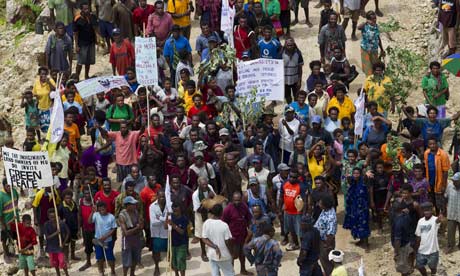
    MDG : Papua New Guinea land grab : Customary landowners against SABL

    Last year, customary landowners from Pomio villages, in East New Britain province, protested against the biggest land grab in Papua New Guinea’s history. Photograph: Paul Hilton/Greenpeace

    International land investors and biofuel producers have taken over land around the world that could feed nearly 1bn people.

    Analysis by Oxfam of several thousand land deals completed in the last decade shows that an area eight times the size of the UK has been left idle by speculators or is being used largely to grow biofuels for US or European vehicles.

    In a report, published on Thursday, Oxfam says the global land rush is out of control and urges the World Bank to freeze its investments in large-scale land acquisitions to send a strong signal to global investors to stop “land grabs”.

    “More than 60% of investments in agricultural land by foreign investors between 2000 and 2010 were in developing countries with serious hunger problems. But two-thirds of those investors plan to export everything they produce on the land. Nearly 60% of the deals have been to grow crops that can be used for biofuels,” says the report.

    Very few, if any, of these land investments benefit local people or help to fight hunger, says Oxfam. “Instead, the land is either being left idle, as speculators wait for its value to increase … or it is predominantly used to grow crops for export, often for use as biofuels.”

    The bank has tripled its support for land projects to $6bn-$8bn (£3.7bn-£5bn) a year in the last decade, but no data is available on how much goes to acquisitions, or any links between its lending and conflict.

    Since 2008, says Oxfam, 21 formal complaints have been brought by communities affected by World Bank investments, in which they claim that these have violated their land rights.

    Oxfam’s chief executive, Barbara Stocking, said: “The rush for land is out of control and some of the world’s poorest people are suffering hunger, violence and greater poverty as a result. The World Bank is in a unique position to help stop land grabs becoming one of the biggest scandals of the century.”

    She added: “Investment should be good news for developing countries – not lead to greater poverty, hunger and hardship.”

    According to the International Land Coalition, 106m hectares (261m acres) of land in developing countries were acquired by foreign investors between 2000 and 2010, sometimes with disastrous results.

    Nearly 30% of Liberia has been handed out in large-scale concessions in the past five years, and up to 63% of all arable land in Cambodia has been passed over to private companies.

    Oxfam dismisses the claim made by the World Bank and others that lots of available land is unused and waiting for development. “It is simply a myth. Most agricultural land deals target quality farmland, particularly land that is irrigated and offers good access to markets.

    “It is clear that much of this land was already being used for small-scale farming, pastoralism and other types of natural resource use.”

    A 2010 study by the Independent Evaluation Group (IEG) – the World Bank’s official monitoring and evaluation body – stated that about 30% of bank projects involved involuntary resettlement. The IEG estimated that at any one time, more than 1 million people are affected by involuntary resettlement in active World Bank-financed projects.

    Oxfam urged the UK government, one of the bank’s largest shareholders, to use its influence to persuade it to implement the freeze. “It can also play a crucial role as president of the G8 next year by putting food and hunger at the heart of the agenda, and addressing land grabs as part of this. Critically, it can also press the EU to reverse biofuels targets – a key driver of land grabs.”

    Stocking said: “The UK should also show leadership in reversing flawed biofuels targets, which are a main driver for land and are diverting food into fuel.”

    In a statement to the Guardian, the International Finance Corporation, the World Bank’s private lending arm, said: “IFC does not finance land acquisitions for speculative purposes. We invest in productive agricultural and forestry enterprises that can be land intensive to help provide the food and fibre the world needs. IFC has roughly a $4.85bn portfolio of agri-related investments. Of that, roughly $600m has a land component. Total land holding related to those investments total 0.7m hectares.

    “Competition for scarce land resources has spurred rising investment in land. This competition can fuel conflict with existing users. Inevitably, bank group involvement in forestry and agriculture is not without risk, particularly given the fact we are operating in imperfect governance environments. But the total number of complaints received gives no explanation as to their validity.”