Author: admin

  • Barack Obama’s $1.8bn vision of greener biofuel

    Barack Obama’s $1.8bn vision of greener biofuel
    ? President takes on the powerful farming lobby
    ? Switch from food crops  to fight climate change
    Suzanne Goldenberg, US environment correspondent
    Wednesday May 6 2009
    The Guardian

    The Obama administration took on the powerful farming interests in America’s heartland today, making clear it does not see corn-based ethanol as part of the long-term solution to climate change.

    The new proposals on the biofuel ? in the face of intense pressure from agricultural companies and members of Congress from corn-growing states ? were seen as the first test of Barack Obama’s promise to put science above politics in deciding America’s energy future.

    Ethanol had once appeared to provide a transport fuel which did not increase carbon dioxide. But studies have suggested that the fuel needed to process the corn meant the ethanol could be more polluting than the fossil fuel it was meant to replace. Furthermore, the use of food crops for biofuel was blamed for a substantial part of the large price rises seen in 2008.

    Administration officials  set out a $1.8bn (?1.19bn) plan to develop a new generation of more environmentally-friendly biofuels that are not made from food crops and have a lower carbon footprint, while also providing an immediate bail-out of existing corn ethanol producers, which are suffering in the global economic crisis: falling petrol prices have undercut demand for ethanol at the pump.

    Lisa Jackson, head of the Environmental Protection Agency, made clear she does not see corn-based ethanol as a permanent part of America’s clean energy mix.  “Corn-based ethanol is a bridge… to the next generation of fuels ,” she said.

    The EPA proposed a new standard for advanced biofuels, ensuring they are at least 50% cleaner than petrol. Jackson said existing bio-ethanol resulted in a 16% reduction in greenhouse gas emissions.

    The agency said it would also take into account the environmental impact of turning land over to biofuel crops, a key demand of  the industry’s critics.

    Environmentalists saw the move as an early indication that the Obama administration would stand its ground against powerful industrial interests.

    “For an administration that has already staked so much on restoring science to the process of governing, this was a really critical test,” said Nathanael Greene, a renewable energy expert at the National Resources Defence Council. “This was the first big industry where we are starting to see some of the potential changes required by climate policy and the administration is ready to stick to the science and not get rolled by industry.”

    The country’s fuel producers gave a cautious welcome to the announcement, but added that they would continue to challenge the EPA’s criteria for measuring the environmental cost of fuel crops.

    The impact on the ethanol industry of the agency’s proposal, which now undergoes public review, was softened by Obama’s decision to put the agriculture secretary, Tom Vilsack, who is from the corn growing state of Iowa, in charge of a new task force that will oversee biofuel development. The officials also said there would be considerable sums available to farmers to make the transition from using corn to make biofuels to using pulp and agricultural waste.

    The programme envisages $1.1bn to help ethanol producers market the fuel, and to convert their processing plants from fossil fuels to renewable energy. “There is over $1.1 billion of opportunity here,” Vilsack said.

    Energy secretary Steven Chu said there would be an additional $786m towards the development of new biofuel refineries and the design of flex-fuel cars.

    The administration’s move on ethanol comes nearly two years after Congress ordered fuel refineries to increase their use of ethanol, and by 2022 to step up the share of advanced biofuels in the country’s fuel mix.

    The law ordered all ethanol produced after 2007 to meet a standard 20% reduction in greenhouse gas emissions, and for advanced biofuels to meet a 50% reduction target.

    Existing ethanol producers will be exempt from those targets, but new plant will be required to make the grade. That represents a big challenge for the production technology.

    Copyright Guardian Newspapers Limited 2009

    If you have any questions about this email, please contact the guardian.co.uk user help desk: userhelp@guardian.co.uk.
  • Help us fight climate change,Dame Elisabeth Murdoch asks first lady

    Help us fight climate change, Dame Elisabeth Murdoch asks first lady

    Stuart Rintoul | May 09, 2009

    Article from:  The Australian

    DAME Elisabeth Murdoch has written to Michelle Obama inviting her to join an environmental “call to arms” she is launching, called Influential Women for Climate Change Action.

    In the letter, the latest signal by the Murdoch family of its commitment on climate change, its matriarch, who turned 100 in February, tells the US first lady the world is facing a “global emergency”.

    Dame Elisabeth says the group will be a “campaign to enlist influential women in Australia and around the world to take the lead in protecting and nurturing Mother Nature by encouraging people to reduce their emissions”.

    “Having seen many challenges in my 100 years, I believe it is time to add my voice to what could be termed ‘a call to arms’, a call for people around the world to act now to reduce our impacts on the planet,” Dame Elisabeth writes.

    “It is plain to see humanity cannot go on living beyond the planet’s means. Climate change is not the first manifestation of this, just the latest and most serious. As recent extreme events like the Victorian fires and the Queensland floods demonstrate, it threatens the future for generations living now, as well as for those to come.

    “From a personal point of view, I have lived long enough to have a great-great granddaughter starting life, and I wonder what her world and her life will be like if we do not act in her defence now.”

    Dame Elisabeth tells Ms Obama of the Global Green Plan Foundation, a project of which she is patron, which is developing an environmentally focused school curriculum warning of the dangers of climate change.

    The curriculum, aimed at middle-years students, was launched yesterday at Williamstown High School in Melbourne, where Dame Elisabeth was described by foundation president Hal Hewett as “the world’s only centenarian climate change campaigner”. The curriculum, Living in 2030: An Experiment in Survival, backed by Fuji Xerox, invites students to imagine the world in 2030 if nothing is done to curb “economic rationalist thinking” with its “lunatic slogan, ‘Grow at all costs”‘ and to find solutions to global warming and diminishing resources.

    Dame Elisabeth was joined at the launch by actress and green campaigner Isabel Lucas.

    Dame Elisabeth’s letter was sent to Ms Obama last week. Mr Hewett said it was now being considered “in both the East Wing and the West Wing” of the White House.

    In November 2006, News Corporation chairman Rupert Murdoch announced a change of heart on climate change, saying that while he remained sceptical of doomsday scenarios, “the planet deserves the benefit of the doubt”. In May 2007, he said News Corporation, owner of The Weekend Australian, would be carbon neutral by 2010, saying climate change posed “clear, catastrophic threats”.

  • Rocky start to coal emissions talks

    Rocky start to coal emission talks


    Lenore Taylor, National correspondent | May 09, 2009

    Article from:  The Australian

    THERE has been an acrimonious start to negotiations between the coal industry and Greg Combet, the “troubleshooter” appointed to win its support for the Rudd Government’s delayed emissions trading scheme.

    The Australian Coal Association and executives from the biggest coal mining companies yesterday presented Mr Combet with an ACIL Tasman survey predicting the Government’s current arrangements for the industry would, over the first 10 years of the emissions trading scheme, force 16 coal mines in NSW and Queensland to shut prematurely, costing almost 10,000 jobs.

    It said that by 2015, 7600 jobs would be lost.

    But Mr Combet said after the meeting that “as a former union official I recognise an ambit claim when I see one and this is definitely an ambit claim”.

    The Government excluded Australia’s biggest export industry from its arrangements to give free permits to big emitters on the grounds that the emissions produced during coal mining varied enormously from mine to mine.

    It instead offered the industry a $750 million compensation package over five years.

    But the industry says the emissions trading scheme will cost it $14 billion over 10 years due to the purchase of permits and increased transport costs.

    And it says that over the same period, coal production will be 22 million tonnes below what is regarded as business as usual. As a result, state governments will forgo significant annual coal royalties, it says.

    The industry argues the ACIL Tasman survey of mines proves the Government based its decision on faulty data and that the vast majority of mines are actually emissions-intensive enough to qualify for assistance.

    It is demanding inclusion in the compensation scheme, a decision that would be worth about $500million a year to the industry, or $2.5 billion over the five years for which the industry is being offered $750million.

    Mr Combet contests the modelling by ACIL Tasman, a firm of economic consultants, saying it has made “false assumptions”.

    He said the modelling assumed Australia would adopt an emissions reduction target of 15 per cent of 2000 levels by 2020 and that no competing coal mining nations had a cost on carbon.

    The Government has said a 15 per cent target would require significant emission reduction promises from other nations.

    But the industry hit back last night, saying the Government had linked a 15 per cent target only with reduction commitments from developed nations, not the developing nations that constitute almost all its major competitors.

    And it said the modelling showed even the Government’s 5 per cent unconditional reduction target would cause 11 mines to shut prematurely, costing almost the same number of jobs.

    Mr Combet said the industry would be getting back to him with more data and negotiations with the coal industry would continue.

    Opposition emissions trading spokesman Andrew Robb said: “The research released today is just the latest in a series of revelations that show that tens of thousands of jobs will be lost with no environmental benefit if the flawed scheme is forced through.”

    On Monday, the federal Government announced significant changes to its proposed scheme, including a one-year delay and extra help for those industries that qualify for compensation.

  • Climate change displacement has begun- but hardly anyone has noticed

    Climate change displacement has begun – but hardly anyone has noticed

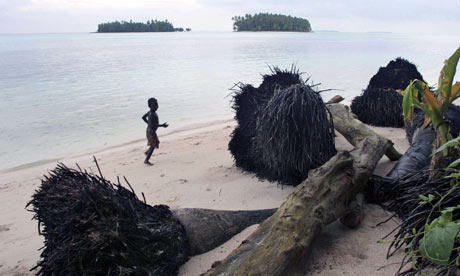
    The first evacuation of an entire community due to manmade global warming is happening on the Carteret Island

    Rising isea levels endangered life on Iolasa island on the Carterets Atoll, Papua New Guinea

    Rising sea levels have eroded much of the coastlines of the low-lying Carteret Islands situated 50 miles from Bougainville Island, in the South Pacific. Photograph: Jeremy Sutton-Hibbert /Greenpeace

    Journalists – they’re never around when you want one. Two weeks ago a momentous event occurred: the beginning of the world’s first evacuation of an entire people as a result of manmade global warming. It has been marked so far by one blog post for the Ecologist and an article in the Solomon Times*. Where is everyone?

    The Carteret Islands are off the coast of Bougainville, which, in turn, is off the coast of Papua New Guinea. They are small coral atolls on which 2,600 people live. Though not for much longer.

    As the Ecologist’s blogger Dan Box witnessed, the first five families have moved to Bougainville to prepare the ground for full evacuation. There are compounding factors – the removal of mangrove forests and some local volcanic activity – but the main problem appears to be rising sea levels. The highest point of the islands is 170cm above the sea. Over the past few years they have been repeatedly inundated by spring tides, wiping out the islanders’ vegetable and fruit gardens, destroying their subsistence and making their lives impossible.

    They are not, as the Daily Mail and the Times predicted, “the world’s first climate-change refugees”. People have been displaced from their homes by natural climate change for tens of thousands of years, and by manmade climate change for millennia (think of the desertification caused in North Africa by Roman grain production).

    Some people ascribe the fighting in Darfur – and the consequent displacement of its people – to climate change, as people struggle over diminishing resources. But this appears to be the first time that an entire people have started leaving their homes as a result of current global warming.

    Their numbers might be small, but this is the event that foreshadows the likely mass displacement of people from coastal cities and low-lying regions as a result of rising sea levels. The disaster has begun, but so far hardly anyone has noticed.

    Monbiot.com

    * thanks to Jon Freeman for alerting me to this story

  • Skilled migration intake to be slashed

    Skilled migration intake to be slashed

    May 9, 2009, 7:08 am

    Australia’s skilled migration intake will be slashed for the second time in the past two months.

    Next week’s federal budget will cut the general skilled migration intake for the next financial year by about 7,000 people to 108,000, Fairfax reports.

    The government’s move follows a decision taken in March to shed 18,500 places.

    The total reduction of 25,000 places will constitute a 20 per cent cut to the program.

    The cuts are the deepest since the previous recession, Fairfax reports.

    The move is expected to go ahead despite figures released this week which show the unemployment rate fell from 5.7 per cent to 5.4 per cent, or 27,000 jobs, last month.

  • Why green leaders backed the carbon plan

    Why green leaders backed the carbon plan 

    Greg Roberts | May 09, 2009

    Article from:  The Australian

    DON Henry was about to set off on a hike through the bush from Victoria’s Great Southern Road last Sunday morning when he got the call.

    A staffer in Penny Wong’s office asked if the Australian Conservation Foundation director could hop on a plane to Canberra for a make-or-break meeting with the Climate Change Minister that evening. Henry was given the bones of a major proposal that would underpin Kevin Rudd’s revamped carbon pollution reduction scheme.

    The bait for the ACF head was that the Rudd Government was prepared to lift its target for the reduction of carbon pollution from 15 per cent below 2000 levels by 2020 to 25 per cent below. During Sunday afternoon, Henry had telephone discussions with ACF president Ian Lowe, a climate scientist, who was at his Sunshine Coast home. The pair agreed the 25 per cent target was an offer too good to refuse.

    Henry turned up for the 6pm meeting in Wong’s Parliament House office. Also present were ACTU president Sharan Burrow and Climate Institute director John Connor. World Wide Fund for Nature chief executive Greg Bourne hooked into the meeting by telephone from Sydney.

    The ACF, WWF and the Climate Institute had joined the ACTU and the Australian Council of Social Service in an alliance — the Southern Cross Climate Coalition — with a common position on emissions trading.

    The Prime Minister and Wong knew it was crucial to win over the moderate environmentalists if their plan was to have credibility. The state conservation councils and large organisations such as Greenpeace and the Wilderness Society were excluded from the negotiations, as were the Greens, because Rudd knew they would not compromise on their demands for much higher emission cuts.

    The climate coalition leaders knew secrecy was paramount. Sharing information even with members of their own organisations was tightly restricted.

    The coalition also knew that, while Wong was trying to woo them, parallel negotiations were under way with the Australian Industry Group and the Business Council of Australia. That increased the pressure on them to strike an agreement.

    Rudd turned up at a crucial point in the meeting and remained for 30 minutes. He told those present he became convinced at the recent G20 summit that a deal would be sealed at Copenhagen this year for a substantial cut in global emissions.

    The Prime Minister insisted the key factor to force change would be a commitment from US President Barack Obama to back proposals for big emission cuts. With a deal at the UN climate change meeting in Copenhagen in December as good as settled, Australia’s 25 per cent cut would be a reality, Rudd said.

    When Wong and Rudd announced the new scheme at 12.40pm on Monday, they were at pains to point out it was backed by the climate coalition members as well as the two industry groups.

    Bourne and ACOSS chief Clare Martin flew to Canberra to join Henry, Burrow and Connor in declaring their support for the plan at a news conference. Henry, aware key conservation groups had been left out of the loop, fired off an email to a who’s who of the environmental movement.

    “In balance, both Ian Lowe and I believe this is a useful step forward along the crucial path of achieving deep cuts in emissions,” Henry said in the email.

    The problem for Henry, which may yet undo the ACF’s support for the plan, is that the 25 per cent target, notwithstanding Rudd’s confidence about Copenhagen, is aspirational in the eyes of critics. The Government’s commitment to reduce emissions remains at its white paper level of 5 per cent.

    The coalition believed it won a concession when Rudd agreed to review financial assistance to affected industries after agreement was struck at Copenhagen, instead of in 2014, as in the legislation. But the legislation shows Wong can review the assistance at any time.

    The Sunday night summit was the culmination of negotiations between Wong and the coalition leaders, who had met four days earlier in Canberra. The outcome is that Rudd has wedged the environment movement, and many conservationists are angry at Henry and Lowe over what they regard as a sell-out.

    Queensland Greens co-ordinator Drew Hutton says the coalition leaders were hoodwinked. “They somehow were convinced the 25 per cent target was solid when it is anything but,” Hutton says.

    Wilderness Society campaign director Lyndon Schneiders says the coalition leaders should have consulted more widely. “We are very disappointed at the position they took,” Schneiders says.

    Henry defends the plan. “This is a significant step forward that puts Australia in the leadership group to argue for an ambitious outcome at Copenhagen.”

    Lowe says the deal is “almost embarrassingly inadequate” but the best that could be achieved. “The main objective was to get an international agreement.”