Author: admin

  • Commerce group calls for brake on emissions trade law

    Commerce group calls for brake on emissions trade law 

    Lenore Taylor, National correspondent | May 08, 2009

    Article from:  The Australian

    THE Australian Chamber of Commerce and Industry has sided with the Coalition to argue that it is premature to pass emissions trading legislation this year, and unnecessary because of the Rudd Government’s proposed delay to the scheme’s start date.

    On Monday Prime Minister Kevin Rudd received strong backing for proposed changes to the scheme from business groups including the Business Council of Australia and the Australian Industry Group, both of which agree with the Government’s contention that the scheme needed to pass the Senate this year in the interests of budget certainty.

    But ACCI, which yesterday announced it was commissioning major research into the impact of the scheme on the small and medium businesses it represented, said there was “no policy or timing reason” for the legislation to be passed this year.

    Opposition leader Malcolm Turnbull has said Australia should not finalise its ETS until after the UN Copenhagen meeting in December.

    “Get the scheme right. Get the design right. There is no need to finalise it in the next five or six weeks. They have not done adequate economic modelling, particularly on the impact on jobs in regional Australia,” he said.

    Climate Change Minister Penny Wong insisted yesterday it was essential for the legislation to be passed before Copenhagen.

    “We need to ensure we give the right signals to investors and we also need to ensure we go to Copenhagen with a scheme to match our targets,” she said.

    The Opposition has also been emphasising the potential costs of the scheme for smaller businesses that will not have to purchase emissions permits, but which will still face higher electricity costs.

    ACCI has commissioned a study from Castalia Strategic Advisors on the impact of the scheme on plastic and chemical manufacturing, food processing and freight and transportation, to be finalised in June.

    A document submitted to the UN this week shows most developed countries that are part of the Kyoto Protocol are in the process of setting a 2020 target for the successor agreement to be negotiated at Copenhagen, but only three have announced a target and only one — the European Union — has legislated one.

    In the US Congressman Mike Doyle, a key Democrat working on proposed emissions trading legislation to reduce emissions by 25 per cent of 2000 levels by 2020, said it was likely in the first 10 or 15 years of the scheme most permits would be given to major industries for free.

    Under the revised Australian laws some of the heaviest emitting industries would get up to 95 per cent of their permits for free. Other industries will initially get almost 70 per cent of their permits for free, but these rates will decline over time.
     

  • China ready for post-Kyoto deal on climate change

    China ready for post-Kyoto deal on climate change

    Dramatic reversal in US position under Obama has brought Beijing to the table on emission cuts, says UK climate secretary


    china emissions

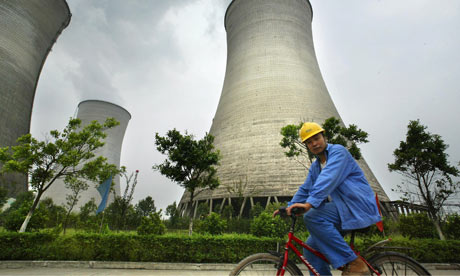
    A worker rides past towers of a coal-fired power plant in Guangan, China. Photograph: Frederic J Brown

    China is ready to abandon its resistance to limits on its carbon emissions and wants to reach an international deal to fight global warming, the Guardian has learned.

    According to Britain’s climate change secretary, Ed Miliband, who met senior officials in Beijing this week, China is ready to “do business” with developed countries to reach an agreement to replace the Kyoto treaty.

    Miliband said he was encouraged by the change in tone since late last year in the country that emits more greenhouse gases than any other. “I think they’re up for a deal. I get the strong impression that they want an agreement,” he told the Guardian.

    “They see the impact of climate change on China and they know the world is moving towards a low-carbon economy and see the business opportunities that will come with that.”

    The shift in the Chinese position significantly improves the chances of an agreement being reached when world leaders meet in Copenhagen in December to negotiate a deal that scientists say is critical if dangerous warming is to be avoided.

    While Britain and the European Union – which have a large historical responsibility for greenhouse gas emissions – are pushing for ambitious reduction targets at home, no global climate deal will be possible in Copenhagen without the agreement of China and the US, which together are responsible for more than 40% of the world’s annual carbon emissions.

    China’s official negotiating position is unchanged, but the government is understood to be preparing a set of targets up to and beyond 2020 to lower the country’s “carbon intensity”. This translates to cutting the emissions needed to produce each unit of economic growth.

    Miliband said Barack Obama’s pledge to reduce US emissions to 1990 levels by 2020 has unblocked the international negotiating process.

    “China used to think the developed world is not serious. That’s what they were saying [at UN talks] in December,” he said. “But now they know the US is on the pitch and ready to engage with them. It has made a real difference to what China is saying.”

    His comments echoed the message from Chinese officials. Su Wei, a senior negotiator, told the Guardian last month that the US had made a “substantive change” under the Obama administration.

    “The message we have got is that the current US administration takes climate change seriously, that it recognises its historical responsibility and that it has the capacity to help developing countries address climate change,” Su said.

    But while the tone may have changed, there is still a long way to go before agreement can be reached on specifics.

    China wants developed nations to commit to more ambitious reduction targets, to share low-carbon technology and to set up a UN fund that would buy related intellectual property rights for use across the world. Beijing’s position is complicated by the fact that it already owns a large share of the patents for wind and solar energy in developed nations.

    Europe and the US accept the Chinese economy should be allowed to grow further, improving the living standards of its millions of poor, before it makes overall emissions reductions. Instead, the western nations are pushing for strong measures to improve efficiency and establish caps for certain industries. One possibility being considered by Chinese officials is to set a carbon intensity goal up to 2040 that would include energy efficiency, renewable energy, transport and afforestation.

    “It would be very welcome for China to set a commitment for carbon intensity,” said Miliband. “It would send a signal around the world.”

    He was visiting Minqin county, a remote area in north-western China threatened by desertification and drought. Along with the melting of the Himalayan glaciers, the spread of deserts and the shortage of water have highlighted the destructive impact of unsustainable development and climate change.

    “We’re very concerned about climate change,” said Xu Wenshan, the deputy mayor of Wuwei, at a welcome banquet. “Living in such an ecologically fragile area, we will feel the impact directly if there is a further rise in the temperature.”

    Jim Watson, of the UK’s Tyndall Centre for Climate Change Research, said it had become the mainstream view in China that global warming was caused by human activity, which was not the view five years ago.

    “We see significant policy shifts and encouraging developments in technology, for example phenomenal development of wind power and plug-in cars. That could be a sign of things to come,” he said. “My impression is that although the negotiators haven’t moved ground officially, there are a hell of a lot of new ideas. They are very interested in low-carbon economy.”

    Last month, the Tyndale centre published research showing that it was possible for China to begin reducing its total emissions from 2020.

    Government officials say that is unrealistic and China has so far resisted announcing a target for when emissions might peak. But the authorities tend towards the later end of the various academic forecasts of between 2020 and 2040.

    Watson noted that if emissions are measured on a historical per-capita basis, China is 78th in the world rather than first.

  • Rees Govt internal battle leaves NSW solar future in the dark

    Rees govt internal battle leaves NSW solar future in the dark
     
    Media Release: 7 May 2009
     
    In Upper House question time today, Energy Minister Ian Macdonald refused to say when he would release the report of the task force on solar feed-in tariffs or when the scheme would start, according to Greens MP John Kaye.
     
    Dr Kaye said: “Late last year Ian Macdonald promised a new tariff to help households become solar electricity generators and to create green jobs.
     
    “A bitter battle that has pitted the Department of Climate Change against Treasury and their allies in the Department of Water and Energy has thrown NSW’s renewable energy future into a state of paralysis.
     
    “The Climate Change Department and its Minister Carmel Tebbutt are pushing for a gross feed-in tariff that pays for all the energy generated by roof-top solar panels.
     
    “They are being bitterly opposed by Treasury, who want to knobble the scheme with a highly ineffective net tariff that pays the premium rate only for the solar energy that is left over after all the household appliance have been powered.
     
    “The Department of Climate change are right to oppose a net tariff that would do nothing to encourage household investment in renewable energy.
     
    “Ian Macdonald dodged my question in the NSW Upper House this afternoon when I asked about the four month delay in the release of the report.
     
    “The best he could say is that there would be an announcement soon.
     
    “According to his media release of 24 November 2008, the report of the taskforce was to be given to the government in January 2009 and the scheme was ‘expected to be implemented  by the middle of [2009]’.
     
    “The report is still secret and the July start date is now unattainable.
     
    “NSW is missing out on thousands of jobs because Premier Nathan Rees has failed to resolve the dispute.
     
    “He should immediately override Treasury and insist on an effective gross feed-in tariff,” Dr Kaye said.

  • Rees Govt’s $16.5 BN ELECTRICITY BILL SQUANDERED ON COAL POWER

    REES GOVT’S $16.5 BN ELECTRICITY BILL SQUANDERED ON COAL POWER

    The $16.5 billion upgrade of NSW’s electricity wires and poles
    approved today by the Australian Energy Regulator will lock the state
    into a coal-powered future. The opportunity to take the state forward
    to smart grids, intelligent load control and embedded clean energy
    sources has been lost. The Rees government has got away with building
    a 1960s electricity superhighway for the coal-fired generators to
    pump their greenhouse-polluting energy into NSW homes

  • Support splits green group

    Support splits green group

    Tom Arup and Adam Morton

    May 6, 2009

    Divisions are emerging in the Australian Conservation Foundation’s board and council over the foundation’s apparent backing of the Government’s emissions trading scheme.

    ACF executive director Don Henry backed the Government’s legislation after changes announced on Monday. The changes include raising the 2020 emissions reduction target range to 25 per cent in the event of strong global agreement, delaying the scheme, and extra help for industry.

    While Mr Henry was at pains yesterday to point out the ACF still had serious reservations about the scheme, other members of the ACF hierarchy were taken aback by Mr Henry’s support for legislation that included the 25 per cent target.

    The Age was told yesterday the ACF’s 40-member council would harden its position against the scheme rather than back it. The board was not informed of the decision to support the legislation.

    Mr Henry said a decision had been made by himself and ACF president Ian Lowe. “We will be having a discussion with the board at the next sitting in a couple of days,” he said.

    Mr Henry said the ACF would continue to campaign for tougher targets. The decision to back the legislation was made because the tough 2020 target would give greater impetus to global climate negotiations.

    Rank-and-file members of the ACF have also expressed anger. Pablo Brait, a 10-year member, quit in protest over the foundation’s support for a policy that scientists warned would not prevent runaway climate change. He knew of others who had taken a similar stance.

    Environment groups including Greenpeace, the Wilderness Society and Friends of the Earth have joined pressure group GetUp in opposing the proposed scheme. The Climate Institute and the WWF support it.

  • Economic recovery unlikely given oil supply

    During May to September 2007 I had plenty of time for reflection and observation. In September 2007 I expressed concern to my family that we could be headed for something nasty and that it could be the big one. Like an idiot I prepared our house for sale when I should have just taken whatever I could get. By January 2008 when I put it on the market it was too late and I didn’t read it.

    In September 2007 I said we had a 50:50 chance that this could be the big one coming – the one that would change things forever. By January 2008 I had upgraded that to a 75% chance. I am still sticking with that, but the odds may be slightly higher.

    By the big one, I mean when the world hits the wall, when scarcity of natural resources governs, not scarcity of money. Growth will no longer be the status quo. It is physically impossible for this to be the case. That means decline is inevitable. It doesn’t mean the end of the world but it does mean a whole new paradigm, particularly in what one invests in.

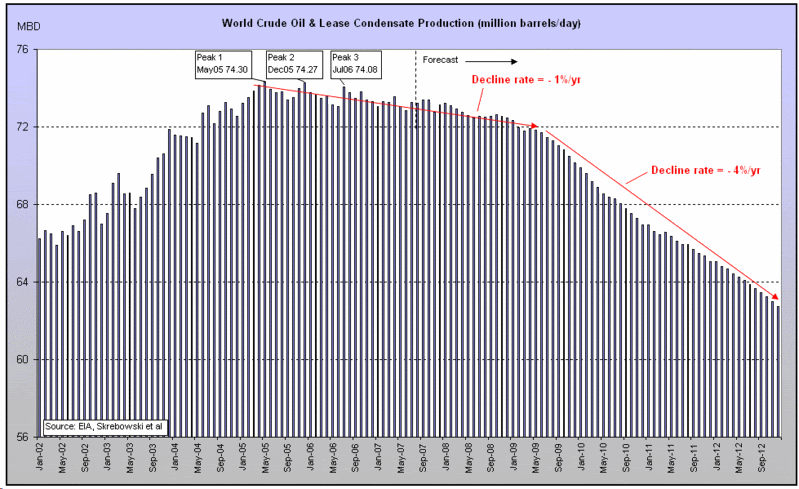
    Total productionIf the attached graph is correct and there is to be an oil slide of 2.9% pa that will probably translate to a decline in GDP of about 1.5% pa. Scary stuff if you are hoping to return to business as usual. Australia is particularly vulnerable because of where it currently competes to buy oil. Nearly all of those countries are already in decline (cf Vietnam, Indonesia). The projected deficit in what we want and what we can get is 55% by 2025.

    The way I see it, the recession could be long enough that it takes us into the next oil shortage which in turn will precipitate a tumbling oil price through catastrophic collapse of demand. A bumpy ride is ahead for sure. No conventional wisdom is going to cope with this. We may even see a change in government breakup. The dichotomy now is supposedly to share the scarce resource of monetary wealth. What if it breaks into how to share the scarce resource of the environment?