Author: admin

  • Europeans shrink from climate commitments

    Read Reuters story on UN Climate Chief comments

    Related story from the UK Guardian.

    By David Brunnstrom and Marcin Grajewski

    BRUSSELS (Reuters) – European Union member states hit by the global economic crisis urged the bloc Thursday not to promise the developing world more money to combat climate change than they can afford.

    The comments could worry organizers of a conference in Copenhagen on finding a successor to the Kyoto protocol against global warming because its success hangs on whether enough money can be found to persuade poor nations to tackle the problem.

    EU member states including Poland, Bulgaria and Hungary fear EU negotiators will commit them to providing more money than they can now afford because of the economic downturn.

    “We should readjust the priorities,” Bulgarian Prime Minister Sergei Stanishev told reporters at a summit at which EU leaders were discussing the climate issue and looming recession.

    “What really concerns EU citizens today is how jobs will be preserved and how we can keep Europe steady in this unprecedented crisis.”

    Polish and Bulgarian officials said they wanted more precise details of how the burden would be shared before the United Nations climate change conference in Copenhagen in December.

    “Obviously the enthusiasm for having economic support for the climate package has not increased during the economic crisis,” said Cecilia Malmstrom, EU affairs minister of Sweden, which will hold the EU presidency during the Copenhagen talks.

    “That is an issue that is of great concern to us.”

    POOR COUNTRIES SEEK HELP

    Poor countries blame industrialized nations for climate change and say they do not do enough to help the poor adapt to its impact, such as by creating drought- or flood-resistant crops, or helping build barriers to rising sea levels.

    “The EU will have to pay the bill for its historical emissions — this means committing to provide at least 30 billion euros per year by 2020 to an international climate fund for developing countries,” said politician Rebecca Harms of the German Green group.

    Polish Prime Minister Donald Tusk told reporters informal discussions had focused on an annual EU contribution of between 20 billion euros and 40 billion.

    He said Warsaw would oppose any attempt to divide that burden up according to countries’ emissions levels — a move that would hurt Poland as it relies on heavily-polluting coal.

    The east European states fear a repeat of their problem last year when the EU committed to cutting carbon dioxide emissions by 20 percent by 2020. They recognized the potential impact on their economies too late to steer the debate.

    Central and eastern Europe countries are trying to stop an evaporation of foreign funds that prompted Hungary and Latvia to seek a lifeline from the International Monetary Fund and contributed to social unrest.

    Some experts see the Copenhagen conference as the last chance to keep global warming in check.

    U.N. climate chief Yvo de Boer this week criticized European finance ministers for not living up to promises made at the launch of the two-year process in Bali in 2007.

    Danish Prime Minister Anders Fogh Rasmussen urged his European counterparts not to put the brakes on funding.

    “I would very much like to see the EU in the driver’s seat. We have to send a clear message that we are going to take on a fair share of the global financial burden,” he said.

    (Additional reporting by Ingrid Melander; Writing by Pete Harrison; Editing by Timothy Heritage)

  • Indians march against Monsanto

    And they have done and are doing a bucket load of things to keep farmers and everyone else from having any access at all to buying, collecting, and saving of NORMAL seeds. 

    1.  They’ve bought up the seed companies across the Midwest.

    2.  They’ve written Monsanto seed laws and gotten legislators to put them through, that make cleaning, collecting and storing of seeds so onerous in terms of fees and paperwork and testing and tracking every variety and being subject to fines, that having normal seed becomes almost impossible (an NAIS approach to wiping out normal seeds). Does your state have such a seed law? Before they existed, farmers just collected the seeds and put them in sacks in the shed and used them the next year, sharing whatever they wished with friends and neighbors, selling some if they wanted. That’s been killed.

    In Illinois, which has such a seed law, Madigan, the Speaker of the House, his staff is Monsanto lobbyists. 

    3.  Monsanto is pushing anti-democracy laws (Vilsack’s brainchild, actually) that remove community’ control over their own counties so farmers and citizens can’t block the planting of GMO crops even if they can contaminate other crops. So if you don’t want a GM-crop that grows industrial chemicals or drugs or a rice growing with human DNA in it, in your area and mixing with your crops, tough luck.

    Check the map of just where the Monsanto/Vilsack laws are and see if your state is still a democracy or is Monsanto’s. A farmer in Illinois told me he heard that Bush had pushed through some regulation that made this true in every state. People need to check on that.

    4.  For sure there are Monsanto regulations buried in the FDA right now that make a farmer’s seed cleaning equipment illegal (another way to leave nothing but GM-seeds) because it’s now considered a “source of seed contamination.” Farmer can still seed clean but the equipment now has to be certified and a farmer said it would require a million to a million and half dollar building and equipment … for EACH line of seed. Seed storage facilities are also listed (another million?) and harvesting and transport equipment. And manure. Something that can contaminate seed. Notice that chemical fertilizers and pesticides are not mentioned.  

    You could eat manure and be okay (a little grossed out but okay). Try that with pesticides and fertilizers. Indian farmers have. Their top choice for how to commit suicide to escape the debt they have been left in is to drink Monsanto pesticides.

    5.  Monsanto is picking off seed cleaners across the Midwest. In Pilot Grove, Missouri, in Indiana (Maurice Parr), and now in southern Illinois (Steve Hixon). And they are using US marshals and state troopers and county police to show up in three cars to serve the poor farmers who had used Hixon as their seed cleaner, telling them that he or their neighbors turned them in, so across that 6 county areas, no one talking to neighbors and people are living in fear and those farming communities are falling apart from the suspicion Monsanto sowed. Hixon’s office got broken into and he thinks someone put a GPS tracking device on his equipment and that’s how Monsanto found between 200-400 customers in very scattered and remote areas, and threatened them all and destroyed his business within 2 days. 

    So, after demanding that seed cleaners somehow be able to tell one seed from another (or be sued to kingdom come) or corrupting legislatures to put in laws about labeling of seeds that are so onerous no one can cope with them, what is Monsanto’s attitude about labeling their own stuff? You guessed it – they’re out there pushing laws against ANY labeling of their own GM-food and animals and of any exports to other countries. Why?   

    We know and they know why. 

    As Norman Braksick, the president of Asgrow Seed Co. (now owned by Monsanto) predicted in the Kansas City Star (3/7/94) seven years ago, “If you put a label on a genetically engineered food, you might as well put a skull and crossbones on it.”  

    And they’ve sued dairy farmers for telling the truth about their milk being rBGH-free, though rBGH is associated with an increased risk of breast, colon and prostate cancers. 

    I just heard that some seed dealers urge farmers to buy the seed under the seed dealer’s name, telling the farmers it helps the dealer get a discount on seed to buy a lot under their own name. Then Monsanto sues the poor farmer for buying their seed without a contract and extorts huge sums from them. 

    Here’s a youtube video that is worth your time. Vandana Shiva is one of the leading anti-Monsanto people in the world. In this video, she says (and this video is old), Monsanto had sued 1500 farmers whose fields had simply been contaminated by GM-crops. Listen to all the ways Monsanto goes after farmers. 

    Do you know the story of Gandhi in India and how the British had salt laws that taxed salt? The British claimed it as theirs. Gandhi had what was called a Salt Satyagraha, in which people were asked to break the laws and march to the sea  and collect the salt without paying the British. A kind of Boston tea party, I guess.  

    Thousands of people marched 240 miles to the ocean where the British were waiting. As people moved forward to collect the salt, the British soldiers clubbed them but the people kept coming. The non-violent protest exposed the British behavior, which was so revolting to the world that it helped end British control in India.   

    Vandana Shiva has started a Seed Satyagraha – nonviolent non-cooperation around seed laws – has gotten millions of farmers to sign a pledge to break those laws.   

    American farmers and cattlemen might appreciate what Gandhi fought for and what Shiva is bringing back and how much it is about what we are all so angry about – loss of basic freedoms. [The highlighting is mine.]


    The Seed Satyagraha is the name for the nonviolent, noncooperative movement that Dr. Shiva has organized to stand against seed monopolies. According to Dr. Shiva, the name was inspired by Gandhi’s famous walk to the Dandi Beach, where he picked up salt and said, “You can’t monopolize this which we need for life.” But it’s not just the noncooperation aspect of the movement that is influenced by Gandhi. The creative side saving seeds, trading seeds, farming without corporate dependence–without their chemicals, without their seed.

    ” All this is talked about in the language that Gandhi left us as a legacy. We work with three key concepts.”

    ” (One) Swadeshi…which means the capacity to do your own thing–produce your own food, produce your own goods….”

    “(Two) Swaraj–to govern yourself. And we fight on three fronts–waterfood, and seed. JalSwaraj is water independence–water freedom and water sovereignty. Anna Swaraj is food freedom, food sovereignty. And Bija Swaraj is seed freedom and seed sovereignty. Swa means self–that which rises from the self and is very, very much a deep notion of freedom. 

    “I believe that these concepts, which are deep, deep, deep in Indian civilization, Gandhi resurrected them to fight for freedom. They are very important for today’s world because so far what we’ve had is centralized state rule, giving way now to centralized corporate control, and we need a third alternate. That third alternate is, in part, citizens being able to tell their state, ‘This is what your function is. This is what your obligations are,’ and being able to have their states act on corporations to say, ‘This is something you cannot do.’”

    ” (Three) Satyagraha, non-cooperation, basically saying, ‘We will do our thing and any law that tries to say that (our freedom) is illegal… we will have to not cooperate with it. We will defend our freedoms to have access to water, access to seed, access to food, access to medicine.’”
  • Maldives tries to avert disaster

    From the UK Guardian

    Nasheed approached British climate change experts Chris Goodall and Mark Lynas to help develop the radical carbon-neutrality plan. The pair worked on a package of measures that could virtually eliminate fossil fuel use on the Maldive archipelago by 2020.

    The plan includes a new renewable electricity generation and transmission infrastructure with 155 large wind turbines, half a square kilometre of rooftop solar panels, and a biomass plant burning coconut husks. Battery banks would provide back-up storage for when neither wind nor solar energy is available.

    The clean electricity would power not only homes and businesses, but also vehicles. Cars and boats with petrol and diesel engines would be gradually replaced by electric versions.

    Goodall, author of Ten Technologies to Save the Planet, led the development of the clean-energy package. He said: “The Maldives could just give up. Its people could declare themselves climate change refugees and ask for sanctuary elsewhere. But the new government is taking a stand and asked us to give them a plan for a near zero-carbon economy.

    “We don’t want to pretend that this plan is going to be easy to implement. There will be hiccups, and electricity supply will occasionally be disrupted. But we think that building a near-zero-carbon Maldives is a realistic challenge. Get it right and we will show the apathetic developed world that action is possible, and at reasonable cost.”

    The Maldives is one of the world’s lowest-lying countries, with 385,000 people living mainly on land less than two metres above sea level. The country would be rendered almost entirely uninhabitable by a rise in sea levels of one metre.

    Lynas said: “The Maldives is in the front line of climate change. It is perhaps the most vulnerable country in the world. If nothing is done to cut global carbon emissions, the country will sink beneath rising seas this century. It is a poor country, but here we have a government that is throwing down the gauntlet to the rich, highly polluting countries.”

    The Maldives plan is not the first national carbon-neutrality target. Norway is aiming to be zero-carbon by 2030. However, the Maldives scheme is more ambitious – not just in terms of its 10-year timetable, but also because it aims to totally decarbonise the local economy. By contrast, the Norwegian scheme allows a large slice of domestic emissions to be offset by investments in forestry schemes overseas.

    The cost for the package of low-carbon measures is estimated to be about $110m a year for 10 years. The scheme should pay for itself quite quickly, because the Maldives will no longer need to import oil products for electricity generation, transport and other functions. If the oil price were to rise to $100 per barrel, the payback period would be as short as 11 years. At current prices, it would take roughly twice as long to break even.

    Nasheed said: “Climate change is a global emergency. The world is in danger of going into cardiac arrest, yet we behave as if we’ve caught a common cold. Today, the Maldives has announced plans to become the world’s most eco-friendly country. I can only hope other nations follow suit.”

  • Marine dead zones expanding rapidly

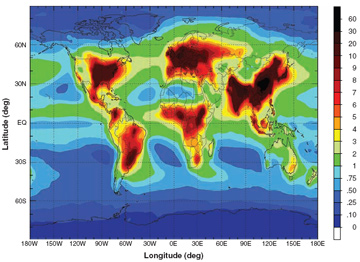
    Dead zones are caused by agricultural runoff, especially nitrogen-rich fertilizers, and the burning of fossil fuels. The pollutants cause marine eutrophication, whereby the ecosystem receives too many nutrients, triggering massive algae blooms, which eventually die and are broken down bacteria. By breaking down the algae the bacteria consume excessive amounts of oxygen, essentially starving the marine system.

     
    Estimated N deposition from global total N (NOy and NHx) emissions, totaling 105 Tg N per year. Image appeared in J.N. Galloway et al (2008). “Transformation of the Nitrogen Cycle: Recent Trends, Questions, and Potential Solutions,” Science 16 May 2008.

    The majority of dead zones are near large populations in wealthy nations. For example, the United States’ east coast is covered with hypoxia sites, as is much of western and northern Europe. Such areas—heavy in industry, fishing, and runoffs from intensive agriculture—spew massive amounts of nutrient-rich pollutants into the sea.

    The authors note that “most of these systems were not hypoxic when first studied, but it appears that from the middle of the past century, the dissolved oxygen concentrations of many coastal ecosystems have been adversely affected by eutrophication.” A number of human-related factors likely caused the sudden explosion of dead zones, but certainly the development in the 1940s of mass-produced fertilizer containing nitrogen is a major culprit.

    Dead zones live up to their name in terms of biomass, the loss of which adds greater strains on already overfished and overexploited oceans. As an example, the researchers note that the Kattegat sea—between Denmark and Sweden—has experienced high levels of fish mortality and a collapse of their lobster industry due to eutrophication. In addition, they estimate that if the entire Baltic Sea recovered from eutrophication it would be one-third to one-half more productive—a boon for Scandinavian fishermen and a reprieve from other fishing areas.


    Global distribution of the 400+ marine systems with dead zones caused by increased eutrophication. Their distribution matches the current human “footprint” in the northern hemisphere. In the southern hemisphere, dead zones have only been reported recently. [Image courtesy of Science/AAAS]
  • Worlds seafood to disappear in 40 years

    From NaturalNews

    The number of “dead zones” in coastal regions around the world continues to rapidly increase, according to a study conducted by researchers from the Virginia Institute of Marine Science and the University of Gothenberg, and published in the journal Science.

    “It’s not sort of a local or regional problem, which is how it was thought of in the past,” researcher Robert Diaz said. “It is actually a global problem.”

    Dead zones are areas where oxygen has become so depleted that little or no marine life is able to survive. They form when excessive plant nutrients, particularly nitrogen and phosphorus, run off from the coast and lead to an explosion of algae blooms. When this vastly increased biomass dies and sinks to the bottom, its decomposition leads to the proliferation of oxygen-consuming bacteria.

    In some cases, this may lead to increased crowding pressure in other parts of the ocean.

    “Fish are the best at avoiding dead zones,” Diaz says. “When the oxygen starts to decline, they’re smart – they leave, they don’t hang around. Crabs and shrimp are pretty good at getting away, too, as are lobsters.”

    Many slower moving animals such as clams, worms and small crustaceans, however, simply die.

    In the current study, researchers found that the number of dead zones has steadily increased from 39 at the end of the 1960s through 63 at the end of the 1970s, 132 at the end of the 1980s and 301 at the end of the 1990s to the current number of 405. The total area consumed by dead zones now measures no less than 95,000 square miles.

    The major sources of the pollutants that produce dead zones are fertilizer runoff from industrial agriculture and nitrogen-based byproducts of fossil fuel use.

    “Most of it is agricultural-based, but there is a lot of industrial nitrogen in there, too, if you consider electric generation,” Diaz said.

    Dead zones now function as one of the primary stresses on marine biodiversity, along with overfishing and habitat loss.

  • Pharma ships bird flu to Europe


    The Australian Vaccination Network press release

    Could this be the start of the Bird Flu epidemic?

    It could be the plot line for a Hollywood thriller – shades of I Am Legend. But recently-released information showing that the influenza vaccine produced by Baxter International Inc was ‘unintentionally’ contaminated with live H5N1 avian influenza virus has shocked the medical world and caused panic in the European nations where the vaccine was distributed and administered.

    Interestingly, Baxter has been awarded contracts by several nations around the world to develop an Avian influenza vaccine. This ‘error’ on their part could be the means by which an epidemic of this fatal form of influenza begins in the community.

    This is just one more piece of evidence to show that vaccine manufacturers do not maintain strict controls over their production processes or facilities.

    On May 1, 2008, the FDA (Food and Drug Administration) cited Merck & Co.  for contamination at their plant which produces the Gardasil vaccine – a vaccine which is credited with causing 17 serious reactions a week in Australian girls who receive it.

    The letter which the FDA wrote to Merck in regards to their plant inspection, describes “significant deviations from current good manufacturing practice (CGMP)” and described a failure to “…assure that drug products conform to appropriate standards of identity, strength, quality, and purity.”

    In addition to the Gardasil vaccine, this plant produces Liquid PedvaxHIB®, RECOMBIVAX HB®, ProQuad®, Gardasil®, VAQTA®, and COMVAX®. Merck is also the manufacturer of the MMR (Measles, Mumps and Rubella) vaccination which we currently use in Australia.

    “The government, medical community, and the pharmaceutical companies all have a duty of care to ensure that the vaccines we are administering to our children are as safe and pure as they possibly can be. It is obvious that this duty of care is not being taken seriously. The AVN demands more transparency regarding the vaccine production process and inclusion of representatives of our organisation on the government committees that oversee these processes.” says Meryl Dorey, President of the Australian Vaccination Network.