Author: admin

  • Massachusetts aims for 10 percent wind power


    by Carl Levesque, AWEA – RenewableEnergyWorld.com

    Providing further support to a package of previously passed legislation impacting renewables development, Massachusetts Governor Deval Patrick set a goal of developing 2,000 megawatts (MW) of wind power capacity by 2020.

    “With the growing interest in wind turbines we see in communities across the Commonwealth of Massachusetts and the abundant wind resource we have off our coast, wind power is going to be a centerpiece of the clean energy economy we are creating for Massachusetts,” said Patrick.

    Massachusetts has been selected by the U.S. Department of Energy for one of just two Wind Technology Testing Centers in the country.


  • Farmers ‘gutted’ by reef damage claims

    A MASSIVE surge of polluted water has spewed onto the Great Barrier Reef following heavy rains that hit north Queensland last week, environmentalists say.

    WWF reef spokesman Nick Heath has called for tougher regulations on farm chemicals following the flow of polluted runoff.

    “When big weather systems blow through the area, a lethal chemical cocktail of farm pesticides, nutrients and sediment gushes on to the reef from Queensland’s many rivers,” the WWF said.

    The WWF estimated up to one million megalitres – enough polluted water to twice fill Sydney Harbour – entered the reef after a monsoon brought drenching rain to north Queensland.

    Mr Heath said satellite imagery confirmed water flows travelled to mid-shelf reefs, causing algal blooms.

    “If we are to give our iconic reef the best chance of withstanding climate change, we must ensure its water quality is as clean as possible,” Mr Heath said. “It is astounding what we are allowing to happen to the reef.”

    Premier Anna Bligh last year flagged farming regulation and penalties after years of voluntary efforts to help save the reef had not worked.

    The announcement was unpopular with farmers but Ms Bligh said the reef would die if nothing was done.

    A recent study showed more than 6.5 million tonnes of sediment was discharged into the reef in 2007 – four times higher than estimated pre-European settlement levels.

    It’s estimated the reef injects $6 billion into the tourism economy each year and provides about 65,000 jobs

  • Melting glaciers start countdown to climate chaos

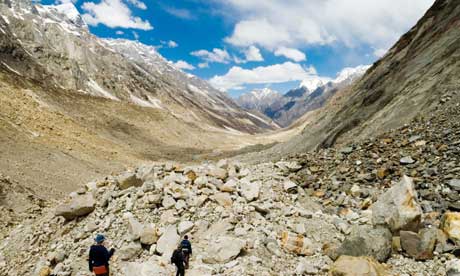
    Trekkers crossing Gangotri glacier in Indian Haimalayas

    Trekkers crossing Gangotri glacier in Indian Himalayas. Photograph: Alamy

    For centuries, writers, painters and photographers have been drawn to the wild and seemingly indestructible beauty of glaciers. More practically, they are a vital part of the planet’s system for collecting, storing and delivering the fresh water that billions of people depend on for washing, drinking, agriculture and power. Now these once indomitable monuments are disappearing. And as they retreat, glacial lakes will burst, debris and ice will fall in avalanches, rivers will flood and then dry up, and sea levels will rise even further, say the climate experts. Communities will be deprived of essential water, crops will be ruined and power stations which rely on river flows paralysed.

    As a result, people will have to change their lifestyles, their farming, even move their homes, says Achim Steiner, executive director of the United Nations Environment Programme (UNEP). He also fears the problem could exacerbate tensions over inadequate supplies between neighbouring states and countries, possibly spilling over into conflict.

    ‘We’re talking about a major transformation, from household livelihood to big industries,’ says Steiner. ‘While I’m always cautious about “water wars”, certainly the potential for water to become a trigger for more tension and, where there’s already conflict, to exacerbate conflict is another issue that’s not hypothetical.’

    The scale of the problem so alarms Lester Brown, a leading environmental thinker, that he fears huge populations dependent on glacier-fed rivers in Asia – 360 million on the Ganges in India and 388 million on the Yangtze in China alone – will not be able to feed themselves, with devastating effect on already rising global food prices.

    ‘These populations are larger than the populations of any other country in the world,’ said Brown. ‘We know from models there will be shifts in rainfall, crop yields reducing, but these are theoretical. Here there’s a degree of certainty we’ve not seen before in terms of an historically negative effect on food security.’

    Glaciers act like gigantic water towers: snow falls on the top in wet seasons, where it freezes and compacts over years, while melting water at the bottom is released gradually, keeping rivers flowing even in the hottest weather. ‘Glaciers are like a bank,’ says Professor Wilfried Haeberli, director of the World Glacier Monitoring Service. ‘You have income – mainly snow – and you have expenditure – mainly melting: the difference between snowfall and melting is the yearly balance.’

    Since at least 1980 the service has kept a constant record of this net gain or loss in mass balance of 30 ‘reference’ glaciers in nine mountain ranges around the world. It has also used travellers’ diaries, photographs, and the clues left on landscapes scarred by the moving mass of ice and debris to map historic growth and the gradual decline of glaciers since the mid-19th century.

    From 1850 to 1970, the team estimates net losses averaged about 30cm a year; between 1970 to 2000 they rose to 60-90cm a year; and since 2000 the average has been more than one metre a year. Last year the total net loss was the biggest ever, 1.3m, and only one glacier became larger. Worldwide, the vast majority of the planet’s 160,000 glaciers are receding, ‘at least’ as much as this, says Haeberli, probably more – a claim supported by evidence from around the world.

    In North America, Dr Bruce Molina of the US Geological Survey says that in Alaska ’99-plus per cent of glaciers are retreating or stagnating’.

    In the European Alps, a report last year by UNEP said glaciers declined, from a peak in the 1850s, by 35 per cent by 1970 and by 50 per cent by 2000, and lost 5-10 per cent in the mega-hot year of 2003 alone.

    UNEP has also reported declines in the last 50-150 years of 1.3 per cent in the Arctic islands to 50 per cent in the North Caucasus in Russia, 25-50 per cent in central Asia, a 2km retreat of the massive Gangotri glacier which feeds the Ganges, 49 to 61 per cent in New Zealand, and 80 per cent in the high mountains of southern Africa. There is also ‘considerable’ shrinking of medium and small glaciers in central Chile and Argentina accompanied by ‘drastic retreat’ of glaciers in Patagonia to the south.

    The only region where glaciers are advancing is Scandinavia, where climate change has increased precipitation to more than compensate for higher melting, and even there the growth has stagnated, says Haeberli.

    Based on the forecast increase in global temperatures this century, the UNEP report warned of ‘deglaciation of large parts of many mountain regions in the coming decades’. Perhaps most shockingly, it predicted two-thirds of China’s glaciers would disappear by 2050, and ‘almost all would be gone by 2100’.

    Ironically, the immediate local threat is that more meltwater will combine with rains to cause floods – a problem already suspected in parts of China, says Molina: ‘Some large floods have destroyed their infrastructure, taking out bridges, roads and villages. Another threat is that meltwater will collect in glacial lakes until they burst. In the Himalayas, UNEP says some lakes have grown 800 per cent since the 1970s.

    Longer term, though, the problem is less water, as even fast-melting glaciers are too small to keep rivers flowing during dry seasons. To make matters worse, freshwater supplies are also threatened by evaporation in warmer temperatures, pollution and growing demand from a rising and more affluent population. And – like glaciers – snow and thus snowmelt is also declining in the same areas.

    This would have an immediate effect on people who depend on rivers for washing and drinking, irrigating crops, powering hydroelectric stations, transport and – often – religious and cultural traditions. Further afield, drying rivers would no longer be able to recharge groundwater tables used by cities.

    The problem is perhaps most acute in Asia, where glaciers are an important source for nine major rivers which run through land occupied by 2.4 billion people. In Pakistan, for example, 80 per cent of agricultural land is irrigated by the Indus, which the WWF last year highlighted as one of the world’s 10 big at-risk rivers because retreating glaciers provide 70-80 per cent of its flow.

    On a global level, scientists warn that melting glaciers are contributing more than ever to rising sea levels: expansion of warmer water is estimated to cause two-thirds of the problem, but melting glaciers and icecaps are the second biggest contributor. A recent paper published by Science calculated acceleration of glacier melt could add 0.1-0.25m to sea-level rise by 2100.

    Globally there are also concerns that water and food shortages will force more people to flee: just last week the European Commission predicted climate change would be a ‘major driver’ for ‘millions’ of environmental migrants within a decade.

    Experts are calling on political leaders to step up attempts to cut greenhouse gas emissions to slow and eventually stop global warming. Before then, however, they say governments need to do much more to encourage water efficiency, change to less water-thirsty crops and build flood protection and storage where possible. ‘It’s not a reason to sit back and say “it’s all too late”,’ insists Steiner.

  • Jakarta in danger from Climate Chaos


    Of all cities in Southeast Asia, Jakarta is the most vulnerable to the impacts of climate change, a study reveals.

    The Singapore-based Economy and Environment Program for South east Asia (EEPSEA) ranked Central, North and West Jakarta at the top of a list of administrative regions prone to climate change, followed by Mondol Kiri province in Cambodia and East Jakarta.

    The report, prepared by economists Arief Anshory Yusuf and Herminia A. Francisco, reveals Jakarta is vulnerable to all types of climate-change related disasters except for tropical storms.

    “It is frequently exposed to regular flooding but most importantly, it is highly sensitive because it is among the most densely-populated regions in Southeast Asia,” said the report released Wednesday.

    Arief is an environmental economist at Padjadjaran University in Bandung.

    The EEPSEA assessed Jakarta’s history of exposure to five types of natural disaster —floods, landslides, drought, sea-level change and tropical storms — in the period from 1980 to 2000, along with those of 530 other areas in Southeast Asia.

    The results were drawn up by considering each area’s exposure to disasters and its ability to adapt to such threats, and comparing those findings with the vulnerability assessment framework of the United Nations’ Intergovernmental Panel on Climate Change.

    Other vulnerable areas in Indonesia include West Sumatra and South Sumatra, the study says.
    The study also reveals that all regions in the Philippines, Vietnam’s Mekong River Delta, Cambodia, North and East Laos and Bangkok are vulnerable.

    “The Philippines, unlike other countries in Southeast Asia, is not only exposed to tropical cyclones, but also many other climate-related hazards; especially floods, landslides and droughts,” it said.

    In Malaysia, the most vulnerable areas are the states of Kelantan and Sabah.

    Thailand and Malaysia are the most capable of adapting to the impacts of climate change, according to the report.

    “Overall, the areas with relatively high adaptive capacities are in Thailand, Malaysia and Vietnam whereas areas with relatively low adaptive capacities are mostly in Cambodia and Laos,” the EEPSEA said.

    The EEPSEA was established in 1993 to support research and training in environmental and economics studies. It is supported by the International Development Research Center, the Swedish International Development Cooperation Agency and the Canadian International Development Agency.

    A study by the State Ministry for the Environment revealed earlier that flooding, combined with a rise in the level of the sea could permanently inundate parts of Greater Jakarta, including Soekarno-Hatta International Airport.

    International activists have branded Indonesia the world’s third biggest polluter after the United States and China, mostly due to widespread forest fires.

    Developing nations, including Indonesia, have repeatedly called on rich nations to provide financial assistance to enable them to adapt to the impacts of climate change.

  • Shark victim philosophical

    According to Dr Stephen Wroe from the University of New South Wales, these are exploratory nibbles by the great white pointer, which uses its mouth to sense whether a prey is worth eating. Interviewed by The Generator last year, Dr Wroe said the great white has two rows of very sharp teeth and an exploratory nibble usually means a large tear, often down to the bone.

    The great white is one of only three breeds that attack people in Australia. It is a cold water animal, more prevalent here during winter, that bites but does not eat people. The bull shark is a warm water dweller that breeds in estuaries where it is difficult to see. The tiger shark is a tropical animal that visits the local surf during summer. Bull sharks and tiger sharks do eat people.

    The last fatal shark attacks in Northern NSW took place in 1992 and 1983. Swimmers have a much greater chance of dying in a car accident on the way to the beach, or of drowning than they do of being killed by marine life.

    Drowning and car crashes, though, are our fault and seem relatively benign. Being eaten, in contrast, makes us seem small and vulnerable. It challenges our egotistical view that the world is our oyster. That’s why it is so important to hear the victims acknowledging the rights of the shark.

    Our fear of predators, and our own predation, mean that we eliminate competition from other animals everywhere we go. It took humanity around 5,000 years to walk from the tip of Alaska to the tip of Chile as we migrated out of Asia. The fossil record reveals that around 2,000 years after humans arrive, large animals such as mammoths, giant bears, bison and anteaters vanish. The populations of mice, rats and indian mynahs, however, flourish.

    The American fossil record reveals the damage done by stone age humans. Steel age Australians have eliminated thousands of species in two short centuries. If we continue the trend, we will find ourselves in a Blade Runner world where the only animals are animatronic and our only companions are the algae that feed us and the pests that live on our scraps.

    In case you think this is fantastic, consider that that latest fad in biofuels is algae. These microscopic plants can absorb carbon dioxide and sunshine to produce fuel or food, faster than land plants.

    We do not have to worry about oil depletion, shrinking water supplies and the consequent food shortages, we can simply live on synthetic food and energy with our pet rats, cockroaches and mynahs.

    That’s something to look forward to.

    Listen to the Generator interviews with Shark experts

    Hear about the mechanics of shark bite
    Rosy talks to Valerie Taylor


    Read shark news on The Generator

    NBA Star speaks out for Sharks
    Insects on the menu as food costs soar
    Longline fishing reintroduced in California
    Sydney desal plant’s giant “vacuum cleaner” poses risks to sealife
    Aussie sharks particularly sensitive

    Sharkwater premiere a sellout success
    Garrett saves shark habitat
    Deep sea pollution becomes critical

  • Lake Eyre gets another drink

    From the ABC

    The Queensland weather bureau says water might start flowing into Lake Eyre in South Australia’s far north for the first time in eight years.

    Water from the recent floods in Queensland is starting to make its way down the Georgina and Diamantina rivers towards the lake.

    The bureau’s hydrology manager Peter Baddiley says there is still plenty of time left in the wet season, so even more water could reach the system.

    “We’ve got two or three months to run on our wet season but really these floods that have started up in the start of January and are running down our channel country now are the first pulse of the season,” he said.

    “But there’s not a lot of volume in it.

    “Future rain over the next couple of months would certainly increase the chance of water arriving into Lake Eyre in more significant quantity.”