Author: admin

  • Coastal erosion management in NSW

    Coastal erosion management in NSW

    Introduction

    Erosion at Collaroy

    Coastal communities and local councils are facing difficult issues associated with coastal erosion along the NSW coastline. This issue is not new: records show coastal properties being affected by coastal erosion dating back to the 1940s.

    NSW has an established framework for managing coastal erosion risks through the NSW Coastal Policyexternal link, the Coastal Protection Act 1979 and the Coastal Protection Regulation 2011. This framework involves local councils, with financial and technical support from the State, undertaking coastal hazard studies and developing coastal zone management plans which then inform land-use planning, development controls and coastal activities. These plans should contain a range of suitable management strategies to inform the community about how coastal erosion will be dealt with in their communities.

    Coastal erosion management by local councils

    In addition to preparing coastal zone management plans, local councils can carry out activities to reduce the impacts of coastal erosion on property and infrastructure. These activities may include dune restoration, beach nourishment and constructing protection works such as seawalls and groynes.

    Under the Infrastructure State Environmental Planning Policy (SEPP)external link, councils need to refer coastal protection works proposals to the NSW Coastal Panel.

    Councils may also levy a coastal protection service charge on land where the current or past landowners have voluntarily constructed coastal protection works. This charge covers council costs for maintaining the works and restoring the beach if the works cause erosion and must be levied in accordance with adopted guidelines.

    Coastal erosion management by private landowners

    Landowners in specific locations can place sand or sandbags on the beach under strict conditions as emergency coastal protection works to reduce the impact of coastal erosion on their property during small storm events. If the bags cause erosion they are to be removed.

    Note: the NSW Government intends to revise the arrangements for emergency coastal protection works under its stage one coastal management reforms.

    Private landowners may also lodge a development application for other coastal protection works. Under the Infrastructure SEPPexternal link, the NSW Coastal Panel is the consent authority for long-term coastal protection works where the council does not have a coastal zone management plan in place – where a plan is in place, council is the consent authority.

    Coastal management reforms

    The NSW Government announced (120908MediaRelCoastMgt.pdf, 109kb) its stage one coastal management reforms on 8 September 2012.

    Page last updated: 11 September 2012
  • Sea ice reduction at tipping point

    Sea ice reduction at tipping point

    Date
    September 23, 2012
    Steadily shrinking ... Greenland experienced melting across 97% of its surface in June and July this year.

    Steadily shrinking … Greenland experienced melting across 97% of its surface in June and July this year. Photo: Reuters

    AS ARCTIC sea ice hits a record low, scientific focus is turning to climate ”tipping points” – a threshold that, once crossed, cannot be reversed and will create fundamental changes to other areas.

    ”It’s a trigger that leads to more warming at a regional level but also leads to flow-on effects through other systems,” Will Steffen, the chief adviser on global warming science to Australia’s Climate Commission, said.

    There are about 14 known ”tipping elements”, according to a paper published by the US Proceedings of the National Academy of Sciences.

    In the case of the Arctic ice cap, less ice means less white surface to reflect heat and more dark water to soak it up. This leads to higher temperatures, which scientists say will unlock more ancient greenhouse gases frozen into ocean depths and permafrost, speeding climate change, interfering with ocean currents, rainfall patterns and weather.

    Advertisement

    Next to the Arctic ice cap, Greenland experienced melting across 97 per cent of its surface in June and July. It is unclear what the tipping point is for the melting of the Greenland ice sheet. Melts similar to this year’s seem to occur every century or so. What is known is that if temperatures keep rising as they are, the ice sheet will start to disintegrate on a massive scale some time in the second half of this century.

    Tentative estimates from Australian and international studies say that another 1.5 degrees of warming would push Greenland across the threshold into irreversible melt, a process that would continue for centuries. There is enough ice in Greenland alone to raise sea levels off NSW and Victoria by four to nine metres.

    Frozen methane trapped in pockets around the Arctic circle is also seen as a critical tipping element. Methane is a potent greenhouse gas, and as frozen earth thaws, more is leaking out. There are no exact measurements on the rate of leakage. Rough estimates suggest 30 to 60 billion tonnes of methane may leak by 2070.

    Other potential tipping elements include monsoon patterns and the El Nino-Southern Oscillation cycle, which scientists expect will start to shift quite suddenly in response to global warming.

    Changes in tree cover, especially in giant forests like the Amazon, are also expected in response to changing rainfall and more heat – and this would have the effect of amplifying global warming because fewer trees would mean less carbon dioxide was being soaked up out of the air.

    As the polar ice cap shrivelled at unforeseen speed, Professor Steffen said he had changed his mind about the Arctic tipping point in past weeks. Existing predictions of an ice-free North Pole by 2050 were looking hopelessly wrong. ”I would say that, certainly, it is looking like 2050 would be an outlier now – I’m pretty certain that we have now passed the tipping point for Arctic sea ice,” he said.

    Sea ice reached a minimum size of 3.41 million square kilometres, down from an average of 7.4 million in the 1980s, 6.8 million in the 1990s and 5.7 million last decade. Professor Steffen believes ”the most radical projection is about 2016, and probably the most conservative projection is about 2030, for when it will be ice free”.

    The speed of events is why scientists are so worried. The only known way to stop these thresholds being crossed is to cut greenhouse emissions triggering these changes, and there are few signs of that occurring.

    ”This is absolutely the critical decade for action,” climate expert Tim Flannery said this week.

    Read more: http://www.smh.com.au/environment/climate-change/sea-ice-reduction-at-tipping-point-20120922-26dm6.html#ixzz27GI6cENo

  • A planetary emergency

    A planetary emergency

    I’ve been calling that “in the pipeline” — as in, “we have .8°C warming now, and another .8°C is in the pipeline, inevitable.” The following illustrates this perfectly:

    Another result is the likely release of large amounts of methane — a greenhouse gas — trapped in the permafrost under Greenland’s ice cap, the remains of the region’s organic plant and animal life that were trapped in sediment and later covered by ice sheets in the last Ice Age.

    And finally, hello methane, and a fact you may want to stash away:

    Methane is 25 times more efficient at trapping solar heat than carbon dioxide, and the released gases could in turn add to global warming, which in turn would free up more locked-up carbon.

    And that’s your global climate report for today. Still to come — a review of our five-pronged approach to a solution and a preliminary to-do list.

    Full commentary here.

  • More on Arctic methane—Vast kilometer-wide methane “plumes” seen in Arctic ocean as sea ice retreats

    Saturday, September 22, 2012

    More on Arctic methane—Vast kilometer-wide methane “plumes” seen in Arctic ocean as sea ice retreats

    | Reddit | Tumblr | Digg | FARK

    Via commenter eggroll_jr, in response to this post —

    — we find this article about the appearance of “methane plumes” now rising through the newly warmed Arctic ocean.

    From The Independent last December:

    Vast methane ‘plumes’ seen in Arctic ocean as sea ice retreats

    Dramatic and unprecedented plumes of methane – a greenhouse gas 20 times more potent than carbon dioxide – have been seen bubbling to the surface of the Arctic Ocean by scientists undertaking an extensive survey of the region.

    The scale and volume of the methane release has astonished the head of the Russian research team who has been surveying the seabed of the East Siberian Arctic Shelf off northern Russia for nearly 20 years.

    We talked about methane here (scroll down) in reference to the methane trapped in Greenland permafrost and sealed from the atmosphere by now-disappearing ice sheets.

    This story is about methane shooting up through the Arctic ocean itself in vast torch-like plumes and headed straight for the surface and the atmosphere.

    The scale of the phenomenon — as usual — is the big surprise:

    “Earlier we found torch-like structures like this but they were only tens of metres in diameter. This is the first time that we’ve found continuous, powerful and impressive seeping structures more than 1,000 metres in diameter. It’s amazing,” Dr Semiletov said.

    “I was most impressed by the sheer scale and the high density of the plumes. Over a relatively small area we found more than 100, but over a wider area there should be thousands of them,” he said.

    One thousand meters is a kilometer, folks — more than half a mile. These are high-density methane columns, compressed tight by the high pressure of the ocean itself, many wider than a kilometer. And they think there are thousands of them.

    Add methane from the ocean depths, methane from the Greenland permafrost, and methane from the Siberian permafrost to the air, and we have unleashed a monster.

    How big a monster? This big:

    Scientists estimate that there are hundreds of millions of tons of methane gas locked away beneath the Arctic permafrost, which extends from the mainland into the seabed of the relatively shallow sea of the East Siberian Arctic Shelf.

    And this big:

    The total amount of methane stored beneath the Arctic is calculated to be greater than the overall quantity of carbon locked up in global coal reserves[.]

    I want to send you to the article for the rest; it’s fascinating in a data-rich way.

    There’s even a discussion about why methane is so dangerous, and why those estimates of its effect relative to CO2 move around — from 20 to 25 times more damaging — depending on who provides them.

    Time to get cracking. My personal climate estimate, 2022, may sadly be on target [EDIT: or way to optimistic]. The next post will focus on solutions. Stay tuned.

    GP

    To follow or send links: @Gaius_Publius

  • How will climate change affect food production?

    How will climate change affect food production?

    This Q&A is part of the Guardian’s ultimate climate change FAQ

    See all questions and answers
    Read about the project

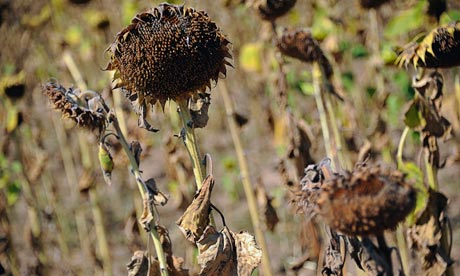
    Drought and food price : Dried sunflowers near the village of Kondofri, Bulgaria

    Dried sunflowers in a village near Sofia, Bulgaria. Heatwaves in Europe, some as hot as 40C, have ruined the harvest in many regions of the country. Photograph: Vassil Donev/EPA

    Food is one of society’s key sensitivities to climate. A year of not enough or too much rainfall, a hot spell or cold snap at the wrong time, or extremes, like flooding and storms, can have a significant effect on local crop yields and livestock production. While modern farming technologies and techniques have helped to reduce this vulnerability and boost production, the impact of recent droughts in the USA, China and Russia on global cereal production highlight a glaring potential future vulnerability.

    There is some evidence that climate change is already having a measurable affect on the quality and quantity of food produced globally. But this is small when compared with the significant increase in global food production that has been achieved over the past few decades. Isolating the influence of climatic change from all the other trends is difficult, but one recent Stanford University study found that increases in global production of maize and wheat since 1980 would have been about 5% higher were it not for climate change.

    All else being equal, rising carbon dioxide concentrations – the main driver of climate change – could increase production of some crops, such as rice, soybean and wheat. However, the changing climate would affect the length and quality of the growing season and farmers could experience increasing damage to their crops, caused by a rising intensity of droughts, flooding or fires.

    The latest IPCC report predicted improving conditions for food production in the mid to high latitudes over the next few decades, including in the northern USA, Canada, northern Europe and Russia. Conversely, parts of the subtropics, such as the Mediterranean region and parts of Australia, and the low latitudes, could experience declining conditions. For example, across Africa, yields from rain-fed agriculture could decline by as much as 50% by 2020. Beyond this, if global temperatures rise by more than about 1–3°C, declining conditions could be experienced over a much larger area.

    The future course of global food production will depend on how well societies can adapt to such climatic changes, as well as the influence of other pressures, such as the competition for land from biofuel production. The IPCC concluded that in the poorer, low-latitude countries, climate change could seriously challenge the capacity to adapt for a warming of more than 3°C. The richer, higher latitude countries are likely to have a greater capacity to adapt and exploit changing climatic conditions.

    But we can’t ignore the potential for “surprises” down the line. There are many uncertainties in such predictions. The world has not seen such changes in climate for millennia, and so it is impossible to know how our agricultural systems will react in the real world. For example, the complex interlinkages with the impacts of climate change on pests, diseases and pollinators, like bees, are largely unknown. Also, climate models have difficulty in accurately predicting the detailed local environmental changes that are important for food production, particularly weather extremes.

    A looming vulnerability is the world’s fisheries, which provide an important source of protein for at least half the world’s population. Fisheries are already stressed by overexploitation and pollution. Warming surface waters in the oceans, rivers and lakes, as well as sea level rise and melting ice, will adversely affect many fish species. Some marine fish species are already adapting by migrating to the high latitudes, but others, such as Arctic and freshwater species, have nowhere to go. The absorption of carbon dioxide emissions by the oceans also has a direct impact on marine ecosystems through ocean acidification.

    But what does this mean for food security – the price and availability of food for the world’s seven billion people? A 2011 Foresight report concluded that climate change is a relatively small factor here, at least in the short term, when compared with the rapid increases in global food demand expected in the next decade. On current projections, by 2050 there will be between one and three billion additional mouths to feed. As people become wealthier, they also demand more food and disproportionally more meat, which requires far more land and water resources per calorie consumed. When these factors are combined, it points toward a future of increasing and more volatile food prices.

    As was seen during the 2007–08 food price spikes, the poorest countries and communities will be hit first and hardest. The Foresight report concluded that international policy has an important role to play here – today, despite plentiful supplies of food globally, almost one billion people are undernourished.

    Finally, food production itself is a significant emitter of greenhouse gases, as well as a cause of environmental degradation in many parts of the world. Agriculture contributes about 15% of all emissions, on a par with transport. When land conversion and the wider food system are taken into account the total contribution of food may be as high as 30%. This means that to limit the long-run impacts of climate change, food production must become not only more resilient to climate but also more sustainable and low-carbon itself.

    • This article was written by Nicola Ranger of the Grantham Research Institute on Climate Change and the Environment at LSE in collaboration with the Guardian

    The ultimate climate change FAQ

    • This answer last updated: 10.07.12
    Read about the project and suggest a question
    Report an error in this answer

    Related questions
    What is the economic cost of climate change?
    What is the Stern review?

  • Four-degree rise demands 90-degree rethink

    Four-degree rise demands 90-degree rethink

    Date
    September 22, 2012
    • 2 reading now
    • 1
    Lost since 1979 ... about 80 per cent of summer sea-ice.

    Lost since 1979 … about 80 per cent of summer sea-ice. Photo: Nick Cobbing

    Climate change has moved into a new and dangerous phase. The Arctic has been warming two to three times faster than the rest of the world.

    In the past few weeks, melting of the Arctic sea ice has accelerated dramatically, reducing the area and volume to levels never previously experienced. About 80 per cent of the summer sea-ice has been lost since 1979; on current trends the Arctic will be ice-free in summer by 2015 and ice-free all year by 2030 – events that were not expected to occur for another 100 years. More concerning, the Greenland ice sheet this year has had unprecedented melting, adding to a trend that will substantially increase sea levels.

    Beyond the Arctic, the world is in the fifth year of a severe food crisis – largely climate change driven – that is about to become far worse as the full impact of extreme drought in the US food bowl works its way through the global food chain, leading to price rises from which Australia will not be immune. Drought around the Mediterranean contributed to this and has played a big part in triggering the Arab Spring. Globally, the escalation of extreme weather continues.

    Science is clearly linking these events to climate change, with human carbon emissions as the prime cause.

    Advertisement

    The polar icecaps are one of the vital regulators of global climate; if the ice disappears, the absorption of more solar radiation accelerates ocean warming, with increasing risk of large-scale release of carbon dioxide and methane from melting permafrost. This may initiate irreversible runaway warming.

    Global energy, food and water security are also poised on a knife edge. These changes are occurring at the 0.8 degrees increase, relative to pre-industrial conditions already experienced, let alone the extra 1.2 degrees that probably will result from our historic emissions.

    The “official” target of limiting temperature increase to no more than 2 degrees is way too high. Current policies, such as our Clean Energy Future package, are far worse and would result in a 4 degrees-plus temperature rise. Official panaceas, such as carbon capture and storage, are not working.

    Australian leaders glibly talk about adapting to a 4-degree world with little idea of what it means – which is a world of 1 billion people rather than the present 7 billion.

    We know how to establish a genuine low-carbon economy, which would stave off the worst impacts of climate change, but it is too late for gradual implementation. It has to be set up at emergency speed.

    Yet we hear nothing of this from the political, business or NGO institutions that should be leading the response. Why? Financial incentives are the main culprit, in particular the bonus culture that has spread through Australian business since the early 1990s.

    The damage caused by this culture threatens the very foundations of democratic society. Few directors or executives are prepared to give serious attention to long-term issues such as climate change when their rewards are based almost entirely on short-term performance.

    Many privately agree that climate change needs far more urgent action, but few are prepared to speak out for fear of derailing “business as usual”. This is a fundamental failure of governance – directors have a fiduciary responsibility to objectively assess the critical risks to which their companies are exposed and take action to ensure these risks are adequately managed. But if they acknowledge climate change as a serious risk, they are bound to act, which requires a radical redirection of Australian business away from our addiction to high-carbon coal and gas, our most powerful vested interests losing out in the process. Better, then, to stick to absolute denial, irrespective of the consequences.

    This flows through to politicians, non government organisations and the bureaucracy, who are subjected to immense pressure from the corporate sector not to rock the boat. The chorus is picked up with vehemence by a compliant media and shock jocks, the result being politically expedient and contradictory climate policy.

    Adversarial politics and corporate myopia are incapable of addressing life-threatening climate change. The community must go around these barriers and demand leaders take urgent action before the poisoned chalice we pass to our grandchildren becomes even more toxic.

    Ian Dunlop chaired the Australian Coal Association 1987-1988 and Australian Greenhouse Office Experts Group on Emissions Trading 1998-2000.

    Read more: http://www.smh.com.au/environment/climate-change/fourdegree-rise-demands-90degree-rethink-20120921-26byz.html#ixzz27FG95aoJ