As demand increases for lithium, the essential element in batteries for everything from cameras to automobiles, a researcher is studying potential disruptions to the long-term supply chain the world’s lightest metal.
Tsunamis are synonymous with the destruction of cities, and homes and since the Japanese coast was devastated in March 2011 we now know that they cause nuclear disaster, endanger the safety of the population and pollute the environment. As such phenomena are still difficult to predict, a team of scientists has assessed “potentially dangerous” areas that are home to completed nuclear plants or those under construction.
The Minister for Human Services and Social Inclusion Tanya Plibersek talking to seniors at the Peninsula Community Centre about the Federal Government’s Carbon Tax.
THE Central Coast faces the greatest risk from sea level rise in NSW if no action is taken against climate change.
That’s what Human Services Minister Tanya Plibersek told residents during her visit to the coast on Tuesday to sell the government’s carbon tax.
“We know the science tells us that we need to act on dangerous climate change,” Ms Plibersek said.
“The science shows us that the Central Coast faces the highest risk of inundation from sea level rise in NSW.
“The Federal Government is taking action to tackle dangerous climate change and move Australia towards a clean energy future while supporting jobs and providing assistance to households and pensioners.”
According to the 2009 report Climate Change Risks to Coastal Buildings and Infrastructure, Lake Macquarie, Wyong and Gosford Local Government Areas LGAs were the top three areas estimated to see the highest number of homes in NSW at risk of inundation from a sea level rise.
Lake Macquarie alone may see between 5100 and 6800 residential buildings affected by sea level rise and storm inundation by 2100.
GOSFORD Mayor Laurie Maher said he was not surprised to hear the Central Coast rated highest in the number of homes predicted to be affected by sea level rise. 7 comments
We have the 2 camps on this topic. But I venture to say that the sceptics are in complete denial clinging to statements made by non-science spruikers and one or two scientists who have tried to put a time frame on events. The problem with those folk who live their lives using the flat earth policy is that they will most likely be the first to crow as the water begins to rise. It never ceases to amaze me that some people believe that you can add another 50 billion people to this planet, and then more again, and that she’ll be right. Most scientists have reached agreement on climate change coming after all available evidence was scrutinised and peer evaluated…. not becaust Tony Abbott and the big business lobby (which funds the re-election of politicians) says so. Our granchildren will pay the price for those of us who live on a ‘flat earth’ when this generation is long gone. What a legacy to leave one’s descendants.
Ashley McCallumwrites: Posted on 29 Jul 11 at 12:55pm
Well if Tanya is correct in her outlandish, baseless and alarmist predictions, she should have told her fellow discredited alarmist friend Tim Flannery before he bought his new house on the water at Coba Point, off the Hawkesbury River. Isn’t it odd how they say one thing with their mouths yet another with their wallets. You are being lied to people.
Davewrites: Posted on 29 Jul 11 at 10:27am
More Labor/Green lies to scare us into accepting an unjust and unnecessary tax. As the child once said “The King is in the altogether”. I am so glad that there are enough people in this country with the self confidence and intellect to stand up and call this for what it is; scare mongering, lies and deceit in the interest of a political agenda that can only be called extremist.
Mattwrites: Posted on 19 Jul 11 at 12:20pm
Can you picture those IPCC projections, with different lines on the graph, with the ‘best case’ prediction at the lowest and the ‘worst-case’ prediction at the highest? Those projections were first done in 1992 and re-done about ten years later. Since then, the real data has tracked right along the ‘worst-case’ line for just about everything they measured, including sea level. Yelling about the worst case scenario isn’t scaremongering. It’s happening already.
Peggywrites: Posted on 17 Jul 11 at 03:22pm
I think Tanya doesn’t know the difference between sea level rise and erosion. Wave action of the ocean erodes the sea shore. It’s been doing that long before global warming/climate change was ever invented.
Welcome to the Sydney Coastal Councils Group Website
The Sydney Coastal Councils Group Inc. (SCCG) was established in 1989 to promote co-ordination between Member Councils on environmental issues relating to the sustainable management of the urban coastal environment. The Group consists of 15 Councils adjacent to Sydney marine and estuarine environments and associated waterways, and represents over 1.4 million Sydneysiders.
Congratulations to the new Councillors selected from the Local Government elections held 8 September. We are looking forward to meeting with our new delegates for the next term at our December Full Group meeting.
Mapping and Responding to Coastal Inundation: Project Launch
The CSIRO Responding to Coastal Inundation Launch is being held 4 October 2012 at Town Hall House. Whilst limited to Member Councils, key deliverables will be available on the project page. Click here for the Project Page.
Coastal Management Forum
The Boundaries and Barriers: Managing the Intertidal Zone forum held on the 14 August at Customs House was a successful and informative event. Click here for presenter details and a copy of their PowerPoint presentation from the day.
Climate Change Adaptation
The Forum for the finalisation of the Prioritising Coastal Adaptation Development Options for Local Government project was held 6 September 2012. This project utilises multi-criteria analysis to provide a more holistic approach to decision-making by incorporating community values into the assessment of options. Final outputs, including assessment tools, will be available soon. Click here for the project page.
Landslide Risk Management
The SCCG partnership with Geomechanics Society Australia has produced the Landslide Risk Management Website. Please visit the website and take the test here.
COVERMAR Coastal Vulnerability to Multiple Inundation Sources Project
Dr. Filippo Dall’Osso has completed an extremely comprehensive Literature Review underpinning the Coastal Vulnerability to Multiple Inundation Sources Project. It is available on the Project Page or by clicking on the image above.
UPCOMING AWARDS AND FUNDING
Annual NSW Coastal Management Awards
The Local Government Award is awarded to a coastal local council which has demonstrated excellence in the implementation of ESD in the coastal zone. Click here to find out how to nominate.
Closing date:12 October 2012
The Metropolitan Greenspace Program
The Metropolitan Greenspace Program assists local councils in the Sydney metropolitan region to improve regionally significant public open space, including regional recreational tracks and trails.
Grants of up to $40,000 as part of the NSW Government’s Habitat Action Grant program for projects to improve fish habitat in your area. Click here for more details.
Closing date: 28 September 2012
Keep Australia Beautiful NSW Clean Beaches, Connecting Our Coasts; Presented by Sydney Water
Proudly sponsored by Sydney Water, the Keep Australia Beautiful NSW Clean Beaches – Connecting our Coast Awards encourage and recognise coastal communities, local councils, volunteers and surf lifesaving clubs who protect this State’s beautiful coastline.
Entries are open – for more information click here.
No one knows precisely how much methane leaks from Australia’s growing coal seam gas fields, and more research is needed to back up industry claims about greenhouse emissions, a report produced for the federal government has found.
Methane is a far more potent gas than carbon dioxide, so accurate measurements are needed to work out the industry’s contribution to global warming, said the report commissioned by the Department of Climate Change and Energy Efficiency.
“There is effectively no public information about methane emissions associated with unconventional gas production in Australia,” it said. “This is a matter of some public policy concern, given the projected large growth in production of CSG.”
The issue was a “growing source of controversy in Australia”, according to the report, prepared at consultancy Pitt & Sherry by Hugh Saddler, an adjunct professor at the Australian National University’s Energy Change Institute.
The government is calling for public submissions on the best methods for measuring emissions from coal seam gas drilling. The deadline for submissions has been extended to October 19.
The report found that greenhouse emissions from Australian gas wells were likely to be lower, on average, than those of US gas wells, because of different geological conditions and the more frequent use in America of hydraulic fracturing, or fracking.
There is no published data on methane emissions, and no systematic emissions measurement program under way, but both the CSIRO and the University of Queensland are proposing to do research.
The coal seam gas industry is marketing itself as “up to 70 per cent cleaner than coal”.
The industry body, the Australian Petroleum Production and Exploration Association, said the report showed that gas drilling in the US was not relevant to Australia.
“The key thing to note is that the review does not conclude emissions in Australia are underreported or misreported,” a spokesman for the association said.
“APPEA also thinks that moves to allow for more accurate measurement of emissions from other and all industry sources across the Australian economy, is positive.”
The Department of Climate Change and Energy Efficiency said the report was a “positive contribution” to debate as it worked to refine better methods for measuring coal seam gas emissions.
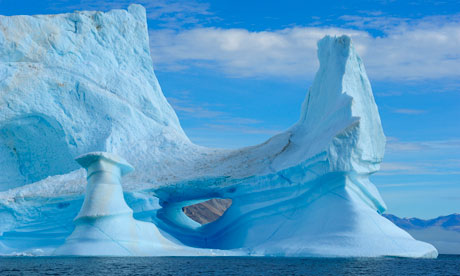
An iceberg off Alaska, 30 miles long and 12 miles wide, halted Shell’s oil drilling operation. It is expected to resume soon. Photograph: Raimund Linke/Getty Images
You are receiving this email because you are a Green Light subscriber.
Click here if you do not wish to receive Green Light emails from the Guardian News and Media. Click here to find out about other Email Services from the Guardian.
Guardian News & Media Limited – a member of Guardian Media Group PLC. Registered Office: Kings Place, 90 York Way, London, N1 9GU. Registered in England No. 908396
The figures speak for themselves. Earth’s veil of atmosphere has warmed by 0.8 degrees since the middle of the 18th century when smoke billowing from furnaces of the Industrial Revolution began.
The temperature rise might not sound like a great deal, but make no mistake: the carbon dioxide being churned out today will linger for centuries to come, scientists say.
The polar icesheets, in particular, are vulnerable to a positive feedback loop that tends to boost the speed at which melting occurs. This, in part, is why the Arctic sea ice has shrunk to its smallest extent yet, raising concerns that Arctic summers might be largely free of ice by the 2030s.
Melting of sea ice does not, in itself, lead to a rise in sea level – but the melting of continental ice sheets, such as the Greenland ice cap in the Arctic, does, explains Monash University plant physiologist Roslyn Gleadow.
Advertisement
“Ice is white and reflects sunlight, ensuring that our polar regions keep cold,” Associate Professor Gleadow explains. “Areas that are ice-free are darker in colour and thus absorb sunlight; they also warm faster than if they were covered with ice.” This positive feedback mechanism serves to increase the initial warming.
To discuss these and related matters, the Royal Society of Victoria is hosting a climate change symposium that opened last night in Melbourne with a free public lecture entitled “Addressing the myths of climate change”.
Today, the symposium begins in earnest with world experts discussing each of three key areas of research: science, impacts and adaptation.
“The symposium aims to provide a forum where experts can engage with the community about issues without the need for overly technical language or political hype,” says co-organiser Associate Professor Gleadow.
The first session this morning will review the welter of evidence for climate change, how it is measured and what is understood about these changes. It will then move to describe projections for the future.
The second session will address impacts on Victoria, along with matters such as water supply, sea-level inundation, agricultural productivity and extreme-weather expectations.
The symposium’s final session will consider options for adaptation to reduce exposure to climate-change impacts. “This is really important because there are opportunities as well as challenges ahead, and we need people from all walks of life to be engaged in this process if we are to arrive at the best possible outcomes,” Associate Professor Gleadow says.
Likely impacts
The projected effects of sea level rise are of intense interest worldwide.
NASA satellite measurements show that coastal regions of the East Antarctic ice sheet, including long stretches of the Australian Antarctic Territory, have been losing about 57 billion tonnes of ice each year for the past three years. The complete loss of the sheet, the world’s biggest expanse of frozen water, would raise sea levels by roughly 50 metres, polar scientists believe.
The West Antarctic ice sheet, in particular, is losing about 132 billion tonnes of ice a year. Global ice losses now contribute an estimated 1.8 millimetres a year to rises in sea level.
Such calculations have given rise to reports suggesting that more than 250,000 homes in Australia could be damaged or lost due to storm surge and sea level rise in coming decades.
Claims that up to 45,000 homes in Victoria alone – worth more than $10 billion – would be threatened by rising sea levels by 2100, were followed by two CSIRO reports that suggest sea levels during storms are likely to be about 15 centimetres higher in 2030 than today.
Another report will consider four sea-level scenarios by 2100, including two based on rises of 80 centimetres, one of 110 centimetres and one of 140 centimetres. Victorian planning regulations currently forecast a rise in sea level of 80centimetres by the end of the century.
Australia contributes significantly to its own potential problems. The nation’s “ecological footprint” is estimated to be something like 7.8 global hectares per person – 2.8 times the average global footprint.
Links
• Find out what’s on today at the Royal Society’s climate change symposium here