Author: admin

  • White House at logger heads over Iran

    The president’s intervention came just weeks after leaks from a White House meeting suggested that Vice-President Dick Cheney, who is understood to favour the use of force, has regained the upper hand over the Secretary of State Condoleezza Rice and Defence Secretary Robert Gates, who both advocate diplomacy and sanctions to isolate Iran. Mr Cheney reacted with fury when the State Department suggested that negotiations might continue past January 2009, when Mr Bush leaves the White House.

    So the question is: did Mr Bush last week set America inexorably on a path to the next war?

    Washington officials, with close links to the Pentagon, the State Department and the National Security Council, say that the speech was designed as a threat not just to Iran, but to America’s Western allies, along with Russia and China, who have been slow to support – or who have opposed – UN sanctions against Iran. James Phillips, a Middle East expert at the Heritage Foundation, who helped devise the war-game scenario, said: "It is simultaneously a shot across Iran’s bows and an appeal for the international community to do more to stop or slow Iran’s nuclear programme."

    A former White House aide added: "If this creates in the Iranians’ mind a state of fear such that they back off, that helps your diplomacy. Bush is a political poker player. To play poker, you have to know when to bluff."

    Mr Bush had another reason for speaking out, too. With General David Petraeus due before Congress on September 11 to report on progress on his "surge" in Iraq, Mr Bush wanted to make the case that a withdrawal from Iraq would boost Iranian influence there – in the hope that this would increase domestic support for his policies.

    In Teheran, Mr Ahmadinejad was also quick to make the Iraq connection, but as an impediment, not impetus, to American adventurism. "We have an expression in Farsi which says, ‘Bring up the one that you have given birth to first, then go for another one’," he said. "Let them do what they started in Afghanistan and Iraq then think of other countries." He dismissed threats of military action as "more of a propaganda measure than factual".

  • Costello bans ethical boycotts

    To quote David Marr:

    No price is too high to pay to protect the Aussie woolgrower. With marked contempt for the effect it would have on freewheeling public debate, Peter Costello has introduced a little bill to clobber campaigners against the bloody business of mulesing sheep. But not only them: his strategy will snare anyone calling for customer boycotts.

    So if you’re asking Australians not to buy lipstick tested on caged rabbits, rugs woven by Pakistani slaves or suits made with mulesed wool, then pray your boycott calls don’t succeed, for the Australian Competition and Consumer Commission is about to be given the power to sue you out of the water if they do.

    I am sure the vegetarians amongst us here would find this situation unacceptable.

    What are some less problematical alternatives to protect legitimate industry interests but also protect the rights of those who wish to speak up on behalf on animals when unnecessary suffering is taking place for the sake of profits?

    Source: Ethics forum ; Photograph: Steve Ferrier

  • Iceland to suspend commercial whaling

    August 26, 2007 – 4:37PM

    The Government of Iceland wants to suspend commercial whaling, Fisheries Minister Einar Gudfinsson confirmed. He told radio RUV in Reykjavik that, as of the close of the current whaling season on September 1, Iceland would for the time being provide no new catch quotas in light of the absence of interest from clients of whale meat.

    In 2006, against the backdrop of strong international protest, Iceland approved for the first time after a break of more than 20 years the killing of 39 minke whales and nine fin whales for commercial purposes.

    But just seven of each of the species were hunted by Icelandic whalers, mostly because of the surprisingly low prospects for sales in Japan.

    Gudfinsson added that he would release catch quotas if there was a clear interest in whale meat from customers.

    "We always said that whale catching has to function according to the rules of the market," he said on Saturday.

    Commercial whale hunts have taken place in the North Atlantic island despite a worldwide ban on whaling by the International Whaling Commission (IWC) in the 1980s.

    In Hamburg, the International Fund for Animal Welfare (IFAW) welcomed the suspension as "the only correct decision."

    Now Iceland should take a second step and terminate the 2003 measure that provides for whaling "for scientific purposes", the IFAW said.

    Source: SMH

    Recent related article of interest: Bloody whate hunt off Japan shocks tourists

    Arseholes slaughter whalePhoto: Right – the Baird’s beaked whale is pictured at Abashiri Port being processed.

    Incredible brutality

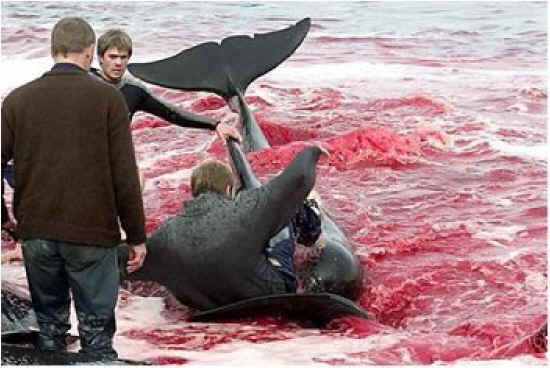
    The Faeroese proudly boast of how much they enjoy the pleasure of making the whales bleed, poking out their eyeballs and ripping the fetuses from the pregnant females. Whether or not the mercury contributes to this barbarism, we can’t say, but it does show that these people have a depraved indifference to the suffering of others.


  • Clear skies for Australia’s ‘blood moon’

    A Sydney astronomer says Tuesday night’s "blood moon" lunar eclipse should be visible to most people across the country.

    Lunar eclipses occur at least twice a year, somewhere in the world, but the last time a total eclipse was visible from Australia’s eastern states was in July 2000.

    "It’s a pretty spectacular sight tonight. It’s also a convenient time for families and safe to look at," Nick Lomb, curator of astronomy at Sydney Observatory, told AAP.

    "It’s rare but not as rare as a blue moon and we will have to find out if it is a full eclipse," he said.

    If the sky is clear, most people should be able to see the moon become red as the earth’s shadow passed over it, Mr Lomb said.

    The moon is expected to rise at 5.22 pm (AEST).

    At 6.51pm (AEST) the eclipse will begin with earth’s shadow starting to block light travelling from the sun to the moon’s surface.

    The eclipse will be full from 7.52pm (AEST) until 9.23pm (AEST), with the moon appearing red, because only the red component of sunlight will be diffracted around the earth onto its surface.

    The Bureau of Meteorology’s website suggests relatively clear conditions for most of the country, although cloud is expected over parts of Victoria and southwestern Australia.

    For those unfortunate to miss out due to bad weather, The Discovery channel is hosting a live broadcast of the eclipse on the internet at http://www.discoverychannel.com.au/eclipse

    Source: SMH  

  • Desalination may trigger water price hike

    But cost confusion rife if dams overflow: In the long term, however, the supply of water should adjust to maintain the supply/demand balance. In this context, it may be more appropriate for usage prices to reflect the LRMC of supply, rather than the short term scarcity of water. Further, setting prices to reflect the short term changes in supply of water may result in perverse outcomes, for example, very low usage prices may be required when the dams are overflowing such that usage prices do not inform customers about the costs of providing them with water in the long term.

    Reflecting costs of desalination plant in prices: There were a wide range of issues relating to how best to reflect the costs of the desalination plant in prices. The first issue that the Tribunal would need to consider was whether the costs of the desalination plant, or a proportion of these costs, should be recovered through developer charges rather than the periodic charges.

    Depends on desal future demand outlook: This largely depended on whether the plant had been constructed to meet the likely future demands placed on Sydney’s water supply due to new growth or whether it is constructed to ensure security of water supply for existing customers. If the plant, for example, had been constructed to meet future demand from new growth areas then it may be consistent with existing pricing policies to recover part of these costs through the upfront developer charges. If the costs of the desalination plant were to be recovered through the periodic charge, the Tribunal will need to consider whether the costs should be reflected in the fixed component of the two-part tariff or whether it should be reflected also in the usage component of the charge. This would, in part, relate to the operating rules of the plant.

    When should desal payoff start? Another issue related to the desalination plant was the point in the price path that these costs should begin to be reflected in water prices. One option, for example, was to allow the capital costs related to the construction of the plant to be recovered from users prior to the plant commencing operation. This may mean a fixed charge being levied on users prior to the commencement of the plant with the usage component of the charge only commencing once the plant is operated. The Tribunal will consider these timing issues for the desalination plant as part of its inquiry processes.

    Tell IPART which system to choose: IPART sought comment on whether the costs of the desalination plant should be:

    • incorporated in upfront developer charges or Sydney Water’s periodic prices or a combination of both;

    • recovered through the fixed component of the two-part tariff or a mix of fixed and usage components;

    • reflected in Sydney Water’s prices prior to the plant being operational.

    Reference: Independent Pricing and Regulatory Tribunal, Review of prices for Sydney Water Corporation’s water, sewerage, stormwater and recycled water from 1 July 2008.Water – Issues Paper DP92, August 2007. Inquiries regarding this document should be directed to a staff member: Richard Warner: (02) 9290 8406; Nigel Rajaratnam: (02) 9290 8467 Website: http://www.ipart.nsw.gov.au

    Erisk Net, 21/8/2007

  • Feds plan water and GM crops for Top End

    Fed taskforce sees strong water-pricing and GM crops as key to land, water use in Top End
    The Federal Government’s Northern Development Taskforce will soon call for expressions of interest and ideas for developing land and water in the Top End, reported <>Queensland Country Life (5/7/2007, p.114).

    Water-efficiency element: Meeting for the first time in Canberra last week, the taskforce has already commissioned work on the Ord region in Western Australia and the Northern Territory. Taskforce chair and NSW Liberal Senator, Bill Heffernan, said the taskforce will investigate new ways to maximise land and water use in the Ord, with a focus on strong price signals for water which will lead to water efficient infrastructure and high-value crops.

    Frankenstein-food element: He said the taskforce would urge the Northern Territory and West Australian Governments to "come to terms with GM technology" – believing the use of genetically modified cropping in the north would be the key to its future. "We’ll be presenting those governments with the findings we have on te science of GM and the role it can play in the future of agriculture in the north of Australia," Senator Heffernan said. "We’re not intrested in playing politics with State and Territory Governments. We want a co-operative relationship with the States."

    Queensland Country Life, 5/7/2007, p. 114