Author: admin
-
This was a guilty verdict on America as well
Only so ghastly is the hell-disaster that we have inflicted upon Iraq that we cannot even say that. Life is now worse. Or rather, death is now visited upon even more Iraqis than Saddam was able to inflict on his Shias and Kurds and – yes, in Fallujah of all places – his Sunnis, too. So we cannot even claim moral superiority. For if Saddam’s immorality and wickedness are to be the yardstick against which all our iniquities are judged, what does that say about us? We only sexually abused prisoners and killed a few of them and murdered some suspects and carried out a few rapes and illegally invaded a country which cost Iraq a mere 600,000 lives ("more or less", as George Bush Jnr said when he claimed the figure to be only 30,000). Saddam was much worse. We can’t be put on trial. We can’t be hanged.
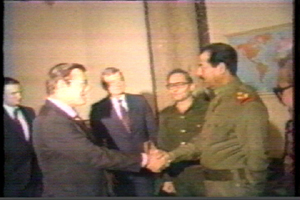 "Allahu Akbar," the awful man shouted – God is greater. No surprise there. He it was who insisted these words should be inscribed upon the Iraqi flag, the same flag which now hangs over the palace of the government that has condemned him after a trial at which the former Iraqi mass murderer was formally forbidden from describing his relationship with Donald Rumsfeld, now George Bush’s Secretary of Defence. Remember that handshake? Nor, of course, was he permitted to talk about the support he received from George Bush Snr, the current US President’s father. Little wonder, then, that Iraqi officials claimed last week the Americans had been urging them to sentence Saddam before the mid-term US elections.
Anyone who said the verdict was designed to help the Republicans, Tony Snow, the White House spokesman, blurted out yesterday, must be "smoking rope". Well, Tony, that rather depends on what kind of rope it might be. Snow, after all, claimed yesterday that the Saddam verdict – not the trial itself, please note – was "scrupulous and fair". The judges will publish "everything they used to come to their verdict."
No doubt. Because here are a few of the things that Saddam was not allowed to comment upon: sales of chemicals to his Nazi-style regime so blatant – so appalling – that he has been sentenced to hang on a localised massacre of Shias rather than the wholesale gassing of Kurds over which George W Bush and Lord Blair of Kut al-Amara were so exercised when they decided to depose Saddam in 2003 – or was it in 2002? Or 2001? Some of Saddam’s pesticides came from Germany (of course). But on 25 May 1994, the US Senate’s Committee on Banking, Housing and Urban Affairs produced a report entitled "United States Chemical and Biological Warfare-related Dual-use exports to Iraq and their possible impact on the Health Consequences (sic) of the Persian Gulf War".
This was the 1991 war which prompted our liberation of Kuwait, and the report informed Congress about US government-approved shipments of biological agents sent by American companies to Iraq from 1985 or earlier. These included Bacillus anthracis, which produces anthrax; Clostridium botulinum; Histoplasma capsulatum; Brucella melitensis; Clostridium perfringens and Escherichia coli. The same report stated that the US provided Saddam with "dual use" licensed materials which assisted in the development of chemical, biological and missile-system programmes, including chemical warfare agent production facility plant and technical drawings (provided as pesticide production facility plans).
Yes, well I can well see why Saddam wasn’t permitted to talk about this. John Reid, the British Home Secretary, said that Saddam’s hanging "was a sovereign decision by a sovereign nation". Thank heavens he didn’t mention the £200,000 worth of thiodiglycol, one of two components of mustard gas we exported to Baghdad in 1988, and another £50,000 worth of the same vile substances the following year.
We also sent thionyl chloride to Iraq in 1988 at a price of only £26,000. Yes, I know these could be used to make ballpoint ink and fabric dyes. But this was the same country – Britain – that would, eight years later, prohibit the sale of diphtheria vaccine to Iraqi children on the grounds that it could be used for – you guessed it – "weapons of mass destruction".
Now in theory, I know, the Kurds have a chance for their own trial of Saddam, to hang him high for the thousands of Kurds gassed at Halabja. This would certainly keep him alive beyond the 30-day death sentence review period. But would the Americans and British dare touch a trial in which we would have not only to describe how Saddam got his filthy gas but why the CIA – in the immediate aftermath of the Iraqi war crimes against Halabja – told US diplomats in the Middle East to claim that the gas used on the Kurds was dropped by the Iranians rather than the Iraqis (Saddam still being at the time our favourite ally rather than our favourite war criminal). Just as we in the West were silent when Saddam massacred 180,000 Kurds during the great ethnic cleansing of 1987 and 1988.
And – dare we go so deep into this betrayal of the Iraqis we loved so much that we invaded their country? – then we would have to convict Saddam of murdering countless thousands of Shia Muslims as well as Kurds after they staged an uprising against the Baathist regime at our specific request – thousands whom webetrayed by leaving them to fight off Saddam’s brutal hordes on their own. "Rioting," is how Lord Blair’s meretricious "dodgy dossier" described these atrocities in 2002 – because, of course, to call them an "uprising" (which they were) would invite us to ask ourselves who contrived to provoke this bloodbath. Answer: us.
I and my colleagues watched this tragedy. I travelled on the hospital trains that brought the Iranians back from the 1980-88 war front, their gas wounds bubbling in giant blisters on their arms and faces, giving birth to smaller blisters that wobbled on top of their wounds. The British and Americans didn’t want to know. I talked to the victims of Halabja. The Americans didn’t want to know. My Associated Press colleague Mohamed Salaam saw the Iranian dead lying gassed in their thousands on the battlefields east of Basra. The Americans and the British didn’t care.
But now we are to give the Iraqi people bread and circuses, the final hanging of Saddam, twisting, twisting slowly in the wind. We have won. We have inflicted justice upon the man whose country we invaded and eviscerated and caused to break apart. No, there is no sympathy for this man. "President Saddam Hussein has no fear of being executed," Bouchra Khalil, a Lebanese lawyer on his team, said in Beirut a few days ago. "He will not come out of prison to count his days and years in exile in Qatar or any other place. He will come out of prison to go to the presidency or to his grave." It looks like the grave. Keitel went there. Ceausescu went there. Milosevic escaped sentence.
The odd thing is that Iraq is now swamped with mass murderers, guilty of rape and massacre and throat-slitting and torture in the years since our "liberation" of Iraq. Many of them work for the Iraqi government we are currently supporting, democratically elected, of course. And these war criminals, in some cases, are paid by us, through the ministries we set up under this democratic government. And they will not be tried. Or hanged. That is the extent of our cynicism. And our shame. Have ever justice and hypocrisy been so obscenely joined?
-
Iceberg warning for ships in Southern Ocean
An iceberg warning has been issued for ships in the Southern Ocean after more than 100 were sighted on Friday just south of New Zealand.
"We were surprised by the number of them and by how far north they were," said squadron leader Andy Nielsen, the captain of the New Zealand Air Force Orion which found the icebergs while on a routine fisheries patrol.
"We were operating in a major shipping lane and, due to the number of these things floating around, we thought it wise that Maritime New Zealand be informed."Squadron leader Nielsen said they radioed in so a navigation hazard warning could be issued.
The northern most iceberg was only 260 kilometres off the New Zealand coast and the largest was estimated at two kilometres by 1.5 kilometres and more than 130 metres high.
– AFP
-
U.S. speeds attack plans for North Korea
A Pentagon official said the Department of Defense is considering "various military options" to remove the program.
"Other than nuclear strikes, which are considered excessive, there are several options now in place. Planning has been accelerated," the official said.
A second, senior defense official privy to the effort said the Bush administration recently affirmed its commitment to both South Korea and Japan that it would use U.S. nuclear weapons to deter North Korea, now considered an unofficial nuclear weapon state.
"We will resort to whatever force levels we need to have, to defend the Republic of Korea. That nuclear deterrence is in place," said the senior official, who declined to reveal what nuclear forces are deployed in Asia.
Other officials said the forces include bombs and air-launched missiles stored at Guam, a U.S. island in the western Pacific, that could be delivered by B-52 or B-2 bombers. Nine U.S. nuclear-missile submarines regularly deploy to Asian waters from Washington state.
The officials said one military option calls for teams of Navy SEALs or other special operations commandos to conduct covert raids on Yongbyon’s plutonium-reprocessing facility.
The commandos would blow up the facility to prevent further reprocessing of the spent fuel rods, which provides the material for developing nuclear weapons.
A second option calls for strikes by precision-guided Tomahawk missiles on the reprocessing plant from submarines or ships. The plan calls for simultaneous strikes from various sides to minimize any radioactive particles being carried away in the air.
Planners estimate that six Tomahawks could destroy the reprocessing plant and that it would take five to 10 years to rebuild.
Asked about the strike planning, Pentagon spokesman Bryan Whitman said the U.S. government is seeking a "peaceful, diplomatic solution" to the threat posed by North Korea.
Regarding any military options, Mr. Whitman said, "The U.S. military is prepared and capable of carrying out all of its assigned missions."
The planning does not mean that the United States will attack, only that military forces are ready to do so if President Bush orders strikes. Concerned about threats from rogue states such as North Korea, Mr. Bush called for a ballistic missile defense system, parts of which are operational.
Defense officials said a key factor in the ramped-up planning effort is China’s new attitude toward North Korea. Beijing’s leaders, upset that North Korea conducted the test, supported a U.S.-led United Nations’ resolution.
Chinese opposition to military action had limited defense planning, the officials said. In the past, U.S. military plans required warning Beijing, a move considered likely to compromise any planned action because of the close military ties between China and North Korea.
The Bush administration regards the new level of Chinese support as a "green light" for more aggressive military planning.
U.S. officials think North Korea will conduct another underground test soon because Pyongyang is demanding to be recognized as a declared nuclear power. Both China and the U.S. gauged the test as only partially successful.
The Yongbyon plant, 32 miles from the coast and a half-mile from a river, is considered a key target because U.S. intelligence agencies suspect that it is where the plutonium fuel used in the Oct. 9 test was produced.
Defense planners also said equipment destroyed at Yongbyon would be difficult to replace once newly approved U.N. sanctions are in place.
Another set of targets could be the nuclear test site near Kilchu, in northeastern North Korea. That site includes several research and testing-control facilities in the mountains — and possibly one more tunnel where a nuclear device could be set off, the officials said.
Recent intelligence reports also provided new information about Pyongyang’s uranium-enrichment program, which remains hidden in underground facilities in northern North Korea, the officials said.
The U.S. Special Operations Command has been planning raids against North Korean nuclear facilities for some time. It has conducted training for joint operations with South Korean special forces as well as unilateral U.S. operations.
U.S. Pacific Command spokesman Capt. Jeff Alderson declined to comment on military planning but said the command is continuing to shift forces to the Pacific and has four missile-defense ships deployed in Japan.
Mr. Bush said recently that any transfer of nuclear weapons by North Korea would be a "grave threat," phrasing viewed as diplomatic code for a military response. Defense officials said the military option will be used if North Korea is caught transferring nuclear arms to other states or terrorist groups. -
US threats to Chavez
Since beginning his presidency in February, 1999, Hugo Chavez and his Movement for the Fifth Republic Party (MVR) have transformed Venezuela from an oligarchy serving the rich and powerful to a model democratic state serving all the people. From the start, Chavez kept his campaign promise and began implementing his vision for political and social change. He held a national referendum through which the people decided to convene a National Constituent Assembly to draft a new Constitution that was overwhelmingly approved in a nationwide vote in December, 1999. It became effective a year later, changed the country’s name to the Republica Bolivariana de Venezuela, and mandated Hugo Chavez’s broad revolutionary vision for a system of participatory democracy based on the principles of political, economic and social justice. Ever since, the people of Venezuela haven’t looked back and won’t now tolerate a return to the ugly past they’ll never again accept willingly.
The Chavez Campaign
Hugo Chavez began his reelection campaign by registering his candidacy at the National Electoral Council (CNE) on August 12, affirming his confidence in the country’s electoral process and saying that his campaign "must be above all a debate about ideas, an opportunity to elevate the level of debate and the political culture." Afterwards he addressed many thousands of his red-shirted supporters in Caracas Square and told them the "Bolivarian hurricane" was beginning with a goal of achieving 10 million votes that would assure a convincing electoral victory in a nation of 27 million people and just over 16 million registered voters according to the CNE as of September 4. If he achieves it, he’ll have gotten the highest ever vote total in the country’s history. He sounded an optimistic note adding "The Bolivarian hurricane will become a million hurricanes in all corners of the country, carrying forward the Bolivarian project and defending the revolution."
Two polls out in September indicate he may be on track toward his goal although their results show a wide variance. Datanalisis reported Chavez had a voter preference of 58.2% (41% ahead of his closest rival) while IVAD’s percentage was 76.9%. And the most recent October University of Miami School of Communication/Zogby International poll shows Chavez with a 59% voter support compared to 24% for his only serious rival, Manuel Rosales (discussed more fully below). The Zogby poll also gave Chavez an overwhelmingly popular approval rating among Venezuelan voters based on his job performance. If the median between these poll results is closest to the right number on December 3 and the voter turnout is high enough, that would translate to a stunning victory for Hugo Chavez whether or not it’s with the 10 million vote total he hopes to get.
Chavez’s current overwhelming popularity is consistent with the results of the Chilean firm Latinobarometro interviews conducted with 20,000 Latin Americans in 18 countries in 2005. It found a higher percentage of Venezuelans calling their government "totally democratic" than any other nationality surveyed as well as Venezuelans expressing the highest degree of optimism about their country’s future in the region. These results contrast to the pre-Chavez era when the country was ruled by oligarchs, ordinary people had no political rights and the level of poverty was extreme enough to cause street riots the government chose to violently suppress. Hugo Chavez changed all that, and he’s campaigning now on his Bolivarian record of accomplishment that made him a national hero to most Venezuelans who only want him as their President as long as he wants the job.
Chavez’s plan to continue in office is part of his "Miranda Campaign" to go beyond the traditional party structure by forming local "platoons" of the "Miranda Campaign Command" across the country. It began with the swearing in of 11,358 battalions and 44,698 squads nationwide to mobilize all Venezuelans to vote on election day and to supervise and handle security, logistics, vote tabulation and other aspects of the voting process. Overall the aim is to bring together 200,000 grassroots leaders of the Revolution who then will be assigned the task of convincing 10 others to vote for Chavez that would mean 2 million votes if successful. In addition, other organizations representing social sectors, workers, peasants, women, small business owners and indigenous groups will be mobilized to support the campaign to build the "new socialism of the 21st century." Chavez also wants to hold a nationwide recall referendum half way through his next term in 2010, if he’s reelected, to let the Venezuelan people decide if the Constitution should be amended to eliminate the current two-term presidential time in office limit. He also announced his Simon Bolivar National Project which includes the following:
— a new socialist ethic especially against corruption
— a new socialist productive model expanding the social economy
— a revolutionary protagonist democracy under which the highest priority would be power to the people including through communal councils
— the Bolivarian ideal of supreme social happiness
— a new internal geopolitics (focused on internal development)
— a new international geopolitics based on a multipolar world focused against US hegemony, and
— assuring Venezuela is a global energy power by developing its Orinoco Belt extra-heavy reserves and raising its daily oil production to six million barrels daily
Hugo Chavez was greeted on September 1 by tens of thousands of supporters after returning from his international diplomatic tour. He went seeking to establish and solidify alliances and gain support for Venezuela’s campaign for the Latin American seat on the Security Council for which voting began on October 16 in the General Assembly but that has been deadlocked since because of US coercive tactics. Chavez told his supporters "This is an election (for president) on whether we want to continue to be an independent republic or return to being a North American colony." He added: "For the first time in history, Venezuela is occupying a privileged position in the world, a position of respect….because we defend with a clear voice the interests of the countries of the Third World and the sovereignty of the peoples." Chavez has a lot of support to do it from most Venezuelans and the 25 political organizations that nominated him including the MVR’s coalition partner Patria Para Todas, Podemos and several smaller parties. But Chavez also knows what he’s up against, and said he is "the candidate of the revolution….and the national majority (and that other candidates are) tools of the US government. In this electoral process there are two candidates only, namely Hugo Chavez and George W. Bush."
On September 9, Chavez’s electoral campaign battalions and platoons were sworn in as part of his "Miranda campaign" to confront "North American imperialism." It was done at a huge rally and march of hundreds of thousands of supporters in Caracas. Chavez used the occasion to propose the formation of a single united political party of the Bolivarian Revolution to be formed in 2007 after the upcoming election. In a speech he called for unity to further "consolidate and strengthen" the spirit of Bolivarianism. He said he wanted it to be the "great party of the Bolivarian Revolution (and that) it should represent the republic and the revolution to the world and establish the strongest connections with the greatest revolutionary parties throughout the world."
The Opposition
A final unknown number of the currently 18 or so announced candidates will be on the ballot on December 3 opposing Hugo Chavez, but only one is of consequence because the US picked and backs him – Zulia state governor (who by law should have relinquished his office to run for president but for whom the CNE made an exception and allowed him to remain in office) and regional Un Nuevo Tiempo party member Manuel Rosales. The other more prominent ones, including Primero Justicia candidate Julio Borges, dropped out to unite behind him as the main standard-bearer of the opposition thus ruling out a primary the US-funded right wing NGO Sumate planned to hold but then cancelled.
It still remains to be seen what strategy the opposition will decide on or even which, if any, of them will show up on election day. Already Accion Democratica, Venezuela’s largest opposition party in size of membership, at first refused to back any candidate. The AD’s General Secretary, Henry Ramos Allup, said the only option is to abstain from the election and that Rosales, Borges (before he dropped out of the race) and other candidates are "like drunks fighting over an empty bottle." Others in his party disagree though calling for an exercise of "democratic resistance." Still it’s clear to all in the opposition, Chavez is so far ahead in the polls there’s no chance anyone can defeat him in a free, fair and open election so it’s likely Rosales was chosen to run with something else in mind, and his strategy will show it as the campaign unfolds and especially as election day approaches.
Clearly the US had the final say in picking him for whatever strategy is planned that may have a lot to do with the fact that he’s the governor of the state of Zulia that has 40% of Venezuela’s oil and where in the past energy elites there supported the state’s independence to free it from the government in Caracas. Rosales also favors this idea (likely with a little coaxing from his US allies) and has called for a referendum to let the people of Zulia decide. He’s also very close to the Bush administration and was the only governor to sign the infamous "(Pedro) Carmona Estanga Decree" after the 2002 coup that dissolved the elected National Assembly and Supreme Court and effectively ended the Bolivarian Revolution and all the benefits it gave the Venezuelan people (for two days).
Rosales’ electoral plan, with considerable US National Endowment for Democracy (NED)-funded through Sumate support, should become clear close to or right after the December 3 election if he’s able to win a majority of the votes in his own state. He may then try to go ahead with an independence referendum, claim fraud in the rest of the country, and make plans to declare himself president of the independent state of Zulia if he, in fact, moves to break away and form it. The Chavez government, of course, will never accept this, and the Sumate/Rosales/Bush administration opposition may use this as as justification to confront it violently when any attempt is made to stop them. This could provide the US a pretext it may be seeking to intervene militarily for whatever reasons it gives such as protecting the lives of US citizens and defending democracy and human rights. If it happens, it would be the same kind of stunt Ronald Reagan used to invade Grenada in 1983 and GHW Bush used to do the same thing against Panama in 1989. On both those occasions, the US acted against leaders who never threatened the US or its citizens. They were forcibly deposed solely because they were unwilling to obey "the lord and master of the universe" from el norte. The same scenario may be planned for Venezuela after the upcoming election. It won’t be long before we find out.
Another possible strategy planned may be similar to what happened in the 2005 National Assembly elections. When it was clear then the major opposition candidates couldn’t win, they dropped out claiming fraud that didn’t exist. It was a cheap transparent stunt decided on a few days before the vote as a way to avoid a humiliating defeat, but it gave the corporate-run media a chance to trumpet their black propaganda and characterize a free and fair election as tainted. The tone out of Washington is always antagonistic and grabbed on to this and at other times with oxymoronic language like Venezuela under Chavez is an "authoritarian democracy, an elected authoritarianism, a threat to democracy, (and) an elected dictatorship," all of it said without a touch of irony. It also gave the opposition a chance to chime in and say voter turnout was low (mostly because opposition supporters had no one to vote for and stayed home) and the results thus had no legitimacy. So it organized street demonstrations in upscale neighborhoods and suburbs to create a false sense of turmoil and disorder.
There was also evidence uncovered at the time that violence was planned for around the time of the election to create unrest and further delegitimate the results. This is how an oligarchy puppet regime in the wings allied with the power structure in Washington operates. They have no respect for the law or norms of conduct and will use any means including murder to try to regain the power they lost to Hugo Chavez democratically. There’s no doubt schemes have already been cooked up quietly that will be sprung between now and the election period. Already on September 2, Caracas Diario Vea reported it learned about a plot involving the right wing opposition. It’s called Plan Alcatraz and is aimed at making unacceptable demands on the National Electoral Council (CNE) sure to be rejected so as to allege fraud and then organize street actions in protest including occupying CNE offices. Manuel Rosales is part of the scheme to lead the protests but he’d have to withdraw from the race to do it, which so far he’s unwilling to do. He has been willing to consult with representatives of the Bush administration and met with them recently on a trip he made to south Florida where he reportedly met with the president’s brother, Governor Jeb Bush.
Colombian right wing paramilitaries are also known to be involved and would be brought in to commit terrorist attacks along the border and in other parts of the country. If that happens, it won’t be the first time as this tactic has been used before and foiled by Venezuelan police when a plot was uncovered and arrests were made. This kind of state-directed terrorism should come as no surprise to those familiar with the government and ideological position of Colombian President Alvaro Uribe that’s hard right and in line with neocon Bush administration policy. Uribe comes from a wealthy land-owning family, has a history of links to the country’s paramilitary death squads and drug cartels, and engaged in state terrorism in the various government positions he held for over 20 years that included kidnappings and assassinations of trade unionists, peasants in opposition groups, social and human rights activists, journalists and others. He’s also committed gross violations of Venezuelan sovereignty and apparently still is doing it egged on by his US ally. In spite of it, or maybe in praise for it, the Wall Street Journal calls Uribe "(maybe) the most clear-thinking, courageous ally in the war on terror that the US has in Latin America." The Journal writer would have been right if she changed the preposition "on" to "of," and the adjectives "courageous" to "outrageous," and "clear-thinking" to "obedient."
In spite of his dubious background, Uribe was elected and then reelected the country’s president (in elections heavily tainted with fraud) and was the only South American leader to support the Bush administration’s invasion of Iraq. He even invited the US to "invade" Colombia to help it double the size of its military and supply it with weapons and intelligence. He already benefits hugely from the billions of dollars his government gets in "Plan Colombia" military aid that’s used to fight the FARC and ELN resistance and has little to do with its supposed aim to eradicate coca cultivation except in areas controlled by those two groups. He’s now the Bush administration’s strongest and most subservient ally in the region, and thus it backs the right Uribe claims he has to intervene militarily in violation of another country’s sovereignty – with bordering Venezuela as the main target.
Reports are increasing that Uribe is directing his policy of state terrorism against Venezuela by continuing to send Colombian paramilitary hired assassins illegally across the border. They’re apparently responsible for a large number of deaths in the countryside, and some have even infiltrated into metropolitan Caracas. High profile figures are also becoming targets as was state prosecutor Danilo Anderson who was killed in a December, 2004 car bombing likely because he headed an investigation of the hundreds of individuals (all from the opposition) suspected of being involved in the 2002 aborted coup attempt. More recently National Assembly (AN) for the Movement for the Fifth Republic, campesino leader, and Chavez supporter Braulio Alvarez escaped a second assassination attempt when his car was attacked and riddled with bullets. Alvarez is working with the government to implement its land reform law that redistributes large, underused land from the latifundistas (large land owners) to landless campesinos that surely is angering the rich landowners who now with Uribe’s help are striking back.
One of Hugo Chavez’s top priorities when first taking office in 1999 was land reform in a country run by oligarchs including rich land owners. He’s been determined to rectify the inequality of land distribution the 1997 agricultural census revealed – that 5% of the largest landowners control 75% of the land and 75% of the smallest ones only 6% of it. His plan led to the current confrontation, but Hugo Chavez is now responding more forcefully and on August 18 announced the creation of civilian/military security units in the large farms that have been taken over in Barinas, Apure and Tachina states. He’s doing it to combat the wave of kidnappings and assassinations especially in areas bordering Colombia that are linked to paramilitary death squads infiltrating into the country. They likely are dispatched by Alvaro Uribe and are employed by the latifundistas. Tachina has been particularly hard hit by this invasion as the number of killings there rose from 81 in 1999 to 93 in 2001, 212 in 2002 and exploded to 566 in 2005 for a total of 2037 deaths in the last seven years. In addition, the Caracas Daily Ultimas Noticias reported in July that 70% of businesses in Tachina bordering Colombia have to pay the paramilitaries a vacuna (vaccine) as protection money to keep from being attacked.
All this is mounting evidence that Hugo Chavez has every reason to fear the Colombian president and sees his close ties to the Bush administration as part of a greater strategy to provoke a confrontation giving the US a pretext to intervene to try to oust and assassinate him. This also seems to be Uribe’s aim as Colombia and Venezuela share a common border, and he fears for his own survival in a country plagued by poverty and violence. Uribe has an ugly record supporting the concentration of wealth and power while cutting vitally needed social services. He’s also allowed his military and paramilitary assassins to displace three million peasants, has one of the worst records of state-directed terrorism in the world, and has a long-term disregard for democracy and human rights. Just across the border his people can see how the Bolivarian Revolution has benefitted Venezuelans and many of them have emigrated there to take advantage of it. It’s hard to imagine those staying behind don’t want the same things and may one day act in their own self-interest to demand them.
Hugo Chavez also needs to be wary of the major new base the US is building in Mariscal Estigarribia, Paraguay, 200 kilometers from the Bolivian border even though it’s far south of Venezuela. Reportedly the base will be able to handle large aircraft and house up to 16,000 troops. Since July, 2005 small numbers of fully-equipped US forces have been in Paraguay and have been conducting secretive operations there. It’s led some military analysts and human rights groups to suspect an interventionist operation is planned, likely directed at Bolivia and its president Evo Morales some of whose policies mirror those of his friend and ally Hugo Chavez. But with enough troops and long-range large aircraft in the region, the base could also be used as a staging area for an operation anywhere within its range that easily could include Venezuela. The human rights group Servicio Paz y Justicia (SERPAJ) in Paraguay believes the US wants the country to be what Panama once was, and to be able to operate there to control the southern cone region of the continent.
It’s also been reported that George Bush recently bought a 98,842 acre farm in Paraguay to go along with the 173,000 acres his father already owns there. Both properties border Bolivia and Brazil and comprise 2.7% of the whole country that comprises an area the size of the state of California. It’s not known what the Bush family has in mind there or whether it may have any connection to a planned US military intervention in the region. It is known Paraguay has no laws criminalizing money-laundering, anti-terrorism or terrorist financing even though if does have an extradition treaty with the US. It’s also important to be mindful of the fact that a dominant US family of two US presidents now owns a sizable piece of real estate in a country able to domicile a large number of US forces. It may only be for whatever personal use they have in mind, but it may not be and we can only speculate on what that may be.
We don’t have to speculate that the US also has another major military base in Manta, Ecuador that’s much closer to Venezuela on Colombia’s southern border and is part of the US’s increasing militarization of the southern continent. The Pentagon says it’s tasked to carry out a variety of security-related missions, but that’s just code language for interventionist ones. Ecuadorian presidential hopeful, Rafael Correa, who’ll now face a runoff vote on November 26 after a tainted first round spoiled his victory, responded to a question recently that he’d allow the base to remain in his country provided the Bush administration gave Ecuador the same basing rights in Miami. But even if this base is closed, the US is currently building another new one in the Dutch colony of Curacao (a popular vacation destination that will be tainted by it) that’s located near the Venezuelan coast and near the oil-rich state of Zulia.
It remains to be seen if he’ll follow through if he wins the presidency, but one positive development to watch is Paraguay’s decision not to renew a defense cooperation agreement with the US for 2007 because it’s unwilling to grant US troops immunity from prosecution by the International Criminal Court in the Hague (ICC). The Court was established to assure perpetrators of war crimes, crimes against humanity and genocide are brought to justice. Foreign Minister Ruben Ramirez announced his country’s decision on October 2 saying his government concluded under international treaty law, exceptions to immunity are only permissible for foreign diplomats and administrative personnel. Paraguay is a member of the South American Mercosur trade block that also includes Brazil, Argentina, Uruguay and Venezuela. These countries have also refused to grant US troops such immunity in another sign the US is losing influence in the region as more leaders in it are standing firm against unreasonable demands from Washington as well as its failed policies. Hopefully the spirit and influence of Hugo Chavez is spreading.
US Intervention in Venezuela’s Political Process – Again
It’s no secret the Bush administration wants to oust Hugo Chavez, has already tried and failed three times to do it, and is now planning another attempt at whatever time and by whatever means it has in mind. It may be staged in connection with the upcoming December election and likely will be a reworked version of what was tried earlier and failed but this time with some new twists and going further than before.
Hugo Chavez knows it’s coming, has taken steps to counter it when it does, and has a hard-to-trump ace in his deck – the many millions of Venezuelans who’ve already shown they’ll come out in force to support him, especially if the stakes are to keep him as their president. Chavez witnessed some of that support when he spoke at an October mass rally in Valencia in the state of Carabobo and sounded the alarm about the Bush administration’s plot to destabilize the election and assassinate him. He indicated to the crowd that "friendly nations" have warned him about this and said: "With God’s favour this will not happen, but if it (did) you know what you would have to do; the Bolivarian Revolution at this stage does not depend on one man." Chavez also said he’s preparing for what he expects will happen and "we are going to hit back so hard that they will not stop running until they reach Miami. Chavez may not have long to wait to find out if his plan can best the one Washington has cooked up.
In the lead-up to whatever is planned, the Bush administration is relying on the usual kind of covert mischief from the CIA that specializes in it. It’s been at it all over the world for nearly 50 years and in Venezuela since Hugo Chavez was first elected. Author and international human rights attorney Eva Golinger obtained top-secret CIA documents through Freedom of Information Act (FOIA) requests showing the Agency had prior knowledge and was complicit in the two-day 2002 aborted coup attempt to unseat President Chavez and that the Bush administration provided over $30 million in funding aid to opposition groups to help do it.
It began in 2001 involving the same quasi-governmental agencies that are always part of these kinds of schemes – the National Endowment for Democracy (NED), International Republican Institute (IRI), National Democratic Institute (NDI), and US Agency for International Development (USAID) which did its work through its Office of Transition Initiatives (OTI). These agencies funded and worked with the opposition staging mass violent street protests leading up to the day of the coup. The documents also showed NED and USAID funded and were otherwise involved in staging the 2002-03 crippling oil strike and the failed August, 2004 recall referendum. The US State Department, National Security Agency (NSA) and White House had full knowledge of and had to have approved each coup attempt.
Most people have some idea how the CIA operates covertly but few know much about the National Endowment for Democracy that was (in language Orwell would have loved) established to "support democratic institutions throughout the world through private, nongovernmental efforts." If fact, its very much a part of government and its purpose is to be the somewhat overt counterpart to the CIA, and in that capacity its hands are almost as dirty as the spy agency short of having actual blood on them. The one objective it pursues above all others is the subversion of democracy including supporting the removal of democratically elected leaders unwilling to allow their countries to become submissive US client states.
It’s already been learned from information made public, including NED Quarterly Reports, that this agency actively supports anti-Chavez organizations in Venezuela and that removal of Hugo Chavez is one of its top priorities. It will also be reported soon in a new book by Eva Golinger called Bush v. Chavez: Washington’s War on Venezuela that the Bush administration since 2005 has increased its (anti-Chavez) "interference by providing funding, training, guidance, and other contacts, and other strategically important ways to support the opposition’s presidential campaign here." Golinger also reports the US anti-Chavez campaign includes the use of "psychological warfare within Venezuela, but also in the international arena, and in the United States." It’s trying "to make people think that Venezuela is a failed or failing state with a dictator, which is how the US government refers to him."
NED is an old hand at this kind of dirty business since it was established in November, 1982 by statute as a supposedly private non-profit organization. It’s hardly that as Congress approves its funding as part of the Department of State budget going to its sister USAID agency. NED also gets some private aid from several well-known right wing organizations including supportive think tanks that provide considerable funding for ultraconservative and business-friendly enterprises.
USAID has considerably greater resources than NED to pursue its activities which supposedly are to function as an independent federal agency providing non-military foreign aid. In fact, however, it’s a thinly disguised instrument of US foreign policy able to do its dirty work while avoiding congressional scrutiny. It, like NED, has in the past been an instrument of US efforts to oust Hugo Chavez, and in the run-up to the December election is likely to be working with the opposition again as it was learned it did in the other three attempts to oust the Venezuelan leader. We’ll have to wait to learn more about what schemes CIA, NED, USAID and other US-related agencies are planning until they begin unfolding or are exposed in advance and are headed off before any harm is done.
The Role of Sumate
Sumate is a nominal non-governmental organization (NGO) founded in 2002 by a group of Venezuelans led by Maria Corina Machado and Alejandro Plaz and now headed by Ms. Machado. It’s true purpose and activities belie the claims it makes to be an organization of independent citizens supporting the democratic process and promoting the political rights of Venezuelans under the country’s Constitution. In fact, it’s a US-supported and funded anti-governmental organization dedicated to the overthrow of the Chavez government and the return of the country to its ugly past ruled by the former oligarchs and the interests of capital.
In the US this kind of activity or any foreign interference in elections would never be tolerated. US election law specifically prohibits foreign nationals or corporations from contributing to any federal, state or local political campaign, and it would be unthinkable to imagine there being any tolerance if it was learned a foreign government attempted to influence the electoral process here. None of this, however, applies to what the US does all over the world rountinely. At least post WW II, this country has a tainted history of meddling in the affairs of other countries almost like we had a birthright to do it. Put another way, according to "Washington-think," what’s good for the US "goose" isn’t allowed for any other country’s "gander."
It’s thus no surprise Sumate went on the Bush administration payroll when it first gained prominence in late 2003 becoming involved in organizing and providing support for the 2004 failed recall referendum signature collection process. Ever since it’s been at the center of anti-Chavez activities and is liberally funded to do it by US agencies like NED and USAID. As mentioned above, it cancelled a primary it planned to hold after the main opposition candidates dropped out so Manuel Rosales could run unopposed against Hugo Chavez in the December election. It’s now moving ahead with the help of millions of dollars of Washington-supplied opposition candidate bankrolling. This was recently revealed in 132 USAID contracts made public that claimed the funding to be politically neutral but which Hugo Chavez believes is being used overtly and covertly to undermine his government. USAID and NED now admit they’re spending (at least) $26 million on the December election, and those organizations never support democratically elected leaders running for office who don’t obey US neoliberal diktats.
Chavez has lots of past experience to back up his claim of US interference and an added new one now after the Bush administration named career CIA agent Patrick Maher as the "mission manager" to oversee US intelligence on Venezuela and Cuba. His previous job was as deputy director of the CIA’s Office of Policy Support and his background includes having been an architect of the counter-insurgency strategy in Colombia as well as managing the agency’s operations in the Caribbean region. William Izarra, a former MVR Party leader and the national coordinator of the Centres for Ideological Formation that organizes grassroots discussions about the Bolivarian Revolution, believes this move elevates Venezuela and Cuba into the "axis of evil" category along with Iran and North Korea, and that heightens the risk of trouble ahead.
The Chavez government knows something is afoot and is taking preventive action by having Venezuelan prosecutors bring conspiracy charges against Sumate leaders. If convicted, Maria Corina Machado could face up to 16 years in prison, and three other Sumate members also face charges. The National Assembly also intends to require "non-profit" groups like Sumate to reveal their funding sources. In addition, it’s recommending Sumate be investigated for currency and tax law violations, and Chavez has threatened to expel US Ambassador William Brownfield whom he accuses of causing trouble as he’s done in the past. All this is playing out in a highly-charged atmosphere of mistrust that’s well-founded according to Eva Golinger who wrote "The Chavez Code: Cracking US Intervention in Venezuela." The book cited clear evidence of the Bush administration’s intent to overthrow the Chavez government, and Golinger recently said Washington is "trying to implement regime change. There’s no doubt about it (even though it) tries to mask it saying it’s a noble mission."
The Prospect for Fall Fireworks in Venezuela
The Bush administration must believe while it’s often wrong it’s never in doubt. It’s already dealing with two out of control conflicts in Iraq and Afghanistan and has blood-stained hands from its complicity with Israel on their co-sponsored conflicts against Lebanon and the one still raging in Palestine. Undeterred, it seems determined to become even more embroiled in the Middle East by planning a possible attack against Iran according to some reliable reports (or at least putting up a good bluff to do it), even though the US public has grown disenchanted with George Bush’s wars and it shows in his low public approval rating. He’s even now drawing flack within his own party, and many Republican candidates for Congress on November 7 see him as radioactive and don’t want him around. So why would this administration be willing to risk making things even worse by trying to forcibly remove a democratically elected leader revered by his people who will never stand by and allow their Bolivarian Revolution to be taken away from them.
Here’s why. Soon after the Bush administration came to power, Vice President (and de facto head of state) Dick Cheney said the US must "make energy security a (top) priority of our trade and foreign policy." The Iraq and Afghanistan wars followed what, in fact, was "boss" Cheney’s diktat with control of energy and its security one of several key reasons why we’re now embroiled in the greater Middle East.
Now fast forward to June, 2006 and it gets more chilling. The US Southern (military) Command in Latin America (that has no business meddling in affairs of state) concluded that efforts by Venezuela, Bolivia and Equador to extend state control over their oil and gas reserves threatens US oil security. A study it conducted states: "A re-emergence of state control of the energy sector (in those countries) will likely increase inefficiencies and….will hamper efforts to increase long-term supplies and production." Even though the region produces only 8.4% of the world’s oil output, it accounts for 30% of US consumption, and most of that comes from Venezuela and Mexico with each of these countries supplying about an equal percentage of our needs.
A secure supply and firm control of oil from the region is crucial to the US, but most of all from Venezuela because of its vast reserves (including its immense untapped amount of Orinco Basin super-heavy tar oil) that potentially are even greater than what’s now available from Saudi Arabia – although that’s debatable and merely suggesting it will open up a torrent of disagreement that may be right. Still, Venezuela, by any measure, has the greatest hydrocarbon reserves in the hemisphere, and that makes the country and Hugo Chavez target number one in this part of the world for US energy security importance and second only after the greater Middle East that includes the Caspian Basin in Central Asia. Couple that with the fact that the US sees Hugo Chavez as the greatest of all threats it faces anywhere – a good example that may and is spreading throughout the region threatening US dominance over it and you have a recipe for a determined effort to oust him by any means including assassination and armed intervention.
Chavez, of course, knows the risk and so do the Venezuelan people who proved in 2002 they will rally en masse as they did then to restore their president to office after the US-staged two-day April coup that year briefly removed him. It’s certain any attempt to oust him again will be met with the same resistance, and it’s hard to imagine how intense it may be if the US succeeds in killing him. There’s no question Washington wants to avoid six more years of Chavez rule and officials there have said it in so many words. They call Hugo Chavez "a clear and present danger to peace and democracy in the hemisphere (and) US strategy must be to help Venezuela accomplish peaceful change (before 2007)." Heinz Dieterich, a Chavez consultant, believes, as does Hugo Chavez, the Bush administration is plotting to assassinate him to prevent his serving another term in office.
So far there’s been nothing more dramatic than the usual US Chavez-bashing especially after his September 20 tour de force at the UN General Assembly when the Venezuelan President had the courage to say what most other world leaders think but only speak about privately. The Bush administration responds claiming the Chavez government is a dictatorship that supports terrorism. It also unjustifiably accuses him suppressing the media and repressing his opposition, and it’s guaranteed a Chavez victory will be challenged with outrageous accusations of electoral fraud arranged by a state-controlled CNE.
The truth on all counts is the opposite of the rhetoric, yet the vitriol continues unabated from Washington and is heard over the corporate-controlled media in both countries. What should be reported (but never is) is that the fairness of the Venezuelan electoral system shames the corrupted one in the US that’s now run by corporate-owned and controlled electronic voting machines manipulated to assure enough business-friendly candidates win even when they’re not the choice of the majority of US voters. Venezuela has real democracy while what’s called that in the US is just a shameless mirage of one – an illusion the public hasn’t caught onto yet. The Venezuelan people know the difference between that and the real thing and will fight to keep it. Sadly, most people in the US are kept uninformed, don’t know what they’ve lost, and can’t even imagine the kind of country they’d have if they had an enlightened leader like Hugo Chavez instead of the appalling one they’re stuck with for two more years.
Things are certain to heat up in Venezuela between now and December 3 as the Bush administration tries to impose on the Venezuelan people what’s it’s already done here at home, and it will be relentless and ruthless about the way it does it. And if covert efforts are afoot, as almost for sure they are, we’ll likely see them unveiled during the election period and they may be ugly. Hugo Chavez expects them, is surely ready to confront them when they’re sprung, and it now remains to be seen how the latest chapter in the Bush administration vs. Hugo Chavez will play out. Stay closely tuned. It won’t be long before the fireworks begin.
Stephen Lendman lives in Chicago and can be reached at lendmanstephen@sbcglobal.net. Also visit his blog site at sjlendman.blogspot.com. -
Ears of plenty
The story actually starts much earlier, around 12,000 years ago. At the time, after several warm millennia, a melting ice sheet in North America collapsed and a gigantic lake drained into the North Atlantic through the St Lawrence seaway. The torrent of cool, fresh water altered the climate so drastically that the ice age, which had been in full retreat, resumed for a further 11 centuries. The Scandinavian ice sheet surged south. Western Asia became not only cooler, but much drier. The Black Sea all but dried out.
People in what is now Syria had been subsisting happily on a diet of acorns, gazelles and grass seeds. The centuries of drought drove them to depend increasingly on wild grass seeds. Abruptly, soon after 11,000 years ago, they began to cultivate rye and chickpeas, then einkorn and emmer, two ancestors of wheat, and later barley. Soon cultivated grain was their staple food. It happened first in the Karacadag Mountains in south-eastern Turkey—it is only here that wild einkorn grass contains the identical genetic fingerprint of modern domesticated wheat.
Who first replanted the seeds and why? For a start, he was probably a she: women have primary responsibilities for plant gathering in hunter-gatherer societies. The time was certainly ripe for agriculture: the ability to make tools and control fire (cooking makes many plants more digestible) was already well established. But was it an act of inspiration or desperation? Did it perhaps happen by accident, as discarded grains germinated around human settlements?

The wheat plant evolved three new traits to suit its new servants: the seeds grew larger; the “rachis” which binds the seeds together became less brittle so whole ears of grass, rather than individual seeds, could be gathered; and the leaf-like glumes that covered each seed loosened, thus making the grains “free-threshing”. In the past two years, the very mutations that allowed these changes have been located within the wheat plant’s genome.
Wheat’s servants now became its slaves. Agriculture brought drudgery, subjugation and malnutrition, because unlike hunter-gatherers, farmers could eke out a living when times were bad. But at least that meant that they could survive. Population growth was now inevitable. Within a few generations, wheat farmers were on the march, displacing and overwhelming hunter-gatherers as they went, and bringing with them their distinct Indo-European language, of which Sanskrit and Irish are both descendants. By 5,000 years ago wheat had reached Ireland, Spain, Ethiopia and India. A millennium later it reached China: paddy rice was still thousands of years in the future.
Wherever they went, the farmers brought their habits: not just sowing, reaping and threshing, but baking, fermenting, owning, hoarding. By 9,000 years ago they had domesticated cattle, to which they could feed wheat to get meat and milk. They could also get precious manure to fertilise the fields. Not until 6,000 years ago did somebody invent the first plough to turn the earth, burying weeds and breaking up the seedbed.

Innovations came slowly in wheat farming. The horse collar arrived in the third century BC, in China. By not pressing on the animal’s windpipe, it enabled the animal to drag greater weight—and faster than an ox. In 1701 AD the Berkshire farmer Jethro Tull devised a simple seed drill based on organ pipes, which resulted in eight times as many grains harvested for every grain sown. Like most agricultural innovators since, he was vilified. A century later the threshing machine was greeted by riots.
In 1815 a gigantic volcanic eruption at Tambora in Indonesia led to the famous “year without a summer”. New England had frosts in July. France had bitter cold in August. Wheat prices reached a level that would never be seen again in real terms, nearly $3 a bushel. Thomas Robert Malthus was then at the height of his fame and the harvest failure seemed to bear out his pessimism. In 1798 he had forecast a population crash, based on the calculation that it was impossible to improve wheat yields as fast as people made babies (each new baby can make more babies; each new field of grain leaves less new land to cultivate).
The Malthusian crash was staved off in the 19th century by bringing more land under the plough—in North America, Argentina and Australia especially. But wheat yields per acre grew worse if anything as soil nutrients were depleted. So in 1898, in a speech to the British Association, a chemist, Sir William Crookes, argued again that worldwide starvation was inevitable within a generation. Population was rising fast. There was little new land to plough. Famines became worse each season, especially in Asia.
This time it was the tractor that averted Malthusian disaster. The first tractors had few advantages over the best horses, but they did not eat hay or oats. The replacement of draft animals by machines released about 25% more land for growing food for human consumption.
The Malthusian limit would surely be reached one day, though. The only way to increase yield was to find a way of supplying extra nitrogen, phosphorus and potassium to the soil. Neither a break crop of legumes, nor manure was the answer, since both demanded precious acres to produce. The search for fertiliser took unexpected turns. British entrepreneurs scoured the old battlefields of Europe searching for phosphorus-rich bones. In about 1830 a magic ingredient was found: guano. On the dry seabird islands off the South American and South African coasts, immense deposits of bird droppings, rich in nitrogen and phosphorus, had accumulated over centuries. Guano mining became a profitable business, and a grim one. Off South-West Africa, the discovery in 1843 of the tiny island of Ichaboe, covered in 25 feet of penguin and gannet excrement, led to a guano rush followed by a mutiny and battles. By 1850, Ichaboe, minus 800,000 tonnes of guano, was deserted again.
Between 1840 and 1880, guano nitrogen made a vast difference to European agriculture. But soon the best deposits were exhausted. In the dry uplands of Chile, rich mineral nitrate deposits were then found, and gradually took the place of guano in the late 19th century. The nitrate mines fuelled Chile’s economy and fertilised Europe’s farms.
On July 2nd 1909, with the help of an engineer named Carl Bosch from the BASF company, Fritz Haber succeeded in combining nitrogen (from the air) with hydrogen (from coal) to make ammonia. In a few short years, BASF had scaled up the process to factory size and the sky could be mined for nitrogen. Today nearly half the nitrogen atoms in the proteins of an average human being’s body came at some time or another through an ammonia factory. In the short term, though, Haber merely saved the German war effort as it was on the brink of running out of nitrogen explosives in 1914, cut off from Chilean nitrates. He went on to make lethal gas for chemical warfare and genocide.
On farms, Haber nitrogen ran into much the same revulsion as had greeted the seed drill. For many farmers, the goodness of manure could not be reduced to a white powder. Fertiliser must in some sense be alive. Haber nitrogen was not used as fertiliser in large quantities until the middle of the 20th century, and for a good reason. If you put extra nitrogen on wheat, the crop grew taller and thicker than usual, fell over in the wind and rotted. On General Douglas MacArthur’s team in Japan at the end of the second world war a wheat expert named Cecil Salmon collected 16 varieties of wheat including one called “Norin 10”, which grew just two feet tall, instead of the usual four. Salmon sent it back to a scientist named Orville Vogel in Oregon in 1949. Vogel began crossing Norin 10 with other wheats to make new short-strawed varieties.
In 1952 news of Vogel’s wheat filtered down to a remote research station in Mexico, where a man named Norman Borlaug was breeding fungus-resistant wheat for a project funded by the Rockefeller Foundation. Borlaug took some Norin, and Norin-Brevor hybrid, seeds to Mexico and began to grow new crosses. Within a few short years he had produced wheat that yielded three times as much as before. By 1963 95% of Mexico’s wheat was Borlaug’s variety, and the country’s wheat harvest was six times what it had been when Borlaug set foot in the country.
In 1961 Borlaug was invited to visit India by M. S. Swaminathan, adviser to the Indian minister of agriculture. India was on the brink of mass famine. Huge shipments of food aid from America were all that stood between its swelling population and a terrible fate. One or two people were starting to say the unsayable. After an epiphany in a taxi in a crowded Delhi street, the environmentalist Paul Ehrlich wrote a best-seller arguing that the world had “too many people”. Not only could America not save India; it should not save India. Mass starvation was inevitable, and not just for India, but for the world.
 No need to starve
Borlaug refused to be so pessimistic. He arrived in India in March 1963 and began testing three new varieties of Mexican wheat. The yields were four or five times better than Indian varieties. In 1965, after overcoming much bureaucratic opposition, Swaminathan persuaded his government to order 18,000 tonnes of Borlaug’s seed. Borlaug loaded 35 trucks in Mexico and sent them north to Los Angeles. The convoy was held up by the Mexican police, stopped at the border by United States officials and then held up by the National Guard when the Watts riots prevented them reaching the port. Then, as the shipment eventually sailed, war broke out between India and Pakistan.
Natural-born mutants
As it happened, the war proved a godsend, because the state grain monopolies lost their power to block the spread of Borlaug’s wheat. Eager farmers took it up with astonishing results. By 1974, India’s wheat production had tripled and India was self-sufficient in food; it has never faced a famine since. In 1970 Norman Borlaug was awarded the Nobel Peace Prize for firing the first shot in what came to be called the “green revolution”.
Borlaug had used natural mutants; soon his successors were bringing on mutations artificially. In 1956, a sample of a barley variety called Maythorpe was irradiated at Britain’s Atomic Energy Research Establishment . The result was a strain with stiffer, shorter straw but the same early harvest and malting qualities, which would eventually reach the market as “Golden Promise”.
Still Pictures
Today scientists use thermal neutrons, X-rays, or ethyl methane sulphonate, a harsh carcinogenic chemical—anything that will damage DNA—to generate mutant cereals. Virtually every variety of wheat and barley you see growing in the field was produced by this kind of “mutation breeding”. No safety tests are done; nobody protests. The irony is that genetic modification (GM) was invented in 1983 as a gentler, safer, more rational and more predictable alternative to mutation breeding—an organic technology, in fact. Instead of random mutations, scientists could now add the traits they wanted.
In 2004 200m acres of GM crops were grown worldwide with good effects on yield (up), pesticide use (down), biodiversity (up) and cost (down). There has not been a single human health problem. Yet, far from being welcomed as a greener green revolution, genetic modification soon ran into fierce opposition from the environmental movement. Around 1998, a century after Crookes and two centuries after Malthus, green pressure groups began picking up public disquiet about GM and rushed the issue to the top of their agendas, where it quickly brought them the attention and funds they crave.
Wheat, because of its unwieldy hexaploid genome, has largely missed out on the GM revolution, as maize and rice accelerate into world leadership. The first GM wheats have only recently been approved for use, their principal advantage to the farmer being so-called “no till” cultivation—the planting of seed directly into untilled soil saves fuel and topsoil.
Soon after Norman Borlaug went to India in 1963, a remarkable thing began to happen. The world population growth rate, in percentage terms, had been climbing steadily since the second world war (bar a two-year drop in 1959-60 caused by Mao Xedong). But in the mid 1960s it stopped rising. And by 1974 it was falling significantly. The number of people added each year kept on rising for a while, but even that peaked in 1989, and then began falling steadily. Population was still growing, but it was adding a smaller and smaller number each year.
Demographers, who had been watching the exponential rise with alarm, now forecast that the population will peak below ten billion—ten gigapeople—not long after 2050. Such a low forecast would have been unthinkable just two decades ago. Already, in developing countries, the number of children born per woman has fallen from six to three in 50 years. It will have reached replacement-level fertility (where deaths equal births) by 2035.
This is an extraordinary development, unexpected, undeserved—and apparently unnatural. Human beings may be the only creatures that have fewer babies when they are better fed. The fastest-growing populations in the world over the next 50 years will be those of Burkina Faso, Mali, Niger, Somalia, Uganda and Yemen. All except in Yemen are in Africa. All are hungry. All remain untouched by Borlaug’s green Revolution: all depend on primarily organic agriculture.
In 10,000 years the population has doubled at least ten times. Yet suddenly the doubling has ceased. It will never double again. The end of humanity’s population boom will happen in the lifetimes of people alive today. It is the moment when Malthus was wrong for the last time.
Of course feeding ten billion will not be trivial. It will require at least 35% more calories than the world’s farmers grow today, probably much more if a growing proportion of those ten billion are to have meat more than once a month. (It takes ten calories of wheat to produce one calorie of meat.) That will mean either better yields or less rainforest—which is why fertilisers, pesticides and transgenes are the best possible protectors of the planet. The story of wheat is not finished yet.