Author: Geoff Ebbs

  • Circular economy funding needs oversight, suggests Responsible Wood

    With governments funding startups in the social enterprise and circular economy space there is a need to keep an eye on the outcomes being delivered, according to representatives of Responsible Wood.

    Mark Thomson and Jason Ross have worked with the timber and paper industry to developed agreed frameworks for marking wood-based products as sustainable. As a result, they understand the need for agreement as well as the challenges. Great Notion’s Geoff Ebbs met with them in Brisbane today (Thursday, June 20) to discuss the lessons they have learned and how they might be applied in the circular economy and social enterprise space.

    Mark Thomson is the director of Responsible Wood and is concerned that a lack of oversight might damage the reputation of the movement and lead to its dismissal by mainstream business.

    “The implicit assumption that a startup is good just because it is a social enterprise or identifies with the circular economy, may need to be challenged,” he told Great Notion.

    Marketing manager, Jason Ross pointed out that if the overarching aim is to spread the concepts of the circular economy as broadly as possible into the business community, then it is critical that the concepts are clearly understood and communicated.

    “Business and government really need to address social and environmental viability as well as economic considerations,” added Mark. “Poor implementation could undermine that.”

    “We saw in early sustainability standards that hasty implementation of environmental standards discredited the idea of sustainability,” he said. His experience is primarily in timber and paper, but our discussion ranged across similar experience in technology standards, water and sewage recycling and the interactions between rich and poor nations through international programs designed to help that fall into disrepute.

    Great Notion and Responsible Wood
    Geoff Ebbs, Jason Ross and Mark Thomson discuss certification and standards

    Mark observes that there is a natural tension between encouraging innovation and diversity on one hand, and managing processes to ensure a common purpose on the other.

    “My experience indicates that certification and standards provide an enabling platform that encourages innovation in an orderly manner and avoids catastrophic failure that is damaging to reputation as well as slowing progress.”

    He points out that in the timber industry separate standards developed by environmental groups and industry groups developed from divergent starting points but have evolved to accommodate each other and create a working, global set of standards.

    Jason Ross adds that any working agreement between different groups involves compromise, but it is important to ensure that those compromises do not undermine the fundamental intent of the agreement by embedding poor practice as standard.

    Great Notion is engaged in ongoing discussions with Responsible Wood about presenting the advantages of the Circular Economy and a Zero Growth Economy to business.

  • The best and worst of recycling

    Agricultural use of single-use-plastics dwarves domestic use, Jenny Brown of Envorinex told a crowd of forty at The Precinct in Brisbane last night. The good news is that the company which she founded and heads as managing director, is doing something about it.

    A manufacturer of plastic goods for industrial and infrastructure applications since 2003, Ms Brown has been waging war on waste by recycling as much plastic as possible and delivering goods made from 100% reclaimed waste in the bulk of her products.

    Jenny Brown of Envorinex at the Circular Economy Meetup - June 2019
    Anshu Sisodia and Jenny Brown of Envorinex with friend at Brisbane’s Circular Economy meetup for World Environment Day in June

    “Plastic can be re-used dozens of times and last for centuries if it is properly processed,” she said, “the important thing is to get it right the first time.”

    Some of Envorinex greatest successes include the processing of tonnes of bags and tubes used to deliver saline solution in hospital and converting that into mats and other products.

    “All of the goods that leave our factory can be recycled again, and again and again,” she said.

    Envorinex is based in northern Tasmania and employs around twelve full time staff on two different production lines, reclaiming and processing waste and producing a range of products from guide posts for roads, antifatigue mats for oil rigs, through to simple clips and accessories for a range of applications.

    Ms Brown is in Queensland to explore the establishment of a processing plant to recycle a significant portion of the agricultural waste from the southern half of the state.

    Her presentation included images of tonnes of single use plastic discarded by strawberry and livestock farmers. Envorinex also processes hard plastics recovered from mines and Tasmania’s very active salmon and oyster farming industry. The stanchions and frames used to contain the fish or on which the oysters grow, are replaced every three to five years and include many tonnes of plastic.

    She said that the enemy of recycling is contamination. This is not so much the organic material that attaches to the plastic as the ropes, nylon clips and other attachments that have to be removed manually, vastly increasing the cost of handling and recycling.

    She also noted that most manufacturers reduce costs by mixing substances such as sawdust with virgin plastics to reduce costs and by skimping on other additives that ensure longevity and recyclability.

    Answering a question from the audience about domestic use of single-use-plastics she said that Envorinex deals exclusively with industrial and agricultural waste because domestic waste is so contaminated that it is extremely difficult to recycle.

    “This is why the waste from Australia and other rich countries has been rejected by China, India and Malaysia. They simply cannot process it,” she said. The problem is partly that packaging is often made from a mixture of products that cannot be effectively separated as well as the poor handling and sorting on the part of domestic users.

    She also noted that there are some applications, such as hospital equipment, where single use plastics are necessary but, that generally speaking, single use packaging items are the major problem.

    More information is available from the Envorinex website

  • Growth, or not, and a little Wisdom

    A public discussion on the Post-Growth Future for Business held at University of Queensland generated far-reaching discussion last Friday, 7th June.

    Dr Cle-Anne Gabriel
    Dr Cle-Anne Gabriel at UQ Business School

    Hosted by Dr Cle-Ann Gabriel, who is researching business models for sustainability, the event outlined the reasons for considering an end to growth, the challenges that poses for business and some approaches that can help business flourish in a post-growth environment.

    Key among the ideas was that individual businesses can grow in a zero growth economy, the challenge is where the degrowth comes from to balance that out.

    Dr Gabriel provided an overview of the philosophical underpinnings of zero-growth, the difference between degrowth (it is a process that can be applied to specific areas, such as developed countries, to move toward a post-Growth economy) and post-Growth, and a list of the challenges facing economists.

    Dr Michelle Maloney

    Dr Michelle Maloney, codirector of the New Economy Network, walked through the recent history of growth and the increasing influence of finance as a result of neo-liberalism and some of the tools being used to replace economic growth in specific communities.

    Associate-Professor Bernard McKenna

    Associate Professor Bernard McKenna focused on the nature and application of wisdom. He pointed out that the application of theory and dogma to economic management and in governance generally can lead to harsh and unintentional harm, if is applied without the ameliorating impact of wisdom.

    The complimentary and thorough talks generated vigorous and wide ranging discussion in the workshops raising a number of interesting questions and observations.

    One very challenging observation was that the exponential curves of the “Great Acceleration” all follow similar trajectories to that of population. If deforestation, plastic pollution, ocean acidification, falling water tables, disappearing ice etc are all functions of overpopulation, then this leads to the challenging idea that reducing population would solve all the other problems on its own. That in turn leads to the uncomfortably cynical observation that the inaction of the world’s richest nations on climate change and their increasing hostility to immigration could well engineer such an outcome by simply letting three quarters of the world disappear in an ecological catastrophe.

    Professor McKenna’s work on Wisdom would obviously not accommodate such a conclusion.

  • Geoff Jnr on deGrowth

    A much younger Geoff Ebbs discusses a Zero Growth economy in 2010
  • Dick Smith and Geoff Ebbs discuss degrowth

    Entrepreneur and adventurer Dick Smith is no stranger to controversy.

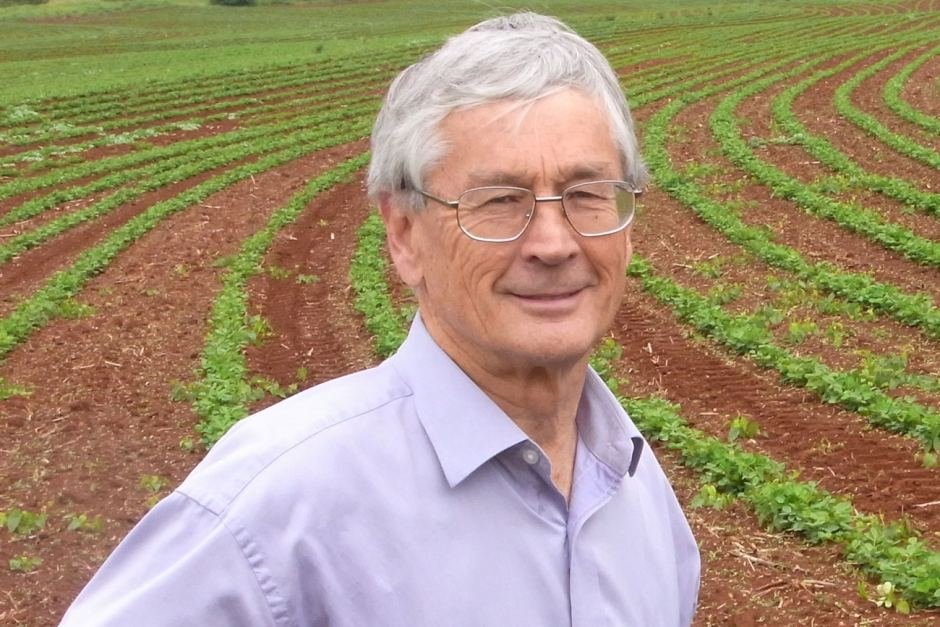
    Dick Smith appeared on the ABC discussing Australian food production

    Over the years he has threatened to run against Tony Abbott, as well as starting a range of ventures that can only be described as profit for a purpose. Dick Smith foods for example was set up with the sole purpose of keeping Australian food processors in Australian hands.

    In this interview with Geoff Ebbs, Dick Smith discusses the end of growth and the challenges inherent for capitalism in that concept.

    Dick and Geoff discuss growth and capitalism in this section of a 15 minute interview.

    The interview was first aired on The Generator, a weekly radio show on Byron Bay’s Bay FM that ran from 2005 until 2009.

  • Schoolkids stump speakers at Climate Week Event

    Questions from students and millennials went unanswered last night at the first of the Climate Week Speakers Series held by CitySmart at the State Library in South Brisbane last night (Tuesday).

    Questions from students and millennials went unanswered last night at the first of the Climate Week Speakers Series held by CitySmart at the State Library in South Brisbane last night (Tuesday).

    “How can you maintain hope in the face of the Climate Emergency when it is clear that the general public really does not care?” came the earnest plea from a young woman after articulately the outlining the causes for despair.

    “What is the intersection between recycling and climate change?” asked one twelve year-old, whose primary education obviously extends includes an understanding of the issues beyond the majority of panellists on the stage. Certainly they failed to come close to interpreting the question, let alone answering it. “Embedded energy,” would have been a good start, as long as it was followed by a sensible and straightforward explanation.

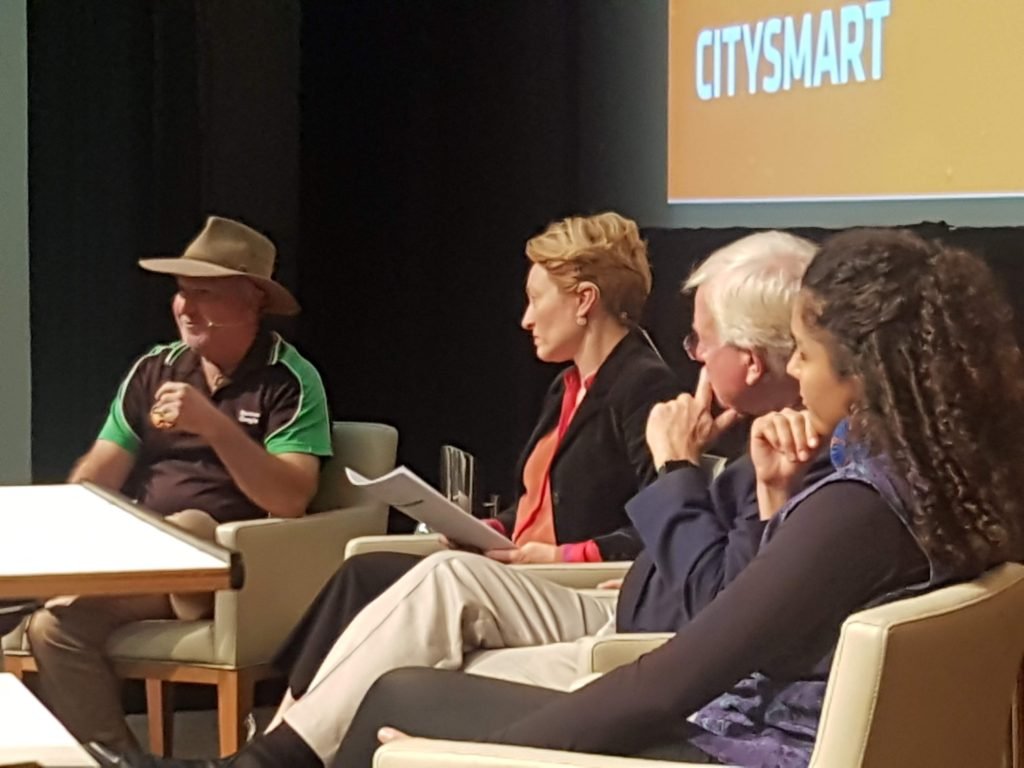
    It was a far cry from what we got, however. Angela Heck of CitySmart did a good job of introducing the guests and managing the panel but she had her work cut out.

    The panel at Climate Week Speaker Series
    Farmer Greggie, Angela Heck, Roy Tasker, Sabrina Chakori at CitySmart’s Climate WeekSpeakers event


    Farmer Gregie from 4 Real Milk has made a name for himself on breakfast television with his colloquial language, his upside down milk bottle trick (in which the cream on the unhomogenised milk keeps the milk in the bottle) and his heartfelt pleas for consumers to consider the plight of farmers. His rhetoric is not up to the job of considering the difficult issues at hand, though, and he manages to terribly mangle the facts on regenerative farming and carbon sequestration, which is a pity as he is making a valid point. The underlying current of climate denial does not help, though it probably explains his popularity on free-to-air TV.

    Professor Roy Tasker from Planet Ark presented an overview of DrawDown, Paul Hawken’s roadmap for energy descent aimed at governments and community leaders. He crossed horns with farmer Gregie by pointing to the facts on global meat production and climate change, while conceding that industrial harming produces most pollution as well as harming animals and the local environment. That he did not acknowledge the important role of animals in regenerative farming is partly due to the complexity of the issue and partly due to the mess that Farmer Gregie had already made of the topic.

    Tasker also forgot to stress the importance of getting the plans in DrawDown into the hands of our rulers, simply asserting that it is time to act and telling the assembled and experienced activists to write letters and use social media to enhance their activism. That promotion of clicktivism grated on the many climate activists in the room who have been on the barricades for decades and are looking for real messages of hope in what is a frightening and truly dire situation. When two women in their twenties seriously question the value of procreation due to failure to act on this major challenge we need stronger action than facebook is able to provide.

    Professor Roy Tasker knows the place is burning
    Professor Roy Tasker of Planet Ark knows the world is burning

    Unfortunately, he presented an over-simplistic view of smart electricity meters and completely failed to explain their role in building a more flexible electricity network. He also struggled to answer the most basic questions about the energy balance in a domestic home, the role of biogas, and the embedded energy in a solar panel.

    Sabrina Chakori more than made up for the lack of brain power in her male companions and presented a lightning walk through the research she has done toward her PhD. She is studying and running a volunteer not for profit Tool Library at the Queensland State Library because she has drawn the conclusion that we need to reconsider the role of growth if we are going to solve the problem of living on a planet with finite resources and a growing population.

    She reminded the panel more than once that recycling consumes resources and corrupts materials (see our piece Recycling is just rubbish) and that we cannot consume our way out of the climate crisis and social injustice. Unfortunately, her questioning of the role of economic growth is not going to get her a seat opposite David Koch and so breakfast viewers will continue to see the likes of farmer Gregie assert that volcanoes produce more greenhouse gas than humans instead of an anything approaching reasonable analysis.

    Despite my bitching and moaning, CitySmart has done a great job of crafting a panel and thus an event that has both public appeal and generates real discussion. It is just that, like the un-named millennial with whom I opened the article, I cannot help but despair at what appeals to the public.

    Relevant articles

    https://www.greatnotion.news/recycling-is-just-rubbish/

    https://www.climate.gov/news-features/climate-qa/which-emits-more-carbon-dioxide-volcanoes-or-human-activities

    https://thegenerator.news/thegenerator/soundfiles/Heinberg_Lifeboats.mp3

    https://www.greatnotion.news/dick-smith-discusses-degrowth-with-geoff-ebbs/