Familiar road tropes establish spine-tingling chills when you are directly immersed in the experience
There is nothing like a road trip to highlight personality
traits and set the scene for a battle between the small domestic world
established in the car interior and the big bad world outside the windows of
that private space.
So, a white Volvo and a domestic spat and a potentially
loving resolution in a dark and lonely rural setting provides the perfect seed for
a road drama.
In a brilliant piece of self reflective immersive theatre,
digital art outfit The Farm, invites audiences to attend the drama in their own
cars, circled around the paddock with their FM radio and headlights as an
integral part of the theatre experience.
The scene is set as soon as you turn up, and the experience
builds gradually as you queue in your cars, test the radio connection, are
reminded of your relationship with the car and are instructed in the etiquette
of this post-modern drive in theatre.
When the play begins, you have actually been transported
into the lonely, rural, roadside night where the drama takes place. The couple
in the car in front of you reflect the (mostly) couples in the car that form
the audience.
That the drama involves a series of familiar, even cliched road
centred scenarios only strengthens the trope that you are in the play, that the
play is exactly what you expect to see, in the same way that the familiar
components of the horror thriller, provide comfort and fear at the same time.
So, the play takes our couple through the dramas of a lone
attacker, a pedestrian accident, a gang of motorcycle riders and a zombie
apocalypse. As the action expands out from the paddock that is the stage into
the circle of cars that is the audience, the suspension of disbelief into which
we all surrendered early in the process immerses you thoroughly into the action.
I sweated with fear, my skin crawled in anticipation at the same time as I
laughed at the neighbouring theatre goers giggling hysterically in their
vehicle.
As well as the rich conceptual layering of the play itself,
the physical acting borders on the incredible. Actors emulating accident
victims float and jerk unrealistically in your headlights, slight young women
bundle giant zombies into the Volvo boot, one actors walks another along the
doors of the car so they fall in through an open window, this is magic rendered
in a paddock with a minimum of sets.
This is fully realised modern theatre in the making. It
combines digital technology, immersive experience, physical theatre and layered
cultural awareness.
The play is Throttle, the venue is the Mudgeeraba
Showgrounds, the production company is The Farm and tickets are available
through Bleach, the Gold Coast Arts Festival. The play is sold out, so you will
not get the chance to see it this time round but I’m sure you will have that
chance in the future. This is too good to disappear into the ether without
spawning other appeareances, derivative works or both.
The circular economy differs from a linear economy because the output of one process is the input of another.
The available outputs of the food production are uneaten vegetable matter and sewage from which we can harvest nutrients, energy, water and solid waste. Natural ecosystems are circular in that plants and animals accumulate nutrients and grow during their life, and then release those nutrients back to the environment as they excrete, or when they die.
An ecosystem is a circular economy built of component linear processes. An ant nest organizes and concentrates nutrients that form a valuable supply for nearby trees or scavenging beetles. A tree accumulates resources and stores them in the form of timber.
A specific ecology may also rely on external cycles. A rainforest, for example, relies on a larger circular system for its water. The water cycle injects water into the rainforest which releases it to the sea. The rainforest is also a net user of energy. Sunlight powers the growth of the forest, and is the primary source of energy for all other life forms.
Of course, sunlight also powers the water cycle, evaporating water and driving the winds that move clouds around the earth. Our fossil fuels come from ancient forests. The only sources of energy on earth that are not derived from sunlight are the gravitational pull of the tides and the geothermal energy from our molten core.
When planning a circular economy, it is critical that we take note of this net use of energy, and the reliance on larger cycles, so that we do not cripple each component of the ecosystem with artificial constraints. Linear processes can participate in a circular economy if their waste provides valuable inputs to other areas of the economy.
Edison went through many thousands of
versions of the electric light globe, literally, before finding one that worked
and could be mass produced.
Photo credit: Richard Warren Lipack / Wikimedia Commons.
It is these thousands of iterations that
led to his famous observation that success is one percent inspiration and 99
percent perspiration.
The one percent inspiration is critical,
though. Without an idea that drives us forward, we would never keep going
through the endless repetition of trial and error that builds success.
It is that inspiration that builds staff
and customer loyalty and that gives your brand meaning.
Many branding tools, discussions and
seminars, including Simon Sinek’s famous Why Ted Talk, emphasise the importance
of passion in building your unique brand identifier.
But inspiration has another, deeper
significance for business in tough times.
Nearly all businesses, and business models,
have a reasonable chance of succeeding when the economy is booming, but we need
something special when the going gets rough. The customer and staff loyalty,
and their willingness to pay for our unique value, is an important ingredient
in the recipe for survival.
The challenge in tough times is to find
that competitive edge that allows us to thrive while others are struggling.
Some businesses become more aggressive, use their market position to dominate
their competitors, or their global reach to drive down costs. These strategies
are exploitative. In the current global economic climate, these strategies
exacerbate the problems we all face, not ameliorate them.
The premise of Great Notion is that
innovation and inspiration provide a non-exploitative differentiator and allow
us to build stronger, long lasting relationships with our stakeholders. We can
expand by exploiting others, or we can outcompete them by being better, and
being better in this context usually means being smarter.
Putting your inspiration at the core of all
your business practice, or identifying the inspiration that belongs at the
heart of your business practice allows you to build value, based on your
values, rather than on exploiting your customers, staff or suppliers.
That is the way to build thriving, viable,
sustainable business. Now, that’s a great notion.
If you are actually interested in the public policy surrounding the decisions around the Corona virus, this article is thoroughly researched and incredibly informative.
Target lockdowns and be effective
As always the devil is in the detail.
The primary consideration is what is different about Singapore and South Korea compared to Italy and Spain? https://lnkd.in/gtfiCf4
This article is reprinted from CNN Online. Read the original.
There are three main ideas of the Green New Deal Resolution introduced by Congresswoman Alexandria Ocasio-Cortez and Senator Ed Markey.
The first is to decarbonize the US energy system — that is, to end the emissions of carbon dioxide (CO2) from burning coal, oil and natural gas, in order to stop global warming.
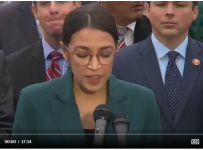
Alexandria Ocasio-Cortez launching the Green New Deal
The second is to guarantee lower-cost, high-quality health coverage for all.
The third is to ensure decent jobs and living standards for all Americans, in part by making colleges and vocational schools affordable for all.
The right wing and corporate lobbies are already hyperventilating: It is unachievable; it will bankrupt us; it will make us into Venezuela.
These claims are dead wrong. The Green New Deal agenda is both feasible and affordable. This will become clear as the agenda is turned into specific legislation for energy, health care, higher education, and more.
The Green New Deal combines ideas across several parts of the economy because the ultimate goal is sustainable development. That means an economy that delivers a package deal: good incomes, social fairness, and environmental sustainability. Around the world, governments are aiming for the same end — a “triple-bottom line” of economic, social, and environmental objectives.
In the US, the economy is feeding the wealth of billionaires while leaving tens of millions of households with no financial cushion at all. Meanwhile, the fossil-fuel lobby continues to endanger the planet by promoting the use of fuels that contribute to climate change, raising the risk of mega-floods, droughts, hurricanes, and heat waves, claiming many lives and costing the US more than $450 billion during 2016-18, or more than $150 billion per year on average.
The key ideas of the Green New Deal — decarbonization, lower-cost health care, and decent living standards for the working class — have been studied for years. The Green New Deal Resolution is the opportunity, finally, to put that vast knowledge into effect.
What is absolutely clear is that the Green New Deal is affordable. The claims about the unaffordability of these goals are pure hype. The detailed plans that will emerge in the coming months will expose the bluster.
Decarbonizing energy
Consider the challenge of decarbonizing the energy system. As noted in the Green New Deal resolution, the recent report of the Inter-Governmental Panel on Climate Change calls for global decarbonization by 2050, an achievable goal that requires coherent and accelerated actions by the US and other nations.
The Green New Deal is the occasion to put America’s utilities, builders, and automakers to the challenge of accelerating their technological overhauls to complete decarbonization by 2050 or earlier. The resolution calls for a 10-year mobilization effort to achieve “net-zero greenhouse gas emissions” but not for a precise timeline for completing decarbonization. The timing will depend on the pace of new zero-carbon investments and the phase-out of existing fossil fuel-based technologies.
Decarbonization will include the following measures. Electricity generation will shift from coal and natural gas to wind, solar, hydro, and other zero-carbon technologies. Cars and trucks will shift from gasoline to electricity, using batteries or fuel cells (with hydrogen manufactured by electrolysis). Planes will use electricity for short flights and advanced zero-carbon fuels for longer flights. Buildings will be heated by electricity (such as heat pumps) rather than boilers and furnaces.
The costs of renewable energy are plummeting, making decarbonization eminently feasible. Detailed estimates put the costs of substantial decarbonization (80% or more by 2050) at around 1% of GDP per year or less. (See here for one recent study). In many cases, renewable energy is already at “grid parity,” meaning that it is at a cost point comparable to fossil fuels. Most of the modest costs of decarbonization will never hit the federal budget, as they will be absorbed by the utility industry, the automobile producers, and other parts of the private economy.
Decarbonization is already underway in the US, just not yet with the pace and scale required. US utilities are no longer building coal-fired power plants; many are now scrapping plans for gas-fired plants in favor of renewable energy. Investors and in-house lawyers are warning companies not to invest in fossil fuels, as these investments would be stranded in future years. Automobile companies are rapidly shifting to electric vehicles. New buildings are going electric, with tough efficiency codes. These transformations are being driven mainly by environmental regulations, integrated resource planning by utilities, and market forces, not by federal outlays.
Medicare for all
Lower-cost, high-quality health care for all, for example through Medicare for All, is also within reach. As with decarbonization, the right wing and corporate lobbies are using scare tactics to hide the basic fact: Health care costs in the US can be cut considerably, while improving services.Fighting climate change may be easier than we think
The US spends around 17% of its gross domestic product (GDP) on health care coverage, while other countries spend 10-12%. The main difference lies with the high prices of US health care, for drugs, hospital stays, medical procedures, and other goods and services, rather than with greater utilization of health services. These high prices have resulted in part from the rising concentration and market power of health care providers at the metropolitan level. The result is outlandish salaries, bloated administration, heavy costs of advertising, and other inefficiencies that result in high incomes for the health care industry and exorbitant costs for taxpayers and for workers paying for private health care plans.
The question is therefore not whether we can afford Medicare for All, but whether we will get there before the private health care industry bankrupts us. As one approach, the private insurance premiums now flowing to private health insurers could be re-directed to a Medicare account that would reimburse the health providers at Medicare rates, with much lower management salaries and administrative costs. The nationwide cost savings of Medicare for All — hundreds of billions of dollars per year — could be remitted to taxpayers or used to reduce the federal budget deficit.
College for all
Similar budget analyses demonstrate the feasibility of other parts of the Green New Deal. Can debt-free higher education for all be achieved? The other rich countries all accomplish it. One proposal for “College for All,” presented by Senator Bernie Sanders, would cost around one-quarter of 1% of GDP, a price point that is tiny compared with the burdens of a society weighed down by student debts that create lifelong anxieties until retirement years.
The Green New Deal proponents are absolutely correct on the merits. Decarbonization, Medicare for All, debt-free higher education, and other social benefits are feasible, affordable, and smart. They will deliver great savings in the case of health care, environmental benefits in the case of decarbonization, and renewed social mobility in the case of debt-free higher education.
As a next step, the Green New Deal ideas should be turned into legislation, plans and budgets. When the Federal Interstate Highway System was being debated in 1955, every Congressman received a booklet with detailed maps showing how their district would benefit from an interstate highway system. It’s now important to provide a roadmap of the Green New Deal, showing for each part of the country how the Green New Deal package can be accomplished at low cost and with enormous economic, social and environmental benefits.
Minister Enoch argued recently to increase the levy on dumping waste in landfill
Launching the Circular Economy Lab in
Fortitude Valley yesterday evening, the Minister for Arts, Science and
Environment, Leeanne Enoch, said that Queensland has committed $150,000 to the
lab as part of its commitment to protect the natural assets of the State, such
as the Great Barrier Reef.