Reef grief competition heals despair with creativity
Liberals turn on market forces to protect coal
Climate deniers are going under – courtesy @Bruceneeds2know
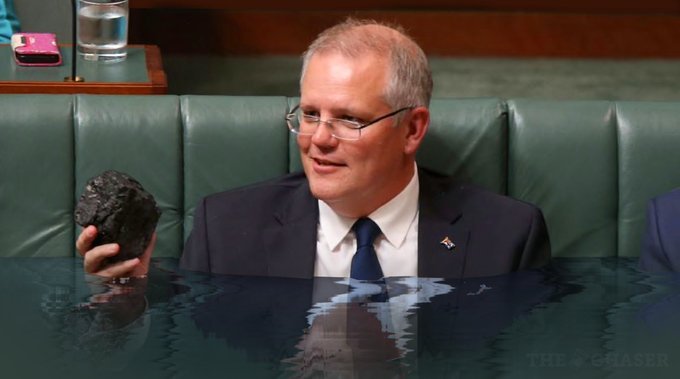
Once a political party dedicated to the ideology of a free-market that operates with minimal government intervention, the Liberal Party this week announced that it will oppose moves by investors and financial institutions to replace coal fired electricity generation with renewables. In announcing that it would use foreign-investment and competition veto powers to stop tech billionaire Mike Cannon-Brookes from purchasing AGL and closing down coal fired power stations, Scott Morrison said, “our government is very committed to ensure we sweat those assets for their life [to keep] energy prices affordable ”. Cannon-Brookes has consistently pointed out that renewables are bringing energy prices down.
This move by the party is consistent with the politically engineered sacking of the CEO of AGL in 2018 when he announced that the company would close the Lidell power station early and replace it with renewables. Banks, private equity firms and insurance companies have all damned the Liberal Party for allowing the influence of the coal lobby to set policy that limits sensible economic investment in energy solutions that address the climate emergency.
Yesterday we globally celebrated the contribution made by women through events such as the National Art Gallery announcing that it has reached gender equity in its collection and the newspaper Big Issues publishing a list of 50 feminist books to smash the patriarchy. Many thoughtful women have been more cautious, however, identifying that some of the fundamentals have not changed, especially the ongoing and weekly murder of Australian women, generally by ex-partners. Last IWD, Dr Quek and Dr Tyler pointed out on the ABC’s Mindfield that one of the world’s most prominent IWD websites claims, “Equality is not a women’s issue, it’s a business issue.” The Times of India directly confronted the “misogynist patriarchy in which we live” with a wide ranging vox pop listing “what women really want.”
Truth is the first casualty as Australia toes US line on Ukraine
The government has announced that it will outlaw media and speech that does not follow the US-NATO line in unilaterally damning the Russian military action in the Ukraine despite a highly complex situation involving multiple ethnic and political groups and decades of struggle. In a statement yesterday, Foreign Minister Marise Payne said, “The Australian Government is placing new sanctions on Moscow’s propagandists and purveyors of disinformation, who are trying to legitimatise Russia’s unprovoked, unjustified invasion with false narratives such as the “de-Nazification” of Ukraine.”
The announcement follows an ABC press release defending its censorship and exclusion of a Russian born Australian who asked a Q and A panel last Thursday night, why the media ignores the activities of the Azov regiment.
Al Jazeera described the Azov Regiment as ultra-nationalist, right wing fighters integrated into the Ukrainian armed forces in 2014 after fighting against Russia in the Crimea. The Ukrainan president at the time Perozhenko described them as “our best warriors” at an awards ceremony where he gave them official status and funding. Putin has stated that one of the aims of Russia in the Ukraine is to de-militarise and de-Nazify the Ukraine. The Azof regiment have terrorised Roma and Jewish community, gay groups, and left-wing organisations. They smear their bullets with pig fat to dishonour Chechen Muslims who are in the Ukraine specifically to fight them.
PM leaps into action as Climate Emergency reaches Cronulla
The Guardian illustrating B.O.M figures showing the impact of the atmospheric river
Australia’s East Coast rain bomb is actually an atmospheric river, dragging warm water evaporated from the coral sea down the east coast of Australia where it is dumped as the air rises and cools on contact with the coast. The phenomenon causes many floods in the West Coast of the USA and is known as the pineapple express because the warm water comes from Hawaii.
The local phenomenon is caused when an east coast low is held against the Australian coast by a stationary high over New Zealand. The effect of climate change has been to increase the amount of water in the atmosphere and to push it further south reaching Newcastle, Sydney and Woollongong.
The Betoota Advocate joked this week that these towns form the acronym N.S.W. which is the region the Liberal Party considers to be the ‘real Australia’ and that the Prime Minister now understands that there is a climate emergency because the floods have reached Cronulla.
The Prime Minister is visiting Lismore today, where residents are arguing whether to greet him with actual pitchforks or with a damages bill.
Reef grief competition heals despair with creativity
Ecowarrior organisation Extinction Rebellion, also known as XR, has put together a competition to find a song that best encapsulates “Reef Grief” and deal with the phases of grief, denial, anger, bargaining, depression, and acceptance. Entries from members of the public, including 4ZZZ listeners, are welcome but must be submitted by this Friday, Details are available at http://reefgrief.org/competition/
Like the Rings that rule Tolkein’s Middle Earth, the challenges of implementing the SDGs are manifold but there is one challenge that ‘binds them all’. That challenge is our addiction to economic growth.
Geoff talks to Dick Smith about capitalism and sustainability in 2008
Here’s Dick Smith talking to me in 2008. There is a longer version of that interview on this site. In the longer interview Dick talks about attempting to run the Australian Geographic magazine as a non-growth company. He believes that the tenets of capitalism, even the most destructive of its characteristics, are a function of human nature.
Geoff in 2010 on sustainability and the economy
In 2010, running for the Federal seat of Richmond, I talked a lot about the relationship between economic growth and environmental harm. As I say in this clip, the maths are simple. You cannot keep using finite resources for ever, it just does not add up.
The obvious challenges of increasing economic growth on a finite planet led to a recasting of the debate and a lot of attempts to introduce sustainable growth and green growth. Abundance became a popular catch word.
That emphasis on consumers and consumer choice making green purchasing decisions underpins a lot of advertising.
Consider this advertisement from 2019 selling SodaStream, a product that ships carbon dioxide around the planet in aluminium containers. The environmental benefits of SodaStream are the packaging that it replaces. Whether that justifies the claims made in this ad, you will have to determine yourself.
Your Life Your Planet used the SodaStream ad to introduce a conversation about degrowth.
A more sophisticated response to the blunt mathematics I used in the 2010 election are that we can decouple economic growth from environmental harm. That is, we can have economic growth and a clean environment by focusing on green growth. Here is Ross Garnaut explaining to me how decoupling works.
Ross Garnaut and Geoff Ebbs discussing decoupling
The challenges of decoupling are too complex to go into here, but they include the amount of time it takes to change what we are doing compared to how fast we need to change to avoid environmental catastrophe as well as the gap between what is technically feasible and what we manage to achieve.
If you watch the discussion after the SodaStream advertisement, above, you will hear Sabrina Chakori discussing Jarven’s paradox which explains that when we get efficient at managing a precious resource we start using more of it instead of saving it for a rainy day. Here is Sabrina chatting to me on EcoRadio about other ways that we might look at the economy instead of putting growth in conflict with our existential survival.
These different views of the relationship between the economy, especially economic growth, and the environment are useful starting points for discussion about what is greenwash and what are genuine attempts to build a sustainable future.
Deforestation is a significant contributor to climate chaos, biodiversity loss and depletion of groundwater. It requires significant effort on a number of levels.
There are global certification bodies that provide a form of policing, including the capacity to interrogate the source of timber products using a chain of custody, or record of the handling of the product from forest to retail product. They are far from perfect, however.
There are also significant global reforestation projects that deserve examination for both their success and their failures.
This article provides a quick overview
What’s the problem?
The European Comission provides some clear definitions of sustainable management and the degrees of damage that we need to avoid.
Degradation is the initial phase in which natural forests become damaged, either by unsustainable logging (tree removal in an unselective or concentrated way so that the original forest canopy cannot recover) or by competing land uses such as mining, infrastructure, agriculture, and the resettlement of populations. Often these occur in combination.
Deforestation occurs if degradation goes unchecked. Most or all forest cover is lost. If left undisturbed and not eroded by the elements, many deforested areas can partially or fully recover to their former state. More often however, the pressures from other land use prevents this and result in permanent deforestation.
Desertification happens in areas where the forest cover (continuous canopy) is largely or totally lost and climatic conditions (rain, wind, snow, etc.) intervene destructively so as to impoverish, deplete, or remove soil.
Some of the facts presented by the EC demonstrate the nature of the problem.
Unsustainable management in many tropical countries has led to forest degradation and deforestation, and has contributed 17.5% of all greenhouse gas emissions.
In 2009, the forest certification schemes covered some 74.7 Mha or 42% of EU forests. Globally, they cover only 15% of forests. More than 90 % of certified forests are in OECD countries.
While the figures have changed in the last decade, it is clear that the problem of tropical forest management remains a major challenge.
Next, lets identify the two major forest certification bodies.
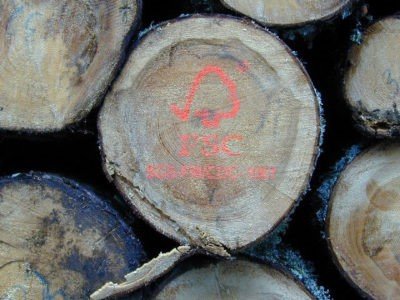
The Forest Stewardship Council (FSC) claims to be the most rigorous form of certification and facilitates and supports a chain of custody, as a commercial service provided by certifying agencies.
The Forestry Stewardship Council certifies forests, timber and operators
The Program for Endorsement of Forest Certification (PEFC) collects and collates information and efforts by national certification authorities. It is known in Australia as Responsible Wood and you can get the general tenor of their approach in this article from 2017.
Geoff interviews the director and marketing officer of Responsible Wood
Natasha Stevenson posted this handy summary of the differences between the two organisations on her linked in feed. https://www.linkedin.com/pulse/5-differences-between-fsc-pefc-natasha-stevenson/
Top Down” vs. “Bottom Up”
FSC is an international standard which is nationally adapted to act as an independent monitoring body, ensuring forestry is working to certain standards -> a “top down” approach PEFC is active in over 30 countries and assesses independent forestry management schemes against international criteria for sustainable forestry -> a “bottom up” approach
The Scale
FSC covers 187 million hectares of forest (30 000 certificates) PEFC covers 260 million hectares of forests (17 800 certificates)
Purpose
FSC was created to prevent illegal timber being consumed and is more focused on the environmental aspects PEFC is essentially a build on from FSC to facilitate certification of sustainable forestry, but adapted especially for small scale land owners
Certificate Types- Level of Commitment
FSC: Forest management, chain of custody and controlled wood PEFC: Forest management, chain of custody and project certification
Certification
FSC is a second party certification; the organisation issues the certificates PEFC is a third party certification; they use certified institutions
Are they working?
The following article is taken from Yale 360 e, an environmental publication of the University.
In a 2014 report, Greenpeace, an FSC member, accused FSC-certified logging companies in Russia of “wood-mining” forests the way they might strip-mine coal, as a non-renewable resource, and of harvesting “areas that are either slated for legal protection or supposed to be protected as a part of FSC requirements.”
In 2015, the U.S. flooring company Lumber Liquidators pleaded guilty to smuggling illegal timber from the last habitat of the Siberian tiger in the Russian Far East. Its main supplier of solid oak flooring was a Chinese company named Xingjia, which held an FSC “chain of custody” certification, meaning it was licensed to handle FSC-certified timber. According to an investigator in the case, another Chinese company marketing to the United States offered to put an FSC label on illegal wood flooring in exchange for a 10 percent markup.
In Peru, investigators determined in 2016 that more than 90 percent of the timber on two recent shipments bound from the Amazon to Mexico and the U.S. was of illegal origin. In what it called an “unprecedented enforcement action,” the Office of the U.S. Trade Representative last October banned the main exporter in those shipments from the U.S. market. That company, Inversiones La Oroza, still boasts on its website that it “complies with the principles and criteria of Forest Stewardship Council (FSC),” though FSC finally suspended its certification in 2017.
In 2015, an undercover investigation implicated an FSC-certified Austrian company, Holzindustrie Schweighofer, in illegal logging in Romania, including some in national parks and other protected areas. An FSC expert panel subsequently recommended that the organization “disassociate” from Holzindustrie Schweighofer based on “clear and convincing evidence” of illegality. FSC opted at first for suspension instead. An outcry from environmentalists soon pushed it to break ties with the company, but FSC is already working on a “roadmap” to bring Schweighofer back into certification.
The cases in China, Peru, and Romania all resulted from undercover operations by the Environmental Investigation Agency, a Washington, D.C.-based nonprofit. “We didn’t mean to go after FSC,” says David Gehl, that group’s Eurasia programs coordinator. FSC just kept turning up in the same places as a lot of illegal logging, he says. Many logging companies appeared to obtain an FSC certification for management practices on one forest, and then use it to cast a halo over their far more extensive dealings in forests elsewhere, with little regard for sustainability or even legality.
The Great Green Wall
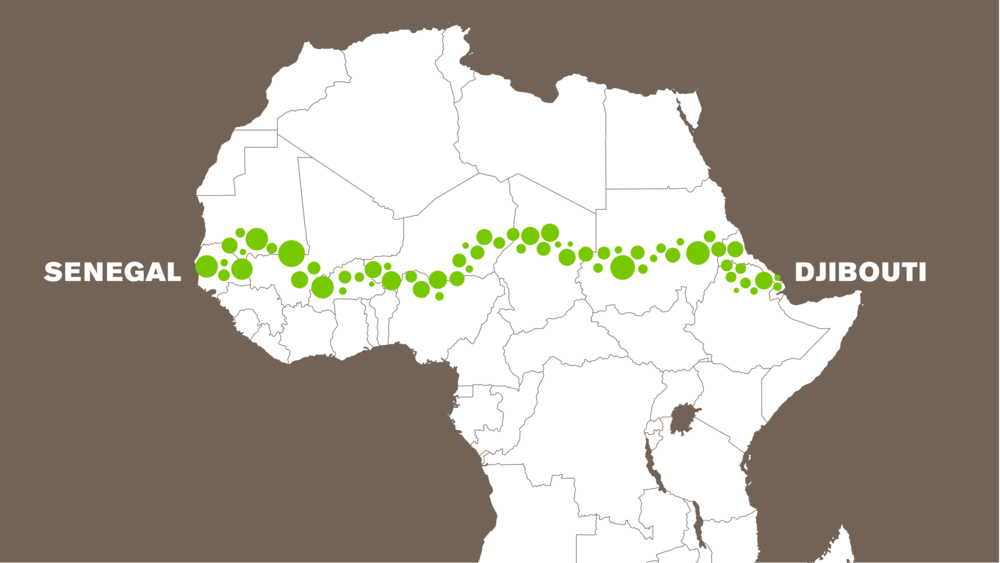
Started in 2007, the Great Green Wall is an enormous project intending to plant a “barrier against climate change running across the Sahel region. This semiarid region of western and north-central Africa extends from Senegal to Djibouti. It forms a transitional zone between the arid Sahara desert to the north and the belt of humid savannas to the south.”
The United Nations and the World Bank have worked with 11 nations across Africa and spent billions of dollars with mixed success.
The challenges faced in such an ambition project include failure to engage local land management practice, exclusion of marginalised groups such as youth, women, or ethnic minorities because of local culture, economics and politics, predatory land trading and agricultural interference, a lack of measurement methods to monitor outcomes, and lack of follow through to ensure that planted forests remain cared for until well established.
The international organisations have worked hard to learn lessons from these struggles and overall, most people consider the project a significant success. The world bank independent assessment group writes …
Many unqualified statements have and continue to attribute Sahelian greening entirely to the actions of farmers.
One specific example of this is described by FAO specialists Moctar Sacande and Nora Berrahmouni (2016). Investigating four cross-border regions of Mali, Burkina Faso, and Niger located in dryland ecosystems of the Sahel, they used local farming expertise to identify the selection of suitable native species for large-scale natural capital restoration in the framework of the GGW. Starting from the assessment of local farming needs, the most environmentally well-adapted and economically relevant species were prioritized, quality seeds were collected, and nursery seedlings produced, all under the technical supervision of the villages. Consequently, ‘‘from 2013 to 2015, 55 woody and herbaceous species were planted to initiate restoration of 2,235 ha of degraded land. On average, 60% of seedlings survived and grew well in the field after three rainy seasons” (Sacande & Berrahmouni, 2016:479).
It is clear then, that while European nations have implemented highly monitored and sophisticated forest management practices, the rest of the world has a long way to go and we have much to learn about supporting nations with limited resources to participate in this important global project.
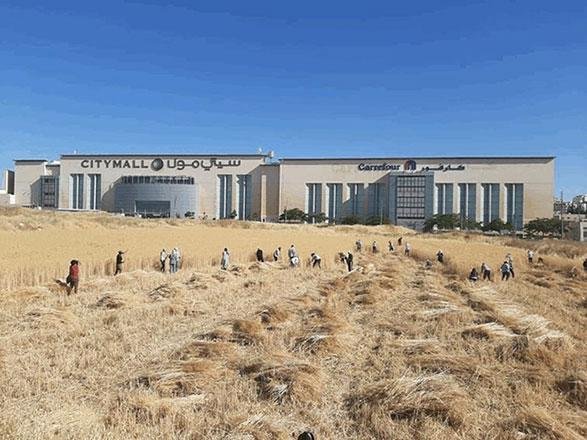
Urban farmers in Jordan’s capital, Ammam, have harvested a second crop of wheat grown in the ancient city’s glamorous shopping district.
One of the Al-Barakeh wheat fields in Ammam
The food sovereignty initiative was begun by a social enterprise, Al-Barakeh, in 2019 when bread became scarce during a strict CoViD lockdown. Until the 1960’s Jordan was a significant wheat exporter, but urbanisation, globalisation and an end to government subsidies means the nation now imports 97 percent of its wheat. Al Barakeh now sell’s 700 bags of bread every day, made with local wheat. Al-Barakeh founder, Rabee Zureikat, says that the word Barakeh means blessing, “a value system based on sharing and cooperation, being a part of a community and part of nature.”
The Institute for Energy Economics and Financial Analysis published a report this week showing that governments are not reducing their use of coal as promised at Paris and, even if they did, it would not be enough to meet the emission reduction promises consistent with 2degrees of warming.
The graphs outlining the energy descent required to meet the Paris targets are so far removed from the actual projections of governments, it is almost certain that climatic chaos will seriously undermine civilisation.
From the Production Gap report 2021
On the other hand, there are indications that the use of coking coal, used to make steel, is beginning to decline as new, cleaner methods of steel production come online. Electric arc furnaces can be used to recycle existing steel and direct reduction processes using hydrogen are moving into production. The decarbonisation of the economy is beginning, but is not happening fast enough, according to the report.
The real kicker in the conversation, though, is that urgent as greenhouse gas emissions are, they are only one of the existential threats to human life. Biodiversity loss, falling water tables, microplastic pollution, nutrient imbalance and a string of other challenges are just as significant and a lot more difficult to solve. Australia and the US need to reduce our emissions by seven eighths to make the Paris targets, we need to limit our overall consumption by a similar amount to help restore other global systems to balance.
Carbon tunnel vision ignores the other, urgent existential threats
You can read a longer version of this article, based on the on air analysis linked above, at Geoff Ebbs’ blog. Here are links to some of the sources, used to put this together.