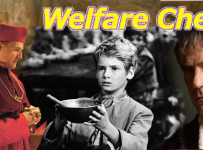
Why pay billions of taxpayer dollars to christian welfare groups when they have been exposed as Criminal Gangs. Not only has the Royal Commission into Abuse Sexual identified the repeat offending of those organisations, it has shown that they closed ranks to protect their members in an organised manner, abusing their political influence to avoid prosecution. These gangs can no longer be allowed to provide welfare services.
The evidence thrown up at the commission is more than enough to justify kicking a large proportion of the so called christian operators of schools, orphanages and other institutions for ever. We must curtail the power they have abused by taking welfare out of their hands and putting it in the hands of the community. Right now, the opposite is happening. The community sector is being starved of funds and the money is being poured into the churches.
This argument is not anti-theism.
For a start, my targets are the institutions not the faithful. It is the institutions that have the money and the power to hire managers and staff of the organisations that house the homeless, protect the vulnerable and feed and clothe the poor.
Second, my charge is not that religious institutions have no place in welfare. That place, though, should be limited to the wishes of its members and their capacity to fund those wishes. To put the church in charge of taxpayer funded programs of government is to grant them inappropriate privilege. To do that at a time when they have failed their flock so criminally is simply insane.
Third, I am not arguing that organisations should be denied funding on the basis of their belief patterns. That would be discrimination of the worst kind. It is appropriately discriminating, however, to conclude that legally incorporated bodies that have repeatedly broken the law and used their institutional power to avoid prosecution are inappropriate bodies to receive public funding to deliver public services.
I am not claiming that religion is evil. Indeed, greed and lust for power is not the exclusive province the christian church. Private operators in the welfare sector have been notorious since Dickens penned Oliver Twist. The religions institutions who have now been exposed as harbouring the most heinous criminals while also being largely responsible for the welfare sector in Australia for a very long time reflect the make-up of society at the time. Had the penal colony been founded by Zoroastrian imperialists, I am sure they would have gone through a similar bout of cruelty.
Our problem is not the religiosity of these institutions it is that they are being handed ever more money and power as the ideological drive to get rid of the public service pushes more and more victims into their care.
Ponder this as you next take up your burden. May righteous anger leaven your pain.
Behold. Damascus is taken away from being a city, and it shall be a ruinous heap.
Isaiah 17:1
Humanity has created a world in our own image
The Cross is cranky that we are stuck in the debates of last century.
Atheists justify their godlessness to the faithful. Deep ecologists argue for a less anthropocentric morality in a society that worships money. Capitalists argue for economic growth in an age of constrained resources.
We need to move past god and past materialism but we still use arguments that pits one against the other.
Put simply, the dilemma is that a rational, evidence-based view of the world puts the observer, us, at the centre of meaning. What is missing from that mechanistic, reductionist approach is the humility and awe that engenders proper respect for the universe that spawned us.
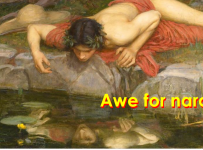
That is to say that replacing religious faith with a rational, mechanistic world view has created the disaster of the Anthropocene. The narcissists are in charge of creation!
As the world becomes the plaything of our imagination, it is reduced from an endlessly mysterious universe to a vast computer game. In that computer game anything that is beyond the capacity of our imagination and ability to control is simply consigned to the edges.
This dilemma is not new. It has always been thus.
Until recently, though, the light of reason illuminated a small enclave in a dark and mysterious wilderness that was undeniably larger and more powerful than all of humanity put together.
Now, the wilderness has been pushed back to a very fragile periphery. One simple example: Over 99% of the mammal bio mass on the planet is now domesticated.
So, we do not need to believe in an invented god to make us be good, but our self-centred intellect has not given use the wisdom to use the power we now control. We need to be reminded that the universe is not our plaything; that a little humility and respect is in order.
To quote Thomas Berry, “Most of all we need to alter our commitment from an industrial wonderworld achieved by plundering processes to an integral earth community based on a mutually enhancing human-earth relationship.”
We cannot achieve that while atheists and deep ecologists throw rocks at each other or, even worse, talk past each other and so fail to engage.
One ray of hope: the forces of the status quo are also philosophically split.
On one hand, fundamentalist believers simply want to stop thinking and be told what to do and, on the other side of the same coin, their leaders want everyone else to stop thinking so they can tell them what to do. This dynamic is driven by the primitive tribal desire for protection by their gods.
On the other hand, the power elite want to turn humanity into cogs in the totally godless machine that chews up all before it to generate its wealth and power.
The contract between the fundamentalists and the military-industrial complex is brutally simple. Give us your money, your young and the power to make decisions for you and we will feed and house you while the rest of the world swelters and starves.
This has always been the promise to the faithful. It is the same contract promised to the people of the USA, Iran and Russia. The gods change, but the machine simply demands cannon fodder to capture more resources.
The philosophical schism in the current expression of this contract is that it assumes the worship of money. Promised wealth is the reward for sacrificing yourself and your family to the machine. Wealth on earth has replaced a belief in the reward of the afterlife. Expose that and you expose the underbelly of the machine.
Our simple and robust counter is, “Money cannot save you from exploitation. Dedication to a harmonious and cooperative future can.”
It is pretty easy to drive logical holes through the argument that Russia, Iran, Turkey and the USA are all fighting in Syria to save the souls of the local people. It is much harder to convince them that there is a robust and vigorous future on a planet of nine billion people.
The battle for the hearts and minds of the tax-payers who provide the money, the bodies and the materials for war that will last a lifetime is not being fought rationally. By keeping a large part of the population on the brink of economic disaster it is easy to frame the global challenges as a scrabble for the last remaining riches in which we fight or die.
As always, the philosophical challenges cannot be unhinged from the economic and political ones.
We need to attach degrowth to communal abundance and robust longevity of resource management to a non-anthropocentric view of the universe.
We need a narrative of meaning that people can adopt and live by that counters the economic rationalism on which our daily activities currently hinge. Developing that narrative is not trivial.
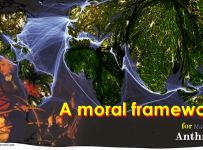
We have to remember that it has taken 600 years for the “Venetian method” (of binding society together through accurate and fair accounting of profit) to become the central tenet of our moral framework. It will not be displaced overnight.
We have to remember that it is 1700 years since Constantine re-appropriated and directed the succour people find in their religion in the name of consolidating his empire. The destructive nature of the Imperial Roman religious project and the Inquisitions that naturally flowed from it are deeply ingrained in our social institutions and need to be undone very thoroughly. That will take time.
The deeper challenge, though, is to re-integrate the ancient awareness of and respect for the awesome integrity of the universe without resorting to the fundamentalism of faith-based doctrine. We have built a world view in our image and like all good narcissists are blind to the limits of our obsession.
We have adorned the lowest heaven with lamps, missiles for pelting devils. We have prepared a scourge of flames for these, and the scourge of hell for unbelievers: an evil fate!
The Koran 67:6
The Cross is on a mission to explore the terrain of a moral framework without god as its central reference and that recognises the immorality of the mega-machine.
Organised religion, like corporations, and state bureaucracies are evil to the extent that they negate humanity and they are at the extreme edge of negative territory in this regard, right now. The sexual abuse scandal in the church, the corporate trafficking in slave labour the willingness of political rulers to sacrifice millions of lives to abstract ends are all examples of this.
Havec Pavel put it this way in an interview forming the first chapter of Disturbing the Peace.
A genuinely fundamental and hopeful improvement in “systems” cannot happen without a significant shift in human consciousness. … It’s hard to imagine the sort of systems I’ve tried to describe here, coming about unless man, as I’ve said, “comes to his senses”. This is something that no revolutionary or reformer can bring about, it can only be the natural expression of a more general state of mind, the state of mind in which man can see beyond the tip of his nose a d prove capable of taking on – under the aspect of eternity – responsibility even for the things that don’t immediately concern him, and relinquish something of his private interest in favour of the interest of the community, the general interest. Without such a mentality, even the most carefully considered projects aimed at altering systems are bound to fail.
Pavel proposes a moral framework without mentioning spirituality. He proposes that it is central that we take responsibility for the world beyond the immediate material environment and the consequences that we can detect in it. That additional awareness needs to be nurtured. Its development will be a significant evolutionary process. We must do more than simply damn religion and faith for the blind alleys down which they have led us.
We can damn religious institutions for the fact that their character as mega-machines consumes and depcreciates humanity. We can damn gods for the fact that we have used their elevated status to create meaning and justify our own purpose. Simply leaving behind the tribal competition as to whose god is more powerful, however, gets us no closer to describing or developing the state of mind we must enter to live harmoniously. Of course we need to leave blind faith behind to create the space in which greater awareness can evolve, but that alone is not enough. It is a necessary but not a sufficient condition.
Our task is to transcend the selfish grasping that has provided the evolutionary impetus that has created the Anthropocene. That means recognising values other than accumulation and consumption. Those higher values, then, are not simply material. Transcendence requires the recognition of the non-material character of those values.
This is vastly different than the second step of the twelve step program. That step directs its adherents to recognise that there is a larger force than themselves, it is cast as an acceptance of our own limitations. The opposite is true. We must remain responsible for our own actions. We must take responsibility for the fact that we are imperfect, but our actions impact on it. We must accept that the world is imperfect, and strive to take the real, flawed substance of reality and improve on it.
The second law of thermodynamics describes the nature of the life force as it applies to the material world. Structure is potential energy. As structures collapse, energy is released. The compost pile becomes hot as the complex plant matter breaks down, releasing the energy captured from sunlight as it energised the synthesis of that plant matter. Entropy is the lowering of energy, the “natural” end point of the universe. Life is the gathering and harnessing of energy to organise matter, to add structure. Plants provide the bulk of the energy for the ecosystem, converting carbon dioxide and water into complex carbohydrates using the energy of the sun.
Life then accumulates energy to create order. Civilized societies are more complex, involve more infrastructure, than primitive ones. When empires collapse civilisation decays. The ants nest is weakened and retreats to one corner of its physical space.
Our task, then, is not to reject structure and order, as they are the natural legacy of life. Our task is to direct our lives to enhance rather than destroy the environment that nourishes us: to determine principles that inform the design and implementation of our structures. Our task is the application of the principles of deep ecology to the ancient idea of husbandry.
The relevance of religion to this discussion and the raison d’etre for The Cross is that we currently do not have a cohesive value system beyond the material and commercial one that has usurped traditional systems.
Most importantly, the institutions with the most to lose are using the fear generated by the crises engendered by our self-centred materialism to generate a nostalgia in traditional faith-based moral frameworks. This is a backward step that can only accelerate the existential crisis that faces us in the Anthropocene.
It is imperative, then, that we clarify the discussion by separating morality, spirituality and belief. Further, we must underpin the mechanistic view of science with a moral framework that guides the application of its evidence-based research. This has economic, political and spiritual implications that all need to be explored.
And the anger of the Lord was against Israel, and he delivered them into the hands of the spoilers that spoiled them and he sold them into the hands of the enemies round about.
Judges, 3:14
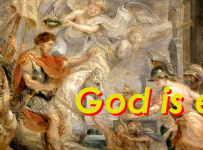
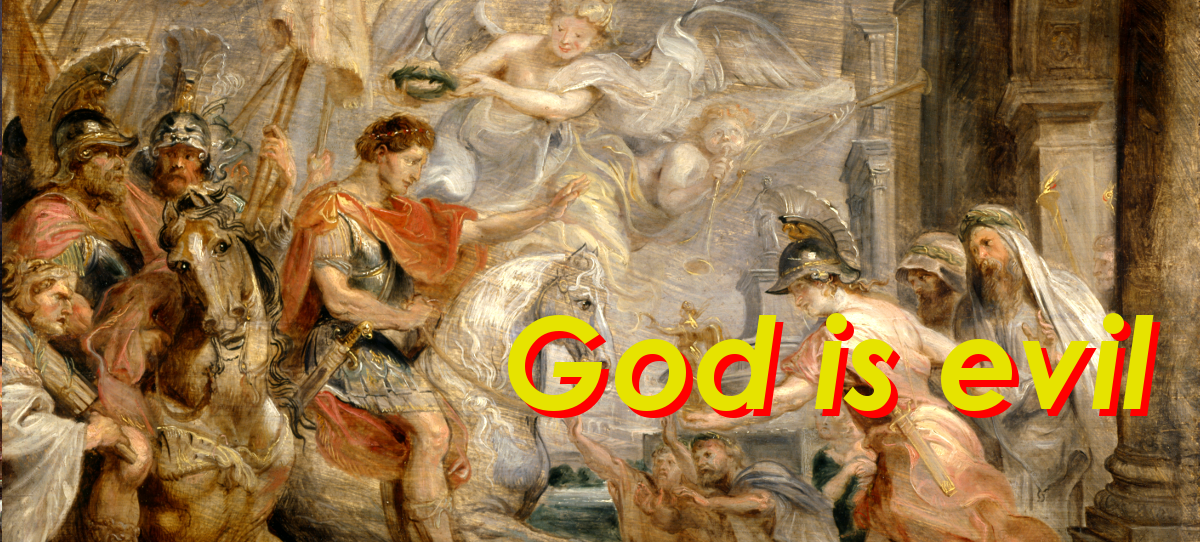
Constantine enters Rome – by Rubens.
The events at the 2015 hearings Royal Commission into Institutional Responses to Child abuse almost exclusively occupied The Cross last year. As a result you could be excused, Dear Reader, for thinking that might be this project’s raison d’etre.
Not so! Justifiable on past performance, perhaps, but incorrect.
The Cross exists to challenge the dominant assumptions of the Christian West and its hegemonic view of the geopolitical landscape. This ranges from the institutional rumblings of the established churches and the governments that protect them, the hysterical self-satisfaction of the Christian right as it carves a swathe through the falling middle-class, the arrogant rantings of the anti-theists and the empty posturing of the agnostic left.
In short, current discourse completely fails to apprehend the many and varied influences of religion, its role in society and therefore the damage it continues to do and the good that it should.
Worse, the dialectic of attacking or defending religion further fails to offer any evolution away from the tribal defensive ”My god is better than your god” and the disastrous consequences of that position in a time where weapons of mass destruction abound.
As a consequence, there is a complete misunderstanding of the role of secular government and so almost no healthy policy development to deal with the population’s need for narrative frameworks to meet the challenges of overpopulation, peak energy and climate chaos.
Some starting points.
There is no external god, driving the universe. There is no intelligent design.
We know this because we continually recreate God in our own image. All metaphysical frameworks mirror the structures of our apprehension of reality. Just as the aliens that visit earth and molest its citizens have evolved over the last century with the technology those citizens use in their day to day life and experience in their collective imagination through the shared fiction of cinema, television and radio, so has god evolved with human society.
Religion is an important cultural glue.
There is always common, agreed narrative that provides the shorthand that allows us to assume the meaning of things so we can get on with the rest of our lives. This cultural agreement allows us to meet with a common agenda and engage peacefully in quite complex dialogues and sophisticated activities. Culture need not be faith based, but there are always belief systems and it serves no purpose to deny the historical role of religion in providing that cultural glue.
Religion is an apparatus of the state.
Agriculture was developed at sword point to feed a standing army: There was no initial benefit for the farmer in stocking the king’s granary.
Since the emergence of the city, made possible by agriculture, the state has required more complex disciplinary and revenue raising structures to support its internal complexity. The marriage of religion and state was perfected by the Roman Church starting with Julius Caesar’s assumption of the roles of both Flamen Dialis and Pontifex Maximus and culminating in Constantine’s Nicene Conference which agreed on a Creed that served both the Christian priesthood and the imperial apparatus.
Ironically, JC (of the coin) was appointed Flamen Dialis by a jealous uncle precisely because it was the ancient religion that was deliberately powerless in state affairs. The high priest could not touch iron and all his trappings of office dated from an earlier Bronze age. By merging the Flamen Dialis, the Pontifex Maximus and the role of Consul, Caesar made himself a divine ruler, transcending the democratic apparatus of the Republic.
Constantine specifically recognised that religion was more effective (and cost effective) than brute force and it was easier to work with the priests than use a standing army to oppose them. He was opposed by the religious philosophers who understood that harnessing religion to the state was about power not spirituality.
We stand roughly 1700 years down the track, with a couple of centuries of Inquisition, brutal Crusades and three centuries of christian-justified colonialism under our belts.
Money is the new religion
Money provides the abstract value system by which we measure good.
In the last century we have shifted our focus of worship from the cross to the dollar. We believe in money because the institutional apparatus tells us this is the glue that holds society together.
Economic rationalism identifies the monetary cost of services as the yardstick by whether we know something is working. Social services are funded on the basis of outcomes that are accounted for to determine if funding should continue.
This befits a material world understood by the abstraction of numbers. The centrality of commerce to governance was perfected by the Venetians when they invented that great tool of economic rationalism, double entry book keeping. We now know, as Oscar Wilde so eloquently put it, the price of everything and the value of nothing.
It is notable that the Venetians accepted large wads of cash from the French Pope to transport French troops to the holy lands and fight for control of the religious relics of Jerusalem. Instead of heading to the Levant, the Venetians took the troops to Constantinople to gain control of the centre of commerce.
Thus began the process of supplanting religious values with commercial ones.
God is evil
This demonstrably illogical statement provides a dramatic starting point that is consistent with the full article published on The Generator. On one level it is not consistent with atheism in that god cannot be evil if god does not exist. In the context that god was only ever a human construct to provide meaning and has always been abused by those with the power to do so, it is as close to the truth as we are going to get. My final point is a perfect illustration of this illogical truth.
Commerce uses God to justify its wars.
Given this past, our furious refusal to acknowledge it, the fact that we still use it to justify increasingly complex and nasty wars over the geopolitical end-game for the planet’s last cheap energy, it is more critical than ever that these layers of belief, assumption and deliberate falsification are exposed examined and questioned. We have an “amoral” network of global corporations using Gods they do not believe in to exploit the passions of populations obstructing access to the resources they wish to control.
Even more challenging, we confront the existential crisis that we have the power to destroy our own species or, at least, civilisation and, without some moral framework underpinning radical change, this appears to be an almost inevitable outcome. As a result, there is a real and urgent imperative to create a new metaphysical framework that is not materialistic and self-centred but is rights and evidence based.
That is the mission The Cross sets itself at the beginning of the 2016th year of our lord, as they say in the Christian establishment of the European dominated globe in which I write.
There is a room at the Parliament House where disaffected ex-ministers meet. Other Parliamentarians refer to it as the Monkey Pod. Chief monkey was once famous for three word slogans. It was thought quite impressive that a monkey could string three words together convincingly enough to cause humans to repeat and discuss them as a meaningful phrase.
Westender can reveal, however, that the ape did not invent the phrases on its own. Humans were employed to invent them and teach them to him. Yes, that’s right, Moulah changed hands.
Of course, the monkey did not pay the money. Money is poured into the monkey pod – not generated there. The money was paid by vested interests for global use and the monkey was just trained to use the important lines. The fossil fools are those who are bought, not those who do the buying.
“Coal is good for humanity” was developed by Burston Marstellar for a global campaign by Peabody Energy, the world’s largest privately held company. It was such an important campaign that they decided to use five words. Not only that, but there are a flotilla of other phrases: energy poverty, little black rock, amazing things, watch what coal can do for you. Murston Marstellar used the same techniques for decades on the payroll of big tobacco.
Even after the world wildlife fund successfully took Peabody to court in the UK for misrepresenting the facts, those phrases are still being used. “This little black rock can do amazing things” is still being promoted across social media as I write. The moulah is still being spent even though the monkey is rattling the bars of a much smaller cage.
It was something of a slap in the face then, for Westender to be offered a tiny amount of money to run a piece of PR fluff on the civil contribution of the fracking industry. At a word rate we are talking here around thirty cents a word. While competition from out of work journalists has caused word rates to drop, both owners of Westender have earned considerably more than a dollar a word at many points in their somewhat chequered careers.
Only a dozen words actually did the work, the rest was designed to carry them. Thousands of jobs; world class natural gas; exciting economic and employment boost. There was a mangled piece of logic about falling oil prices that makes no sense when you parse it.
Compared to the hundreds of thousands spent on three word slogans it is an absolute pittance. Of course, Westender was not being asked to craft the words, merely mouth them like a member of the monkey pod. And that is the greater insult.
Of course, Westender has to live. We regularly write puff pieces for local eateries, we run advertisements for local politicians, and once – without payment – we even ran a puff piece for the Australian Air Force about a local girl who was allowed into a plane.
Our reporting on coal has gone through a similar arc to the rest of the media. During the 2013 election campaign (doesn’t Gillard and the Carbon Tax seem like a century ago) we argued internally whether anti-coal campaigns were too Green or just too radical, divestment was still considered weird, an idea that students had got out of Rolling Stone and coal was generally considered reliable, even though it had not yet been found to be good for humanity.
Since then, the Greens have started winning lower house seats in rural areas with the backing of farmers, Glen Lazarus has reinvented himself as a representative of Lock the Gate, conveniently forgetting it was a coal magnate who put him into power in the first place, and the banks have walked away from Adani in the Gallilee Basin.
What has changed is the hysteria with which the fossil fuel advocates are screaming from the sidelines. Even though they are now throwing money at small independent publications to try and build grass roots support, we’re not picking it up.
In the interests of fairness and even-handed reporting we have given you the three key phrases, free of charge, in the context of the truth. Anyone who wants the original press release which we were offered a hundred bucks to publish, just ask.
A Salisbury woman was told by Brisbane City Council today that a community garden she has built with local children is to be torn down by Council.
“I’m afraid I was not very polite,” Ms Pia Deerain told The Generator, “I told him not to save it for the children and hung up in his ear. Those kids put their heart and soul into this little garden.” Ms Deerain and nine neighbourhood children have started a compost heap and vegetable garden in her front yard, which last month extended onto the nature strip. Today, a council worker rang Ms Deerain to tell her that the garden will be dismantled. There has been a spate of battles between gardeners and council recently with high profile celebrities such as the ABC’s Jerry Coleby Williams getting involved in some early cases in 2008. He recently published a how-to article on working with Council on his own web-site. The most recent case in Norman Park was allowed to remain after a number of high profile articles in the mainstream media. Council reports that it has “decided that the garden may remain once a trip hazard has been removed”.
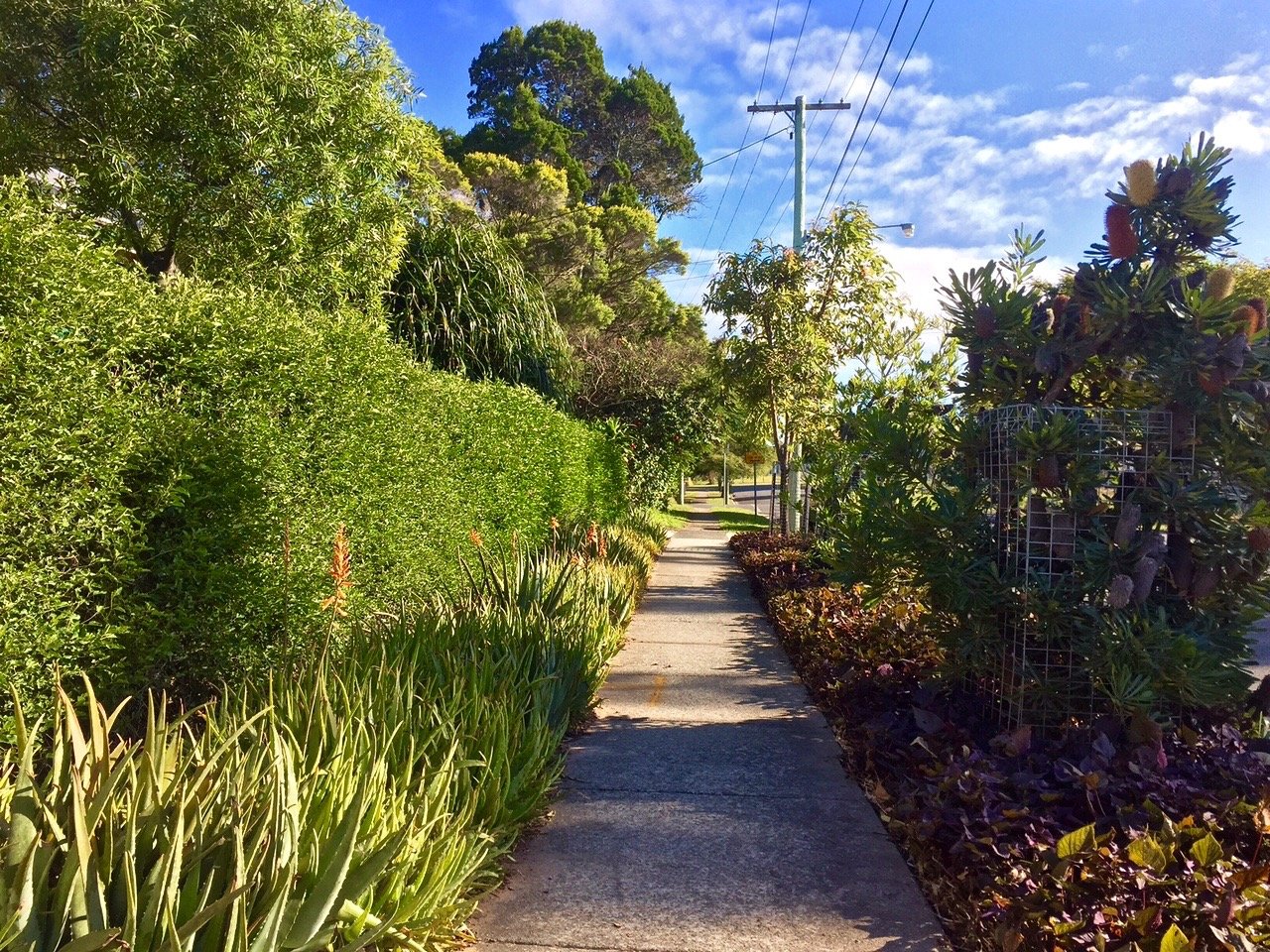
Jerry Coleby Williams’ nature strip
Council’s online advice is that nature strip gardens should not obstruct access to services and should not involve weeds or inappropriately large trees. Council has told Ms Deerain that they have picked out her garden in response to a complaint, but have not revealed the nature of the complaint. The Generator observes that this may be due to Ms Deerain hanging up while the Council worker was still talking. “We are talking about a couple of vegetable gardens in 30cm high bed,” Ms Deerain said. “If anyone needs access to the services I can remove the whole bed in fifteen minutes with a normal garden shovel.” The controversial garden is geographically in the centre of the Moorooka Ward. Councillor Steven Griffiths has been involved in a number of greening Moorooka activities across the ward. His office has been contacted by The Generator for comment. Greens candidate for Moorooka Leo Campbell said “Obviously Council has to ensure that planting in public spaces is appropriate, but the emphasis should be to encourage local food production and community engagement.” Readers can contact Steven Griffiths as follows. Phone: 07 3403 1730 Fax: 07 3403 1733 Email: moorooka.ward@bcc.qld.gov.au Website: www.stevegriffithsmoorooka.com Write to: www.stevegriffithsmoorooka.com/contact-us