Author: Geoff Ebbs

  • The Vatican needs thought leaders

    The Vatican needs thought leaders

    Send Tone to the Vatican

    Eric Abetz bemoaned this week the hegemony of the left wing press – he must mean Rupert, surely – in running down the Christian Right while failing to name, let alone declare its alliance with, the Secular Left. It is time he said, quoting from his Climate Denier’s handbook, that the press put both sides of the debate.

    I dispute his binary analysis, but he is entitled to his 15 minutes of fame like the rest of us.

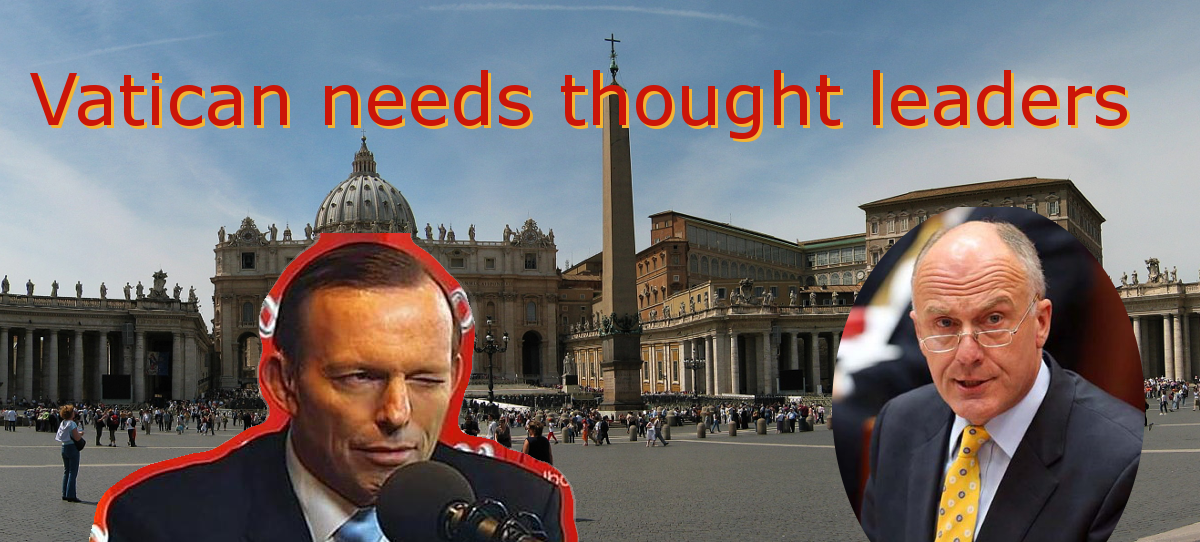
    Eric the Hun crossed the line into satire, though, when he lamented the loss of the Thought Leader, Tony Abbott, who was busy in a bow tie, lecturing the Angela Merkel on her misplaced altruism. Only by following Australia down the well-trodden path of torturing the politically unpalatable on remote islands as a deterrent to the more deserving poor can we find it in our colonist hearts to offer inclusion to a select few who fill in the paperwork and plead correctly.

    As The Cross sat down to push aside the latest sex abuse scandals and wax lyrical about the failure of the Abbott to sear his fanatic brand of religion onto Australian society through sheer political incompetence (he was made Prime Minister for god’s sake, and blew it!) the Curia started to tear itself apart in response to the Pope’s edict to stamp out corruption.

    Like a flash of divine inspiration, like the slashing of the Gordian knot, The Cross solved a number of problems with one simple thought. We can leave Abbott in Europe to advise the Vatican. He is trained up in the faith, his surname gives him the semblance of some sort of liturgical authority. Born in England he can wangle an EU passport.

    Abetz can join him. He only renounced his German citizenship in the weeks before the federal election. Even if there is not a cool-off period that allows him to cancel the cancellation, he can eat some humble pie and throw himself on Chancellor Merkel’s charity to get himself allowed in.

    Once there they will be able to apply their brilliance to the problems confronted by the Vatican. After all they are used to the budget emergency and the internal leaks.

    Tone has learned a thing or two about the rat in the ranks through the coup he has just suffered down under and will be able to plot with his old mate Pell about how best to bring the radical reformer Frankie under control before he goes to Hollywood and wins the hearts and minds of middle class whites.

    While Russia and the US harness Islam to battle out the positioning of the pipeline from the last reserves of cheap oil in the world, Tone and Eric can harness the energy of the Vatican to answer the important questions of whether or not women can be abolished and if God the Son is made of the same substance as God the father.

    Many of you will have assumed that Constantine settled this 320 years after the death of our lord by killing and banishing all the Arian bishops and putting together the Nicene Creed. Unfortunately for those who like their philosophy simple, though, Simeon the Stylite took the awful truth deep into the caves of Syria and sat on a pole for thirty years to protect it.

    The tearing apart of Syria to pipe the world’s last cheap oil west has released Simeon’s Secret. Observing Constantine at work, he noted that religion as we know it (as Constantine presented it) is simply a servant of the state that harnesses the fanaticism of the fringe dwellers in society to work for the State instead of against it. Using force to subdue your population is hard work and expensive, telling them that you are fighting for their beliefs though has the double bonus of freeing up your army to do other work and swelling its ranks with a bunch of manic fighters simply frothing at the mouth to die in the name of the cause.

    As it was in the third century so it is now.

    The fact that Tone failed to convince secular Australia that he was the true representative of the spirit on earth will not stop him having a go elsewhere.

    The Cross will watch with interest.

  • Listening Brief 1 – Rachel Rothschild – Lessons from acid rain  

    Listening Brief is a series of podcasts compiled by Charles Worringham on topics of interest to followers of The Generator.  They are generally 45 minute pieces. Let me know if you would like precis style summaries.

    Our very first guest, Rachel Rothschild, is working on her book RR2 A Poisonous Sky: Acid Rain and the Emergence of Environmental Science and Diplomacy, outlining the history of acid rain and how the world dealt with it from its emergence as a global problem in the sixties.

    There are important lessons here for current diplomacy on greenhouse emissions in the lead-up to the Paris climate talks.

    Rachel is an Assistant Professor at New York University where you can visit her profile page, or alternatively, her personal website.


    Play
  • The John James Newsletter 152

    The John James Newsletter 152

    John James, author, healer and publisher
    John James, author, therapist and publisher

    To subscribe or unsubscribe email John

    Once to every man and nation
    Comes the moment to decide,
    In the strife of truth and falsehood,
    For the good or evil side
    James Russell Lowell 
    People are lazy. With television you just sit – watch – listen. The thinking is done for you
    Roger Ailes
    A Manifesto for The Platform
    There is a deep despair growing among good people as Trump promises to dismantle seventy years of Social Justice reforms and Environmental Safeguards. We have struggled and devoted our lives to implement worthwhile policies over our lifetimes, and they could be gone in a trice. I sense a forlorn hopelessness growing among us. Instead, The Platform offers an alternative. The Manifesto does not aim at concentrating all our efforts on fighting the polluters. We accept that so much heating is now built into the system that it does not matter what we do we will still suffer massive sea level rise and droughts, food scarcity and deaths. The Manifesto offers the positive message that we can make life better now and in the future, and that we, the people of Good Will, can succeed at this. The Manifesto for Our Platform offers the promise that we can do something, in place of succumbing to numbing despair.
    This is the amateur film I assembled for the October Forum “Tomorrows World”- A climate change potpourri
    Alarm Over “Witch Hunt” 
    Trump demands list of Civil Servants who worked on Climate Policy under Obama. “This action should not be viewed in isolation, The Trump transition team is teeming with individuals with a proven history of attacking climate scientists and undermining climate science. Several members now overseeing federal agencies have harassed scientists based on their research and have long signaled a desire to dismantle federal climate science research.”
    Flynn’s Wacky Worldview
    Skepticism about Michael Flynn’s fitness for the position of national security adviser appears to be growing as more media outlets are paying closer attention to his (and his son’s) core beliefs about the world. Such scrutiny also appears to be more relevant since President-elect Trump may be relying more heavily on Flynn than on the CIA or other government intelligence agencies for his own assessment of world events.
    It is the people who will be paying the price. 
    Trump will use the media to sugarcoat, falsify, distract, intimidate, glorify and massify the millions of people who believed, once upon a recent time, that he would “Make America Great Again.” As the profiteers of Wall Street and the war hawks blend with the corporate statists, the super-confident Trump is telling us what their products will be like and that he’ll be their salesman. If you think all this sounds predictable, there are going to be more than a few “black swans” (to use Nassim Taleb’s best-selling book title) coming over the horizon. It is time to mobilize as citizens in the Paul Revere mode.
    The December 19 Electoral College Vote : Anti-Trump Coup Attempt Underway?
    Trump won 306 Electoral College votes to Hillary’s 232, her’s heavily concentrated in the northeast, mid-Atlantic and west coast. He won 30 states to her 20 – 270 EC votes needed to be elected. It would take 37 electors, from states he won, to deny him their vote, thereby throwing the process to House members to elect the president.
    Methane has just spiked at 2436 ppb
    Methane levels over the Arctic Ocean were as high as 2436 parts per billion on the afternoon of December 5, 2016, with most rising from the water. Pre-industrial level was ~720 ppb and each molecule is 20 times more potent than C02. Add that up!
    Start-up company breathes new life into old tyres
    A biofuel from old rubber tyres that can run turbo-charged diesel engines while reducing emissions by 30 per cent.’We have zero waste from the tyre’
    CEFC backs 270MW Sapphire wind farm, in vote of confidence for merchant market
    A consortium between Vestas and Zenviron will deliver the project, with Vestas supplying and commissioning the turbines, and Zenviron delivering the balance of plant. TransGrid will build, operate and maintain an on-site substation connecting the Sapphire project to the national energy grid.
    FBI v. Assange
    Former Icelandic minister claims US sent ‘planeload of FBI agents to frame Assange’ during mission to the country in 2011.

    The startling rise in oral cancer in men, and what it says about our changing sexual habits

    Oral cancer jumped 61% from 2011 to 2015. HPV infects cells of the skin and the membranes that lines areas such as the mouth, throat, tongue, tonsils, rectum and sexual organs. Transmission can occur when these areas come into contact with the virus. HPV is a leading cause of cervical, vaginal and penile cancers. Younger men are more likely to perform oral sex than their older counterparts and to engage with more partners.
     
    A Drive To Save Saharan Oases As Climate Change Takes a Toll
    From Morocco to Libya, the desert oases of the Sahara’s Maghreb region are disappearing as temperatures rise and rainfall decreases. Facing daunting odds, local residents are employing traditional water conservation techniques to try to save these ancient ecosystems.
    Is Sustainability Destroying the Earth?
    Only one-quarter of all consumption is by individuals. The rest is taken up by industry, agribusiness, the military, governments and corporations. Even if every one of us made every effort to reduce our ecological footprint, it would make little difference to overall consumption. If the lifestyle actions advocated really do keep our culture around for longer than it would otherwise, then it will cause more harm to the natural world than if no such action had been taken.
    Saudi Arabia’s Glass: Half Empty or Half Full?
    The people of Saudi Arabia have long accepted the bargain imposed by the founding king, Abdul Aziz al-Saud, in which they are disenfranchised but acquiesce in political powerlessness as the state provides them with security and a comfortable life. Now they are being asked to do more for themselves while the government does less, regardless of the price of oil.
    Congress Votes To Give Jihadists Anti-aircraft Missiles 
    The Senate passed a bill that puts every American who travels by plane at risk.  It is among the stupidest pieces of legislation ever written – to provide shoulder-launched ground-to-air missiles to lunatic jihadists who will undoubtedly use them to take down American or Israeli jetliners. The argument that these Islamic militants are fully vetted is complete nonsense as both the New York Times and the Wall Street Journal have repeatedly shown. Rebel groups “have entered into battlefield alliances with the affiliate of al Qaida in Syria formerly known as al Nusra to render the phrase ‘moderate rebels’ meaningless.”
     
    The “Golden Arches” Theory of Decline
    One of the answers to Trump, Putin, Orban, Erdogan, Salvini, Duterte, Le Pen, Farage and the politics they represent is to rescue democracy from transnational corporations. It is to defend the crucial political unit that’s under assault by banks, monopolies and chainstores: community. It is to recognise that there is no greater hazard to peace between nations than a corporate model which crushes democratic choice
    A degree by degree explanation of what will happen when the earth warms
    At 2C temperature increase the hot European summer of 2003 will be the annual norm. Anything that could be called a heatwave thereafter will be of Saharan intensity. Even in average years, people will die of heat stress.
    Beyond 2C billions of people will face an increasingly tough battle to survive. To find anything comparable we have to go back to the Pliocene 3m years ago. There were no continental glaciers in the northern hemisphere (trees grew in the Arctic), and sea levels were 25 metres higher than today’s. In this kind of heat, the death of the Amazon is as inevitable as the melting of Greenland.
    Between 3 and 4C the summers get longer  as soaring temperatures reduce forests to tinderwood and cities to boiling morgues. Temperatures in the Home Counties could reach 45C – the sort of climate experienced today in Marrakech. Droughts will put the south-east of England on the global list of water-stressed areas, with farmers competing against cities for dwindling supplies from rivers and reservoirs. Air-conditioning will be mandatory for anyone wanting to stay cool and the abandonment of the Mediterranean will send even more people north to overcrowded refuges in Scandinavia.
    Between 4 and 5C it will be an entirely different planet. Ice sheets have vanished from both poles; rainforests have burnt up and turned to desert; the dry and lifeless Alps resemble the High Atlas; rising seas are scouring deep into continental interiors. Even in Canada and Siberia summers may be too hot for crops to be grown away from the coasts. When temperatures were at a similar level 55m years ago in the early Eocene, alligators were living in the Arctic.
    Between 5 and 6C at the end of the Permian, 251m years ago, 95% of species were wiped out. That episode was the worst ever endured by life on Earth, the closest the planet has come to ending up a dead and desolate rock in space. On land, the only winners were fungi that flourished on dying trees and shrubs.
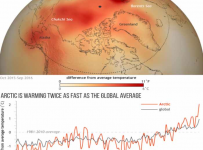
    Arctic Warming at Least Twice as Fast as Rest of World
    Much of this melt was almost certainly driven by the record warm Arctic temperatures seen during 2016. And according to NOAA, this year shattered all previous high marks for Arctic heat by a big margin — hitting 3.5C warmer than 1900. Overall, this rate of warming is at least twice as fast as the rest of the globe.
    Change in the Arctic this year was unlike any ever seen, scientists say 
    The annual Arctic Report Card documented air and sea-surface temperatures are higher, sea ice is sparser and more fragile and ocean waters absorbing more carbon, thus changing their chemistry to more acidic levels, while warming tundra is now expelling more carbon than it is drawing in from the atmosphere.
  • G20 Summit raises rights reminder

    Police prepared for G20
    Police have announced they are ready to fight but will not do so unless necessary

    Last night’s G20 Summit hosted by Souths Leagues Club and Westender brought to the fore that our rights as citizens to go about our daily business without interference from police have been suspended in the Southbank area during the G20.

    While the police repeatedly declared their intent to cooperate with citizens exercising their freedom to express their views and protest peacefully, the law allows them considerable scope to stop and search anyone within the declared zone, demand name and address and a declaration of intent with sweeping powers of arrest should a citizen refuse to cooperate with those requests.

    An outline of the implications of these changes to the law has been prepared by Caxton Legal Service and is available here.

  • Cloud technology does not replace support

    One of the claims of many cloud technology vendors is that you can save money by dealing directly with them.

    These claims are often made to justify the practice of renting software rather than purchasing it. Accounting software, for example, used to cost a few hundred dollars every two to five years, at the discretion of the business using the software. These days we increasingly rent it, in the cloud for thirty to fifty dollars a month.

    The advantages to the software company are obvious, the fact that they have to work so hard to sell the advantages to us is some indication that it is something of a one way street. There are fewer advantages flowing to us.

    The notion, then, that the cloud offers us a support free environment in which we can eliminate some of the costs of keeping our networks up to date, maintaining the latest version of the software and so on, is an integral part of the story. It is true, cloud software keeps improving, without any real effort on our part.

    There is a further advantage. The level of integration available between cloud vendors thanks to the wonders of web-services is incredible. My accounting software, interrogates my bank accounts, submits forms on my behalf to the tax office and invoices to those suppliers using the same package. That offers a considerable cost saving. Even more impressively, at year end, it produces the paperwork to submit to ASIC, saving me $750 at the accountant.

    That is a good example of the cloud delivering on its promise.

    The network of computer dealers, the channel, who traditionally serve the small to medium enterprise market are themselves small to medium enterprises and they are directly in the firing line of the cloud vendors. It is the elimination of the channel that is supposed to justify the increased costs of renting rather than buying software.

    Channel consultant and 2011 inductee into the Australian Reseller News Hall of fame, Moheb Moses, has written eloquently this month on the dangers inherent in this simplistic approach. As a channel consultant his job is to help resellers respond to this challenge and he makes some important points. Primary among these is identifying the real value proposition of resellers in the age of the cloud.

    The value offered by software distributors and installers to customers is not neccesarily vendor-specific, they really come into their own in looking after our interests, in understanding our business requirements and fine-tuning the combination of products we need to best serve those requirements.

    He inverts the traditional diagram of how the channel works to explain the problem.

     “Ask most vendors why they have a channel and they will usually provide reasons like reach, coverage, access to new customers, etc. In effect they view the role of the channel as an extension of their sales force.

    Interestingly, when partners are asked this question many of them also provide a similar answer. But this is a vendor-centric view of the world.

    When we look at the role of the channel from a customer’s perspective, we almost need to turn this diagram upside down.

    In other words, users perceive the channel as their conduit to multiple products and services from multiple vendors to create a solution. In effect they view the role of the channel as an extension of their IT Department.

    He then goes on to point out that the impact of the cloud may have eliminated some of the advantages that the channel offered the vendor, but they have not eliminated the advantages that that network of suppliers and support agencies offers to the user.

    The problem is when you look at it from a customer’s perspective. If we replace the channel with a cloud, as in the diagram below, the customer experience may not always be ideal.

    The issue for customers (especially in that enormous gap between Consumer and Enterprise) is that they need more than single function consumer apps, and they don’t have the internal resources that Enterprise has to evaluate and build the best solution themselves.

    And while the pure cloud vendors will say they have a “complete solution” they are only talking about their piece of the puzzle. For example, a cloud CRM vendor won’t sort out a problem with (say) the cloud Salesforce Automation vendor’s product. The cloud Email Archiving solution may use a completely different architecture to the rest of the cloud Backup and recovery strategy. In fact, for a lot of customers, getting technical assistance with a cloud product can be a problem because they often don’t even know where to start or their only means of communications is a faceless chat box.

    So, until every vendor can solve every problem for every customer, the channel is unlikely to disappear. Yes the role of the channel will change. Maybe instead of Systems Integrators, we’ll see Cloud Integrators or Cloud Brokers. Maybe instead of profit models being based on big lumpy one-off payments, businesses will adapt to smaller monthly recurring revenue streams. But the channel exists to fill the gap between the vendor’s product and the customer’s expectations, and I think we will need companies to do that for a long time to come.

    As we have written in Business Voice numerous times before, the critical element for success in an interconnected world is that we define the unique advantage that we offer, focus on that, and network with other agencies who can provide the complementary components. The twentieth century model of expanding through the value chain is only available to the very successful and very large.

    As businesses facing the challenge of paying more for the software that we used to upgrade only when we could afford it we need to work out how to maximise the value we get from that investment.

    Using our cloud suppliers to provide the matching of our business requirements to the mix of sofware services which we buy is almost certainly a big part of the puzzle.

  • Fossil-free superannuation fund launched

    Bill McKibben
    Bill McKibbon’s article in Rolling Stone – Do the Maths – kicked off the divestment movement

    Newly launched superannuation provider MyFuture Super claims to be Australia’s first fossil-free superannuation fund. The company said today that many funds are marketed as sustainable but invest in fossil-fuels such as coal seam gas and petrochemical companies such as Exxon Mobil, BP, Woodside, Rio Tinto and Petronas Gas.

    The company is appealing to investors keen to use their superannuation as a tool to counter corporate influence on government policy.

    If 20,000 of us were to shift our superannuation, we’d have a billion dollar divestment movement. With tens of thousands of Australians regularly taking part in rallies and marches in support of climate action, adding divestment to the mix will really turn up the heat on the fossil fuel industry,” the company’s press release said.

    There is still a pathway to cutting carbon pollution rapidly enough to avoid the worst climate tipping points. It begins with shifting our money out of funding climate collapse and into funding climate solutions.

    The announcement closely follows the publication of Karen McLeod’s article on the performance of ethical investments in Westender’s September edition.