Activists from legal, communications, mutual aid and class mobilisation backgrounds met to discuss ways that they might be stronger together at a Community Day for Climate at Brisbane’s Northey Street City Farm organised by XR Meanjin.
Geoff Ebbs, Andy Paine and Devlin Pointon at XR Community Day for Climate
A revolting murder. A war between exploitation for profit and land management. Deep insight into the Australian psyche. A small town divided between environmental values of koala habitat and the riches offered by industrial agribusiness. A determined environment officer is killed in cold-blood by a self righteous land developer. How does a community heal such an ugly rift? How does a film maker deal with the divide?
Hear Geoff interview director Gregory Miller, in the Cage. Kate Holden’s new book A Winter Road has caused us to refresh this story.
Writing in this week’s Pearls and Irritations, Peter Sainsbury points out that the most recent Intergovernmental Panel on Climate Change (IPCC) projections regarding climate change assume continual economic growth as fundamental to their projection. Their modelling offsets this with unprecedented technical change, such as green hydrogen and green steel and new, negative emissions technologies. Europe’s Fit for 55 zero-emissions plan, also predicates economic growth, decoupled from environmental harm. Sébastien Wälti of the Swiss National Bank and other degrowth researchers point out that the vast sums of money spent on emissions reduction technologies over the last two decades have had very little impact on emissions. Reducing consumption and population rather than inventing new technologies.
Europe will spend 30% of its total budget on reducing emissions by 50% in the next decade as part of its plan to achieve net-zero emissions by 2050. The Carbon Border Adjustment Mechanism (CBAM) is an essential part of that, putting a carbon price on imports from countries like Australia that do nothing to reduce their own carbon emissions. Economists have joined environmentalists in celebrating the plan as creating a level playing field. “Anyone can get an exemption to the CBAM if they have an equivalent [carbon price] at home,” said energy economist, Sir Dieter Helm. China has criticised the CBAM but, at the same time, is introducing the world’s largest carbon trading scheme. The USA and Canadian governments have proposed similar schemes.
A submission to the Parliamentary Enquiry into the funding of fossil fuel exports shows that one trillion dollars, or 37% of Australian’s superannuation funds, is managed by members of the Responsible Investment Association of Australia, the RIAA, and so is unavailable for investment in fossil fuels, logging and other environmentally harmful activities. The RIAA submission says that 2 out of 3 Australians do not want their investments being used for environmental harm.
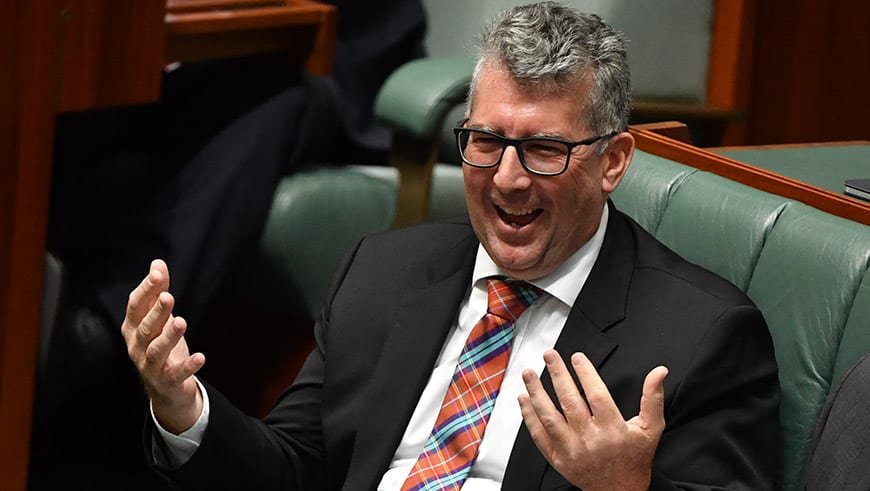
Keith Pitt representing the people of Rockhampton in the Australian Parliament
“It is of great concern to me that a legitimate industry like coal mining, which makes a significant contribution to the national economy and employs thousands of Australians, is being held back by what can only be described as corporate activism.”
Resources Minister Keith Pitt
Last week, Minister Pitt addressed the Australian Petroleum Production and Exploration Association conference in Perth last Wednesday to attack activist groups such as Greepeace. He urged petroleum companies to make submissions to the inquiry to prevent activism that “ignores the fact that resources development in Australia is carried out safely and responsibly and that Australia’s economy was built off the back of the resources sector”.
The terms of the inquiry are to inquire into:
The domestic and foreign investment opportunities and challenges for Australia’s export industries and their associated businesses, arising from changes in prudential standards and practices across banking, insurance and superannuation institutions, in addition to publicly-listed companies, with particular reference to:
The existing and future contribution of Australia’s export industries;
The investment guidance and advice provided by Australia’s financial regulators, including the Australian Prudential Regulation Authority (APRA), the Reserve Bank of Australia (RBA) and the Australian Securities and Investments Commission (ASIC), to banking, insurance and superannuation institutions, and also to publicly-listed companies, in relation to investment in Australia’s export industries;
The approach and motivations of our financial institutions, including banks, insurers and superannuation funds, as well as publicly-listed companies, to their investment in Australia’s export industries;
The consequential impacts of (2) and (3): a) For legitimate. law-abiding businesses connected to Australia’s export industries; b) On regional and rural economies that are reliant on Australia’s export industries. particularly in light of the COVID-19 recession; c) Our national economy. particularly in light of the COVID-19 recession;