Category: Archive

Archived material from historical editions of The Generator

  • World Bank threatens Congo’s rainforest

    World Bank plans to increase timber production in Congo threaten the environment and ignore the rights of forest dwellers.
    By Jean-Roger Kaseki, March 19, 2007 9:00 AM,

    In 2004, more than 100 environment, development, and human rights groups in the Democratic Republic of Congo called on the World Bank to stop plans that would carve up the world’s second-largest rainforest into industrial logging concessions.

    Photo by Michael K. NicholsInternal World Bank documents obtained by the Rainforest Foundation revealed that the bank intended to create a favourable climate for industrial logging in the Congo, and envisioned a 60-fold increase in the country’s timber production.

    Plans for the development of the forests would have major repercussions on the rights and livelihoods of millions of Congolese citizens, with serious and irreversible impacts on the forest environment.
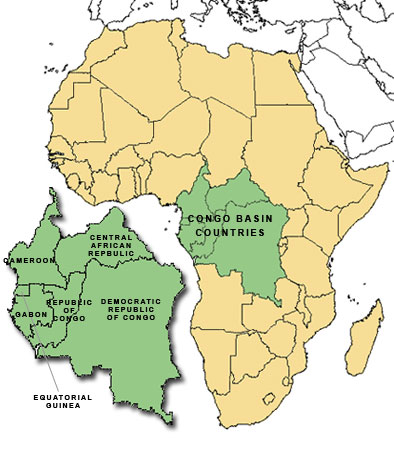
    Map of the countries of Congo basinCovering around 1.3 million square kilometres, the rainforests of the Democratic Republic of Congo are the largest in the world after Amazonia, and have so far largely been spared extensive destruction. An estimated 35 million people live in and around these forests, including Bantu farmers, and Twa and Mbuti hunter-gatherer Pygmies.

    Full story on comment is free

    The Congo is the Earth’s second largest river by volume and has the world’s second largest rainforest (18% of the planet’s remaining tropical rainforest). The Congo Basin represents 70% of the African continent’s plant cover and makes up a large portion of Africa’s biodiversity with over 600 tree species and 10 000 animal species. Six nations – Cameroon, the Central African Republic, the Republic of Congo, the Democratic Republic of Congo, Equatorial Guinea and Gabon – share the 1.5 million square mile Congo basin.

    The Congo is one of the world’s most threatened ecosystems. Commercial logging, clearing for subsistence agriculture, and widespread civil strife has devastated forests, displaced forest dwellers, and resulted in the expansion of the “bushmeat” trade. Since the 1980s, Africa has had the highest deforestation rates of any region on the globe.

    Source: rainforests.mongabay.com/congo

  • Seeney accuses Qld gov of stealing water for profit

    Reference: Queensland Parliament, Record of proceedings, First Session of the Fifty-second Parliament, Thursday, 8 March 2007, p.795. The document is available at http://www.parliament.qld.gov.au/hansard

    Erisk Net, 14/3/2007

  • Tas gov fast tracks Gunns’ $2b pup mill

    Tasmania’s politicians would determine the fate of a $2 billion pulp mill, prompting claims the state was descending into “cronyism and corruption". Premier Paul Lennon announced cabinet backing for a fast-track assessment of Gunns Ltd’s project, outside the planning system, reported The Australian (16/03/2007, p.2).

    State fast tracks assessment after the Gunns shock: The fast track was agreed at emergency meetings of cabinet and the Labor caucus after Gunns on Wednesday withdrew the project from the independent planning process.

    No public debate: The new process – which sources said would involve assessment by expert consultants – would be put to a recalled state parliament this week. Sources said the assessment could be as short as two months, and no longer than five, with no input from the public.

    Parliament to have final say: Parliament would also have the final say on whether the biggest development proposal in the state’s history could be built on the Tamar River, near Bell Bay, in northern Tasmania.

    The blame game: Gunns claimed that delays before the Resource Planning and Development Commission, and its inability to come to a verdict before November, had forced its hand. However, the man appointed only last month to head the RPDC assessment, former judge Christopher Wright, has blamed Gunns for "all or most" of the delays.

    The Australian, 16/3/2007, p. 2

  • Water fills Lake Eyre

    South Australia’s Lake Eyre continues to fill with water from prolonged heavy rains in the north of the country.  Inital water from rains this season evaporated or were absorbed into the soil before reaching Lake Eyre, which is the lowest point on the continent.

    Lake Eyre


    A lone yacht takes a rare opportunity to sail in Lake Eyre. Photo: David Mariuz

    Source: theage.com.au  

  • Venezuela Squeezes Out the International Monetary Fund

    He also announced that Argentina and Bolivia have eagerly adhered to the development fund. “Seven years ago I was alone in South America with a proposal for the Bank of the South, a bank that is ours to replace the international financing system, the International Monetary Fund and the World Bank. 15 days ago with Argentina we signed an agreement and today we have agreed to move forward to outline the Bank of the South. Tomorrow, Bolivia will adhere to the Bank of the South. They are building a bank that is ours.”

    Leaders in the Southern Cone, so far from Venezuela, Argentina and Bolivia, have joined the bank project with hopes that such a bank would allow Latin American nations to avoid the policy conditions that generally come with IMF loans.

    According to Alan Cibils, an Argentine economist specializing in foreign lending institutions, the Bank of the South is still in its early stages but could develop into a concrete alternative to the IMF and World Bank. “It could be that part of the function of this bank is to act as a lender of last resort for countries in crisis that need funds and instead of going to the IMF they would go to the Banco del Sur, so that’s a possibility. The other possibility or the other alternative is that it acts as a development bank for development projects of the different countries. I think either way it’s a good idea to have both of these functions.”

    The IMF’s current crisis has further compelled leaders to look for regional alternatives for financing. “I think that it points to a very clear failure of the northern institutions specifically the IMF and also the World Bank and the effects of the policies they have promoted in Latin Ameirca and throughout the world,” says Cibils. He adds, “so having an alternative institution that is local and really obeys more to local needs than to the
    need of northern finance I think is a good thing and is desirable.”

    Despite enthusiasm, Cibils warns that the fund will have to overcome corruption and stay wary of draining economic reserves in the respective Latin American countries. “Now how this will be implemented and whether it will be able to act outside of the clientalism and corruption that you sometimes have in governments like Argentina for example is an open question.”

    Carlos Aznarez international journalist with Resumen Latinoamericano says that Argentina and Brazil joined the Bank of the South project to keep up with competition with one another in the global market and in leadership of Mercosur. “Not all the countries think the same about the Bank of the South. The idea that is pushing Chavez is the idea to precisely use the funds and federal reserves from each country to promote economic growth in Latin America’s poorest countries.” Although he says he is skeptical over Brazil’s and Argentina’s intentions to adhere to the regional fund. “The direction this project is going to take depends on the ideological influence of Venezuela. Bolivia is the country that is going to receive substantial support because it doesn’t have a lot of economic alliances. And Brazil and Argentina are going to flirt with the Bank of the South.”

    The Bank of the South is set to begin operations within four months with international reserves from all participating nations. Venezuela hopes that Nicaragua and Ecuador will soon join the fund, whose initial capital will be 10 percent of Caracas and Buenos Aires international reserves, or roughly seven billion dollars.

    Marie Trigona is an independent journalist based in Buenos Aires.