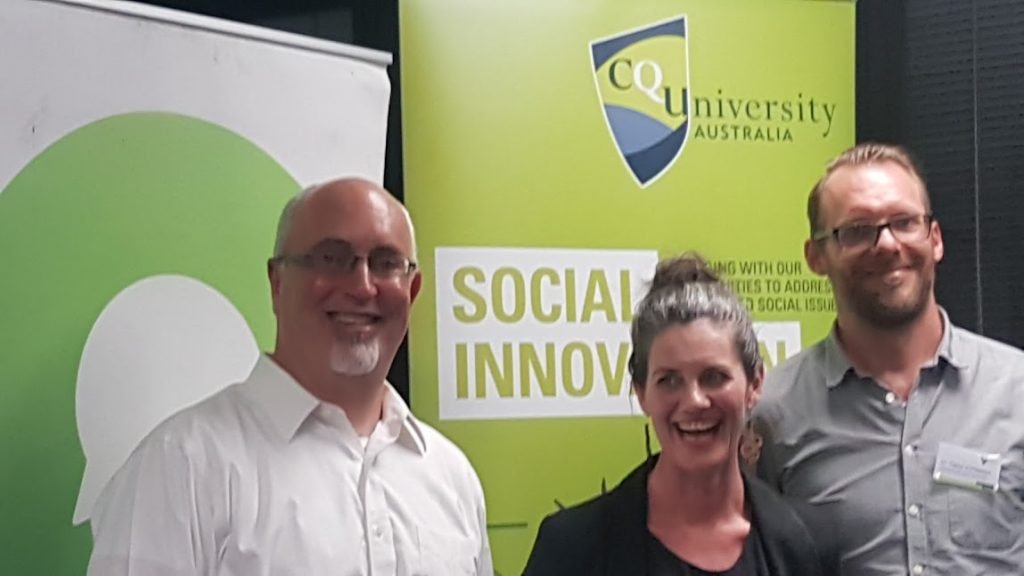
I had the honour and privilege of meeting a dozen young women
interested in business with purpose at the QUT Foundry last week. Organised by
HerHub, the event was billed as “Beyond the circular economy” and promised to
navigate the Circular Economy, the Performance Economy, the Sharing Economy and
other terms that confront and confuse people who want to do more than make a
quick buck.
One of the reasons for this particular framing is that the
Circular Economy is getting a
bit of press recently. State Governments, including Queensland
and Victoria
have announced plans to transition to a circular economy, the Queensland Chief
Entrepreneur has been travelling the state promoting
it and presented the state’s emerging Circular
Economy Lab at the recent Circular
Economy Conference in Finland.
With the emphasis in most circular economy discussions clearly
on waste reduction and resource efficiency, significant concern has been raised
by serious thinkers about the “wicked problems” of climate chaos, economic
growth, population growth, global equity and social justice. None of these
problems are necessarily addressed, let alone solved, by the more efficient use
of finite resources.
To unpack this knotty field of enquiry and explain the
various Economies, post-growth, de-growth, social enterprise, profit for purpose,
philanthropy, charity and BCorp I set out to build a map of the landscape by
creating some broad divisions starting with the difference between the profit
and the non-profit sector.
Identifying antecedents
Traditionally, business has been for profit and government and
chanty have not. The government provides schools, hospitals, the police and utility
services such as water while charities did good work of supporting people who were
left behind by the business of business. The way that industry coding systems such
as the Australian
Tax Office Business Industry Codes (ATO BIC) and the Australia
and New Zealand Standard Industrial Classification (ANZIC) work reflects
this, with very high level codes for activities such as Charity and Government
that put them on a par with Manufacturing, Agriculture or Mining.
The inherent assumption here is important: the accumulation
of wealth is different to the provision of services for the public good. This
contrast is consistent with the traditional left, right divide of politics: you
are either focused on doing good or on making money.
The economic and political history of the last fifty years
has blurred this simple separation. That blurring comes from many sources.
Dispossessed groups, such as First Nation people, have long
analysed charity as enshrining a power imbalance in which the powerful assist
the powerless to a limited extent on the understanding that they do not attempt
to tackle the underlying power structure. This can be summarised in the phrase “a
hand up, not a hand out”.
That battle to create independent funding and so escape the
tyranny of the purse strings has become important in a range of sectors that
have suffered funding cuts as governments have begun to withhold funding from
groups that tackle their agenda. At a global level this is evident in the US government’s
refusal
to fund any international aid agency that supports abortion. John Howard
tied school funding to the flying of the Australian flag and throughout the
noughties and teens conservative governments have
closed funding of environmental groups, and those fighting for the rights
of women, queers and refugees.
When the Australian Climate Council was defunded by the
Abbott Government in 2013 it
turned to crowdfunding to keep the door open, forcing both the government
and the activist sector to become more sophisticated in funding and regulation campaigns
and activism designed to achieve social and environmental outcomes.
This is an extension of the much longer term project to
measure all social activity in dollar terms. The public accounting of welfare
agencies and support services played into the hands of large charity providers
who could afford the administration staff to meet the reporting requirements and
thus had the infrastructure to support small delivery services. This consolidation
of the community service sector led to the acceptance that there was a
relationship between funding and outcomes, that outcomes cost money and created
a measurable value.
The reason for identifying these different historical
reasons for relating the impact of outcomes to the cost of achieving them is to
understand the different threads that have informed the growth of what we now
call social enterprise and impact investment. There is a blend of the desire
for independence, recognition of value, justification of activity and alignment
of value.
Australia’s National Disability Insurance Scheme is a
world-leading experiment that was initiated by a 2011 Productivity
Commission inquiry that determined it was more productive for the entire
economy to harness the energy and creativity of the disabled by integrating
them into the workforce than it is to exclude them by providing them with welfare.
As a result, we have launched a scheme in which the disabled are treated as
clients that select the services they need to achieve the outcomes they want in
a transactional relationship with service providers. The logic is that this
will empower those clients to be agents of their own destiny and thereby
contribute more to society at lower cost than if they are simply supported to
survive.
One outcome of this is that services providers have had to
evolve the administrative and customer service activities to support those
transactions instead of simply applying for large chunks of block funding.
Discussing this on
ABC Radio Vision Australia’s manager for government relations, Chris
Edwards, said that the service has gone from managing seven block funding
grants to over 30,000 individual subscribers and had major teething problems in
establishing commercial communications with its vision impaired audience.
And so, to terms
Given the landscape, then, it is a little easier to place
the various terms upon it.
Social enterprise has gone through a number of
iterations, commencing in the mid-nineties as a response to the economic
rationalist agenda that community services should be able to justify the
expense of operating the services they provided. Some parts of the sector began
to explore entrepreneurial alternatives to grants as a form of funding their
activities. By adding elements of enterprise to their service they could
explore alternative means of accounting for that value.
It now contains a mix of community services who seek funding
from transactions with their clients, enterprises that are fundamentally
created to support a community or create a social, environmental or cultural impact
and enterprises that can claim to achieve some impact even if that is as simple
as a foundation created to support a small number of disabled people, or an
enterprise created to provide employment for a marginalised group in one location.
The key point about social enterprise is that its proponents
attempt to merge a social benefit with some form of enterprise. The general
rule of thumb is that at least 50% of the total turnover of the organisation
should come from enterprise. It is much harder to measure the impact of that
activity but it is generally held that the impact should be the primary purpose
and that the organistion should be able to point to its theory of change and
demonstrate how its actual activities work toward achieving that change.
Complementing social enterprise are impact investors,
who are prepared to invest in activities that have a positive social, cultural
or environmental impact even if it means a somewhat smaller return on
investment. Impact investors are not specifically concerned with investing in
social enterprise, they may support research into a product designed to solve
an issue on a totally philanthropic basis. Generally, they are led by wealthy
people who know how to build wealth and so there is often a net growth in the
value of their investment despite the fact that its primary purpose may not be
financial. Globally, that model is led by philanthropic organisations such as
the Bill and Melinda Gates foundation. A range of groups who suggest that
putting money into traditional charities is an ineffective way to address
global problems use the term impact investment to explain their strategy.
The Australian Federal Government is currently putting
together an Impact Investment Working Group, charged with developing a policy
for supporting impact investors and freeing them from some traditional
restrictions imposed by the corporations law.
Impact investors are generally patient investors.
That term is applied to anyone who is prepared to forgo a short term return on
investment for some reason. That reason may or may not be related to the impact
of the investment, for example it might be for higher long term gains. It is
generally true, however, that the primary reason for patience in an investor will
include some non-financial outcome, which is probably aligned with the values of
the investor.
Social trade is a term used to describe social
enterprise which explicitly infers a transactional basis that is arguably
implicit in the term social enterprise. Social traders Australia is a body
designed to promote social trade that has very specific entry criteria. These
are a rigorous expression of the criteria described under the social enterprise
heading and social traders may generally be described as social enterprises.
Profit for purpose organisations are very similar
with the notable absence of any restrictions on the purpose. The term is
largely used to impress investors who, on the whole, are more comfortable with
organisations focused on profit, than on organisations focused on creating an
impact. The lines between profit for purpose companies and social enterprises
are somewhat blurry as a result but tend to be more commercially oriented and
seek a higher profile through marketing and participation in government funded
programs.
The sharing economy can be used as a term to describe
activities that tend not to be commercial, but allow its participants to
benefit by trading unwanted or spare goods with others and so reduce their
expenditure and consumption. Such activities might be driven by either outcome
(impact), and might also involve a financial transaction despite being driven
by the desire to build community, reduce consumption or waste rather than to
raise a profit. Peer to peer organisations like AirBnB and Uber are often
described as being in the sharing economy, the notable difference is that the enabling
platform is owned by a corporation that is building wealth for its shareholders
not the members of the community.
The gifting economy is a different term, often used to
describe transactions in situations where money does not exist, but which
overlaps significantly with the sharing economy and which excludes corporate
ownership of the platform that facilitates the service.
The circular economy is not a subset of this
landscape, it is a different way to approach the problem.
The simplest way to describe the circular economy is to
contrast it with the linear economy of extraction, manufacturing, consumption and
waste. One example of the linear economy is that we catch rainfall in the
mountains using a dam, we pipe it into a city, and then pump our sewage out
into the ocean. Another is that we dig up a resource, like coal, we burn it to
produce heat or energy in the form of electricity and release the carbon
dioxide, pollutants and waste products into the environment. One does not have
to think terribly hard about the consequences of the linear economy with a
growing population on a finite planet to realise the value in considering ways
to make it more circular in nature.
The classic metaphor for a circular economy is the ecosystem
of something like a rainforest, in which all resources are re-used, there is no
waste, and one organism’s output is another organism’s food. Commercial
examples are mining the waste stream through re-use of products, or full corporate
responsibility for a product from manufacture to remanufacture. Many white goods
companies in Germany, for example, re-use the bodies of their appliances to
deliver new models, rather than allowing the customer to throw them out.
A close examination of the circular economy reveals that
some activities are more efficient than others. Re-use of a manufactured part
is orders of magnitude more efficient than recycling, ofr example, and so many
models of the circular economy involve concentric loops with the “inner circle”
being the most efficient. The so-called performance economy promotes the
ongoing ownership of the product by the manufacturer, leading to the re-definition
of the product as a service. Powerful as the resulting Functional Service
Economy is, one only has to consider the price of software, or photocopying
to see that corporate handling of products of services have not always worked
in favour of the customer.
The circular economy and its variants are attractive to
industry and government because the concept has a significant and positive
impact on waste, resource consumption and pollution without undermining the
basic tenet of capitalism that we must maintain infinite economic growth. It is
essentially a resource efficiency model of industry, despite the possibility of
applying the definition to community, environmental and cultural outcomes.
On the other side of the line sharply differentiating those
approaches supporting capital growth from those attempting to ensure long term
sustainability are post-Growth, de-Growth and Natural Capitalism.
The fundamental principle in this field of enquiry is that
we cannot grow infinitely on a finite planet and, since capitalism requires continuous
economic growth to survive, we must move beyond growth to build a sustainable
economy.
De-growth is the movement defining the ways in which we
might uncouple our personal activity or or social organisation from the requirements
of continuous growth. It examines how we might live without money, what
business means if money is not the primary objective. Post Growth defines forms
of social organisation that might emerge and allow us to exist in a world that
does not rely on growth. So degrowth is the pathway and post growth could be
seen as the destination. Natural capitalism is one of the many forms of
economic organisation described as a solution to the problem of infinite growth
and the outcome of degrowth.
A Post Carbon economy is a subset of these broad
philosophical views of the future that is specifically focused on mitigating
Climate Chaos and coping with Peak Oil. It is essential that we move to a post-carbon
economy to survive on a planet with billions of humans but it is a necessary,
not a sufficient condition. Further, it is increasingly apparent that some of
our ruling elites have already made the same assessment and prefer to dispense
with billions of humans than with the convenience of burning fossil fuels. Jem
Blendell’s Deep Adaptation explores the stark reality of our options and
challenges us all to change our practice in the face of those choices.
Navigating the future
A map is only useful if there is the will and skill to use
it to guide us to a particular destination. Every budding entrepreneur or
socially concerned citizen will have their own priorities in selecting points
on the map, and pathways between them. Those priorities will be driven in part
by logical reasoning and in part by innate resonance and desire.
What is apparent to this author, though, is that the
emerging generation is better informed, connected and equipped to deal with
these challenges than those of us who have blundered into it. One of the few
skill sets I would suggest is better held by the generation born in the middle
of last century is the practical skills of surviving in the physical world. If the
elders can humbly offer the wisdom of their years and that practical experience
to the clear sighted, engaged and connected humans taking the reins of society
now, we have some hope of salvaging enough skerricks of civilisation to pass
onto future generations despite the inevitable depletion in our numbers and
standard of living.