Category: Energy Matters

  • Peak Oil Mitigation: Cars With 70+ Miles Per Gallon Available Globally But Not …

    News 3 new results for PEAK-OIL
    Stagecoach: Green Peak Oil Stock Expanding in North America
    Forbes
    In our new peak oil world of $4 gas and, more and more people are opting for bus travel. The young like it: My girlfriend’s daughter travels by bus almost exclusively, even though she owns a car. None of the problems above are likely to get any better.
    See all stories on this topic »
    Peak oil debate is over, and U.S. energy independence will be obtained by 2020.
    Examiner.com
    Amazingly, a growing chorus of analysts are arguing that the peak oil debate is over and the US will soon achieve energy independence. I agree. It is over, and the US will soon achieve energy independence. However, the implications of this are negative
    See all stories on this topic »
    Peak Oil Mitigation: Cars With 70+ Miles Per Gallon Available Globally But Not
    World Of WallStreet
    What do you think? Still getting double the gas mileage of the USA’s fleet with existing European auto technology seems noteworthy. Suppose Peak Oil kicks in with something like 4% less liquid fuels per year available to the USA citizen.
    See all stories on this topic »
  • Converting Carbon Emissions into Liquid Fuels


    Converting Carbon Emissions into Liquid Fuels

    Posted: 17 May 2012 03:16 PM PDT

    It is pretty much unilaterally agreed that renewable energy is vital for the future of energy production, and with that in mind many companies are researching new ways of creating cheap alternatives to traditional fossil fuels.One idea that is becoming more popular is capture and recycling of carbon emissions to create ‘syngas’ which can then be converted into transportation fuel.One company researching this technology is Carbon Sciences from California whose chief executive, Byron Elton, admitted that, “whilst you can achieve…

    Read more…

    State Department Shuts Down Wind Turbines due to Noise Pollution

    Posted: 17 May 2012 03:15 PM PDT

    A few residents in Falmouth, Massachusetts have finally won in their battle to have local wind turbines shut down due to the noise levels that they produced.The Department of Environmental Protection released a report on Tuesday which stated that the noise levels from turbines less than 1,500 feet from the nearest home exceeded the acceptable state levels. Three megawatts of wind power will be shut down whilst further investigations are under way.There is fear that this finding will give power to the increasingly vocal opponents of wind power.…

    Read more…

    Mid-Atlantic States now have enough Solar Capacity to Power 1 Million Homes

    Posted: 17 May 2012 03:13 PM PDT

    Over recent years many nations around the world have acknowledged the need to employ a transition from fossil fuels to renewable energy. Whether it be due to the threat of diminishing oil supplies, or in an attempt to reduce their carbon emissions and the rate of climate change. In this fashion the number of renewable energy installations, such as wind and solar farms have exploded, with gigawatts of clean energy being developed each year.In the US, the total solar capacity in the Mid-Atlantic states has doubled for the past two years consecutively,…

    Read more…

    You are subscribed to email updates from OilPrice.com Daily News Update
    To stop receiving these emails, you may unsubscribe now.
    Email delivery powered by Google
    Google Inc., 20 West Kinzie, Chicago IL USA 60610

    Posted: 17 May 2012 03:16 PM PDT

    It is pretty much unilaterally agreed that renewable energy is vital for the future of energy production, and with that in mind many companies are researching new ways of creating cheap alternatives to traditional fossil fuels.One idea that is becoming more popular is capture and recycling of carbon emissions to create ‘syngas’ which can then be converted into transportation fuel.One company researching this technology is Carbon Sciences from California whose chief executive, Byron Elton, admitted that, “whilst you can achieve…

    Read more…

    State Department Shuts Down Wind Turbines due to Noise Pollution

    Posted: 17 May 2012 03:15 PM PDT

    A few residents in Falmouth, Massachusetts have finally won in their battle to have local wind turbines shut down due to the noise levels that they produced.The Department of Environmental Protection released a report on Tuesday which stated that the noise levels from turbines less than 1,500 feet from the nearest home exceeded the acceptable state levels. Three megawatts of wind power will be shut down whilst further investigations are under way.There is fear that this finding will give power to the increasingly vocal opponents of wind power.…

    Read more…

    Mid-Atlantic States now have enough Solar Capacity to Power 1 Million Homes

    Posted: 17 May 2012 03:13 PM PDT

    Over recent years many nations around the world have acknowledged the need to employ a transition from fossil fuels to renewable energy. Whether it be due to the threat of diminishing oil supplies, or in an attempt to reduce their carbon emissions and the rate of climate change. In this fashion the number of renewable energy installations, such as wind and solar farms have exploded, with gigawatts of clean energy being developed each year.In the US, the total solar capacity in the Mid-Atlantic states has doubled for the past two years consecutively,…

    Read more…

    You are subscribed to email updates from OilPrice.com Daily News Update
    To stop receiving these emails, you may unsubscribe now.
    Email delivery powered by Google
    Google Inc., 20 West Kinzie, Chicago IL USA 60610
  • NUCLEAR POLICIES: Power shift begins to move German industry

    NUCLEAR POLICIES: Power shift begins to move German industry
    Germany’s third largest aluminium producer has filed for bankruptcy as trade groups call for affordable power supply equivalent to the nuclear capacity taken off the grid as a response to the Fukushima accident.

    ENERGY & ENVIRONMENT: EDF posts record carbon efficiency
    The carbon intensity of generating capacity owned by the EDF group of companies fell below 100 g/kWh for the first time in 2011, while in France EDF’s emission rate dived 25% to 30.4 g/kWh.

  • We Have Finally Reached Peak Government

    We Have Finally Reached Peak Government

    death star

    wikimedia commons

    As the foundations that supported an expansive centralized State crumble, the entire centralized State is revealed as unsustainable: we have reached Peak Government.

    In previous entries this week, I have detailed the profound unsustainability of government pensions and entitlements such as Medicare. These are symptoms are a larger phenomenon: Peak Government, the realization that Central States cannot sustain their current budgets or future promises.

    Most informed people are familiar with the concept of Peak Oil, but fewer are aware that we’re also entering the era of Peak Government. The central misconception of Peak Oil — that it’s not about “running out of oil,” it’s about running out of cheap, easy-to-access oil — can also be applied to Peak Government: It’s not about government disappearing, it’s about government shrinking.

    Central government — the Central State — has been in the expansion mode for so long that the process of contracting government is completely alien to the nation, to those who work for the State, and to those who are dependent on the State. Thus we have little recent historical experience of Peak Government and few if any conceptual guideposts to help us understand this contraction.

    Peak Government is not a reflection of government services or the millions of individuals who work in government; it is a reflection of four key systemic forces that drove State expansion are now either declining or reversing. The Four Key Drivers of State Expansion The twin peaks of oil and government are causally linked: central government’s great era of expansion has been fueled by abundant, cheap liquid fuels. As economies powered by abundant cheap energy expanded, so did tax revenues.
    Demographics also aided Central States’ expansion: as the population of working-age citizens grew, so did the work force and the taxes paid by workers and enterprises.

    The third support of Central State expansion was debt, and more broadly, financialization, which includes debt, leverage, and institutionalized incentives for speculation and misallocation of capital. Not only have Central States benefited from the higher tax revenues generated by speculative bubbles, they now depend on debt to finance their annual spending. In the U.S., roughly one-third of Federal expenditures are borrowed every year. In Japan — which is further along on this timeline, relative to America — tax revenues barely cover social security payments and interest on central government debt; all other spending is funded with borrowed money.

    The fourth dynamic of Central State expansion is the State’s ontological imperative to expand. The State has only one mode of being, expansion. It has no concept of, or mechanisms for, contraction.

    In my book Resistance, Revolution, Liberation: A Model for Positive Change, I explain this ontological imperative in terms of risk and gain. From the Central State’s point of view, everything outside its control poses a risk. The best way to lower risk is to control everything that can be controlled. Once the potential sources of risk are controlled, then risk can be shifted to others.

    Put another way, once the State controls the entire economy and society, it can transfer systemic risk to others: to other nations, to taxpayers, etc.

    In effect, the State’s prime directive is to cut the causal connection between risk and gain so that the State can retain the gain and transfer the risk to others. The separation of risk from gain is called moral hazard, and the key characteristic of moral hazard can be stated very simply: People who are exposed to risk and consequence act very differently than those who are not exposed to risk and consequence.

    Every time the Central State guarantees something, it disconnects risk from consequence and institutionalizes moral hazard.

    To take but one example of many, when the Central State guarantees mortgages so lenders and originators cannot lose and the borrower can’t lose more than his modest 3% down payment, then everyone in the chain is encouraged to pursue risky speculations because the State has disconnected risk from the consequence of a potentially large loss. The risk hasn’t vanished; it has simply been transferred to the taxpayers, who absorb the inevitable losses that result when speculation is encouraged.

    Separating risk from gain inevitably generates systemic instability. The entire credit-housing bubble can be seen as proof of this dynamic.  All four of the causal factors itemized above are turning against continued expansion:

    • The key energy source of global transportation, liquid fuel, is no longer cheap and easy to access.
    • The demographics have reversed as the population of State dependents is soaring.
    • Debt has expanded to the point that servicing that debt now threatens the financial stability of the State and its currency.
    • The State’s separation of risk and consequence is generating systemic instability.

    There are plenty of models of State expansion — democracy, socialism, communism, theocracy, and so on — and none for State contraction. This suggests that the down slope of Peak Government will be disorderly and rife with unintended consequences. The Failure of Separation of Powers The predominant Western model of governance assumes, incorrectly, that a “separation of powers” within the State will limit the State’s appetite for control. But rather than limit the State’s expansion, the State’s subsystems — the institutions of executive power, legislative power and judicial power — are competing to gain as much control as possible over both the State itself and the nation’s social and financial systems.

    This competition doesn’t weaken or limit the State; rather, it lends the State a fearsome competitive advantage, as each institution gains power as the State expands. So even though the competition between the three may appear to limit the power of each, in aggregate this competition only increases the State’s expansion as each seeks to outdo the others in reach, influence, and power.

    Regardless of which institution wins or loses a particular squabble, the State inexorably expands its control and power. And just as inexorably, elites within the State — systemically protected from the risk created by their policies — will experience a rising sense of omnipotence as their private power rises in tandem with the State’s expansion.

    These powers also offer State elites a way to radically lower their own risk and dramatically increase their private gain by leveraging the State’s vast powers to their own private benefit. In other words, not only does each agency and branch of the State seek to expand its reach and power, so, too, does every individual within the State who can leverage the power of the State to protect his/her own individual gain. The State as Protector of Private Gain The Central State is granted unique powers of coercion by its membership (the citizenry) to protect them from the predation of foreign powers, individuals, and subgroups seeking monopoly. The citizens grant the State this extraordinary power to protect their freedom of faith, movement, expression, enterprise and association and to insure that no subgroup can dominate the nation for their private gain.

    Granting this power to the State creates a risk that the State itself may become predatory. To counter this potential, the State has the self-limiting mechanisms of a separation of powers such that no one institution or agency can dominate the State and thus the nation.

    But as we have seen, the separation of powers has failed to limit the expansion of the State; rather, it has become a competitive advantage, feeding the State’s expansion. There are no State-based limits on the State’s concentration of wealth and power.

    There is a great irony in this concentration of power in the State: the power is concentrated to protect the citizenry from predation and exploitation, but that concentration becomes an irresistible attractor for all those seeking to increase their private gain via monopoly, cartels, collusion, fraud, and other forms of predation.

    The wealth that can be concentrated in private hands is not limited or self-regulated, and so private concentrations of wealth inevitably exceed the ethical threshold of individuals within the State (i.e., their resistance to bribes and self-interest). This structural imbalance leaves the State intrinsically vulnerable to the influence of private wealth. Once this wealth has a foothold of influence within the State, it can then bypass the State’s internal controls and become the financial equivalent of cancer: a blindly self-interested organism bent solely on growth at the expense of the system as a whole.

    Rather than protect the citizens from exploitation, the State’s primary role becomes protecting the private gains of elites who have taken effective control of the State’s vast powers. The Death Spiral of an Expansive State We can now see that the Central State faces an impossible contradiction: to pursue its primary purpose of protecting the citizenry from predation, it is granted powers that enable it to evade its own self-limiting mechanisms. Private concentrations of wealth gain control over the State’s machinery of governance, and the resulting partnership of private and State elites suppress the mechanisms that were intended to limit private influence over State power.

    To enhance their own power, these elites increase the State’s reach until it dominates the entire political, social, and economic system. This sets up an inherently self-destructive feedback loop in which the State’s actions to protect its self-serving elites weaken both the State and the nation. The State’s inefficiencies pressure the nation’s output, even as the State increases its share of the national income to maintain its self-serving elites and quiet its potentially restive dependents. The more the State expropriates, the less surplus is left for productive investment, and so the nation’s output continues to decline.

    This dynamic creates a positive feedback loop (i.e., a death spiral) of higher taxes and lower investment in productive assets. Post Peak-Government Living In Part II: The End of the Free Lunch, we consider what citizens can do to limit their own risk as the Central State contracts.

    We explain how the State has unfairly used taxpayer-funded subsidies to erode participation commerce and investment at the local level that in ages past provided transparency into the true value of labor.
    Now that the artificial influence of these subsidies is waning as the State can longer longer afford them, reactivating the infrastructure and processes for enterprise at the community level will be critical to transitioning to a sustainable and more resilient economic model.

    Click here to access Part II of this report (free executive summary; paid enrollment required for full access).

    This essay was first published on chrismartenson.com.

    New Max Keiser: On the Edge with Charles Hugh Smith. I was sharper in the “live in Paris” interview but Max is always worth watching: “Renouncing debt would be the way forward and eventually that will happen everywhere–either the currencies will go to zero, what people call hyperinflation, or the debt will be defaulted on.”

    Warm the hearts of your family while cooling the planet–plant a garden!: largest discount ever from Everlasting Seeds. It’s the perfect time to start your veggie/herb garden, and Everlasting Seeds is offering oftwominds.com readers 15% off all products:Buy a Vegi-Max and share with friends! For small gardens: The Simple Garden – Special price: $29.95 + $8.00 shipping
    Contains 30 seeds of each:     Corn     Broccoli     Pea     Onion     Radish     Carrot     Cabbage     Tomato     Cauliflower     Spinach     Lettuce     Pole Bean

    Resistance, Revolution, Liberation: A Model for Positive Change (print $25)
    (Kindle eBook $9.95)

    Read the Introduction (2,600 words) and Chapter One (7,600 words) for free. We are like passengers on the Titanic ten minutes after its fatal encounter with the iceberg: though our financial system seems unsinkable, its reliance on debt and financialization has already doomed it.We cannot know when the Central State and financial system will destabilize, we only know they will destabilize. We cannot know which of the State’s fast-rising debts and obligations will be renounced; we only know they will be renounced in one fashion or another.
    The process of the unsustainable collapsing and a new, more sustainable model emerging is called revolution, and it combines cultural, technological, financial and political elements in a dynamic flux.
    History is not fixed; it is in our hands. We cannot await a remote future transition to transform our lives. Revolution begins with our internal understanding and reaches fruition in our coherently directed daily actions in the lived-in world.

    Read more posts on Of Two Minds »

    Please follow Business Insider on Twitter and Facebook.

  • Inventors race to breathe extra life into batteries

    Inventors race to breathe extra life into batteries

    Eric Niiler

    May 17, 2012

    WHEN Noam Kedem was strolling around the Consumer Electronics Show in Las Vegas in January, he was struck by the fact that business seemed to slow down every afternoon. And it wasn’t because of the usual post-lunch blahs.

    With attendees using bigger and more powerful mobile phones, “you couldn’t talk to anyone after 3 p.m. because their smartphone batteries had all died,” said Kedem, vice president of marketing at Leyden Energy, a battery technology firm based in Fremont, California. “Everyone was running from charger to charger.”

    From iPhones and laptops to electric vehicles, much of our plugged-in lifestyle seems tied to finding a suitable wall outlet. Yet consumer frustration has only grown as each new device drains batteries ever more quickly. Perhaps it’s not surprising, then, that the phrase “ihatebatterylow” has become a big hit on Facebook and Twitter.

    Driven by this consumer frustration as well as by a recent jolt of federal funding for improved batteries, university labs, small start-ups and corporate research divisions are all trying to make breakthroughs that will give us more room to roam away from our alternating-current tethers.

    Though most of these designs haven’t hit the consumer market yet, the past few years have seen a surge of new configurations and chemistry that may solve some of our low-battery woes, said Esther Takeuchi, a professor of advanced power systems at the State University of New York at Buffalo. “With the combination of new materials, new design concepts, and new production and manufacturing methodologies, I believe we will get there,” she said.

    Takeuchi said the current gold standard for batteries is lithium-ion, which was commercialised more than 20 years ago and is now commonly found in computers, camcorders and mobile phones.

    Some researchers are trying to pack more power into existing lithium-ion cells; others are looking to incorporate such elements as sulphur, zinc, magnesium and even air into new types of batteries.

    But while the race is on to make this quantum leap, some observers caution that improvements will take longer than the big jumps in memory and speed that have occurred in the computer industry roughly every 18 months.

    “If you want to talk about a tenfold improvement, it might be a while,” said John Gartner, senior research analyst at Pike Research in Boulder, Colo. “But we are going to see consistent improvements across the board.”

    Batteries work by converting a chemical reaction into electrical energy. Electrons form a circuit by flowing from one electrode – a positively charged cathode – to another one – a negatively charged anode – through an electrolyte, which can be either liquid or solid. The voltage difference between the two electrodes produces an electrical current. Italian physicist Alessandro Volta make the first one in 1800 by stacking layers of zinc, cloth and silver.

    In the 20th century, heavy but long-lasting lead-acid batteries were developed for vehicles, while portable yet disposable alkaline batteries were commercialised for torches, smoke detectors and almost everything else.

    Improvements to rechargeable lithium-ion batteries appear to have the most promise, at least right now. These batteries, used in most consumer electronics, including mobile phones and iPads, have a limited life span and charge capacity. But researchers say they can be made tremendously more efficient and long-lasting.

    Researchers at the University of Texas developed the first lithium-ion rechargeable battery in the early 1980s,

    And while today’s lithium-ion batteries last longer than older nickel-metal-hydride rechargeables, some experts say there’s plenty of room for improvement.

    “Lithium-ion is only at the halfway point of what’s theoretically possible,” said Dane Boysen, director of the US Department of Energy’s Advanced Research Projects Agency-Energy battery program, which has awarded $US36 million to 10 projects since 2010. One of the grantees, Envia Systems of Newark, California, said in February that it could now more than double the power stored in its rechargeable lithium-ion battery, thanks to its new manganese-based cathode and silicon-carbon anode. The claim was verified by the Naval Surface Warfare Center in Crane, Indiana, a federal lab that evaluates engineering and electronics projects for the Pentagon.

    General Motors has an agreement with Envia to use its new advanced lithium-ion battery for the Chevy Volt in the next two to three years. Boysen says the technology could make its way further into the consumer market relatively quickly, allowing laptops to run for 12 hours straight instead of six hours as is common now, for example.

    Meanwhile, Pellion Technologies, started by scientists from the Massachusetts Institute of Technology, is building a manganese-based battery. Pellion claims it will have twice the energy of existing lithium-ion batteries, for both small consumer products and electric cars.

    Toyota researchers in Michigan say they are developing a magnesium battery that can run 400 to 500 kilometres, twice the range of today’s batteries.

    Magnesium is considered superior to lithium as an anode because it can store more of a charge, lasts longer and doesn’t build up dendrites, tiny chemical deposits that can be a safety problem.

    The obstacle facing developers is finding the right kind of cathode and electrolyte to use with magnesium. An Israeli scientist put together the first rechargeable magnesium-sulphur battery in 2000, but it didn’t hold much of a charge. Pellion has used high-powered computers to screen 10,000 substances to see if they would work together with magnesium. Pellion officials said recently that they have narrowed it down to a few dozen candidates, while Toyota reported in August that it is using magnesium, sulphur and a special electrolyte.

    Then there are lithium-air batteries, which use carbon for their cathodes instead of metal oxides. Carbon is lighter and reacts with oxygen in the air to produce an electrical current. Although such a battery promises a 1500-kilometre range for electric cars, engineers haven’t yet figured out how to make it recharge properly, according to New Scientist magazine.

    Lithium can also have issues. It ignites in contact with moist air. But IBM researchers in California and Switzerland reported this year that they have solved a key problem by finding a way to get rid of water vapour. IBM hopes to have a prototype lithium-air car battery by 2013, with commercialisation by 2020.

    Hitting a home run in battery technology takes decades, not just years, of research, Boysen said.

    “In batteries, every chemistry is different,” he noted. “Every battery will need a different manufacturing infrastructure. Batteries are a much harder problem to solve” than other technologies, such as building faster computers or new kinds of electronics, Boysen said.

    In fact, two battery companies have had trouble commercialising their rechargeable lithium-ion battery technology, even after getting government help. Ener1 filed for Chapter 11 bankruptcy in January after its main customer, a Norweigan electric car manufacturer, went under. Ener1 had received $US118 million in federal stimulus funds. A123 Systems recently said that it had to replace some faulty batteries in the new Fisker Automotive luxury electric plug-in vehicles. The company received $US249.1 million in federal funding in 2009.

    Despite the potential for failure, some entrepreneurs just won’t give up. Nowhere is that more clear than in the track record of PolyPlus, which has been hunting for the holy grail of battery technology, lithium-air and lithium-water batteries, since the early 1990s. After pursuing lithium-sulphur for years, the company switched to lithium-air in 2003.

    PolyPlus chief executive Steve Visco is finally building a pilot manufacturing plant in Berkeley, California, not far from the Lawrence Berkeley Laboratory, where he works as a fuel cell researcher. He expects to have the first lithium-seawater batteries available in two years; they will power long-distance probes that cruise ocean currents and send back oceanographic data to help scientists make climate predictions.

    The next application will be lithium-air battery pouches that can be inserted into soldiers’ radios. It will take five years before rechargeable lithium-air batteries are ready for the consumer market, Visco said. Scientists need to make sure they can hold up to everyday use without overheating, something that plagued lithium-ion batteries when they were introduced in the 1990s.

    But Visco has one caution for harried consumers who want a longer-lasting phone or laptop. He said that any gains in efficiency – less weight or more run time, for example – will probably get eaten up by the demands of the more and more complex gizmos coming to market.

    “If you put the lithium-air battery in your laptop, it would run twice as long,” Visco said. “But the guys who design laptops will just put more bells and whistles inside it.”

    The Washington Post

    Read more: http://www.smh.com.au/technology/technology-news/inventors-race-to-breathe-extra-life-into-batteries-20120517-1ysqc.html#ixzz1vCKc4PXs

  • Canada axes green advisory body

    Canada axes green advisory body

    The Canadian government is to mark the 25th anniversary of its green business advisers by shutting the agency down

    • guardian.co.uk, Thursday 17 May 2012 18.23 BST
    • Comments (12)
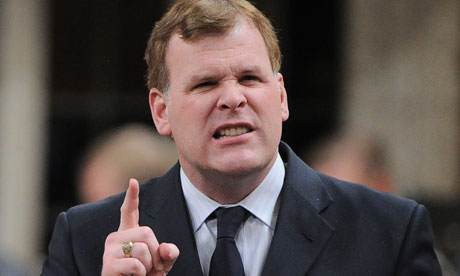
    • Canada's foreign minister John Baird

      Canada’s foreign minister John Baird said taxpayers shouldn’t have to pay for a body that has produced 10 reports promoting a carbon tax. Photograph: Sean Kilpatrick/AP

      The Canadian government is to mark the 25th anniversary of its green business advisers by closing the agency down.

      John Baird, Canada‘s foreign affairs minister and pointman for next month’s Rio+20 Earth summit in Brazil, said this week that the National Roundtable for the Environment and Economy (NRTEE) would have its funding cut in 2013 because of the availability of information from thinktanks, the internet and universities.

      Baird told reporters that Canadian taxpayers should not have to pay for an organisation that has produced 10 reports promoting a carbon tax – “something that the people of Canada have repeatedly rejected”.

      “But that’s not correct,” the Roundtable’s CEO, David McLaughlin, told the Guardian on Thursday, adding that it had never advocated a carbon tax but had looked at cap and trade for regulating Canada’s greenhouse gas emissions in a 2009 report commissioned by the government. “Which was government policy at the time,” said McLaughlin.

      McLaughlin, a former chief of staff to federal finance minister Jim Flaherty, stressed there was always original analysis in its reports, making available information that would not otherwise be in the public domain. McLaughlin also pointed to the Roundtable’s ability to combine research while convening people from industry as well as the environmental sector together.

      Only on Wednesday the NRTEE provided an environmental life cycle analysis commissioned by the federal environment minister, Peter Kent, and a climate change report is due out next month that will look at provincial emissions reduction plans.

      The C$5.2 million funding for the NRTEE will cease as of 31 March next year under a wide-ranging omnibus budget bill C-38 that is currently before Canada’s House of Commons. The legislation seeks to speed up natural resources projects such as oil and gas pipelines, and repeal the Kyoto Protocol Implementation Act.