Category: Energy Matters

  • IEA Report Shows We Are Already In a ‘Peak Oil’ Context

    IEA Report Shows We Are Already In A ‘Peak Oil‘ Context
    The Market Oracle
    Not referring anywhere in its report to Peak Oil, this report like others in the same series however highlights the changing fundamentals of world oil, which show there is a “megashift” in progress towards Peak Oil. *Refinery runs in major global
    See all stories on this topic »

    The Market Oracle
    The Age of Cheap Oil Has Ended
    AllAfrica.com
    The primary reason that oil prices are set to remain high is because we have, by general consensus, reached the peak of oil production, so called “Peak Oil.” In the mid-1950s United States geologist MK Hubbert predicted that US continental oil
    See all stories on this topic »
    Top things to do in Fort Collins: A three-day planner
    The Coloradoan
    Other big events today through Thursday include a free showt by animal comedian Dr. Kevin Fitzgerald, concerts (Donovan Frankenreiter, Epoch When and Doomtree among others), free screening of the documentary films How Cuba Survived Peak Oil and
    See all stories on this topic »
  • Nuclear Alerts

    e Alert – DANGER TO US NUCLEAR PLANTS

    Inbox
    x

    Google Alerts googlealerts-noreply@google.com
    11:19 AM (4 hours ago)

    to me
    News 4 new results for DANGER TO US NUCLEAR PLANTS
    Perfect Nuclear Storm Waiting To Happen In Russia’s Northwest Region – Analysis
    Eurasia Review
    After each nuclear incident, the Russian nuclear authorities say that nothing of significance transpired. However, in its report on the Most Dangerous Reactors, released in 1995, the US Department of Energy ranked the Kola Nuclear Power Plant as the
    See all stories on this topic »
    The Push for Uranium Mining and Nuclear Power
    Energy Digital
    Although nuclear power growth will continue to be driven by emerging economies like China, India, South Korea and even Saudi Arabia, the biggest consumer of uranium in the world today is still the US. There are some 104 nuclear reactors operating in
    See all stories on this topic »
    Lynas haunted by ghosts of Fukushima and Bukit Merah, says CEO
    The Malaysian Insider
    By Clara Chooi The LAMP was fundamentally different from the ARE refinery and the Fukushima nuclear plant, said Curtis. — File pic KUALA LUMPUR, March 20 — Lynas Corporation has insisted that “misinformation” and lingering fears from past radiation
    See all stories on this topic »

    The Malaysian Insider
    Nuke security relevance to S. Korea and Indonesia
    Jakarta Post
    In addition to concerns coming from vertical and horizontal proliferation of nuclear among state actors, potential access and use of nuclear materials and substances by non-state actors — nuclear terrorism — has been perceived as a formidable threat.
    See all stories on this topic »


    Tip: Use quotes (“like this”) around a set of words in your query to match them exactly. Learn more.

    Delete this alert.
    Create another alert.
    Manage your alerts.

  • Google Oil news

    Google Alert – PEAK-OIL

    Inbox
    x

    Google Alerts googlealerts-noreply@google.com
    10:37 PM (14 minutes ago)

    to me
    News 2 new results for PEAK-OIL
    Scaling the peaks of Kohler’s oil clash
    Business Spectator
    There’s no argument that will bring ’em out of the trees faster than anyone suggesting that the peak oil contention is bunk or at least no longer valid. Alan Kohler would know this and have not been surprised that his commentary about the
    See all stories on this topic »
    Top things to do in Fort Collins: A three-day planner
    The Coloradoan
    But you can attend a comedy show, numerous concerts (CSU’s Virtuoso Series, Donovan Frankenreiter and Epoch When among others) and a free screening of the film The Power of Community: How Cuba Survived Peak Oil. Details on these and other events follow
    See all stories on this topic »


    This once a day Google Alert is brought to you by Google.

    Delete this alert.
    Create another alert.

  • Why Irani’s nuclear weapons must be stopped

    Alert – DANGER TO US NUCLEAR PLANTS

    Inbox
    x

    Google Alerts googlealerts-noreply@google.com
    11:26 AM (1 hour ago)

    to me
    News 6 new results for DANGER TO US NUCLEAR PLANTS
    Japan’s Nuclear Crisis Plan Still Lags
    Wall Street Journal
    Critics say the rush to restart reactors in Japan ignores the threat to nearby communities unprepared to deal with a Fukushima-scale nuclear crisis. WSJ’s Chester Dawson Reports from Oi, Japan. In the next few weeks, Japan’s prime minister is expected
    See all stories on this topic »

    Wall Street Journal
    Try a Little Nuclear Sanity
    CounterPunch
    This SANE Act would cut $100 billion from the US nuclear weapons budget over the next ten years by reducing the current fleet of US nuclear submarines, delaying the purchase of new nuclear submarines, reducing the number of ICBMs, delaying a new bomber
    See all stories on this topic »
    Why Iranís nuclear weapons must be stopped
    Moment Nigerian Newspapers
    In the case of the 2011 plane crash, Russian security sources confirmed that the dead scientists worked at the Iranian controversial Bushehr nuclear plant on the Persian Gulf. So far, there have been five identifiable pillars to Israel’s approach to
    See all stories on this topic »
    CLIMATE SPECTATOR: The great gas swindle
    Business Spectator
    Nuclear power hasn’t been an option for a long time. There’s the cost blowouts and years of delay in nuclear projects in the west. The reality that the Chinese-led ‘renaissance’ has only been able to build dangerous second generation plants.
    See all stories on this topic »
    Author sees parallels between prewar, nuclear indoctrination
    The Japan Times
    Recently, Saotome has also begun to speak on the dangers of nuclear power. “I had so desperately advocated against war and for peace that I hadn’t really given much thought to the safety of nuclear power plants,” he mentioned of his pre-March 11 career
    See all stories on this topic »

    The Japan Times
    Nuclear waste begins rolling through West Texas within weeks
    Midland Reporter-Telegram
    Waste Control Specialists bury some of the 3700, 20000-pound canisters of radioactive byproduct material from the Fernald uranium processing plant in Fernald, Ohio. The Low Specific Activity pad at Waste Control in western Andrews County began storing
    See all stories on this topic »


    Tip: Use quotes (“like this”) around a set of words in your query to match them exactly. Learn more.

    Delete this alert.
    Create another alert.
    Manage your alerts.

  • Oil Price Daily News Update

    Oil Price Daily News Update


    Collateral Damage from Afghan Turmoil – the TAPI Pipeline

    Posted: 18 Mar 2012 07:31 AM PDT

    As the reverberations on the 11 March attack by a U.S. soldier on two Afghan villages in Helmand province continue to abrade U.S.-Afghan relations, the deteriorating security situation there after a decade of foreign military intervention will more than likely claim another victim – the long-proposed Turkmenistan-Afghanistan-Pakistan-India natural gas pipeline.Why?Because the incident and its consequences underline beyond any doubt the deteriorating security situation in Afghanistan, and no one is likely to invest in a multi-billion dollar…

    Read more…

    Is it Time to Abandon the Oil Sands Debate?

    Posted: 18 Mar 2012 07:27 AM PDT

    Canada’s natural resources minister told delegates at the International Energy Forum in Kuwait that his country was on the cusp of becoming an “energy superpower.” Canada ranks No. 6 in terms of global oil production, but much of its crude exists in the form of oil sands. European leaders are considering a measure that would classify oil sands as an environmental issue, prompting Canada to threaten to take the issue to the World Trade Organization. With the U.S. political system in a deadlock over Canadian crude, the Ottawa government is now working…

    Read more…

    Despite Negative Press Renewable Energy Revenues Rapidly Expand in 2011

    Posted: 18 Mar 2012 07:24 AM PDT

    Solar, wind and biofuels saw global revenue expand by 31% in 2011. With all the negative hype put out by Big Oil and its acolytes, you’d have thought the green energy market had crashed rather than growing by a third.But investment in green energy rose only 5% over the year, which tells me that somebody is making a lot of money and others are losing out. Green Tech Media reports,“…costs of solar panels fell by more than 40 percent last year, while installations grew by 69 percent, yielding a 29-percent increase in solar market…

    Read more…

    The Ugly Politics of Higher Gasoline Prices

    Posted: 18 Mar 2012 07:20 AM PDT

    The impacts of higher oil and gasoline prices are beginning to ripple across the economy.  Wells Fargo Economics reported today that higher energy prices increased the producer price index (PPI) by 0.4 percent in February 2012 which was the highest monthly gain in the PPI in five months. Wholesale gasoline prices were up for the second-straight month, increasing 4.3 percent, home heating oil was up 5.3 percent and residential electric power prices increased 0.6 percent.The growth in domestic natural gas production from shales has decoupled…

    Read more…

    Shale Gas in Europe: Poland and Ukraine as Pioneers

    Posted: 18 Mar 2012 07:13 AM PDT

    The biggest and most promising European shale gas deposits are located in Poland. The EIA estimates that the Polish shale gas reserves cover more than 300 years of domestic consumption. The unconventional reserves exceed the conventional ones by the factor of 32. So far 109 licences have been granted to national and international groups in Poland. Poland imported more than 10bn cubic metres of natural gas from Russia in 2011. On top of it, coal is used for 90% of electric power generation. Therefore the political support for the development of…

    Read more…

    You are subscribed to email updates from OilPrice.com Daily News Update
    To stop receiving these emails, you may unsubscribe now.
    Email delivery powered by Google
    Google Inc., 20 West Kinzie, Chicago IL USA 60610
    Reply
    Forward
  • Winds of change blow through China as spending on renewable energy soars

    Winds of change blow through China as spending on renewable energy soars

    World’s biggest polluter spends £4bn a year on wind and solar power generation in single region as it aims to cut fossil fuel use

    • guardian.co.uk, Monday 19 March 2012 19.31 GMT
    • Article history
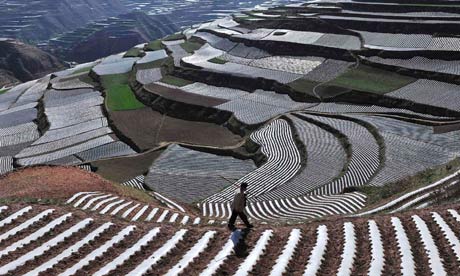
    • A farmer walks past a terrace of dang shen, a traditional Chinese medicine, in Gansu province

      A farmer walks past a terrace of dang shen, a traditional medicine, in Gansu – a region being transformed by spending on renewables. Photograph: Sheng Li/Reuters

      The remote, wind-blasted desert of northwestern Gansu could be the most unloved, environmentally abused corner of China. It is home to the country’s first oilfield and several of the coalmines and steel factories that have contributed to China’s notoriety as the planet’s biggest polluter and carbon dioxide emitter.

      But in the past few years, the landscape has started to undergo a transformation as Gansu has moved to the frontline of government efforts to reinvent China’s economy with a massive investment in renewable energy.

      The change is evident soon after driving across the plains from Jiuquan, an ancient garrison town on the Silk Road that is now a base for more than 50 energy companies.

      Wind turbines, which were almost unknown five years ago, stretch into the distance, competing only with far mountains and new pylons for space on the horizon. Jiuquan alone now has the capacity to generate 6GW of wind energy – roughly equivalent to that of the whole UK. The plan is to more than triple that by 2015, when this area could become the biggest windfarm in the world.

      This is the other side of China’s development. Although it is the world’s biggest CO2 emitter and notorious for building the equivalent of a 400MW coal-fired power station every three days, it is also erecting 36 wind turbines a day and building a robust new electricity grid to send this power thousands of miles across the country from the deserts of the west to the cities of the east.

      It is part of a long-term plan to supply 15% of the country’s energy from renewable sources by 2020. Most of that will come from nuclear and hydropower, but the government is also tapping the wind and solar potential of the deserts, mountain plateaus and coastlines.

      The scale of investment has led to hopes that China may emerge as the world’s first green superpower. This is premature. Breakneck economic growth has left much of the country enshrouded in a murky grey smog. But the environmental crisis is so bad that it is a driver for change.

      Carbon dioxide emissions have more than doubled in the past 10 years, taking China past the US as the world’s No 1 source of greenhouse gases. Dirty smokestacks and illegal discharge pipes contribute to the hundreds of thousands of annual premature deaths from pollution related diseases. Environment ministry statistics suggest that 40% of river water can make you sick.

      Four in five major cities are unlikely to reach the government’s relatively low standards for air quality. Biodiversity is declining, while consumer demand is rising for ever more rare – and expensive – flora, fauna and minerals. More than two dozen areas have been declared “resource depleted”. Droughts are becoming more prolonged and more widespread.

      If environmental damage were fully factored into the state’s account books, China’s economic growth rate would probably be halved, Wang Yuqing – the former deputy director of the state environmental protection ministry – warned this week. He estimated environmental damage last year at about 2.5tn yuan (£250bn), or 5-6% of China’s GDP.

      Government plans to tackle these problems include increasingly ambitious pollution controls, afforestation targets and hydroengineering projects, But the focus of its efforts is the attempted switch from coal to renewable energy.

      The campaign faces economic and technical obstacles. Coal and gas are far cheaper and abundant, which means it will be many years before China’s emissions start to fall.

      But Jiuquan’s planners say their region is testimony to how quick change can come when staple fossil fuels run out. The output of the first local oilfields, which opened in Yumen county in 1939, has fallen by two-thirds since the 80s. New fields are being explored, but officials say the era of “peak oil” in Jiuquan has already passed.

      “This was the cradle of the Chinese oil industry,” said Wu Shengxue, director of Jiuquan’s reform and development department. “But we realise that fossil fuel supplies are limited. They will run out one day. So we need to find other forms of energy. Jiuquan is leading the move to renewable energy in China.”

      Investments in wind and solar are now more than 40bn yuan a year in the region, he said, compared to about 1bn yuan for oil and coal combined.

      The flood of money is transforming this previously poor area. Average urban incomes – once among China’s lowest – have almost tripled since 2000 and are forecast to be higher than the national average by 2015.

      Other regions are following. National planners have earmarked seven regions for huge wind projects, each at least 10GW in size. The state grid has struggled to keep up. Two years ago, almost a third of the turbines were wastefully unconnected.

      This has prompted unflattering comparisons with the Great Leap Forward of the late 50s, when Mao Zedong urged China’s population to ramp up agricultural and steel production to unrealistic levels with disastrous consequences.

      There are echoes of that era in a banner on the street in Yumen New Town, which reads: “Make an effort to develop the economy in a fast leap!”

      Market forces are a secondary consideration. The state grid is legally obliged to pay 0.54 yuan per kilowatt hour (kWh) of wind energy, even though it could get the same amount of coal-fired power for 0.3 yuan.

      The director of the town’s energy department said the fact that the government controls prices rather than the market was good for the development of wind power.

      Yumen used to be known as Oil City but people are now being moved from the old oilfields to a new town in half-completed tower blocks closer to the windfarms.

      “Most people left because business was bad. The environment is much better here,” said Dong Suqin, 66, who relocated three years ago.

      Business is also more promising. By 2020 Jiuquan plans to increase wind power generation sixfold to 40GW. Wu predicts even faster growth between 2020 and 2030, when solar power starts to take off: “That’s when the technology will have matured and the generating costs will be lower. By 2030, I think China will get half its energy from renewable resources and Jiuquan will be famous around the world. People here are going to be rich.”

      His optimism is shared in Dunhuang, a city of ancient Buddhist grottoes and ultramodern solar farms where China’s first 10MW demonstration photovoltaic plant waits to be connected to the state grid.

      “We showed it can be done – this is very significant,” said Song Rongwu, assistant manager at the state development and investment corporation (SDIC) facility. “Ten years from now, I believe every home in Dunhuang will be powered by clean energy. The Gobi desert will be filled with blue photovoltaic panels. It will be a beautiful sight.”

      That is by no mean certain. King Coal’s rule looks stronger than ever. This year, China will – for the first time – account for half the coal burned globally, according to Yang Fuqiang of the World Resources Institute. Last year, this dirtiest of fuels increased its share of national energy supply to above 72%. Meanwhile hydropower declined because of drought, and the wind industry had a year of consolidation.

      Yang says incentives to boost the supply of clean energy are no longer enough. He wants the government to curb demand for fossil fuels by making them more expensive: “We need a cap on coal to send a strong signal to investors – ‘Don’t put your money in coal. Move to cleaner energy.’ ”

      Environmentalists see glimmers of hope in places such as Jiuquan that this might one day change. But the pace is still too slow and there is too much focus on engineering projects in the desert and not enough on consumption habits in cities.

      “We cannot yet say China has finished industrialisation and the dirty phase is finished. This will last quite some time,” said Li Bo of Friends of Nature, China’s first green NGO. “We cannot rely solely on new technology to clean up our environment. We need to talk more about social responsibility and eco-civilisation.”

      Additional research by Cecily Huang